 |
 FOBB this weekend!
 23 July 2014 | by
 I wonder if this is what Rich KI6SN had in mind as a high tech Bumble Bee when he started this contest years ago? (Looks a bit on the QRO side to me – grin!)

Just a gentle reminder that the Flight of the Bumble Bees is this coming Sunday! When I last checked the roster, only about 100 folks have signed up for Bee numbers. That number seems low to me as compared to years past. This is an excellent sprint and is so much fun – it’s almost illegal in this day and age to be able to have this much fun!
So sign up to be a Bee – lets give Rich some work these last few days and get that Bee number up there! And then get out on Sunday with your favorite QRP rig and get some fresh air and get your fun tanks topped off!
Bumble Bee Roster – http://bit.ly/15aGgN1
Da Bee Rulz – http://arsqrp.blogspot.com/2014/07/announcing-ars-2014-fobb.html
72 de Larry W2LJ – Bumblebee #17
QRP – When you care to send the very least!
Larry Makoski, W2LJ, is a regular contributor to AmateurRadio.com and writes from New Jersey, USA. Contact him at [email protected].
The Solar Superstorm of 2012
http://science.nasa.gov/science-news/science-at-nasa/2014/23jul_superstorm/
It never hurts to have a back-up plan.
Mike Crownover, AD5A, is a regular contributor to AmateurRadio.com and writes from Texas, USA. Contact him at [email protected].
The Old Man
 The several times I’ve read the writings of the Hiram Percy Maxim, I get the feeling I would have really liked this guy in real life. I think a lot of his writings could be republished today with some minor editing of language and figures of speech that are no longer around, and the content and arguments would easily apply to current modern day situations and problems within amateur radio. It’s amazing that as much as things change, things are still the same.
This article, Rotten Damped Spark Stuff, is a Maxim gem. Considering Maxim’s feelings at the time about damped spark, I think Maxim would have been equally vocal during the AM versus SSB and code versus no-code test battles in favor of more progressive trends and technology in amateur radio.
Something interesting to note about the article, Maxim ends it with “So long and 73’s to the gang. “[emphasis added]. Any time a boob on the two US ham moron forums wants to argue about the inappropriate use of 73’s, quote this article and tell him to go away.

Anthony, K3NG, is a regular contributor to AmateurRadio.com.
Random Antenna Musings and Power Line Noise
As I have shared in the past I have a 66′ dipole in the attic fed with ladder line. I live in a HOA controlled neighborhood so my antenna options are pretty limited.
Last night I set WSPR up running 2 watts on 20 meters. Started about 2200 UTC. Wow it really seemed open. My 2 watts was spotted multiple times into Europe, Alaska and all over the USA. This antenna does not have a problem getting out.
The problem with my antenna setup is on receive. I have minimum S5 noise on 40 and 30 meters. Typically S7 on 20 meters. Interestingly enough 15 is quieter and 10 meters is typically S2 or so. The noise is static with some noticeable “crackling”.
Last night on WSPR was a great example. I was getting heard ALL over, but I was only decoding about 2 or 3 stations – all in the USA. Also on PSK31 or JT-65 I see guys working DX that I can’t even here or see on the waterfall – my noise level is just too high.
Sometime soon I am going to cut all the power to my QTH and see what the noise level is. If significantly reduced, I will see what I identify as noise sources in my QTH.
Beyond that, less than a 1/4 mile as the crow flies I have identified some very noisy power lines. They are so noisy that it they will completely blank the AM radio in your car when you drive past them.
Here is a picture of where my house sits in relation to the power lines (my dipole runs parallel to the power lines):
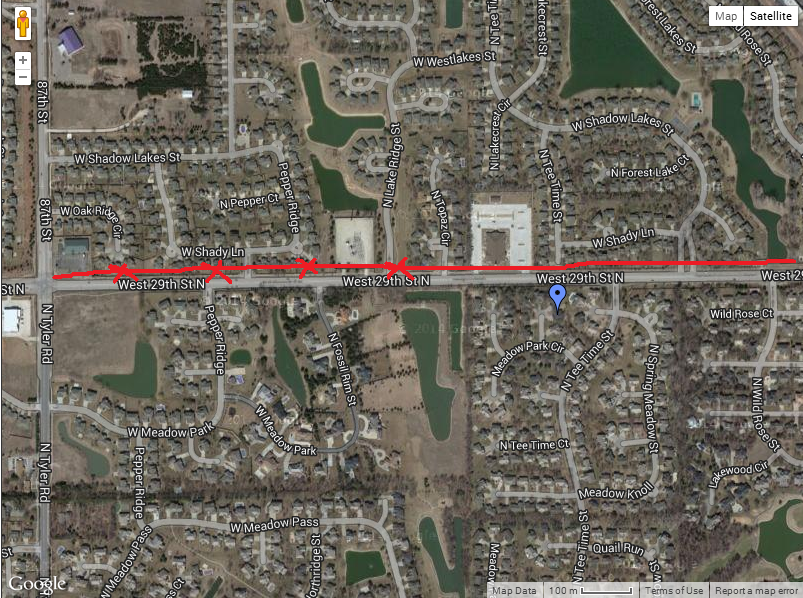 |
| Blue marker is my QTH – Red line is power line (X’s are noisy poles) |
I will be contacting the utility company at some point, but first I want to see how much of the noise is coming from my own QTH.
 |
| Red markers are trees – red line would be horizontal leg of inverted L |
Burke Jones, NØHYD, is a regular contributor to AmateurRadio.com and writes from Kansas, USA. Contact him at [email protected].
Wellbrook Loop Plans
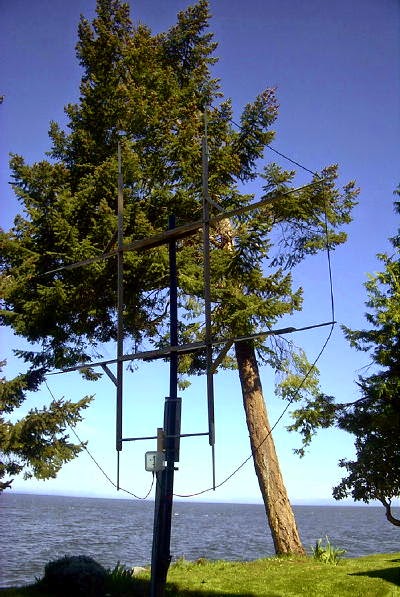 |
| My present 9.5' active loop |
During last winter's DX season I built and played with a number of different preamps for use with my (almost) 10' diameter shielded loop. I had been hoping to get the Burhans Preamp to play-nice above 500KHz so that I might use it for DXing the broadcast band with my new Perseus SDR radio. By bypassing the preamp's LPF, the level of BCB signal delivered by the 10' loop was just too much for the preamp's JFET front end to handle with the consequence being various strong intermod products showing up at several places inside the band. Several different toroidal input transformers produced varied results but none were satisfactory. Although I didn't try it, a smaller aperture loop might do just fine with the LPF removed and even better if there were no blowtorch BCB signals in the vicinity. My particular location, on the east coast of Mayne Island, looks directly across Georgia Strait to several 50KW BCB transmitter sites near the points of nearest landfall. Luckily, this direction is usually in the loop's null when pointing in my favorite target direction of SE/NW for the central U.S. Even so, it would be nice to not have to worry about loop orientation in order to guarantee intermod-free performance.
I did have much better success on the BCB using a version of the PA0RDT active antenna preamp, modified with transformer input to match the shielded loop's low impedance to the JFET amplifier input.
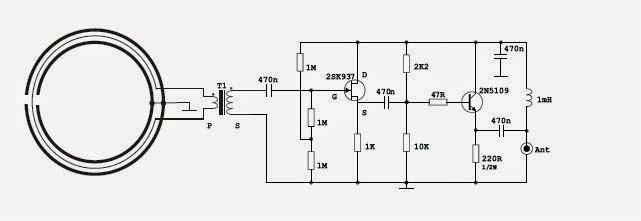 |
| Courtesy: Aldo Moroni |
Gain of the system was adjusted by swamping the transformer's output with various levels of 'R' until there were no signs of intermod products with the loop pointing away from the Vancouver blowtorch signals. The end result was a preamp that had good performance throughout the BCB, even with the big loop, as this recording of French language station, CJBC (860KHz) in Toronto(identifying as 'Radio Canada') demonstrates.
....but unless the loop was oriented in my favored SE/NW direction for most North American targets of interest, there were still a few frequencies that produced some very low-level intermod products. Again, had the loop been just slightly smaller, I think this preamp would do a great job as a wideband loop amplifier for the BCB and above. Although still usable down at 540KHz, performance dropped off rapidly as I went lower in frequency and was not considered usable for the LF NDB band. Perhaps more inductance in the input transformer as well as higher value coupling capacitors would improve LF performance. There is still room for further development of this circuit for LF use with a medium-sized shielded loop.
I recently ordered and received a Wellbrook ALA-100LN loop preamp, which I am anxious to install for the upcoming DX season. With its front-end of 8 JFETS in push-pull parallel, the Wellbrook boasts extremely good strong-signal handling capability within the BCB and below.
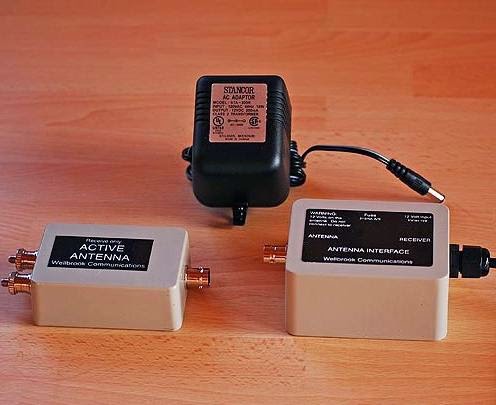 |
| Please visit: http://www.wellbrook.uk.com/ |
My present plans call for a new and lighter loop frame, this time using PVC tubing in some sort of H-frame. I will aim to make the loop as large as possible while keeping within the Wellbrook's circumference limit of about 21m. Mid-summer doodling has produced one possible front-runner but no final decisions have been made.
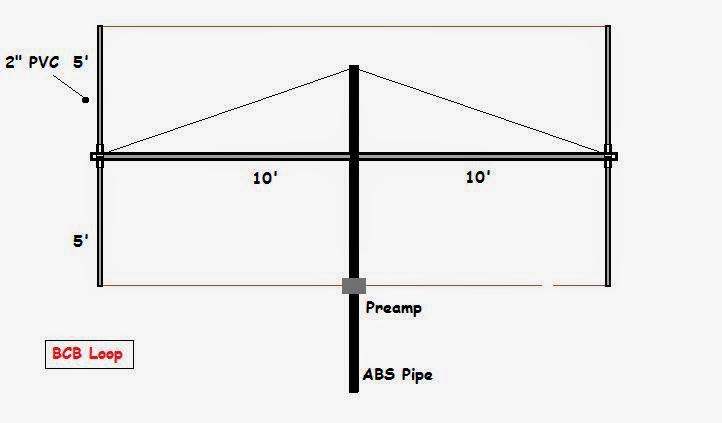 |
| 10' x 20' LF / BCB Loop |
I always savour the design and 'what-if' phase of any new project and the new loop is no exception. Any other ideas for possible frame configurations would be most appreciated.
Steve McDonald, VE7SL, is a regular contributor to AmateurRadio.com and writes from British Columbia, Canada. Contact him at [email protected].
One way to see the windmill
There was a man dangling from a rope painting the cap of our local windmill. I felt like telling him there are easier ways of seeing the windmill! Rather him than me.

Someone suggested I string a long wire to the top of the mill from my bungalow next door. But what happens when the cap turns and the sails go around?

Roger Lapthorn, G3XBM, is a regular contributor to AmateurRadio.com and writes from Cambridge, England.
Uploading ADIF logs from fldigi to LOTW
 I’ve been attempting to get my arms around my various logs from different callsigns. Previously I have had mixed luck with LOTW. Then I pretty much abandoned it. This time I read and re-read the instructions. Today I got my TQ6 file and was off an running.
I exported my current log from fldigi as an ADIF file and then used the TQSL application to upload it. Error, error, error. What was this? I hit Google and started researching:
ARRL’s tqsl messes with fldigi saved QSO_OFF time
I learned more than I wanted to know this morning about what the ARRL¹s tqsl application for LoTW does when it signs your saved fldigi newlog.adif file. It does more than just applying your digital signature. I had a busted QSO with Jeff, N8NOE, on LoTW and spent some time trying to understand what happened. The problem was with the time of the QSO. Both of us log the time at the the end of the QSO; however for there was a disconnect because my QSO time at LoTW showed up as Time ON, rather than Time OFF. Fldigi logs both TIME_ON and TIME_OFF; however, when you ask the ARRL tqsl application to apply your digital signature, it ignores the fldigi saved Time_OFF and converts the TIME_ON to a nonstandard ADIF format called QSO_Time. If you want your fldigi logs uploaded to LoTW to reflect QSO OFF time, you have two options. You can manually edit your On and Off times in Logbook-newlog.adif panel read the same. Another workaround is to use the fldigi File/Export ADIF with the option for Time ON unchecked. Then use a text editor to search and replace TIME_OFF with TIME_ON. This will fool the ARRL tqsl application to log the correct correct QSO time. Another option for someone to think about could be a new macro command that would reset the QSO times (ON and OFF) to be the same when you click on log. If you don¹t believe tqsl changes your fldigi logged QSO TIME_OFF, open one of your last .tq8 files with text editor (I use BBEdit) and scroll down and you will note the nonstandard QSO_TIME time that matches your your ADIF TIME_ON rather than TIME_OFF. 73 Dick AA5VU
… and that is what I did. And it worked! Although the issue Dick describes and the issue I was having were different, the solution still worked.
Now I am trying to add the logs for both my YI9MI and HL9MI operations. We will see how that goes.
Scott Hedberg, NØZB, is a regular contributor to AmateurRadio.com and writes from Kansas, USA. Contact him at [email protected].
 Ham Radio Deluxe |
 W5SWL Electronics |
 Ham Radio Prep |
 KB3IFH QSL Cards  Hip Ham Shirts  HamRadioAuctions HamRadioAuctions Reliance Antennas Reliance Antennas Enigma Shop Enigma Shop |  morseDX  Ni4L Antennas  R&L Electronics R&L Electronics antennas.us antennas.us QRV QRV |
- Matt W1MST, Managing Editor
