 |
 The USA vs Europe
 30 July 2014 | by
 Disclaimer – this is meant to be a bit of humor – let’s not all get offended!
There are many differences between the USA and Europe:

First off, Europe would fit inside the USA.
You call it petrol, we call it gasoline.
You call them chips (or whatever), we call them fries.
You use the metric system, we’re still on standard.
You use Celsius, we use Fahrenheit.
You call it the cinema, we call it the movies.
And so on, and so on, and so on ……….
But as a Ham, I’ve noticed a big difference in the way we approach special event stations. Here in the US, for the most part but not always, we apply to the FCC through the ARRL for special 1X1 call signs. For instance, when the Piscataway Amateur Radio Club celebrated the tri-centennial of the founding of Piscataway, we applied for and used W2P.
The 13 Colonies special event used call signs such as K2I for New Jersey, K2E for Delaware and so on. The special event station that just celebrated the 45th Anniversary of Apollo 11? W4A.
But in Europe, you guys take the opposite route! Special event stations from European nations can be a mouthful. DM200TSV, SF2014ECC, E72NATO, 3E2000PC, LZ1437MGS and my all time favorite, SV2013ATGM.
What I like about these European call signs is that they try to bear some significance towards the event they are commemorating – SV2013ATGM was about Alexander the Great, E72NATO celebrated membership in NATO and so on. A lot more descriptive than 1X1 call signs, that’s for sure.
I’m just waiting to hear one some day that has all the numbers 0 through 9 and all 26 letters of the alphabet. THAT would be a special, special event call sign – a bear to copy, but special, nonetheless!
72 de Larry W2LJ
QRP – When you care to send the very least!
Larry Makoski, W2LJ, is a regular contributor to AmateurRadio.com and writes from New Jersey, USA. Contact him at [email protected].
Video of My Lunchtime Portable Operation
Yesterday, I shot a bunch of video while I was out operating during my lunchtime QRP session.
I got it all edited and it is ready for you to view! This is my first video, so any comments or helpful advice is more than welcomed.
Burke Jones, NØHYD, is a regular contributor to AmateurRadio.com and writes from Kansas, USA. Contact him at [email protected].
Same callsigns?
One of the drawbacks of WSPR (currently) is you tend to get spotted, or spot, the same stations over and over again. I am even seeing the same stations being spotted on 10m and on 6m.
It would be very nice if there were a lot more active stations, so spots came from a variety of stations. I am even seeing this on JT65 and JT9-1.
Perhaps people think these “new fangled” digital modes are hard and so only a limited number of people (currently) use them. Let me say, if even I can use these modes then anyone can! All these modes are great with low power and have really opened my eyes as to how far very low powered signal can be detected.
 |
| 10m unique WSPR spots this afternoon (duplicates not shown) |

Roger Lapthorn, G3XBM, is a regular contributor to AmateurRadio.com and writes from Cambridge, England.
Lunchtime Portable – It’s been a while!

After reading about Mike, VE3WDM going portable, it got my blood pumping to get back out for some lunch time QRP operations!
So last night I tracked down the coax and put the gear in the Pilot. It has cooled off a bit this week, it was only 83 deg here when I arrived at the park. I quickly got the Portable QRP Antenna put up and was on the air!
I worked a total of 6 stations during my one hour of operation. 20 meters was decent stateside, but 17 meters was a disappointment. 17 meters has typically been my favorite band for some lunch time DX!
Here is the run down of todays activity:
W1AW/9 20 meters into Indiana
KW7D 17 meters Paul in New Mexico
I called CQ and…
K7TAN answered me – Don was in Idaho, we had a brief QSO which was nice.
Then back to search and pounce…
K6TW was activating W6/CT-003 Mt. San Antonio which is east of Los Angeles. I would really like to be a SOTA activator sometime!
W1AW/9 this time on 17 meters
and finally…
W0FV was calling CQ on 20 meters and was very loud! Doug was in Grand Junction, CO – we had a brief contact as he gave me a 359 RST. Thanks for pulling me out Doug!
Then it was time to head back to work, so I quickly pulled everything down and headed back to the office.
Another fun lunch time portable QRP session in the books!
Burke Jones, NØHYD, is a regular contributor to AmateurRadio.com and writes from Kansas, USA. Contact him at [email protected].
Overpriced KX3 options
Steve G1KQH has spotted the price of “after-market” mics on eBay. Under £5.
“The price of a Microphone:Someone is having a good laugh at stitching folk up with those KX3 Mics. The whole KX3 price is through the roof but there are plenty on the bands?”

Roger Lapthorn, G3XBM, is a regular contributor to AmateurRadio.com and writes from Cambridge, England.
6m Polar Fun / VE6 To Europe
When you find hams heading for dark basement shacks in the middle of a glorious summer day, chances are they're 6m nuts like me. Sunday morning was a good example of why the magicband can become so very addictive.
For west coast fanatics, the 6m Holy Grail is working Europe. Such summertime opportunities via multi-hop sporadic-E (Es) are very rare and usually very short-lived, so the biggest challenge is just being in front of the radio for those few moments when things 'go polar'.
From here in VE7 land, our best propagation indicator for possible polar openings is the 12 watt VA5MG beacon on 50.034MHz, located in central Saskatchewan. It is rarely heard....but if and when, it often heralds the possibility for some memorable moments for some lucky left-coasters.
Such was the case this past Sunday morning...almost. My normal workbench 'background music', the quiet white-noise hiss of a programmed scan for northern beacons (50.015-50.050), suddenly filled with signals shortly before 0930 local time. The VE4SPT beacon in NE Manitoba and the VA5MG beacon were soon joined by VE8WD/b in Yellowknife, Northern Territories and VY1DX/b in Whitehorse, Yukon. Game on! ..... the north was alive with Es, signalling the all-important first-hop stepping stone to Europe was in place.
After alerting a few dinner-bound Europeans via the ON4KST 6m chat page, I began a prolonged period of over-the-pole CQ's on 50.086. About 30 minutes later, there were a few other west coasters doing the same, along with VE6TA near Edmonton, who was hearing the 15 watt VYØYHK beacon on King William Island in the Canadian Arctic.
 |
| VY0YHK Courtesy: Google Maps |
I continued to CQ for some time, but the most I could muster were three separate callers at various times, all too weak to identify. I later learnt that I was heard by SM2A, who called with 50 watts, as well as DL6HL. It seemed that VE7 was just on the far edge of whatever might be happening. For VE6TA however, the magic was much more powerful.
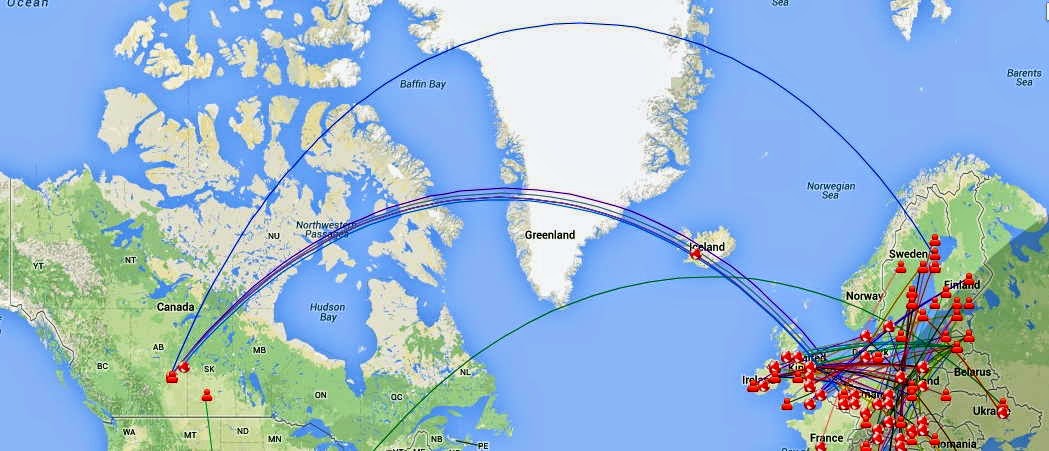
Having only worked two Europeans in several years on the band, Grant bagged six Europeans over the next 30 minutes, hearing ''tnx first VE6" from a few very alert Europeans..... PA5JS, ON7GB, PA7MM, LX1JX, DL1QW, DH6JL and SM2A. Randy, VA6EME, further north in Cold Lake, Alberta heard and worked one European, ON7GB, as did Joel, VE6WQ in Edmonton. As is so often the case, on-the-ground signal footprints are usually very small and stations just a few miles apart can have a completely different experience.
The N3TUQ 6m DX Map starkly illustrates this exciting event, showing Grant in the right spot at the right time, for a very rare mid-summer event. In his own words, "My best day ever on 6m".......
Steve McDonald, VE7SL, is a regular contributor to AmateurRadio.com and writes from British Columbia, Canada. Contact him at [email protected].
Near miss – 11742km on 10m JT65
This evening CA3SOC (Chile) was calling CQ on 10m JT65. I called and called him – he called CQ about 14 times – but I was unable to raise him. At the start he was -16dB S/N but in the end was down to -22dB S/N. I was copied in Sweden at the same time, but that was no compensation.
Earlier in the afternoon I worked an E74 on PSK63, my first ever QSO on PSK at that speed. I am finding real-time keyboard operating in PSK modes quite “challenging”. Whenever I use the keyboard e.g to write this blog, I make lots of errors that need correcting. This is hard on PSK31 and PSK63 in real time. JT65 and JT9-1 are a lot easier. Currently I am using Digipan software which is simple and basic for PSK modes. I am using WSJTX V1.3 r3673 for JT65 and JT9-1.

Roger Lapthorn, G3XBM, is a regular contributor to AmateurRadio.com and writes from Cambridge, England.
 Ham Radio Deluxe |
 W5SWL Electronics |
 Ham Radio Prep |
 KB3IFH QSL Cards  Hip Ham Shirts  HamRadioAuctions HamRadioAuctions Reliance Antennas Reliance Antennas Enigma Shop Enigma Shop |  morseDX  Ni4L Antennas  R&L Electronics R&L Electronics antennas.us antennas.us QRV QRV |
- Matt W1MST, Managing Editor
