 |
 ‘CQ Crossband’ – 630m
 26 August 2014 | by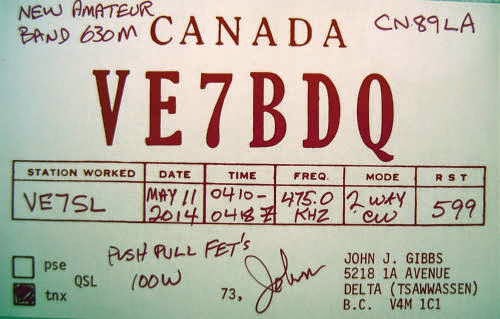
.jpg) |
| First 630m contacts |
Hopefully there will be more stations active before the winter DX season gets underway!
In an attempt to keep my own interest level up as well as trying to get the word out to others about our new band, I've completed crossband contacts with three other VE stations. Two of the contacts were on Vancouver Island....VE7DAY (John) in Campbell River and VA7FC (Perry) in Courtenay. The third station was VE6TA (Grant), near Edmonton, Alberta. A fourth crossband contact was completed when I worked W7WKR (Dick) near Lake Chelan in Washington state. John, VE7BDQ, also completed crossband contacts with VE6TA and W7WKR giving those two stations a 'VE7 two-fer'.


.jpg)
Both John and I would love to do a lot more crossband work, especially with stations in the U.S.A. who presently cannot transmit on the band but may still be very much interested in 630m. A recent overnight beaconing session at 25 watts output clearly indicated that under fairly normal conditions and with a good receiving system on 630m, my normal speed CW signal can cover a wide geographic area during the hours of darkness. Having up to 500 watts of power available for CW, my signals should have good coverage to all of the western and central states at this time of the year.
Such crossband type contacts are perfectly legal between any and all stations in the "amateur radio service" and at one time, this was the only mode available between Europe and North America on the 50MHz band, as this tantalizing review of Cycle 19's amazing propagation explains.
If anyone, anywhere (both U.S. or VE), would be interested in attempting a crossband CW QSO, I would love to try! Please contact me via the comments section below or via e- mail.
I would also be interested in hearing from any Canadians who are planning to get on the new band as I am trying to keep track on my website's LF page.
Steve McDonald, VE7SL, is a regular contributor to AmateurRadio.com and writes from British Columbia, Canada. Contact him at [email protected].
Did you participate in Field Day 2014
You can check to make sure they received it, and if there were any discrepancies with the class/category that you claimed.
Go to: http://www.arrl.org/news/2014-arrl-field-day-logs-received-list-available-for-review
Scroll way down to the bottom of the page and download the PDF.
Even though we got an e-mail confirmation when our log was submitted, I double checked to see if the log for NJ2SP was there. You can call me paranoid, but I just wanted to make sure our inaugural Field Day effort gets counted amongst the masses.
It's there.
72 de Larry W2LJ
QRP - When you care to send the very least!
Larry Makoski, W2LJ, is a regular contributor to AmateurRadio.com and writes from New Jersey, USA. Contact him at [email protected].
Yaesu FT-991 KW/50/144/430 MHz Stations Transceiver
Yaesu FT-991 KW/50/144/430 MHz Stations Transceiver
We are pleased to announce the launch of an exciting new product, The FT-991 HF/50MHz/VHF/UHF Base Station Transceiver. The Yaesu FT-991 Transceiver is capable of operating SSB, CW, AM, FM, Packet and System Fusion C4FMDigital. The legendary tradition of Yaesu design is a legacy of excellence-established decades ago, providing quality, stability and durability. The Yaesu FT-991 is designed for the most competitive operating situations, with a suite of new features to enhance the experience. Whether you primarily operate at home, mobile or in the field, the FT-991 will provide outstanding fundamental performance and an inviting expansion into a full featured base station.
http://nicktoday.com/yaesu-ft-991-kw50144430-mhz-stations-transceiver/
Nick Palomba, N1IC, is a regular contributor to AmateurRadio.com and writes from Florida, USA. Contact him at [email protected].
Master Control for the CW Operator
If you’re an avid CW buff like me, you have accumulated a collection of paddles, bugs, hand keys and keyers. You like to switch off keys and keyers when operating CW. However, it’s such a pain to pull gear off the shelf to plug-unplug keys and keylines.
Here’s a neat solution that only requires hooking everything up once. Using a stereo source selector box (about $30) you connect up four paddles, bugs, hand keys, and keyers to one or two rigs. You can connect one key at a time or all four at once. You can even patch one or all four keys to both rigs simultaneously.
You can appreciate the convenience this offers. Select one of four paddles, keys, or keyers and start sending CW. You can change from one to another just by moving your hand.
Here’s how it’s done. Phono Preamps offers the TCC TC-716 6-Way Stereo Source Selector:

TC-716 Front

TC-716 Back
The selector has a row of six push buttons on the front. On the rear are two mini 3.5mm (1/8″) stereo phone jacks and four pair of RCA phono jacks. Any combination of rigs and keys/keyers can be plugged in. I used simple 6-inch “Y” cables with 2x RCA male plugs to 1x 3.5mm stereo female jack for “Audio 3 through 6”. The selector box and y-cables are available here:
http://www.amazon.com/gp/product/B0001F347K/
http://www.amazon.com/gp/product/B000I23TTE/
Locate the selector box centrally on your desk as you’ll use it often.
73 de Jim KM5M
Jim Sheffield, KM5M, is a special contributor to AmateurRadio.com and writes from Texas, USA.
Nick Builds a 2 Meter Copper J-Pole (portable & collapsible)
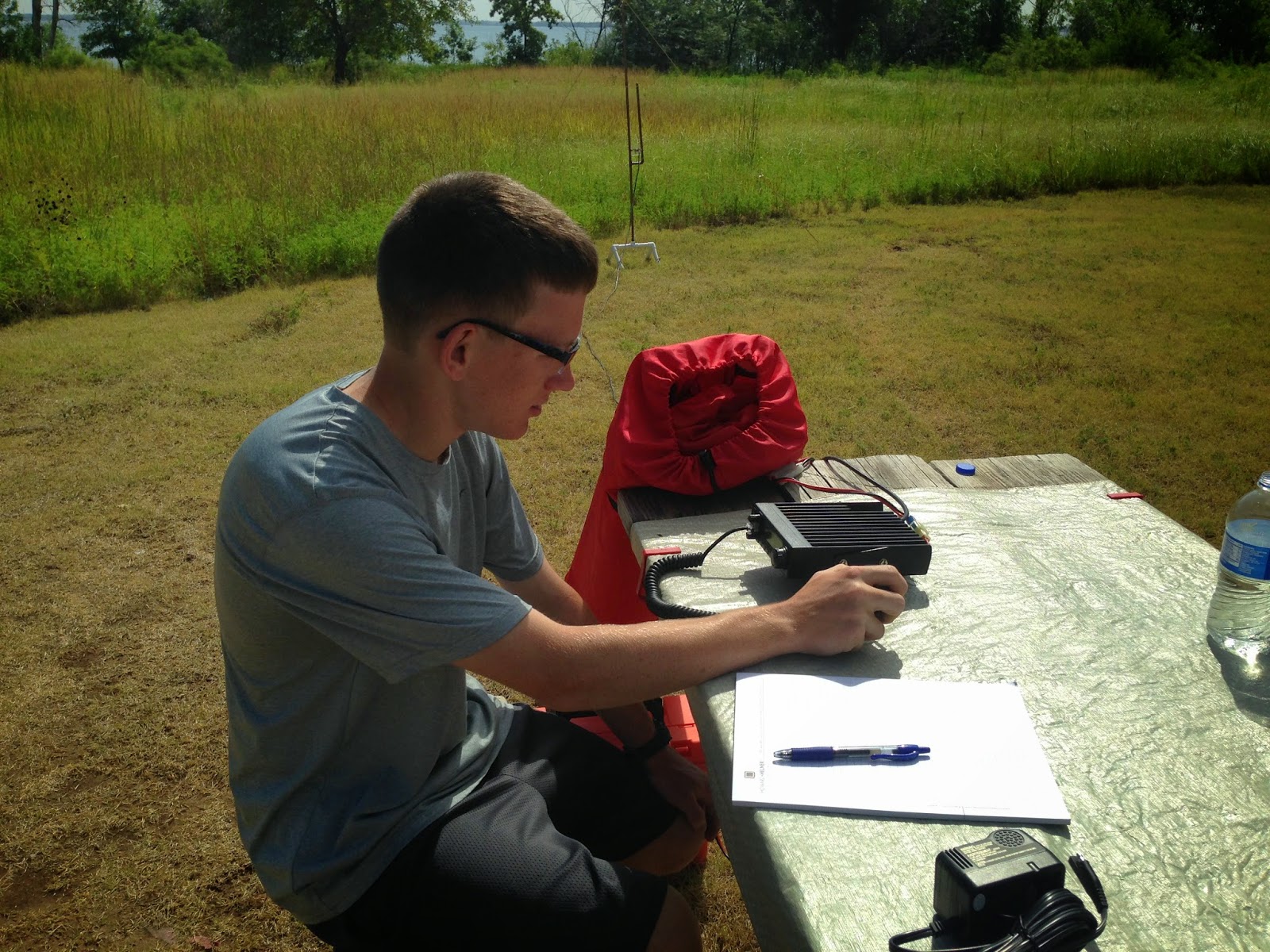 |
| Nick KE0ATH working 2 meters |
Now that my son Nick (KE0ATH) has his ticket, he is putting together a 2 meter “Go Box”. First on the agenda was a nice J-Pole antenna.
He did some searching and found a J-Pole design that collapses down to about 20″ long. The 1/2″ copper pipe segments are held together with a bungee cord run internally.
Nick found a couple different designs and combined them to meet his needs. He plans to use this while camping, etc.
When you watch the video, check out his smile at about the 4:00 minute mark when he makes the first contact on his new antenna – priceless!
We had a blast building this together, and Nick learned several new skills – so it was a great success!
If you have any questions, be sure and give me a shout. You can also see my other videos on YouTube here: N0HYD YouTube Channel
73 – Burke
Burke Jones, NØHYD, is a regular contributor to AmateurRadio.com and writes from Kansas, USA. Contact him at [email protected].
Nick Builds a 2 Meter Copper J-Pole (portable & collapsible)
|
| Nick KE0ATH working 2 meters |
Now that my son Nick (KE0ATH) has his ticket, he is putting together a 2 meter “Go Box”. First on the agenda was a nice J-Pole antenna.
He did some searching and found a J-Pole design that collapses down to about 20″ long. The 1/2″ copper pipe segments are held together with a bungee cord run internally.
Nick found a couple different designs and combined them to meet his needs. He plans to use this while camping, etc.
When you watch the video, check out his smile at about the 4:00 minute mark when he makes the first contact on his new antenna – priceless!
We had a blast building this together, and Nick learned several new skills – so it was a great success!
If you have any questions, be sure and give me a shout. You can also see my other videos on YouTube here: N0HYD YouTube Channel
73 – Burke
Burke Jones, NØHYD, is a regular contributor to AmateurRadio.com and writes from Kansas, USA. Contact him at [email protected].
Bonus Episode: Huntsville 2014

AmateurLogic.TV Huntsville Bonus Episode is now available for download.
George and Wayne make their yearly pilgrimage to the Huntsville Hamfest. We visited with some old friends to find out what they’ve been up to and got some great stories you’ll enjoy.
1:11:47 Southern Amateur Fun
George Thomas, W5JDX, is co-host of AmateurLogic.TV, an original amateur radio video program hosted by George Thomas (W5JDX), Tommy Martin (N5ZNO), Peter Berrett (VK3PB), and Emile Diodene (KE5QKR). Contact him at [email protected].
 Ham Radio Deluxe |
 W5SWL Electronics |
 Ham Radio Prep |
 KB3IFH QSL Cards  Hip Ham Shirts  HamRadioAuctions HamRadioAuctions Reliance Antennas Reliance Antennas Enigma Shop Enigma Shop |  morseDX  Ni4L Antennas  R&L Electronics R&L Electronics antennas.us antennas.us QRV QRV |
- Matt W1MST, Managing Editor
