 |
 This Spewed Out of the Internet #29
 4 October 2014 | by
  More important
 information insight stuff spewing forth from the interwebz:
The actor Tim Allen, who’s character on the TV show Last Man Standing is a ham radio operator, recently received his Technician License. According to Wikipedia, Allen holds the callsign KK6OTD under the name Tim Dick.
The FCC says that Marriott has been interfering with their customers’ use of WiFi hotspots at the Gaylord Opryland Hotel and Convention Center in Nashville, Tennessee. It seems that they wanted to “encourage” customers to pay for WiFi service.
ICOM has made available some cool amateur radio guides on their web site, including a World Map, USA Band Plan Chart and a USA VHF Grid Map. Oh, ICOM, please note that those grid locators are not actually “squares.”
Those Ham Hijinks guys must have bought a new ribbon for their typewriter since they’ve cranked our these articles: Obama Signs Ham Radio Executive Order and Man Creates Multi-Purpose Rotator.
Over at HamRadioSchool.com, I added another Shack Talk article, this one about ham radio awards: Operating Awards: Chasing Wallpaper.
73, Bob K0NR
Bob Witte, KØNR, is a regular contributor to AmateurRadio.com and writes from Colorado, USA. Contact him at [email protected].
2014 SET
Larry Makoski, W2LJ, is a regular contributor to AmateurRadio.com and writes from New Jersey, USA. Contact him at [email protected].
Building For The ‘BK’
 It's almost that time of the year when, once again, the '29ers start preparing for the winter Bruce Kelley Party. In case you're not familiar with the 'BK', it's a winter event celebrating the transmitters of 1929 and earlier. Transmitters used for the event must be self-excited only...no crystals allowed...and the tube(s) used must be those that were available in 1929 or earlier. It's an eye-opener to hear how the band must have sounded in the early days of amateur radio CW...even better if you're making those sounds yourself. The 'BK' usually spawns a flurry of construction, so if you think it is something that might interest you, you have until early December to get ready! Unfortunately many aspiring 29ers always leave it too late and inevitably run out of time before all of the building challenges can be overcome.
Over the next few weeks I'll have more to say about the 'BK' and '29 style in general, since this year, I hope to add an amplifier to my self excited Hull Hartley, shown above.
For now, I'll tease you with the basic information regarding the QSO Party as published by the 'BK' sponsor...the "Antique Wireless Association"......just in case you want to start planning an entry (hopefully!).
The Bruce Kelly 1929 QSO Party is a yearly AWA sponsored event where participants build their own transmitters using the designs, techniques, and tubes that were available in 1929 and earlier, and then put those classic transmitters on the air and try to contact as many other 1929 stations as possible. Since they use early designs, it is a cacophony of whooping, chirping, buzzing, clicking, drifting, swishing, swaying, warbling, and other interesting signals. This is what ham radio sounded like in 1929 and for two weekends in December its 1929 again on the ham bands.
Input Power: Transmitters are limited to a power INPUT of 10 watts or less. However, to help make East-West contacts, power may be increased to 20 watts INPUT between the hours of 0500Z (12 Midnight EST) and 1300Z (8 AM EST). Note this is INPUT power. Power input is calculated by multiplying PA plate voltage x total PA plate current. Example: my plate voltage is 300 volts dc, and plate current is 30 ma, so total input power is 300 x 0.030 = 9 watts input. Stations running more power than this are considered “modern” for this event and do not count.
Frequencies: The QSO Party typically operates between 1800 to 1810 Kcs, 3550 to 3580 Kcs , 7100 to 7125 Kcs, plus or minus depending on QRM. 40 meter activity is up significantly because it offers both night time AND daytime propagation! So when 80 shuts down Sunday morning, I hope to see you on 40m. (Courtesy AWA)
You don't need much in the way of power....every year I work several eastern 'BK' stations that are running just 2 or 3 watts, usually using receiving tubes pressed into RF oscillator service....much like the real boys of '29 likely did.
If you want to try something really different and relive the days of early amateur radio then you've still got time to get started. I have some helpful building hints on my VE7SL Radio Notebook site.
Steve McDonald, VE7SL, is a regular contributor to AmateurRadio.com and writes from British Columbia, Canada. Contact him at [email protected].
FT991 multi-mode, 160m-70cm all mode transceiver
The first UK price looks like around £999 from Nevada who expect stocks spring/summer 2015. This is more than I was expecting.
This image is the best I could find. The image is located on the Universal Radio site in Ohio and the link to the image will be removed if this is a problem.
 |
| http://www.universal-radio.com/catalog/hamhf/3991lrg.jpg |
I would consider investing in this transceiver, but would be looking for a better price. The FT450D is currently £699 in the UK (even less at MLS £619.95 according to G1KQH) I wonder if they will spin out an FT817 replacement based on the FT991 design? I am sure there would be a good market for a 5-10W version here in the UK.

Roger Lapthorn, G3XBM, is a regular contributor to AmateurRadio.com and writes from Cambridge, England.
Amateur Radio Newsline Report 1938 October 3 2014
- ARRL again asks the FCC to make ham radio primary in at 2300 to 2305 MHz
- WIA campaigns to save that nations 9 centimeter ham radio allocation
- FCC Commissioner takes a close look at the 400 MHz and up spectrum
- Good news for Brevard County Florida ham radio tower exemption
- Hollywood Celebrates Ham Radio operation brings a big surprise
- An interesting new rover design is being tested by NASA
CLE186 – Perils of Perseus
 |
| ZVR - 368 Vancouver - Middle Marker Rnwy 08R - reported as far as California |
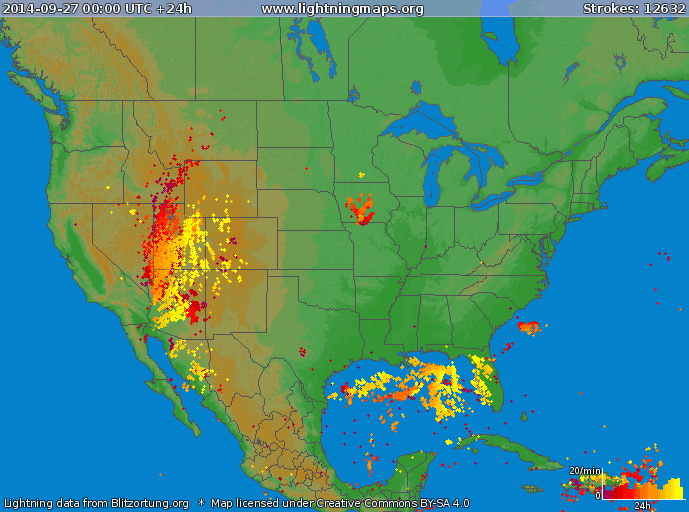
As is usually the case with CLE's, propagation conditions begin to deteriorate shortly after the announcement of the upcoming event. By the weekend's arrival, conditions are usually much worse than earlier in the week and such was the case once again! In North America, lightning activity and mediocre propagation dominated the three-night event, with the consensus of opinion giving the nod to Saturday night and early Sunday morning as being the best period.
 |
| Courtesy: http://www.lightningmaps.org/ |
Here on Mayne Island, Friday night was pretty much a wash and only the stronger signals made it through the din and into the log. A twilight check on Saturday evening indicated improving propagation and less lightning, renewing optimism that the entire weekend would not be a wipeout.
 Since purchasing the Perseus SDR earlier this year, I have been using it exclusively for the past few CLE's. I have been exploiting one of it's main features....the ability to record the entire band overnight and then tune through the band the next day, as in real time. I no longer had to prop my eyelids open until 0100 or later, or to leave a sound sleep to journey out to a cold shack to hunt the pre-sunrise band for anything new....yes, Perseus has made it possible to DX while I sleep!
Now the very concept of this horrifies many of the 'purists' and I myself held-out for several years before venturing over to the darkside...but...embracing new technology along with its associated new learning is what is important. If I get to sleep-in because of it, even better!
So....that's the way it is supposed to work, but due to operator error, Perseus failed to launch on Saturday night, and the best conditions of the CLE were missed altogether. Having seen the error in my ways, the perils of Perseus will, hopefully, not strike again!
Conditions on Sunday night were noisy once again, although not as bad as Friday, and the following log was gathered after parsing through my overnight recordings.
09 29 0900 350 OKT Yoakum, TX - new catch
09 29 0700 350 RG Oklahoma City, OK
09 27 0400 350 SWU Idaho Falls, ID
09 29 0900 350 VTR McGrath, AK
09 29 0800 351 YKQ Wasaganish, QC
09 27 1330 353 AL Walla Walla, WA
09 29 0800 353 CY Cheyenne, WY
09 29 0800 353 DI Dickinson, ND
09 29 0800 353 IN International Falls, MN
09 27 1330 353 LLD Lanai, HI
09 29 0800 353 PG Portage, MB
09 27 0400 353 RNT Renton, WA
09 27 1330 353 ZXY Whitehorse, YT
09 29 1100 355 AUB King Salmon, AK
09 29 0800 355 YWP Webequie, ON
09 27 0700 356 MEF Medford, OR
09 29 0700 356 ODX Ord, NE
09 27 0700 356 ON Penticton, BC
09 27 1330 356 PND Portland, OR
09 27 0700 356 ZF Yellowknife, NT
09 29 0800 356 ZXE Saskatoon, SK
09 27 0400 358 SIT Sitka, AK
09 27 1300 359 BO Boise, ID
09 27 0500 359 SDY Sidney, MT
09 27 1300 359 YAZ Tofino, BC
09 29 0800 359 YQZ Quesnel, BC
09 29 0800 360 SW Warroad, MN
09 29 0900 361 E3 Wabasca, AB
09 29 0800 361 HI Holman, NT
09 29 1000 362 6T Foremost, AB
09 27 1300 362 BF Seattle, WA
09 29 0800 362 CD Chadron, NE
09 29 0600 362 RPX Roundup, MT
09 29 0800 362 YZS Coral Harbour, NU
09 29 0800 364 4D Helmet, BC
09 27 1100 365 AA Fargo, MN
09 29 0800 365 DPY Deer Park, WA
09 29 0800 365 HQG Hugoton, KS
09 29 0800 365 MA Mayo, YT
09 29 0800 366 YMW Maniwaki, QC
09 29 0800 368 ZP Sandspit, BC
09 27 1330 368 ZVR Vancouver, BC
I have, over the years, logged all of these beacons before, except for one..."OKT" in Yoakum, Texas...new catches are always nice and are harder to find it seems. The Google Map's 'street view' shows what appears to be a nice top-loaded "T" antenna at OKT:
 |
| Courtesy: https://www.google.ca/maps/ |
 |
| My CLE186 beacons - Courtesy: https://www.google.ca/maps/ |
It was nice to salvage Sunday night but I'm still a little bummed about missing the best night of the weekend...at least I had a good night's sleep.
Steve McDonald, VE7SL, is a regular contributor to AmateurRadio.com and writes from British Columbia, Canada. Contact him at [email protected].
School Daze
Last night was the second session of our eight week Technician class license class. I think some of our seventeen students walked out of the building with dazed expression on their faces. And I guess that's to be expected right now, as we're out of the introductory "This is Amateur Radio" feel-good fluffy part and we're now into the heart of the course, which is basic electricity and components and all the good stuff.
The concepts of current, resistance, voltage were easily digested by their inquiring minds. The concepts of capacitance, inductance, reactance and impedance? Not so much. But Marv K2VHW and I broke it down into the simplest "lay terms" that we could and I am pretty confident that they have a basic, rudimentary (if not shaky) understanding of the concepts. I am trying pretty hard to find "real world" equivalents that they can relate to, so these concepts don't totally fly over their heads.
I have to admit that back in Ye Olden Days, when I was studying for my Novice license, I wore the very same expression on my face when I left those sessions each Tuesday evening in October and November of 1978.
If you have no concept of electricity and electronics, it CAN seem daunting. But if our students do the required reading, and maybe even do a little Googling on their own, they will have that "Aha moment!" when it all comes together.
As a class, they have several things going for them. The first is that our young students are whizzes at note taking. While Marv is handling the teaching part of a segment, I try to keep an eye on our charges, to watch facial expressions and such. The younger students have their highlighters and pens going at warp speed, taking notes and marking pertinent paragraphs and sentences in their license manuals. The older adult students are no slouches, either. But there's one important difference - their facial expressions are more telling. While the "kids" are sponges, absorbing all this stuff, every now and then, I will see one of the adults screw up their faces as if to say "What?!?" It's at that moment when I will try to pause things for a bit and try to interject an example or some such thing that they're familiar with that brings the concept home to them.
The important thing that we try to stress as much as we can (without beating them over the head with it) is that they HAVE to do the required reading homework. This way, we can answer any questions on any sticky points that they might have. We also give them the reading material that will be covered in the next week's lesson, so that they're not walking into the material blindly.
These two weeks will probably be the very hardest of the eight week class. Electrical concepts and components last night. And next week, electronic and basic radio circuits. After that, we'll get into "the good stuff" - propagation, antennas, operating procedures, setting up a station, etc. That material is probably more in line with what they expected when they were signing up for an Amateur radio course.
I will make it my business during this coming week to make up a handout with some Internet sources that they can refer to in order to make the "meat" that they were fed last night just a little more palatable. As any licensed Ham knows, this is an ongoing process that doesn't end with passing the test. In fact, it's just the very beginning.
72 de Larry W2LJ
QRP - When you care to send the very least!
Larry Makoski, W2LJ, is a regular contributor to AmateurRadio.com and writes from New Jersey, USA. Contact him at [email protected].
 Ham Radio Deluxe |
 W5SWL Electronics |
 Ham Radio Prep |
 KB3IFH QSL Cards  Hip Ham Shirts  HamRadioAuctions HamRadioAuctions Reliance Antennas Reliance Antennas Enigma Shop Enigma Shop |  morseDX  Ni4L Antennas  R&L Electronics R&L Electronics antennas.us antennas.us QRV QRV |
- Matt W1MST, Managing Editor
