 |
 Para-saki all diode QRP transceiver
 14 October 2014 | by
 This looks like a design by Michael Rainey AA1TJ, but this one was on a German blog site of Peter DL3PB. I was very annoyed by the Facebook pop-up that kept appearing. I kept closing the pop-up but it is really annoying. Website owner – PLEASE get rid of it!
See http://streampowers.blogspot.co.uk/2013/08/para-saki-qrp-transceiver-fact-diodes.html .
The design makes extensive use of tunnel diodes, a Michael Rainey favourite.

Roger Lapthorn, G3XBM, is a regular contributor to AmateurRadio.com and writes from Cambridge, England.
Amplifiers by Peter Rodmell G3ZRS
- Everything you need to know about Valve Amplifiers
- History of Valves
- Classic Valve Amplifiers
- Fault finding
- How to make amplifiers for HF and VHF
- ATU's and Tuners
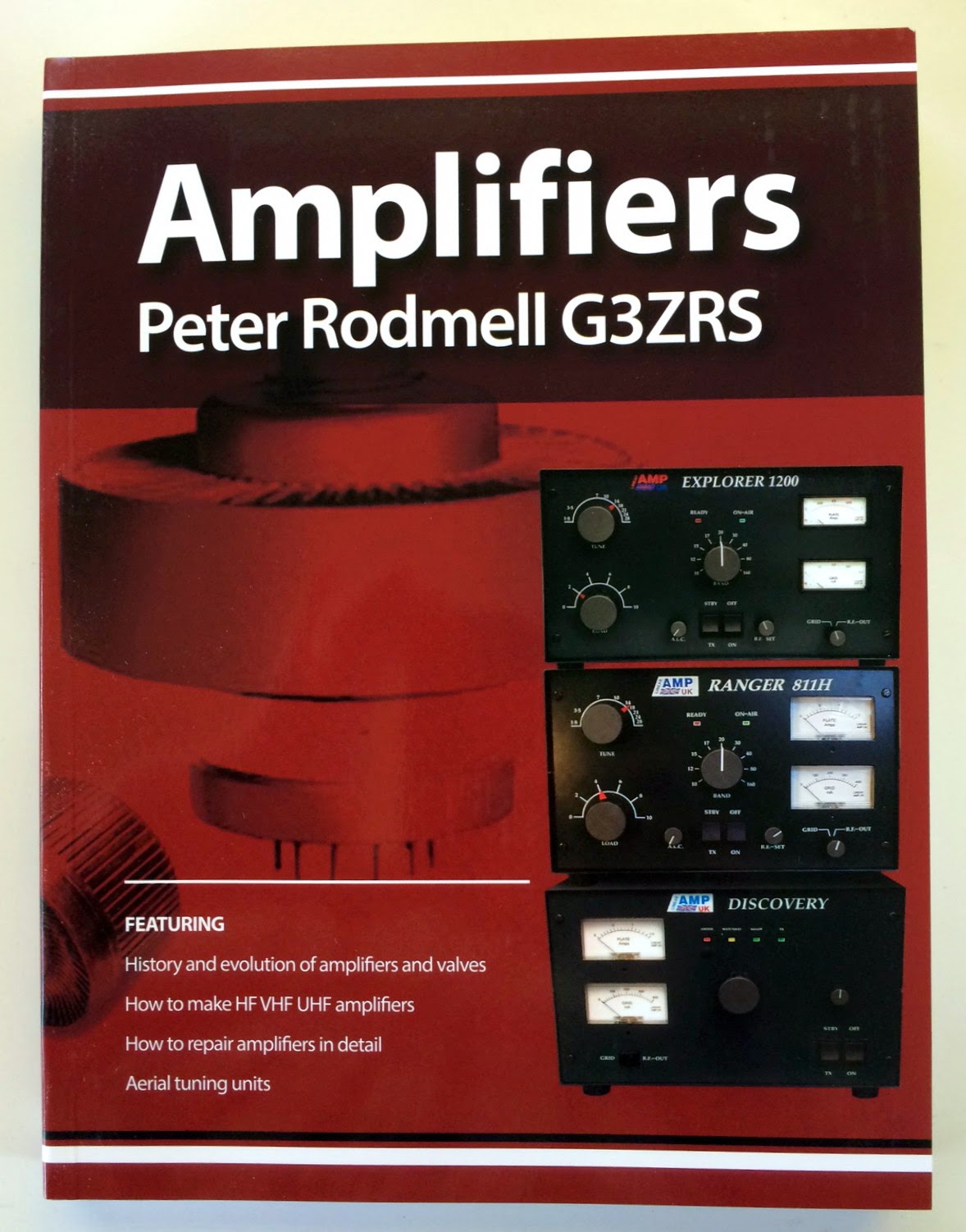
http://www.thedxshop.com/books/amplifiers-by-peter-rodmell-g3zrs.html
I have also seen it being sold on ebay too.
Steve, G1KQH, is a regular contributor to AmateurRadio.com and writes from England. Contact him at [email protected].
Follow me.
If your new to reading this Blog, again please use the Followers link, it would be appreciated to know who is reading it..
Thanks!
73
G1KQH
Steve, G1KQH, is a regular contributor to AmateurRadio.com and writes from England. Contact him at [email protected].
Ham Radio Mystery
I wrote, produced, and recorded Cornbread Road, a ham radio mystery series in 2010 when it was released one episode per week for thirteen weeks. After a successful run, I removed the files from the server as I never intended it to be continuously available.
But ever since then I have made the thirteen audio files available once a year for a limited run — for those who might have missed it. The audio series is available again right now, but only until the end of the month. On Halloween I’ll pull down the files until next year. Download them now or wait until next year.
It’s all fun, fiction and unlike any ham radio story you’ve ever heard told.
Filed under: Ham Radio Tagged: audio 


Jeff Davis, KE9V, is a regular contributor to AmateurRadio.com and writes from Indiana, USA.
Three Steps to Getting Your Ham Radio License
 These are the three basic steps to getting your USA amateur (ham) radio license: 1) Learn the Material 2) Take Practice Exams and 3) Pass the Real Exam.
This article is very short and to the point, for a more detailed explanation see Stu’s article over at HamRadioSchool.com.
1. Learn The Material
The entry level ham radio license is the Technician License, so you’ll need to get a book that covers the theory, regulations and operating procedures required by the Federal Communications Commission (FCC). My recommendation is the Technician License Course over at HamRadioSchool.com, which offers an integrated learning system (web, book and smartphone app).
While you can learn the material on your own, many people find classroom instruction to be very helpful. Check the ARRL web site for courses in your area or just do an internet search for “ham radio license class” and your location.
2. Take Practice Exams
The question pool for the Technician Level Exam is made public, so you have access to every possible question that will be on the exam. Better yet, various organizations have created online practice exams so you can test yourself in advance. After you study the material, take these practice exams to test your knowledge. Go back and study any topics you are having trouble with on the exam. A passing grade is 74%, so you’ll want to be consistently above that before trying the real exam.
These are a few of the available online practice exams: qrz.com, eham.net and aa9pw.
3. Pass the Real Exam
The FCC exams are administered by radio hams known as Volunteer Examiners (VEs), so the exam session is sometimes called a VE session. In most areas, there are exam sessions given on a regular basis. Check the ARRL web site to find a license exam session in your area.
Be sure to follow the instructions of the local VE team, since policies and procedures do vary. If you’ve studied the material and checked your knowledge by taking the practice exams, you should have no problem passing the Technician level exam.
4. One More Thing
Actually, there is one more step to this process. Getting the required FCC license is just the start, a learners permit for amateur radio. You’ll need to get on the air and gain some practical experience. It is extremely helpful to have some help during this process, so I highly recommend that you connect up with a local ham radio club. If you can’t find a club then perhaps make contact with a local ham or two.
There are many hams out there that are willing to help. However, it may be a challenge to find one. You can always drop me an email and I will try to assist.
73, Bob K0NR
Bob Witte, KØNR, is a regular contributor to AmateurRadio.com and writes from Colorado, USA. Contact him at [email protected].
Solar Cycle 25 Predictions
It has been notoriously hard to predict future solar cycles, but the science is improving all the time. Right now, the experts are predicting that solar cycle 25 will be very small indeed. Some think we are moving towards another Maunder Minimum when solar sunspots all but vanish for around 50 years. If so, most of us alive now will never experience “good” HF conditions ever again in our lifetimes. Experts can be wrong!
On a positive note, poor solar activity often means the lower frequency bands are better. With some luck, we may have a new international contiguous band at 60m in a few years’ time. This depends on WRC2015.
Regarding cycle 24, it looks like the peak was Feb 2014.
See http://www.solen.info/solar/ .

Roger Lapthorn, G3XBM, is a regular contributor to AmateurRadio.com and writes from Cambridge, England.
Simple 10m rigs
As 10m slides to the “quieter years” of the solar cycle it will soon be time to look again at using this band for local communications. It makes an ideal band to natter across town and I still think a 10m Fredbox is worth a go. The receiver, a simple super-regen is extremely simple, very sensitive with a simple RF amplifier, but lacking in selectivity so would NOT be useful when the band is busy. At night time in the quieter years it would be perfectly fine. The alternative is a simple 10m DSB rig, which would be compatible with SSB transceivers.
At the moment, my poor health is stopping me doing both of these projects.
See https://sites.google.com/site/g3xbmqrp3/hf/10m_op?pli=1 .
See https://sites.google.com/site/g3xbmqrp3/hf/tenbox .
See https://sites.google.com/site/g3xbmqrp3/hf/10msimple_sb .

Roger Lapthorn, G3XBM, is a regular contributor to AmateurRadio.com and writes from Cambridge, England.
 Ham Radio Deluxe |
 W5SWL Electronics |
 Ham Radio Prep |
 KB3IFH QSL Cards  Hip Ham Shirts  HamRadioAuctions HamRadioAuctions Reliance Antennas Reliance Antennas Enigma Shop Enigma Shop |  morseDX  Ni4L Antennas  R&L Electronics R&L Electronics antennas.us antennas.us QRV QRV |
- Matt W1MST, Managing Editor
