 |
 Disturbing the Force
 20 October 2014 | by
 Smartphones keep getting bigger. Out of the noise about the rising popularity of phablets, one notable observation bubbled to the surface, and that by tech pundit and radio amateur Leo Laporte, W6TWT. Laporte likes the large phones and when chided that it would appear he was holding a waffle to his head when making a telephone call he responds, “who uses a smartphone to make telephone calls anymore?”
That sounds funny, and seems to go against the grain, however, it’s spot on accurate. We very rarely use mobile devices to “talk” with someone after the manner of the ancient rotary phone. We send texts, photos, and Tweet’s. We Facetime, Hangout, Facebook, Instagram and Snapchat. Fact is, we do almost everything with our mobile devices EXCEPT use them as wireless telephones. It’s not a telephone, it’s a personal communicator and the demand for larger screens simply reflects the rapid changes we observe in the way we communicate with each other in the 21st century.
I find that notable because there’s an oddity in the ham radio world that might be explained by it.
Contest organizers and RBN data detectives tell us that CW activity has been on the rise for nearly a decade. We can infer by the increase in QST advertising of paddles, keys, and other such devices that the sale of Morse instruments is at nearly a fever pitch. And yet, despite that, you talk to guys who live in the code trenches and they will lament the serious lack of activity. Sure, some of that may just be the imagination of old men who dream of the better day that never really was, but that doesn’t negate the many credible observations that casual CW use, especially rag chewing, is getting harder to come by.
So what’s really happening?
Hard to say for certain but there is one possibility that would explain the observed rise and fall, at the same time, of CW. It is possible that the way we communicate in the new age has changed from the way we used to do it. The efficacy of CW is legendary and highly advantageous in a contest or when chasing DX. It’s just possible that we’re using CW more for short, rapid exchanges of information — and less for casual operation.
This would explain why the RBN is telling us one thing (way more CW activity) while the good old boys who do nothing but pound the brass tell us something different (CW is dying). Both are right, and wrong. (I told you it was an oddity).
It also explains why way back in our long ago a spiral bound ARRL logbook would last an entire year or more while these days, many of the brethren are putting 2,000 Q’s in the log over a good weekend.
Short, rapid fire CW exchanges = text messaging. Get used to it. Besides, who needs to be loquacious in the 21st century?
(But if you really want to chew the rag using CW, meet me on 7.120 and we’ll do it 20th century style!)
OMG WTF? LOL 73
Filed under: Ham Radio Tagged: cw, ideas 


Jeff Davis, KE9V, is a regular contributor to AmateurRadio.com and writes from Indiana, USA.
Over The Moon – M0NRD
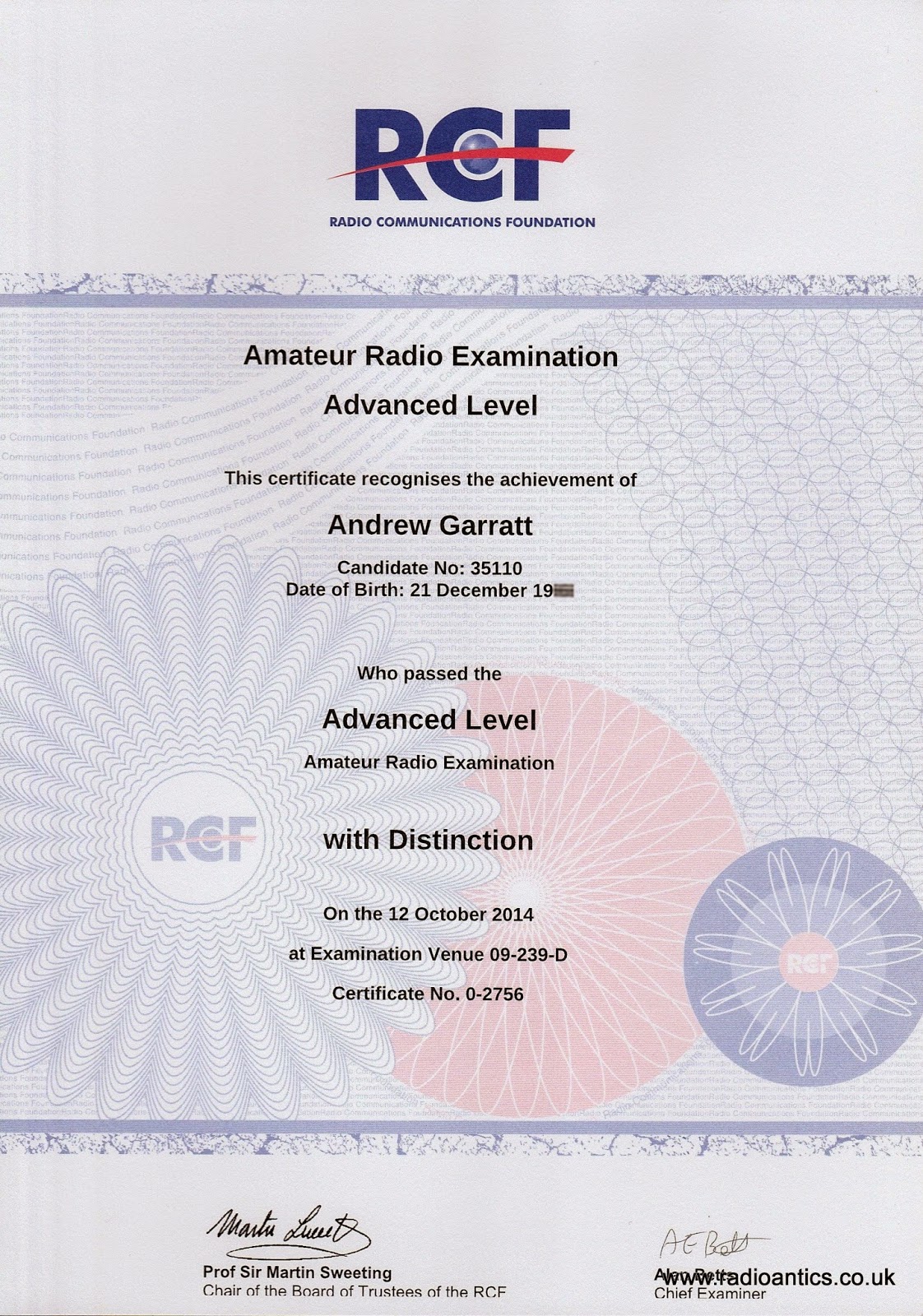
I now have a full licence and a new call sign M0NRD.
I sat the advanced level examination held during the RSGB Convention on the 12th October. The results were due at least six working days later so wasn't expecting to know how I had done till this week so I surprised when the certificate arrived on Saturday morning and was over the moon to discover I'd passed with a distinction.
I only decided to apply to sit the exam last month. Regular readers may have missed the announcement as it was an after thought at the end of another post.
I became a licensed ‘foundation level’ radio amateur last September (M6GTG) and an ‘intermediate’ (2E0NRD) in May this year. It was a bit of a bold decision to attempt the final stage as I hadn't been actively studying for it. There have been many people who have progressed in a shorter time but going through the levels in just thirteen months is a big undertaking especially when time and concentration is taken up with work, career and domestic commitments.
After a cursory glance at the syllabus and a quick leafing through the RSGB Advance! book I had decided while there were quite a few areas that I didn't know in depth the electronics theory and mathematics were okay due to my higher education background (though it has been 26 years since I left University) so I just needed to fill in the blanks.
After posting off the application the plan had been to spend the month going through the book, learning, refreshing and revising the subjects as necessary. Of course I got sidetracked and distracted so it got left it to the last minute, well in fact to the week before the exam.
As soon as I started studying properly I soon realised I'd seriously underestimated the amount of details and facts that I need to understand and recall. I knuckled down and despite doing full days at work I studied in the evenings, making notes, working the questions on the Hamtests website and in the QADV program and gained confidence of getting at least the 60% pass rate. I tested myself on the QADV practice papers and mock papers on the RSGB website and seemed ready.
I had intended to be at the RSGB Convention proper however I agreed instead to spend that weekend at the Mother-in-laws in Cambridge and drove over to Milton Keynes in thick fog on the Sunday morning.
The actual exam seemed reasonable there were a few head scratchers and several questions on topics I suddenly found myself unsure of. I took my time deliberating and checked every single 'licence condition' question against the supplied licence document even if I thought I knew the answer. Double and triple checking questions, values, calculations and answers and with 10 minutes of the alloted time remaining I had filled in the marking sheet and made a quick exit in time to get my Sunday roast dinner.
I had left confident and reasonably happy but over the next few days doubt inevitably started setting in. I kept remembering questions.. had I got that one wrong? I resisted the temptation to check the text book and keep thinking well it is only 60% I need...
To achieve a distinction was very satisfying, a lot of people have said they expected me to walk it but self doubt and a lack of self confidence is something I have suffered from for many years. When I was a spotty student I would probably have agreed but now an overweight, slightly befuddled middle aged man with greying hair you do have your doubts.
I would like to thank all those people who have congratulated me and those who have encouraged me along the way and wish everyone studying and taking the exam in the future the best of luck.
Andrew Garratt, MØNRD, is a regular contributor to AmateurRadio.com and writes from East Midlands, England. Contact him at [email protected].
LHS Episode #133: We’re Baaack!
 Hello again! Linux in the Ham Shack is back online after a three-month absence. Thank you all for sticking out our downtime with us. We’ve retooled the show a little bit, added some segments, and tightened up the format. But all the fun, information and Linux and hammy stuff remains! Looking forward to many more years of our show. Sit tight, strap in–we’re just getting started. Again.
73 de The LHS Guys
Russ Woodman, K5TUX, co-hosts the Linux in the Ham Shack podcast which is available for download in both MP3 and OGG audio format. Contact him at [email protected].
Jamboree On The Air 2014 or J.O.T.A. 2014

City Lights in back and fire

Daytime View from Operating Position

Inside Operations Tent, this is Carl VE3DG
This weekend was JOTA, and this was the 17th year that Gary VE3ODE, Carl VE3DG and myself Fred VE3FAL have put JOTA on for some of the Otters,Beavers and Scouts in the rural area of Thunder Bay. Each year is a new location with which involves a hike and radio operations. This year we were in Oliver Paipoonge at Scouter Jerry’s home location, on his 90 acre property he has a hilltop with trails right to the top, it is about a 20 minute hike up with a backpack. Gary an I hauled our gear up in a buggy I made with gear in a tote, took us about 45 minutes to get the stuff up. A hike was done in the afternoon by the Otters and Beavers and the Scouts spend the night as well, so in our tents we braved the -2c temperatures once again, this morning though was only thick frost and no snow.
For the Otters I put on one of my manpack radios and went down the trail to talk with them, we used an open 10 meter frequency and answered many of their questions and explained how amateur radio worked. The Beavers made a few contacts with various stations around the country. The Scouts also worked stations from Coast to Coast with the best contact being into Saskatchewan with clear signals in the evening on 20 meters.
We were operating a Icom-703 at 10 watts into a windom antenna, it worked very good and of course running on battery power the entire weekend.
Campfire building skills were also part of the day and so were opening and closing ceremonies.
In total over the 2 days we had 17 participants as well as parents and leaders at the site.
Many thanks to Scouter Jerry and his family, Scouter James, Gary, Carl and the rest of the gang for a great spot and good weekend.
Fred Lesnick, VE3FAL, is a regular contributor to AmateurRadio.com and writes from Thunder Bay Ontario, Canada. Contact him at [email protected].
Nice to get back in the radio chair agian.
 |
| Nice to get back on the air again |
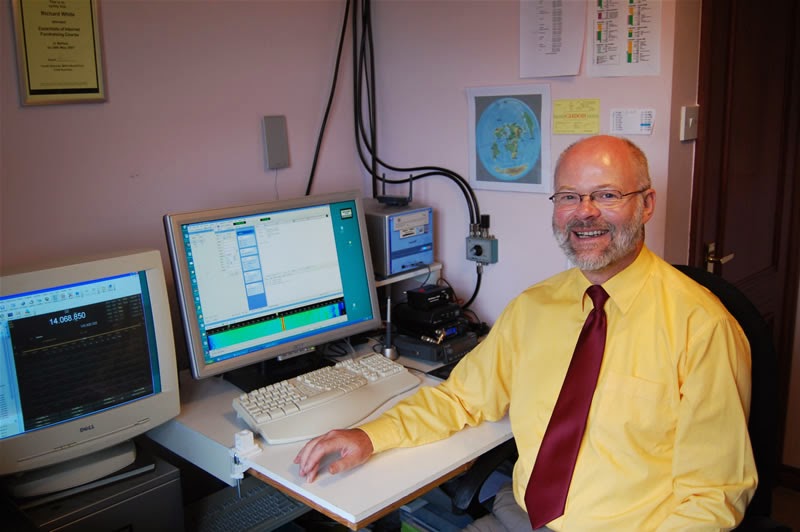 |
| GI4DOH |
Mike Weir, VE9KK, is a regular contributor to AmateurRadio.com and writes from New Brunswick, Canada. Contact him at [email protected].
The Noble Radio NR4SC 70MHz rig: weak signals
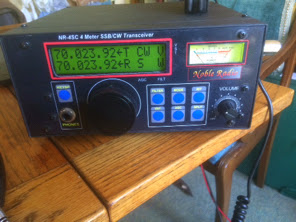
I was very conscious, having been playing with the rig that I really hadn’t put it on any sort of decent antenna. Well, I still haven’t, but at least it was something horizontally polarised!
A few weeks ago I ordered a Moonraker 70MHz HB9CV. I wanted to have an antenna that I could use for some meteor scatter and I was also very interested to see what I could hear over tropo paths with a simple antenna.
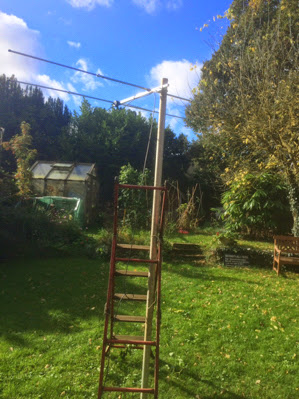
Today I had the chance to put the antenna together, which didn’t take more than about 30 minutes. I mounted it on a spare pole in the garden, held up by a stepladder, so the HB9CV was probably no more than about 8 feet above the ground.
Of course, the first signal that I listened to was the GB3RAL beacon, just a few miles away from me. I was pleased to see that the signal strength varied substantially as I rotated the antenna – anything from about S8 to S1, so the pattern of the antenna was reasonable, despite the low mounting height.
Next I listened for the GB3BUX beacon. I heard nothing and a quick look at the Beaconspot database suggests that it may be off air. Then, I pointed the antenna to the south west to listen for GB3MCB in Cornwall. Very pleasingly, I was able to hear it, just out of the noise, peaking up every few minutes. This may have been tropo or it may have been aircraft scatter. Either way, I continue with my assertion that the NR4SC has a nice quiet receiver. I’ve not, yet, tried this path with the Spectrum transverter. Interestingly, I have not heard GB3MCB on 144MHz very often. I’ve always assumed that is because of Faringdon Folly – a hill to my south west a mere 4 or 5 miles away. So it’s interesting that the path works ok on 70MHz, even with a low antenna.
I also listened for the GB3ANG beacon near Dundee in Scotland. I cannot be certain whether I heard it – certainly nothing concrete, but I’ve a feeling I heard a fragment at one point. More extensive listening would reveal, something I am sure.
This was a very pleasing test and one of the benefits of having the compact NR4SC was that it was easy to bring down to the lounge, with a PSU and connect up to the coax coming in through the patio doors! The NR4SC is very compact and would make the basis of a nice portable station. Just need a matching 150W PA now!
Tim Kirby, G4VXE, is a regular contributor to AmateurRadio.com and writes from Oxfordshire, England. Contact him at [email protected].
The Noble Radio NR4SC 70MHz rig: weak signals
I was very conscious, having been playing with the rig that I really hadn’t put it on any sort of decent antenna. Well, I still haven’t, but at least it was something horizontally polarised!
A few weeks ago I ordered a Moonraker 70MHz HB9CV. I wanted to have an antenna that I could use for some meteor scatter and I was also very interested to see what I could hear over tropo paths with a simple antenna.
Today I had the chance to put the antenna together, which didn’t take more than about 30 minutes. I mounted it on a spare pole in the garden, held up by a stepladder, so the HB9CV was probably no more than about 8 feet above the ground.
Of course, the first signal that I listened to was the GB3RAL beacon, just a few miles away from me. I was pleased to see that the signal strength varied substantially as I rotated the antenna – anything from about S8 to S1, so the pattern of the antenna was reasonable, despite the low mounting height.
Next I listened for the GB3BUX beacon. I heard nothing and a quick look at the Beaconspot database suggests that it may be off air. Then, I pointed the antenna to the south west to listen for GB3MCB in Cornwall. Very pleasingly, I was able to hear it, just out of the noise, peaking up every few minutes. This may have been tropo or it may have been aircraft scatter. Either way, I continue with my assertion that the NR4SC has a nice quiet receiver. I’ve not, yet, tried this path with the Spectrum transverter. Interestingly, I have not heard GB3MCB on 144MHz very often. I’ve always assumed that is because of Faringdon Folly – a hill to my south west a mere 4 or 5 miles away. So it’s interesting that the path works ok on 70MHz, even with a low antenna.
I also listened for the GB3ANG beacon near Dundee in Scotland. I cannot be certain whether I heard it – certainly nothing concrete, but I’ve a feeling I heard a fragment at one point. More extensive listening would reveal, something I am sure.
This was a very pleasing test and one of the benefits of having the compact NR4SC was that it was easy to bring down to the lounge, with a PSU and connect up to the coax coming in through the patio doors! The NR4SC is very compact and would make the basis of a nice portable station. Just need a matching 150W PA now!
Tim Kirby, G4VXE, is a regular contributor to AmateurRadio.com and writes from Oxfordshire, England. Contact him at [email protected].
 Ham Radio Deluxe |
 W5SWL Electronics |
 Ham Radio Prep |
 KB3IFH QSL Cards  Hip Ham Shirts  HamRadioAuctions HamRadioAuctions Reliance Antennas Reliance Antennas Enigma Shop Enigma Shop |  morseDX  Ni4L Antennas  R&L Electronics R&L Electronics antennas.us antennas.us QRV QRV |
- Matt W1MST, Managing Editor
