 |
 Remembering Julian Moss G4ILO
 27 October 2014 | by
 It was with much sadness that I read of Julian’s death last Friday on Twitter and then on his blog
Like many others who have tweeted or blogged about Julian’s passing, I found his blog an inspiration and there was always something of interest for me.
On the air, I think I first worked Julian on 2m CW back in the 1980s when he was still ‘down south’. I remember it well, as G3ILO was local to me and working G4ILO made me smile. We didn’t have many on air QSOs in recent years, although we emailled and commented on each other’s blogs quite regularly.
A memorable communication from Julian was an APRS message he sent me, bounced off the ISS. We also had a nice Echolink QSO one evening, when I was on the train and he was in his shack. We never worked on DSTAR, a mode that it fair to say, did not appeal to Julian at all, and he was quite happy to say so!
Happy memories of a very interesting man who I shall miss. Sympathies to Olga for her loss.
Julian’s last blog post reminds us to hold our loved ones close…
Tim Kirby, G4VXE, is a regular contributor to AmateurRadio.com and writes from Oxfordshire, England. Contact him at [email protected].
Things are very slow on the bands
Lets hope the conditions some what improve this week…..
Mike Weir, VE9KK, is a regular contributor to AmateurRadio.com and writes from New Brunswick, Canada. Contact him at [email protected].
Microvert antenna
Quite a few people who use WSPR use the tiny Microvert Antenna whose design seems to have originated in Germany. For example, this diminutive antenna is only about 30cms long on 28MHz. It uses the coax intentionally as a counterpoise with an RF choke the right distance down the coax. Performance is several S points down on a full sized antenna like a 1/2 wave dipole. With small antennas there is always a compromise! Versions have been made for most HF bands. The antenna looks ideal for portable or balcony use, being small and easy to erect. Perhaps I should test my (currently poor) build skills by making one for 10m or 20m WSPR use?
I wonder who reading this post has used a Microvert Antenna and how they found it?
See http://download.antennex.com/preview/archive4/Apr601/microvert.pdf .

Roger Lapthorn, G3XBM, is a regular contributor to AmateurRadio.com and writes from Cambridge, England.
Solar Flare Magic
 |
| Courtesy: http://www.noaa.gov/ |
 |
| Courtesy: http://www.noaa.gov/ |
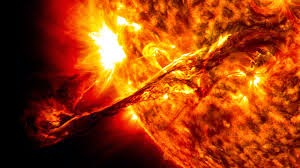
Since then, there have been three more major flares from this same region, one at X1.0 (on Saturday) and the most recent (this morning) at X2.0. Oddly enough, none of these flares have produced CME's as little plasma release has been detected. Any associated auroral events will be very weak or unlikely in spite of region 2192 being geoeffectively positioned at the time of the flares.
However, the near light-speed arrival of Friday's emitted UV radiation caused a fast rise in the muf as spotty signals from various regions of South America were soon being heard on 6m in North America.
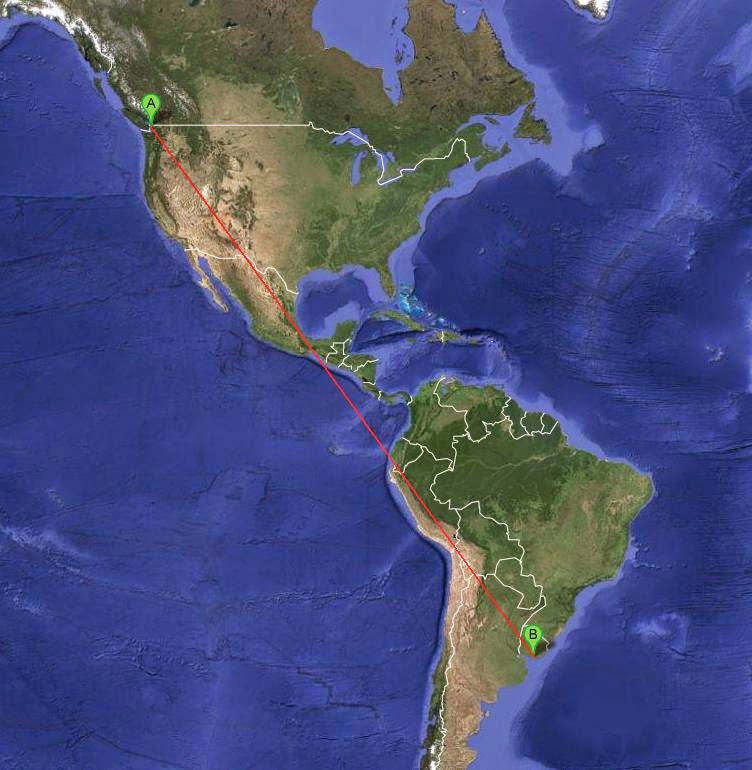
The most prominent signal was that of CX7CO (Carlos), in Montevideo, Uruguay. Thanks to the ever-alert KE7V, who posted news of the sudden arrival of Carlos, he was widely worked around North America including the west coast, a region that is usually left-out of the action. Known to have worked Carlos from here were myself, VE7XF, VE7DAY, KE7V, K7CW and possibly others outside of my hearing range. Shortly after working the west coast, Carlos was heard working JA's as his signal became weaker.
The distance from Mayne Island to Montevideo is 11,425km (7100 miles), which would tend to indicate that the contacts were a result of F2 propagation. Some have suggested a Sporadic-E-to-TEP link but I have my doubts...several 'TEP markers' were not present and there were no signs of any Es activity from this area. Although his signal peaked at 569, it is not uncommon for F2 signals to be weak, unlike the bone-crushing levels they can sometimes reach.
 |
| Courtesy: https://maps.google.ca/ |
Steve McDonald, VE7SL, is a regular contributor to AmateurRadio.com and writes from British Columbia, Canada. Contact him at [email protected].
Julian G4ILO has died, sadly
From Julian’s blog:
Julian died yesterday on 24 October in the presence of his wife Olga and two Hospice nurses at home at 19-45 peacefully and painlessly. He will be always loved and always remembered.
See http://onefootingrave.blogspot.co.uk/ .
We all knew this was likely but it saddens me greatly to report this here.
RIP Julian – you brightened our lives and we will all miss you. Olga, our sympathies to you in your great loss. Julian inspired a great many people. He will be remembered for a long time.
I have no details of memorials (flowers, donations, etc.) or funeral arrangements.

Roger Lapthorn, G3XBM, is a regular contributor to AmateurRadio.com and writes from Cambridge, England.
RIP G4ILO
I have just read on G4ILO's One foot in the Grave Blog, that Julian lost his long battle with his illness yesterday: http://onefootingrave.blogspot.co.uk/
Julian was an inspirational writer, anything new he spotted, purchased, or built, he brought to the forefront of his Amateur radio blog: http://blog.g4ilo.com/ Letting us all know his thoughts and modifications. He tried everything from bargain street kits, Baofeng's to Elecraft, and software writing. He enjoyed his hobby and blogging, which was always written to a very high professional standard.
I am going to miss his regular updates on his blog, because I really enjoyed reading what he had written, and couldn't wait for the next item he was going to write about.
My thoughts and condolances must go to his wife Olga and family.
RIP Juilan Moss G4ILO
Steve, G1KQH, is a regular contributor to AmateurRadio.com and writes from England. Contact him at [email protected].
Calibration time
I had been looking at a way of checking calibration of my DMMs on DC, and this useful board will do that for £4. Using an AD584K Precision reference chip, that will output 4 high stab Volts by the flick of a switch:
10.0 V +/- 10 mV
7.5V +/- 8 mV
5.0V +/- 6 mV
2.5V +/- 3.5mV
Figures quoted are for 15V feeding the input of the board

I have seen these on the Internet at various sources, but my link proved to be the cheapest I could find: http://www.banggood.com/AD548-High-Precision-Voltage-Reference-Module-4-Channel-Calibration-p-932160.html
There is also a full spec sheet on the device at the above link.
I will come back to this when I have boxed it up and terminated it for better protection..
Steve, G1KQH, is a regular contributor to AmateurRadio.com and writes from England. Contact him at [email protected].
 Ham Radio Deluxe |
 W5SWL Electronics |
 Ham Radio Prep |
 KB3IFH QSL Cards  Hip Ham Shirts  HamRadioAuctions HamRadioAuctions Reliance Antennas Reliance Antennas Enigma Shop Enigma Shop |  morseDX  Ni4L Antennas  R&L Electronics R&L Electronics antennas.us antennas.us QRV QRV |
- Matt W1MST, Managing Editor
