 |
 W5KUB Live – Arduino for Ham Radio with Glen Popiel, KW5GP
 31 October 2014 | by
Matt Thomas, W1MST, is the managing editor of AmateurRadio.com. Contact him at [email protected].
CQ Crossband – Final Call – 630m Tomorrow Night
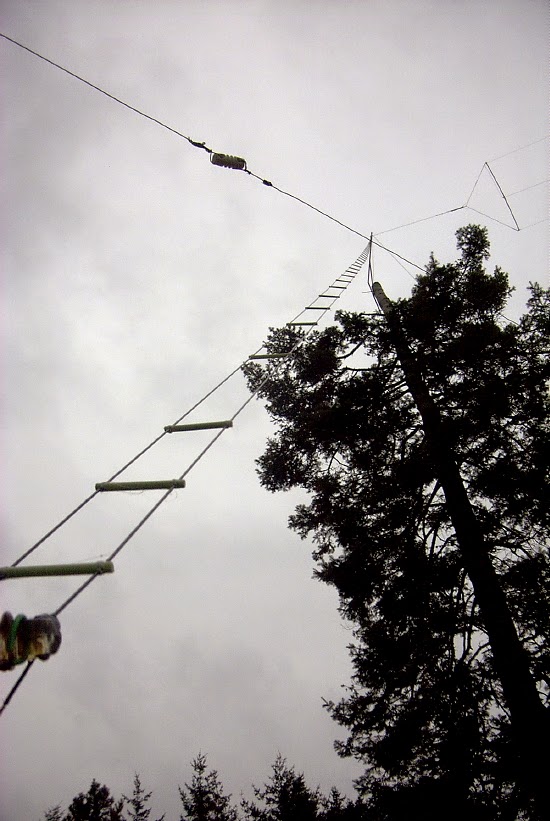
The three VE stations active on 630m CW are looking forward to working you tomorrow (Halloween) evening via the crossband mode during the 630m Activity Night.
In the east, watch for VO1NA. On the west side, watch for VE7BDQ and VE7SL. Here are the transmitting frequencies, times and HF calling frequencies:
- VO1NA - Joe, in Torbay, Newfoundland. Joe will transmit on 477.7 kHz starting at 2130Z Oct 31 and will continue until 0130Z Nov 1. He will listen for callers on 3562 kHz and 7062 kHz.
- VE7BDQ - John, in Delta, B.C. John will transmit on 474.0 kHz starting at 0100Z and will continue until 1000Z on Nov 1. He will listen for callers on 3536 kHz.
- VE7SL - Steve, on Mayne Island, B.C. I will transmit on 473.0 kHz starting at 0200Z and will continue until 0600Z on Nov 1. I will listen for callers on 3566 kHz and 7066 kHz.
I have no idea how many stations will be participating on HF but please do not give up should your first few calls not be answered. If conditions appear to be really good, operating hours will probably be extended. Unfortunately Saturday night will probably be out since it is the Sweepstakes CW weekend and will pretty much plug the HF bands, wiping out the calling frequencies.
Don't forget to watch for the Part 5 Experimental stations (WG2's and WD2's) who will be beaconing and working each other on 630m directly. I'm sure they would appreciate your 'heard' reports as well.
Good luck and see you tomorrow.
Steve McDonald, VE7SL, is a regular contributor to AmateurRadio.com and writes from British Columbia, Canada. Contact him at [email protected].
LNR publish LD-5 manual
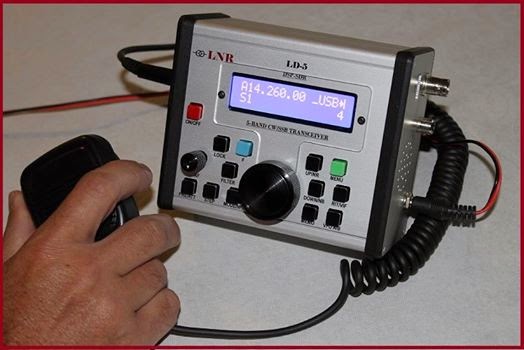
For now though you can download the manual at the link below:
http://www.lnrprecision.com/
Steve, G1KQH, is a regular contributor to AmateurRadio.com and writes from England. Contact him at [email protected].
30m WSPR transceiver kit
By now, you probably realise that I just love WSPR. With quite simple equipment it is possible to be decoded across the planet consistently with real QRP power levels. I am always on the look-out for new ideas, although until my health improves I am not in a position to build too much myself. See http://www.knology.net/~gmarcus/WSPR/wspr_v4.pdf for an example of a complete 30m WSPR transceiver.
This is NOT a new circuit – it has been around for some years – and it still needs a PC for the WSPR software. Some TX-only WSPR beacons use microprocessors to generate the WSPR TX messages, thereby freeing up the PC and consuming little power overall. Some sync to GPS to avoid timing issues too.

Roger Lapthorn, G3XBM, is a regular contributor to AmateurRadio.com and writes from Cambridge, England.
AmateurLogic Live Stream Saturday Nov. 1
We’ve got a bonus episode of AmateurLogic coming your way Saturday Nov. 1 at 1:00 PM CDT, 1700 UTC on www.live.amateurlogic.tv
We will talk with some of the interesting people George met at Pacificon this year.
George Thomas, W5JDX, is co-host of AmateurLogic.TV, an original amateur radio video program hosted by George Thomas (W5JDX), Tommy Martin (N5ZNO), Peter Berrett (VK3PB), and Emile Diodene (KE5QKR). Contact him at [email protected].
AirSpy taking pre-orders for their $199 SDR receiver

From their website:
Airspy is an advanced software defined radio receiver capable of sampling 10MHz of spectrum anywhere between 24MHz and 1.7GHz – and even beyond with extensions. It all started when we needed a good performing receiver that’s still affordable but could not find a good solution in the market, so we designed ours. We believe that as of today, Airspy is the only serious wide band receiver solution that’s high performance and yet affordable.

Some specs:
- Continuous 24 – 1750 MHz RX range with no gaps
- 3.5 dB NF between 42 and 1002 MHz
- Tracking RF filters
- 35dBm IIP3 RF front end
- 12bit ADC @ 20 MSPS (80dB Dynamic Range, 64dB SNR, 10.4 ENOB) – Yeah, size does matter.
- Up to 80 MSPS for custom applications
- Cortex M4F @ up to 204MHz with Multi Core support (dual M0)
- 1.5 ppm high precision, low phase noise clock
- 1 RTC clock (for packet time-stamping)
- External clock input (10 MHz to 100 MHz via MCX connector) – Ideal for phase coherent radios
- 10 MHz panoramic spectrum view with 9MHz alias/image free
- IQ or Real, 16bit fixed or 32bit float output streams
- No IQ imbalance, DC offset or 1/F noise at the center of the spectrum that plagues all the other SDRs
- Extension ports: 16 x SGPIO
- 1 x RF Input (SMA)
- 1 x RF Output (Loopthrough, U-FL)
- 2 x High Speed ADC inputs (up to 80 MSPS, U-FL)
- 4.5v software switched Bias-Tee to power LNA’s and up/down-converters
Thoughts:
From what I’ve read, the big advantage of this over a standard RTL-SDR dongle is much less noise. I haven’t used one, but if it really lives up to their claims the $199 price point is actually pretty reasonable.
http://www.airspy.com / $199
Matt Thomas, W1MST, is the managing editor of AmateurRadio.com. Contact him at [email protected].
Kaboom!

Unfortunately, the rocket was carrying various OSCAR satellites, specifically the GOMX-2 and RACE CubeSats. Fortunately, it appears that no ground personnel were injured or killed by the mishap.
According to the ARRL:
"The 2U GMX-2 CubeSat was intended to test a de-orbit system designed by Aalborg University in Denmark. Karl Klaus Laursen, OZ2KK, is listed as the “responsible operator” on International Amateur Radio Union frequency coordination documents. The Amateur Radio payload proposed using a 9.6 k MSK data downlink on 437.250 MHz. Also on board was an optical communications experiment from the National University of Singapore. The mission also hoped to flight qualify a new high-speed UHF transceiver and SDR receiver built by an Aalborg University team.
The Radiometer Atmospheric Cubesat Experiment (RACE) CubeSat was a joint project between The Texas Spacecraft Laboratory (TSL) at the University of Texas-Austin and NASA’s Jet Propulsion Laboratory (JPL). It carried a 183 GHz radiometer, a new science instrument designed by JPL. The primary objective of the RACE mission was to collect atmospheric water vapor measurements. The spacecraft was equipped to transmit using GMSK at 38.4 k and CW telemetry on a downlink frequency of 437.525MHz, as coordinated with the IARU. TSL’s Edgar Glenn Lightsey, KE5DDG, was listed in the IARU coordination documents as the responsible operator."
The Antares rocket is a design of the Orbital Space Sciences group. It was on a re-supply mission to the International Space Station and had 5000 pounds of cargo as well as more than two dozen satellites on board. Mankind has been launching payloads into earth orbit for 57 years now. This just goes to show, that as much as this is "rocket science" - that stuff still happens.
On a related note, I was able to visually witness a very nice pass of the ISS this Monday evening. It was about a 60 or 70 degree pass just around local sunset. The ISS was very bright and showed up on the horizon right on cue. Wonderful how that works, isn't it? As I watched it fly overhead, just over the waxing crescent moon, I was reminded of the many passes of RS10/11 and RS12/13 in the 90s. I used to work those LEOs a lot, and had many pleasurable contacts over them.
72 de Larry W2LJ
QRP - When you care to send the very least!
Larry Makoski, W2LJ, is a regular contributor to AmateurRadio.com and writes from New Jersey, USA. Contact him at [email protected].
 Ham Radio Deluxe |
 W5SWL Electronics |
 Ham Radio Prep |
 KB3IFH QSL Cards  Hip Ham Shirts  HamRadioAuctions HamRadioAuctions Reliance Antennas Reliance Antennas Enigma Shop Enigma Shop |  morseDX  Ni4L Antennas  R&L Electronics R&L Electronics antennas.us antennas.us QRV QRV |
- Matt W1MST, Managing Editor
