 |
 Largest Sunspot Region (so far) in Sunspot Cycle 24
 4 November 2014 | by
 Look at this huge sunspot, the largest yet of Sunspot Cycle 24! It is about the same diameter as Jupiter! Notice how tiny Earth is, in comparison. Sunspots are regions on the Sun’s photosphere, formed by the “convection” of solar plasma deep inside the Sun, causing the twisting and shifting of magnetic fields. They look like spots on the photosphere because they are cooler than their surrounding solar material, giving them their dark, blemish-like appearance.

Close-up view of NOAA Active sunspot Region AR 12192 (short: 2192)
The sunspot is the largest since November 1990, and is larger than a monster sunspot that spawned a series of major solar flares over Halloween in 2003. AR 2192 was one of the biggest observed sunspots of all time, ranking 33rd largest of 32,908 active regions since 1874, according to NASA scientists C. Alex Young and Dean Pesnell.
Interestingly, this sunspot never released any major coronal mass ejection (CME), because the magnetic fields were too strong to let any significant plasma escape! However, this sunspot group unleashed a fair number of moderate to strong x-ray flares (see one of them in this video at < http://g.nw7us.us/1s7L0vF >). All told, AR 2192 popped off 26 M-class flares, and six X-class flares! Of course, during the last sunspot cycle, Cycle 23, there were many active sunspot regions unleashing flare after flare within hours of each other. That’s typical during the active phase of most sunspot cycles. This cycle, however, is one of the weakest on record, so this large sunspot with its many flares is exciting.

A Close-up of AR 2192
Each sunspot region gets a consecutive number assigned to it by the National Oceanic and Atmospheric Administration (NOAA). This sunspot region is NOAA AR (active region) Nr. 12192 (we often drop the first digit when speaking of a sunspot, so in this case, this region was often referred to as AR 2192).

One of the many x-ray flares originating from Active sunspot Region AR 2192 – this one seen in Extreme Ultraviolet at 131 Angstroms.
This sunspot region increased the ionization of the ionosphere, creating excellent conditions on all of the high frequency spectrum (shortwave, or HF). Even ten meters was alive with world-wide propagation. And, the best news is that this provided an exciting playing field for the CQ WW SSB contest in late October, 2014.
This sunspot region has now rotated away, but may return on about 24 days.
Credit: NASA/SDO/HMI
Check out: http://SunSpotWatch.com
Get the space weather and radio propagation self-study course: http://NW7US.us/swc
Visit, subscribe: NW7US Radio Communications and Propagation YouTube Channel
630m Crossband Summary
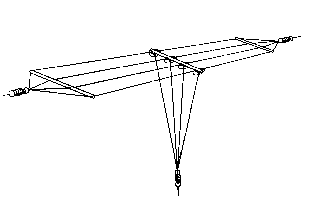
Friday evening's 630m crossband activity was 'interesting' in many respects. Propagation, which had been improving slowly, chose to follow Murphy's Law. The K-index, holding at a quiet '1', rose to level '3' by the time our event had concluded, as the geomagnetic activity ramped up. Additionally, lightning pocketed various areas of the continent, making listening noisy for many.
From here on Mayne Island (CN88iu), good two-way CW crossband contacts were made with the stations in the following order:
- N7IO (Seattle, Washington)
- VE7CA (North Vancouver, BC)
- KK7UV (Missoula, Montana)
- NW7E (Bend, Oregon)
- KU7Z (Ogden, Utah)
- VA5LF (Saskatoon, Sakatchewan)
- K7SF (Portland, Oregon)
- VE7BKX (North Vancouver, BC)
- K6TOP (Los Gatos, California)
- ABØCW (Westminster, Colorado)
- NO3M (Saegerton, Pennsylvania)
- KB5NJD (Duncanville, Texas)
- W7MTL (Independence, Oregon)
- KØSBV (Tucson, Arizona)
- WB6DCE (Seaside, California)
- KO6BB (Merced, California)
- K6CLS (Palo Alto, California)
- WY3B (Kaneohe, Hawaii)
- AA7U (La Grande, Oregon)
I was also more than excited to exchange signal reports with Pennsylvania and Texas. Considering conditions, this distance was far beyond my expectation but both of these stations have very efficient, dedicated 630m antenna systems.
John, VE7BDQ, worked the following stations on crossband:
- VE7CA (North Vancouver, BC)
- W7DRA (Seattle, Washington)
- N7IO (Seattle, Washington)
- NW7E (Bend, Oregon)
- KK7UV (Missoula, Montana)
- KU7Z (Ogden, Utah)
- VA7JWS (Delta, BC)
- VA5LF (Saskatoon, Sakatchewan)
- WB6W (Oysterville, Washington)
- K5HK (Reno, Nevada)
- KØSBV (Tucson, Arizona)
- WY3B (Kaneohe, Hawaii)
It was gratifying to see all of these fellows making the effort to listen for our signals or to attempt the QSO.
This exercise taught me a few things about our new band.
- It is not necessary to have huge antennas and acreage to make this band work. Good solid contacts can be easily made with small backyard antenna systems.
- With good systems on both ends, transcontinental QSO's can be made.
- There really should be more interest by Canadian amateurs in their newest band as so much work has been put into securing this portion of the spectrum as a ham band. It was very disappointing not to work any stations in VE6, VE4 or VE3 land.
- There is already much interest in this band by U.S. amateurs, many of them anxiously awaiting the day that they can also call it a ham band.
I would like very much to continue this type of crossband activity to try and generate more interest in our new band. I'm presently considering a weekly, one-night crossband operation, similar to Friday's event, perhaps running for one hour per week. The main difficulty will be in getting the word out to those that might wish to participate.
Steve McDonald, VE7SL, is a regular contributor to AmateurRadio.com and writes from British Columbia, Canada. Contact him at [email protected].
CQ WW SSB Contest last weekend – guess who forgot?
Darn it! Yet again I forgot this most excellent contest last weekend, although I would have been very restricted as we had our little grandchildren staying. They take priority. I must try next year. Last year I missed it as I was in Addenbrookes Hospital still very ill. The last time I caught it was 2012.
Although I do not much like contests, this one is always a good test and I often fill a few logbook pages with DX contacts. Exchanges are simple and quick. CQWW is usually a good way to increase the DXCC score. I always use real QRP power.
I dislike CW contests as they are too much like hard work. On SSB you can usually work stations, even with 2-5W QRP, especially later on when the big stations have already worked loads and are glad of extra points.

Roger Lapthorn, G3XBM, is a regular contributor to AmateurRadio.com and writes from Cambridge, England.
Arduino Frequency Display For Kenwood TS-520S HF Ham Radio PART 5
This is PART 5 of the project “Arduino Frequency Display For a Kenwood TS-520S HF Ham Radio”.
Steve Leander from www.kv6o.com picked up where I left off in part 4 and completed the project.
He designed a complete DG5 emulator Arduino shield starting from the prototype circuit and adding 5v power regulation and support of a LCD display. Steve completed the software and shared the BOM list, parts purchase links, circuit drawings and his code (here). Thank you Steve for finishing the DG5 emulator board and Arduino code!
Many thanks also to Larry from YouTube Channel “RadioHamGuy” for helping with testing.
Larry makes many great videos about ham and CB radios.
Links to all parts: (PART 1), (PART 2), (PART 3), (PART 4), (PART 5)
.
Photo Gallery
CLICK PHOTO for gallery view and click a SECOND time for hi-resolution image. Click thumbnails on lower right and lower left of gallery to navigate gallery photos.


Todd Harrison, KF7NBI, is a regular contributor to AmateurRadio.com and writes from Arizona, USA.
Xiegu X108 comparisons against other receivers
Playing around with the X108 I decided to make a few comparisons against a few of my other receivers.
In the comparisons I have used the following:
Yaesu Vertex VX1700 with no extra filters: http://youtu.be/bJ_VN7S1PHM
YouKits TJ5A 4 band 20 watt transceiver: http://youtu.be/AAdPPSfl6co
The TJ5A is about 200hz low from the listed W1AW/KP2 DxSummit frequency and that on the VX1700 and X108, but the TJ5A has very little to no background noise and AGC works well.
Antenna was same antenna for all comparisons a OCF Windom for 80-10 at 30′
Fred
VE3FAL


Fred Lesnick, VE3FAL, is a regular contributor to AmateurRadio.com and writes from Thunder Bay Ontario, Canada. Contact him at [email protected].
How had I missed this? The FT-8900 does AM on 28MHz!
How long have I had my FT-8900? Four, five years, maybe? Of course I knew it received AM on air band and have used it on there from time to time, but it never occurred to me that it would work on 29MHz.
This afternoon, I noticed a tweet from Richard GW1JFV saying that he’d worked K1GUP on 29MHz AM and went on to say that he used his FT8900. I happened to be in the shack at the time and had the instruction manual to hand.
Menu item #45 was quickly found AM on | off – which allowed me to toggle AM on to 29MHz.
I fired it up and it sounds ok. Not brilliant on the monitor receiver – perhaps a little harsh, but it’s AM nevertheless.
Another option for using AM on 29MHz. Thanks Richard!
Update: Oh dear – this turns out to be wrong! The 8900 is receive only on AM. After an interesting conversation with Chris G3VEH, I checked this. Although the 8900 transmits when AM is selected, if you listen, it’s actually FM. When Richard made his QSO, his QSO partner must have slope detected his FM!
Tim Kirby, G4VXE, is a regular contributor to AmateurRadio.com and writes from Oxfordshire, England. Contact him at [email protected].
How had I missed this? The FT-8900 does AM on 28MHz!
How long have I had my FT-8900? Four, five years, maybe? Of course I knew it received AM on air band and have used it on there from time to time, but it never occurred to me that it would work on 29MHz.
This afternoon, I noticed a tweet from Richard GW1JFV saying that he’d worked K1GUP on 29MHz AM and went on to say that he used his FT8900. I happened to be in the shack at the time and had the instruction manual to hand.
Menu item #45 was quickly found AM on | off – which allowed me to toggle AM on to 29MHz.
I fired it up and it sounds ok. Not brilliant on the monitor receiver – perhaps a little harsh, but it’s AM nevertheless.
Another option for using AM on 29MHz. Thanks Richard!
Tim Kirby, G4VXE, is a regular contributor to AmateurRadio.com and writes from Oxfordshire, England. Contact him at [email protected].
 Ham Radio Deluxe |
 W5SWL Electronics |
 Ham Radio Prep |
 KB3IFH QSL Cards  Hip Ham Shirts  HamRadioAuctions HamRadioAuctions Reliance Antennas Reliance Antennas Enigma Shop Enigma Shop |  morseDX  Ni4L Antennas  R&L Electronics R&L Electronics antennas.us antennas.us QRV QRV |
- Matt W1MST, Managing Editor
