 |
 Simple 10m DSB transmitter
 21 December 2014 | by
 From Steven, G7VFY comes news of a very simple 10m DSB transmitter from the blog of KA7OEI. This is an experimental very low power transmitter. It is unlikely to be of use in serious applications, but the range might surprise some. On 10m, the antenna is efficient and on a clear frequency it has the potential to get a long way. Over 1000km would not surprise me on a totally clear frequency. After all, 1mW (or so) is about 53 if a 100W signal was 59+12dB. On 10m such signals with 100W are very possible.
See http://ka7oei.blogspot.co.uk/2014/10/the-pointless-10-meter-dsb-qrp.html .

Roger Lapthorn, G3XBM, is a regular contributor to AmateurRadio.com and writes from Cambridge, England.
Large Loop On The Broadcast Band
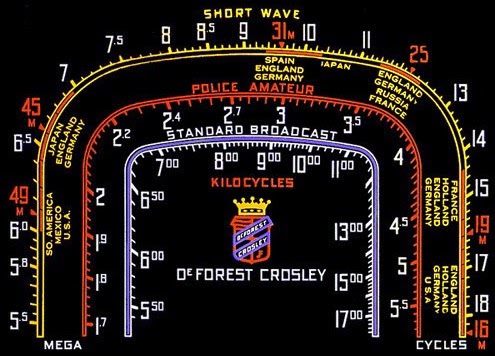
Those of you following my blog will know that I spent some time this fall designing and building a large rotatable loop for LF and MF (BCB) work. So far the loop has met my expectations and is working well. In spite of several strong storm blasts from the southeast (70-90km), the lightweight PVC frame has shown little desire to grab the wind and destroy itself. For anyone seeking a simple and inexpensive method of mounting a rotatable loop or Flag type of antenna, I believe this mounting system would be excellent.
 Over the past few weeks I have logged several new catches on the BCB with three of the highlights shown below. The two stations on 530KHz are both from Cuba...Radio Rebelde at 1Kw (Gauntanamo) and Radio Enciclopedia at 10Kw (Villa Maria). Note how the propagation this night almost puts the two signals, from opposite ends of the island, on a level playing field.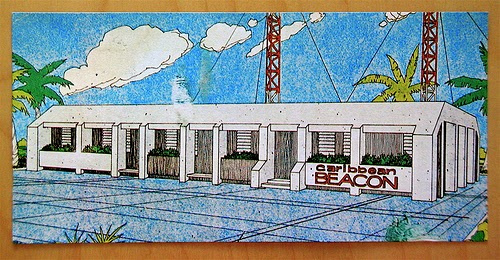
At the other end of the band, the Caribbean Beacon on 1610, from The Valley, Anguilla, has been making regular appearances with a strong signal as well.
A nice domestic catch was one-kilowatt CJEU, Radio Jeunesse in Gatineau, Quebec, operating on 1670KHz.
With the recent surge in solar flaring, the band has not been its normal December self over the past few nights...hopefully the sun will calm down and things can return to normal soon.
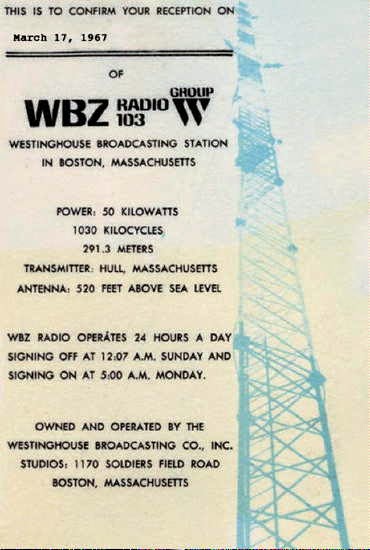
I vividly recall my excitement after catching WBZ-1030 in Boston, MA on my little 5 tube AC/DC radio and loose-coupled longwire. I had been hoping to catch an ID from them after listening for them for several Saturday nights! I even managed to get a QSL for my wall, similar to this one, shortly after the big event.
It's great getting back to my radio "roots" although DXing on the BCB has changed so much over the years, with fewer stations regularly identifying and no longer signing-off at midnight. Using the Perseus SDR has also made catching idents much easier, with the ability to record the entire band for hours at a time...or as long as one's hard-drive will allow.
Steve McDonald, VE7SL, is a regular contributor to AmateurRadio.com and writes from British Columbia, Canada. Contact him at [email protected].
Optical communications – over the horizon (NLOS)
The DX record for communications at optical frequencies is phenomenal these days. There is a growing interest in communications over non line of sight paths (NLOS) using cloud-bounce or clear air scattering. To my knowledge, in recent times experiments are (or are about to start) by F1AVY, VK4EBP , VE7SL and G3XBM (when fit again). I am sure there are others too. Weak signal modes certainly help. I used QRSS3 over an 8.5km NLOS path, but much further has been achieved.
See http://en.wikipedia.org/wiki/Non-line-of-sight_propagation.
Australian Optical DX https://groups.yahoo.com/neo/groups/Optical_DX/info
Nanowaves https://groups.yahoo.com/neo/groups/UKNanowaves/info
Roger Lapthorn, G3XBM, is a regular contributor to AmateurRadio.com and writes from Cambridge, England.
Simon’s Greyline
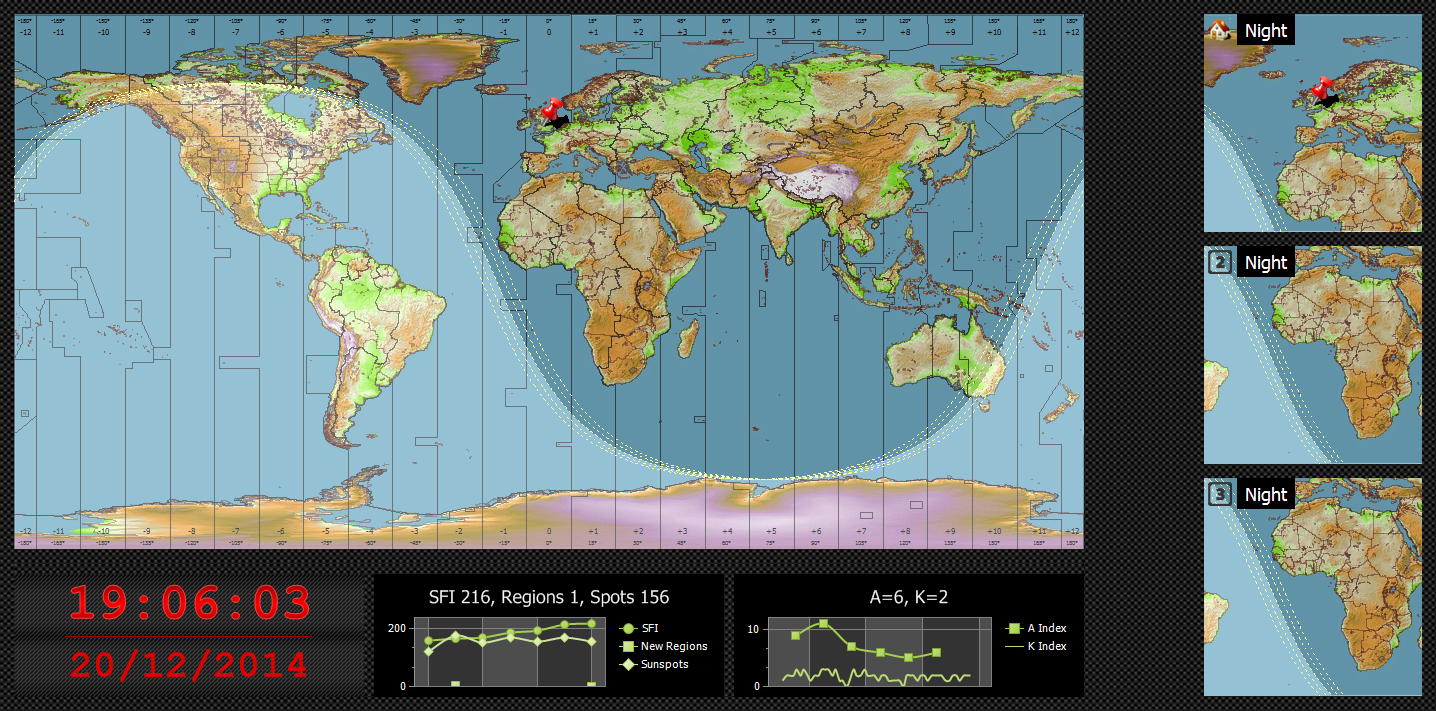
I wrote about this in early October http://g1kqh.blogspot.co.uk/2014/10/new-software.html
Since then the Great Circle map has been given a zoom option, and some minor bugs have been ironed out. I also notice there is now an interface for the Yaesu FT-3000 that has been added, not much reference to this at the moment, and as I do not own this radio I cannot test it out? However, I feel there are great things to come from this program, so it is well worth a download and keeping an eye on its website for future updates:
http://www.dit-dit-dit.com/Downloads.aspx
Steve, G1KQH, is a regular contributor to AmateurRadio.com and writes from England. Contact him at [email protected].
Not much time?
There are a few little electronic toys I am hoping for this year, as well as a book. All will be revealed very soon!
73 Steve
Steve, G1KQH, is a regular contributor to AmateurRadio.com and writes from England. Contact him at [email protected].
Radio Games (HamRadioNow.tv)
In HamRadioNow Episode 178 (Radio Games, embedded below), my partner Jeff AC4ZO and I banter about the concept of “rebranding” ham radio contests to make them more attractive to young people. My suggestion is to call them Radio Games, an allusion to Video Games, of course, which attract young people like crazy.
About this point in this article, I’d be disappointed if a few of you readers didn’t go nonlinear, considering this idea to be:
- fully baked, and
- the end of Amateur Radio as we know it
So if you actually watch the show, you realize that the idea isn’t even half-baked. It hasn’t even hit the oven. It’s fodder for a TV show conversation (makes a good radio show if you just want to listen to it) listen to it
And you’ll notice we wander around the point so much that you may think we’ll never actually make it. But we do. Then it’s off to other stuff. Some of you will like it, some of you will hate it, and that’s show biz.
But while the idea is far from mature, I’m serious about it in some fashion.
I think there’s little argument that we need to attract many more young people to ham radio, people in their teens, twenties and thirties. And I think what what attracted us old farts (I’m 65, and in a couple weeks I’ll hit my 50th year of hamming) isn’t attracting young people today. Not many, anyway. Something about ham radio has to change.
I don’t know what that is. Nobody knows for sure, or we’d be doing it (and once again leading us all to the End of Amateur Radio As We Know It). But for sure it’s not One Thing. It’ll be a lot of things, some little and some big.
One of those things might be figuring out how to make ham radio interesting to some of the people who love video games. They’re mostly young. Many have an interest in technology. And if we got just a small fraction of them, we’re still talking about thousands, maybe tens of thousands. Our contests are a starting point. Just changing the name to (or adding the name) Radio Games isn’t going to fool anyone. But it seems to me that integrating the elements of radio that we know – the vagaries of propagation, the competition for contacts, the reality of having to make something work with your own hardware and skill – to the aspects of video games that they know, might be an interesting mix.
For me, this is just fodder for my TV show and a column here on AmateurRadio.com. I’m sure not going to be the one doing it. I’m not a contester beyond making a few random contacts now and then, and I’m not a gamer. Which just may mean I don’t know what I’m talking about, and that wouldn’t be front page news, either.
But it is something to think about, maybe to talk about. First-class video games are multi-hundred-million dollar epics. The biggest probably involve more money than all of ham radio worldwide. They blow Hollywood out of the water. But a Ham Radio themed game doesn’t have to be the biggest and best. I guess I’d just hope that if someone develops one, it isn’t lame. But everybody’s a critic, and no matter how good it is, someone will call it lame. So I’m not going to worry about it.
Here’s the show. The most perceptive (or maybe just cynical) among you will recognize this column as just an excuse to get people to watch the show. You’d be right. And… sorry about the distorted audio. I did figure out what was happening.*
73, Gary KN4AQ
*What was happening to the audio? Google’s Chrome browser was grabbing the Windows Record Level setting and cranking it up so it could hear me say “OK Google” to initiate a voice search. That happened ever time I opened a tab with Google’s search page in it (and that’s where new tabs defaulted, so if it happened a lot). Later, I found a setting to turn “OK Google” off, but not one to tell Google to leave my audio alone, period. If I initiate a Google Hangout, Google grabs it again. Grrr.
Gary Pearce, KN4AQ, is the host of HamRadioNow.tv. If you enjoy this and other HamRadioNow programs, help keep them 'on the air' with a contribution. Contact him at [email protected].
Winner Announcement for our 2014 NooElec SDR Giveaway
First of all, thank you to the 1,450 people from all over the world who entered the giveaway. That’s a record number of entries for us!
Now for the moment you’ve been waiting for… the winners! OK, here they are:
 Three (3)
Complete NESDR XTR HF SDR packages including:
NESDR XTR SDR Set
(Brand new model, featuring the popular E4000 chip tuner)
Ham It Up upconverter
Upconverter Enclosure (silver)
Male MCX to male SMA pigtail (SDR cable)
Male SMA to female BNC adapter (antenna adapter)
Estimated $129.95 value
Luc ON7DQ
Tom KJ9P
Mika KF4IVM
Five (5)
Complete NESDR Mini 2 HF packages including:
NESDR Mini 2 SDR set
Ham It Up upconverter
NESDR Mini 2 enclosure (silver)
Upconverter enclosure (silver)
Male MCX to male SMA pigtail (SDR cable)
Male SMA to female BNC adapter (antenna adapter)
$111.95 value
Ed N2RWH
Claudio PU4BIT
Paul MM1BJZ
Joseph KK4PYN
John KC8JZO
Twelve (12)
NESDR Mini 2 SDR sets
$25.95 value
Rob KA2PBT
Delrey K4WJR
Mike KA7PLE
Marco DE8MSH
Dale WX8W
Suresh VU3JOG
Boban EA2DVR
Chris KD4OGD
Robert KB5SQG
Carl M0SER
Budd WB7FHC
Bob WB3DYE
If you won, you’ll be hearing from me very soon! If you weren’t one of the lucky winners, NooElec has sent us some coupon codes for those who would like to order on their website:
a special BIG thank you to NooElec!
Matt Thomas, W1MST, is the managing editor of AmateurRadio.com. Contact him at [email protected].
 Ham Radio Deluxe |
 W5SWL Electronics |
 Ham Radio Prep |
 KB3IFH QSL Cards  Hip Ham Shirts  HamRadioAuctions HamRadioAuctions Reliance Antennas Reliance Antennas Enigma Shop Enigma Shop |  morseDX  Ni4L Antennas  R&L Electronics R&L Electronics antennas.us antennas.us QRV QRV |
- Matt W1MST, Managing Editor
