 |
 Pile up rant
 27 February 2015 | by
 The 80 Meter Fox hunting ground takes place on spectrum real estate centering on the QRP Watering Hole of 3.560 MHz. The 80 Meter woods is 10 kHz on each side of that, from 3.550 MHz to 3.570 MHz. One Fox "hides" in the upper half and the other in the lower. You find the Fox calling "CQ FOX", send the required exchange back and forth, and you earn a pelt if successful.
Last night, the two Foxes, Earl N8SS and Dale WC7S decided to do something a bit different. Earl planted himself 1 kHz below 3.560 MHz, while Dale planted himself 1 kHz above the Watering Hole. Both worked split - Earl down and Dale up.
Sounds like good, clean fun, eh? In theory, yes - very good. In practice, good - but not very good. And the difficulty that ensued was not the fault of Earl or Dale. Once again, it was due to the Hounds (AKA, the pile up) not listening.
I caught Earl two minutes into the Hunt at 3.559 MHz. I heard him (key words) call "CQ FOX" and then "DN". That raised my eyebrows a bit, as I wasn't expecting that. But I quickly adjusted VFO B and nabbed him on my third call. At this point, all was peachy keen. Then, going up to the high end of the 80 Acre Woods, I heard Dale's pack of Hounds - not very far away at all. From the location of the Hounds and figuring on a "standard split" of 1 kHz, I figured out that Dale was probably sitting around 3.561 MHz. I tuned over there and indeed, there he was - very weak, around 119 ESP levels.
What made things even more difficult were the Hounds chasing Earl, who weren't listening and were trying to work him by calling "up". And they overwhelmed Dale's weak signal completely. And there lies my complaint. If you can't hear the Fox well enough to determine that he's calling "DN" then what are you doing, calling him at all?
Listen - don't make assumptions!
It got to the point where Dale must have realized something not good was going on, as he moved up a little bit farther. That was nice, but there were other problems to deal with, on that end. I had the KX3 in Dual Watch mode and finally had to turn it off, because some of the shenanigans going on there were pretty bad too. I heard one Hound who blindly sent his call - I kid you not - 10 times in a row without so much as taking a breath! 10 times - really ?!? I think that Dale was able to work two Hounds in the time it took this one guy to send his call that many times. Wow! And obviously, if you are sending your call that many times, then you are not listening - and that's the most important thing you can do in a pile up.
Paul WW2PT is one of the bloggers I list in my blogroll. He has a very good post that contains an interview with the K1N Team, post-Navassa. Go over there and read his post. What you read there will make your eyes wide as saucers. But because this is so important, I am going to take the opportunity re-post the K1N Team's assessment on why many in a pile up are not successful. I wish the Hounds in last night's hunt had read this. The main issues they saw were:
The best advice IS "listen, listen, listen and listen some more". Avoid the temptation to jump in blindly and work shot gun style. In the end, you will work more DX - and Foxes, if you listen. And, by becoming a better operator, you will not only be more successful, you will earn the admiration and esteem of your fellow operators. No one wants to earn the label of "LID".
- Not listening to the DX operator
- LISTEN to and LEARN the rate and rhythm of the operator
- LISTEN to WHERE the operator is listening and his PATTERN of moving his VFO, know where he will listen next!
- Learn to use your radio (split/simplex, etc)
- Do NOT jump to and call on the frequency of the last station worked. The DX station will NOT hear you because the din is total unintelligible chaos. Move UP or DOWN from that frequency, as we on our end were continuously tuning up or down after each Q, so if one jumps onto the last-worked frequency, we will not hear you, even if you were the only one there, as we have tuned off.
- TURN OFF ALL SPEECH PROCESSORS AND COMPRESSION! Do NOT overdrive ALC. There is a night and day difference in listening to NA/AS and EU pileups. The horrible distortion makes it impossible to copy many, if not most EU callsigns. There were MANY loud stations that we did not work, simply because we could NOT understand their terribly distorted callsign. Have you ever listened to yourself in a pileup? We gave many stations a “19” signal report. Very loud, but extremely unintelligible! You want to have INTELLIGIBILITY, not distortion!
- Give your callsign ONCE and ONLY ONCE! DO NOT KEEP CALLING! We would tune on by those who did not stop calling. We are looking for RATE and getting stations into the log. You should be, too!!!
- If the DX station comes back with your callsign, DO NOT REPEAT YOUR CALLSIGN, AS WE ALREADY KNOW IT or we would not have answered you. Many stations (in all modes) would repeat their callsign two, three and even four times! We only want to hear “5NN” or “59” from you. Anything else is a total waste of time and CHEATS others out of a chance to get into the log. Only repeat your callsign if it needs correction, and then let us know it is a correction. Anything else is cheating others out of a contact, as our propagation windows and time on the island are limited and we need to maximize the opportunity for everyone. SPEED.
- Take some time to listen to the next DXpedition working NA and listen to the rate and rhythm of the operator. It is fast, quick and efficient, and more people get into the log! Then listen to him work EU. The wise operator will catch on quickly to what it takes to get into the log!
- SPREAD OUT! Our highest rates (for any continent) were working the edges of the pileup where there was less QRM and weak stations were much easier to work than loud stations in the middle of the pileup. If we say, “Listening 200 – 210,” 70% of the pileup sits exactly on 200 in an unintelligible din, 25% of the pileup sits on 210 and is almost as bad. 5% of the pileup will be spread out somewhere between 201 and 209, making them very quickly put into the log. S P R E A D O U T ! ! ! !
- LOUD is NOT better! MORE AUDIO/COMPRESSION is NOT better! Finding the spot to be HEARD is the MOST important thing you can do to get into the log. My biggest thrill (and I’m sure on both ends) is finding the lone weak station and getting him into the log quickly.
- LISTEN to the DX operator INSTRUCTIONS! As we would constantly tune our VFO, if we find a clear spot, we would often say, “33” (meaning for YOU to transmit on 14033, 28433, etc) and a few would listen and get into the log very quickly. You cannot hear these hints if you keep calling calling calling calling……… Many times I would say, “listening 200-210” and after a while would say, “listening 240-250”. Often 30-45 minutes, even and HOUR later, I would find MANY still calling on the original “200-210”…..of course, they would never show up in our log, as I was not listening there. LISTEN LISTEN LISTEN and LISTEN SOME MORE. The less you transmit, the better chance you have of getting into the log.
- LISTEN
- If you don’t want to get into the DX log, just ignore the above suggestions.
End of rant.
72 de Larry W2LJ
QRP - When you care to send the very least!
Larry Makoski, W2LJ, is a regular contributor to AmateurRadio.com and writes from New Jersey, USA. Contact him at [email protected].
Chew the Rag a Little
We use the spotting networks to save time turning the dial looking for DX, or that needed whatever, we may be chasing. Even the rare times that we may call CQ, it's a quick report and on to the next one. Because of our rush to get through our days, we miss a lot of the hidden treasures available to us in Amateur Radio if just take the time.
I'm as guilty as the next guy of all of the above, that's why I can write about it so easily. However in the last few months I've been taking the time to have real chats or "ragchews" with my fellow amateurs. CW is my preferred mode, and so I have set aside 20 -30 minutes in an evening, rather than watch some TV show I will forget about in a weeks' time, to just sit down and have a chat. I've met some really cool people and had many very satisfying QSO's. I have re-sharpened my CW skills and met some new friends.
So, call CQ instead of watching the spots and see what you get. Talk about your rig, the weather, your paddle or bug and enjoy a relaxing time in your shack. You will feel refreshed to meet others who share this great hobby.
Mike Crownover, AD5A, is a regular contributor to AmateurRadio.com and writes from Texas, USA. Contact him at [email protected].
Haunted?
You know the story. The other night, I loaded the latest version of TQSL for LotW and requested a new call sign certificate from the ARRL. The certificate came, I tried loading it, it wasn't recognized. I tried re-booting the computer several times - nada. I uninstalled TQSL and re-downloaded it and re-installed it. Zilch.
I e-mailed the League and described my problem. They kindly sent me an eleven page .pdf file, describing what to do with troublesome call sign certificates. I was going to un-install TQSL again, delete my certificates and start from scratch. But then I got this nagging little feeling. Give it one more shot, a little voice said.
I successfully signed and uploaded my ADIF file to Newington, without so much as a hiccup, burp or hitch. I did NOTHING new, different or out of the ordinary. Tonight it worked like a charm, when the other night nothing worked. Then I took a look at the certificate properties. "Successfully loaded 2/23/2015" or words to that effect. What? But that's not possible! At least that's not what it was saying the other night! The other night, the certificate couldn't be found!

Excuse me while I run out for some Holy Water. Computers are dark magic and evil. Either that, or I have just crossed over into the Twilight Zone.
72 de Larry W2LJ
QRP - When you care to send the very least!
Larry Makoski, W2LJ, is a regular contributor to AmateurRadio.com and writes from New Jersey, USA. Contact him at [email protected].
Duemilanove
Yes, I did it again. Needed a 25 cent Molex connector and while browsing the electronics supply store I bumped into a rack with Arduino stuff. Maybe it was the Buddhist music playing in the background (the owner of the store is a devout Buddhist and only meditative music is played in the background), but I suddenly felt the urge to buy one. Now remember, I have a love-hate relationship with computers. I prefer having nothing to do with them, but since I cannot avoid them I just go with the flow. Apart from that, I never really got the coding bug.
 But for some reason the urge was too strong this time. And so I spent 15 bucks on a Arduino Duemilanove and 3 bucks on two add on boards: a 3 color LED and an analogue temperature sensor. Not much money to try it out and if I don’t like it then no big loss. Because of the name alone you should buy one, too. Can you name me an electronics product with a sexier name than Duemilanove??? And it just means 2009!!! Sometimes I wish I married an Italian girl, then I would be living in Italy now and be immersed in that wonderful language every day.
Back home I found out that installing the IDE was a simple “sudo apt-get install arduino” and I was connected. It took me all of 15 minutes to get the 3 color LED blinking and I was hooked. This is not difficult at all and a lot of FUN! Now it’s not that I have all the time in the world to start learning to write sketches now. Far from it, I’m as busy as ever. But after introducing the Arduino to my 11 year old son he started playing with it and it took him an hour to make the LEDs blink his name in Morse code (because that’s the only Morse code he knows). This might turn into a nice father-son play-thing and who knows, maybe I finally start to get the coding bug.
Hans "Fong" van den Boogert, BX2ABT, is a regular contributor to AmateurRadio.com and writes from Taiwan. Contact him at [email protected].
Amateur Radio Newsline Report 1954 February 27 2015
- Ham radio responds as a pair of tropical cyclones hit Australia
- The FCC and the FDA look the future of medical remote electronics
- Printed FCC issued ham licenses come to an end
- Stunning images received from the latest ISS slow-scan television experiment
- And the nominating period opens for the 2015 Amateur Radio Newsline Young Ham of the Year Award
THIS WEEK'S NEWSCAST
10m SSB with the Lincoln Mk2
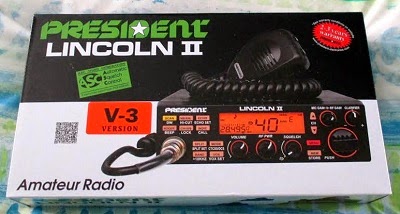
This afternoon, I have been trying out the President Lincoln Mk2 (V3) which arrived early today. I have only tried on SSB but it seems to work, with the first SSB QSO being with N8II in West Virginia at about 1430z. He was using 800W and a 5 element beam! It was hearing plenty from Asia, Europe and North/South America. Maximum claimed power from the Lincoln, controlled by a rotary control on the front panel, is 31W PEP on SSB.
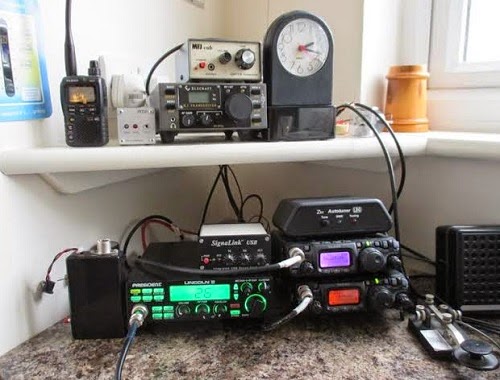 |
| Lincoln Mk2 with the other rigs |
I have still to fully get to grips with the menu but it seems pretty intuitive. There is a choice of display backlight colours, but I find green easiest on the eyes. The other choices are blue and orange. You can alter display brightness and lots of other features – I shall have plenty of time to play. Blue is not good for my eyes on either the Lincoln Mk2 or the FT817. To my eyes, blue is hard to see, whereas the green is very clear.
My biggest issue was getting the power leads attached to the PSU. Before my stroke this would have been trivial. Now it tires me out! I wanted several rigs attached to the PSU at the same time so soldering the plugs on was non-trivial. As you know, speaking too long exhausts me,so I am taking a break.
I am waiting for my 12V battery to charge to test the 40m Pixie. Visually the Pixie build looks fine.
At the moment I am not on WSPR on any band.

Roger Lapthorn, G3XBM, is a regular contributor to AmateurRadio.com and writes from Cambridge, England.
Invisible disabilities
I have come to the conclusion that it is better to be disabled in a visible way than have a disability that cannot be seen easily. On a walk this afternoon at Anglesey Abbey there were quite a few people who were clearly disabled.
My wife says when I walk you cannot tell I have a disability. Inside, I still feel like I am drunk, I tire easily and I still feel wobbly when walking. My voice is still poor and swallow of thin liquids is poor.
Most people think I am fine now. I am still a long way from that although I still feel I am making slow improvements. My current disability is invisible to many.
The ongoing after-effects of my cerebellum brain bleed are the reason I try to avoid too much speaking on the air. WSPR is my favourite mode as no talking is needed. JT65 and JT9-1 are my favourite 2-way digital modes. Although I have used PSK31 I don’t much like it as too many use macros.

Roger Lapthorn, G3XBM, is a regular contributor to AmateurRadio.com and writes from Cambridge, England.
 Ham Radio Deluxe |
 W5SWL Electronics |
 Ham Radio Prep |
 KB3IFH QSL Cards  Hip Ham Shirts  HamRadioAuctions HamRadioAuctions Reliance Antennas Reliance Antennas Enigma Shop Enigma Shop |  morseDX  Ni4L Antennas  R&L Electronics R&L Electronics antennas.us antennas.us QRV QRV |
- Matt W1MST, Managing Editor
