 |
 Review Baofeng FF-12P (UV-5X)
 17 March 2015 | by
 Probably because Baofeng is running out of letters (although I didn’t see the Baofeng UV-5Y or Z yet), there’s a new numbers game in order. The FF-12P is essentially a UV-5X and my sample came in…. silver.
 The radio houses the latest chip set and firmware. Pressing various keys confirm this: pressing ‘0’ for a bit more than a second shows the battery voltage, pressing PTT + Band generates 2100 Hz, PTT + A/B generates 1750 Hz, and PTT + VFO/MR generates 1450 Hz.
The display is of the inverse type, the antenna the short one we all learned to hate, “FF-12P” is printed on both the left and right side of the radio. Batteries / accessories aren’t compatible with the standard UV-5R. While I could find enough suppliers of the FF-12P and UV-5X, not a single one appears to sell spare batteries or any other accessory.
Charger / battery combination
I wasn’t able to charge the battery at first, because the battery and charger don’t match: the two indentations of the battery prevented it from being inserted in the charger. After scraping away enough plastic in the charger I got it to fit.
CHIRP
CHIRP recognized the radio as being a UV-5R and squelch thresholds could be modified without a problem.
Scanning
A clip on YouTube suggested that the UV-5X / FF12P scans faster. This proves to be true: the FF-12P outperforms all other Baofeng radios I own, including the GT-3 Mark II. Scan speed is about 5-6 channels/sec.
Transmitter
Frequency accuracy of the sample: +2 Hz on VHF, -11 Hz on UHF.
Power output VHF: (@ 15 MHz): 4.1 Watts (high), 1.7 Watts (low)
Power output UHF: (@ 435 MHz): 3.6 Watts (high), 1.8 Watts (low)
TX Audio: Bright and loud. Very nice.
Harmonics: the usual peaks on VHF and UHF. Still not very impressive.


Receiver
RX Audio: good.
Front-end: surprisingly good, just like the GT-3 Mark II. Nice.
Sensitivity: -127 dBm (VHF), -125 dBm (UHF). These are good numbers.
Conclusion
The FF-12P aka UV-5X is the typical Baofeng: value for money, but not without its flaws. Harmonic suppression is a mixed bag and the lack of accessories is a potential problem.
The fact that I had to modify the charger to make the battery fit is a dumb factory mistake. The short stock antenna just doesn’t want to die — put a few bucks aside to buy a better one.
The positive side of the radio is the good receiver, good TX audio and faster scan speed. And, if you care about such things, it comes in shiny SILVER!


Hans, PD0AC, is a regular contributor to AmateurRadio.com and writes from Almere, The Netherlands. Contact him at [email protected].
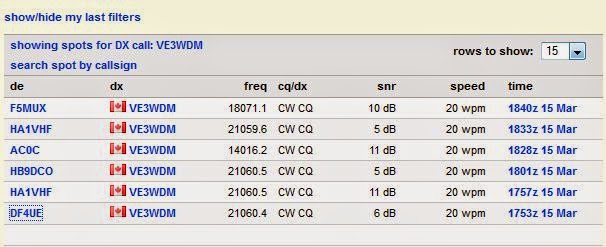
My QRP signal is spotted in Europe!
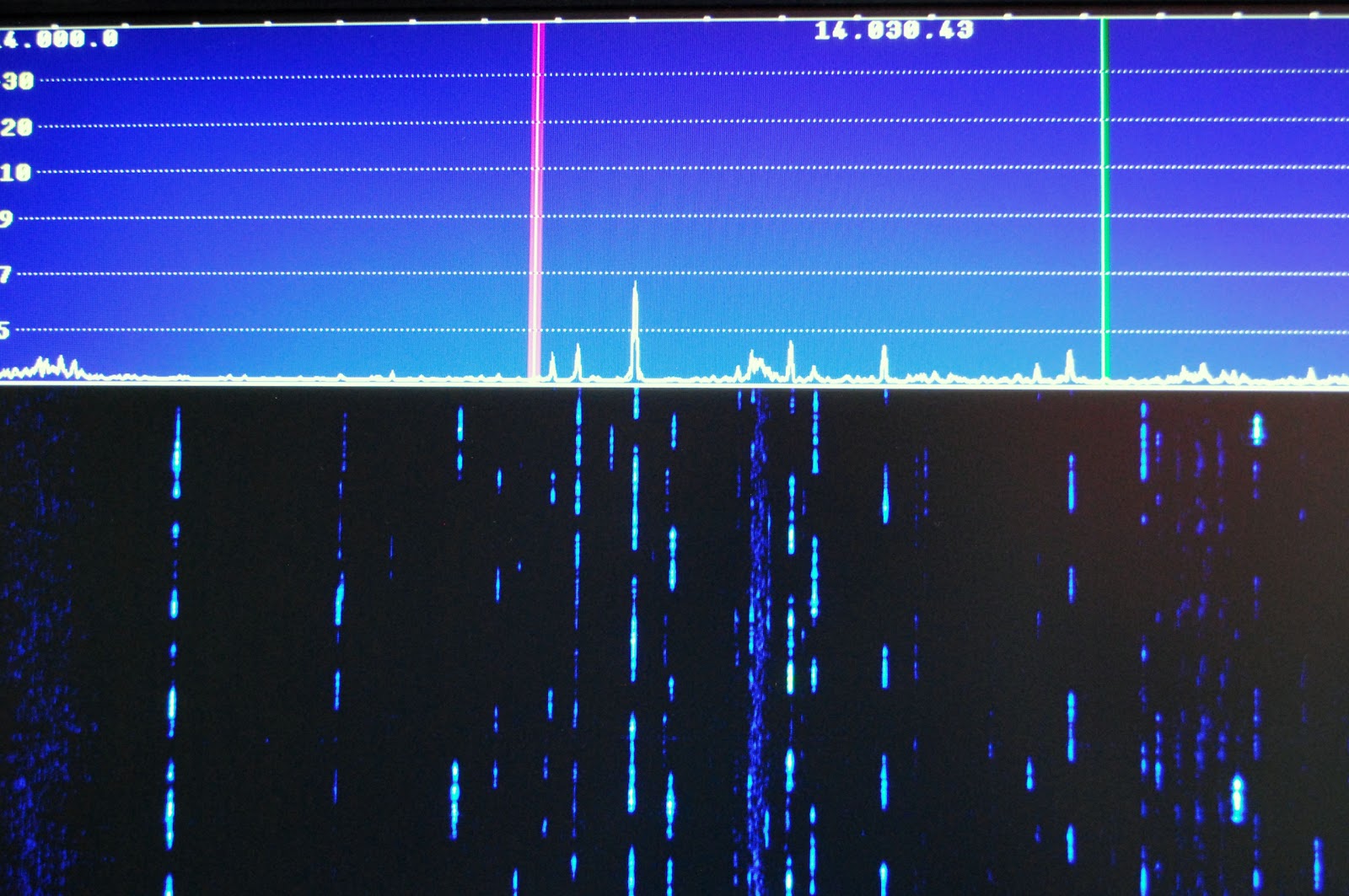 |
| P3 on 20m showing some signals |
Mike Weir, VE9KK, is a regular contributor to AmateurRadio.com and writes from New Brunswick, Canada. Contact him at [email protected].
Rockmite
As I’m moving towards CW as an operating mode I took the plunge and bought a Rockmite kit from Kanga. Lets just say its not working quite as I had anticipated. This time I was very careful to look at the various instructions. Lid everything out and then checked every component as I assembled it.
 Next time I’ll throw these things together in the usual manner. I might have a bit more success. Power on and I get little in the way of audio, a gentle hiss but not much else. So troubleshooting has to begin. Fortunately there is quite a bit of help for this but to be honest I’m not holding out much hope as I did such a thorough job of checking the first time round. Must be a faulty (insert component here)
All good fun and not as if the world will end if I have to spend some time on it.
Alex Hill, G7KSE, is a regular contributor to AmateurRadio.com and writes from Cumbria, UK. Contact him at [email protected].
Spurious Emissions

Anthony, K3NG, is a regular contributor to AmateurRadio.com.
Changing propagation
If proof were needed that we are now on the way down to the next minimum then take a look at the sunspot number graphs at http://www.solen.info/solar/ .
Although conditions are sliding, do not abandon the higher HF bands like 10m. There is (usually) quite a lot of good DX around still. In the last solar minimum I was still able to work well into southern South America on 10m with QRP SSB. WSPR should be even more reliable when conditions are edgy.
I really do hope a strong core of WSPR operators stick with 10m as, in many ways, in the poorer times are when WSPR will be most valuable as a tool. I am hoping that when not on traditional modes like SSB or CW people will still WSPR so we can catch fleeting openings, which are probably far more common than people expect on 10m. Remember, the F2 or transequatorial propagation has only to go above 28.126MHz for 120 seconds and someone on WSPR may spot it!

Roger Lapthorn, G3XBM, is a regular contributor to AmateurRadio.com and writes from Cambridge, England.
Alaskan Morning On The BCB
I have previously only logged one station from Alaska on the medium wave band but then again, I don't often look for them.
I was surprised to hear the normal KBOI (Boise) powerhouse on 670KHz replaced by another strong signal ... KDLG in Dillingham. It can still be heard weakly under KDLG's strong signal. Listen as they go from a piano interlude to the ID. I just can't make out the short part before the identification when the announcer says, "this is your ?? radio station ...". It sounds like 'Monday" but this was on Saturday morning.
Next heard was KICY, in Nome, all in the clear on 850KHz with a good identification.
KICY was followed by KAGV in Big Lake, near Anchorage, on 1110KHz. This was a lucky catch as KBND in Bend, Oregon had a huge signal at the time but went open mike just long enough for KAGV to be clearly heard. Listen as the strong KBND signal goes quiet only to start up again at the end of the Alaskan's identification ... perfect timing!
A fourth Alaskan, KVNT in Eagle River, was also logged on 1020KHz... not with an ident but with talk of "Eagle River".
All-in-all, a good morning to the north. As the solar cycle draws lower and lower, this type of reception will only get better over the next few years ... something to look forward to for BCB DXers.
 |
| courtesy: https://www.google.ca/maps |
Steve McDonald, VE7SL, is a regular contributor to AmateurRadio.com and writes from British Columbia, Canada. Contact him at [email protected].
Anytone Tech models, additional notes
Overall, reviewing these Anytones was a pleasant experience. After the reviews I looked into a few other things.
- The batteries of the ANILE-8R (1300 mAh) and the NSTIG-8R (1800 mAh) are exchangeable.
- The belt clips used on the ANILE-8R and NSTIG-8R are never a perfect fit. With the 1300 mAh battery there’s a gap (easy to lose a radio that way), with the 1800 mAh battery it’s too tight.
- The antenna on the NSTIG-8R heats up fast at maximum RF output; the behavior resembles that of a Baofeng UV-5R stock antenna. The antenna appears to be reasonably efficient though. More tests are in order.
- No such problems with the antennas of the ANILE-8R, the TERMN-8R or OBLTR-8R.
- The NSTIG-8R, TERMN-8R and OBLTR-8R can display the remaining battery voltage. Measurements show that the radios are surprisingly accurate. If the radios say “8.1 Volts”, it really is 8.1 Volts. The ANILE-8R will round it down/up to the closest integer.
- The TERMN-8R is difficult to use on SW because it defaults to 10 KHz steps. SW stations are 5 KHz apart, not 10 KHz. You can use the keypad to enter the correct frequency though. I had the bug confirmed by John; it’s now on the ‘to do’ list and will be fixed.
- The more I had the TX audio compared by other hams, the more impressed I (and they) became.
- There’s an odd problem concerning spectral purity with all x-band capable hand helds I reviewed. It only occurs when both VFOs are active; we (me and a few more knowledgeable RF lab gurus) are looking into that right now.


Hans, PD0AC, is a regular contributor to AmateurRadio.com and writes from Almere, The Netherlands. Contact him at [email protected].
 Ham Radio Deluxe |
 W5SWL Electronics |
 Ham Radio Prep |
 KB3IFH QSL Cards  Hip Ham Shirts  HamRadioAuctions HamRadioAuctions Reliance Antennas Reliance Antennas Enigma Shop Enigma Shop |  morseDX  Ni4L Antennas  R&L Electronics R&L Electronics antennas.us antennas.us QRV QRV |
- Matt W1MST, Managing Editor
