 |
 Amateur Radio Newsline Report 1955 March 6 2015
 7 March 2015 | by
 - Ham radio comes to the aid of a crash victim of an Arkansas auto accident
- IARU Region 1 VHF newsletter charts the future of those very high bands
- ARRL asks members to comment on it's HF band planning proposal
- Get ready for next summers International Lighthouse & Lightship weekend
- Planning continues for the VK0EK Heard Island DXpeedition
THIS WEEK'S NEWSCAST
What happens when the lights go out……not much.
 |
| Candle light |
Mike Weir, VE9KK, is a regular contributor to AmateurRadio.com and writes from New Brunswick, Canada. Contact him at [email protected].
FLDIGI ported over to Android
Download the APK file, manual, and other details from here.
The software seems to cover many of the same functions, and modes, as its big brother Windows version.
I have only had a short time to play around with this tonight, but soon after I downloaded the APK on to my phone, a quick easy configure it was up and running within 5 minutes.
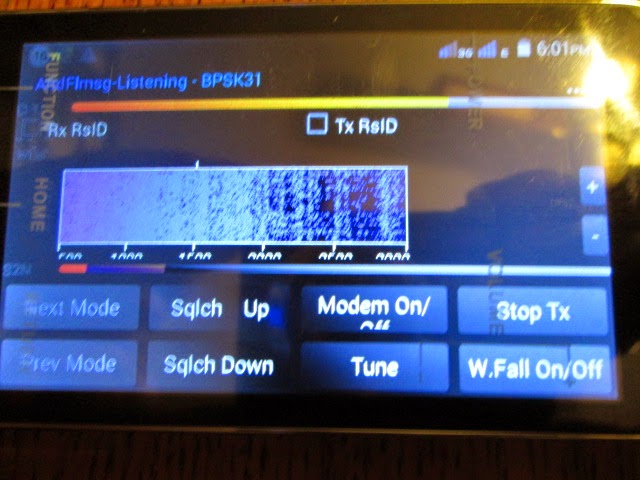
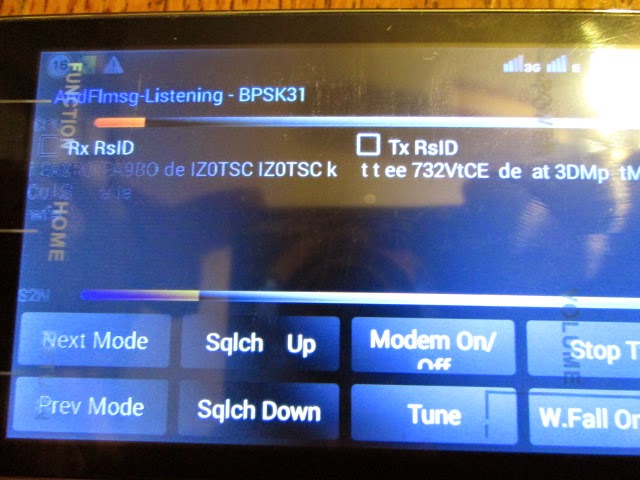
This now opens the door to cheap home and portable operation, using FLDIGI's modes likes PSK31 etc. Using simple Android tablets and Android PCs available from the likes of ebay for less than £50!
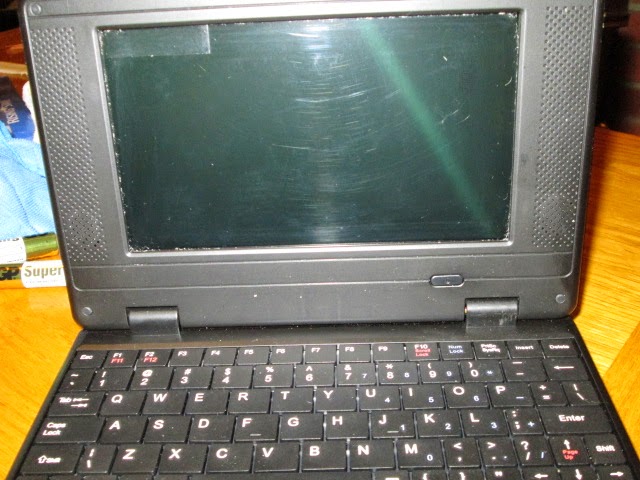
My 7" Android PC below, which should be suitable for use with FLDIGI.
Steve, G1KQH, is a regular contributor to AmateurRadio.com and writes from England. Contact him at [email protected].
Phasers On Medium Wave

A recent posting on the Yahoo ndblist Group page, by veteran LF/MW DXer and front-end guru, Steve Ratzlaff (AA7U) in Oregon, described his thoughts on LF/MW antennas and his experience with phasers:
Some years back at the other place, I experimented with phasers, trying
all the various ones I could find or build. I had a long term loan of
the DXE NCC phaser as well. I compared them mostly at MW where a phaser is generally most useful; but also at LF and HF. In all cases and all
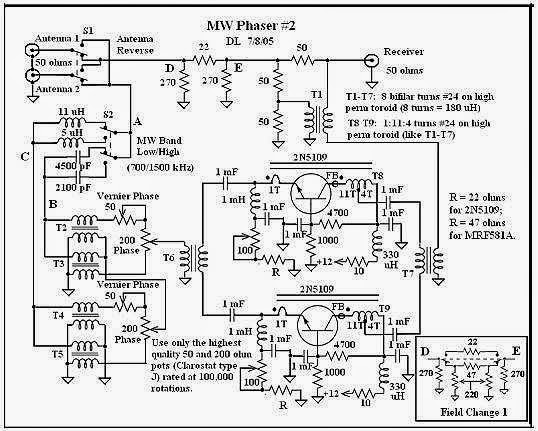
frequencies, without exception, the Dallas Lankford "MW Phaser #2" was
significantly better. I have placed that article in the ndblist Files,
under "Aerials and Technical Files" section should you have an interest
in looking at that article.
For LF use I never found any reason to use a phaser for trying to
optimize the level of a signal. Usually LF signals are short-lived and
often you only have a short time to catch an ident before it fades away.
You can easily waste 30 seconds or more just trying to optimize the
phaser; by that time the signal is usually gone. For those with a local
noise problem from a single general direction a phaser could be useful
in nulling out that noise, though of course you would lose the signals
from that direction too.
I also had room for antenna experiments, being able to compare them with
my longwire antennas. For those with the room, I believe it's hard to
beat an elevated longwire of approx. 400 feet or longer. I was very
fortunate to be able to string two E/W 1600 foot longwires, on either
side of the property about 400 feet apart and roughly parallel; and a
much shorter 400 foot N/S longwire. But even the N/S short one enabled
me to log a number of Greenland beacons (of course this was back when LF
conditions were still excellent, not like now).
Some folks have good results with the K9AY type antenna--Doug in TX has
good results using that antenna. But it's a ground-dependent antenna and
many areas don't have ground characteristics that support such antennas.
My area was one of those--the K9AY never worked very well for me. But an
elevated vertical loop worked very well, using the Wellbrook ALA100
preamp.
I had several rectangular loops up at one time, 120-150 foot
circumference using the ALA100, about 10 vertical feet distance between
the top and bottom wires to give a good capture area. These were very
sensitive at LF and a couple of times I was able to (barely) hear
distant South Pacific beacons that I was also hearing on the 1600 E/W
longwire. And of course the loop antenna is ground-independent so can be
used anywhere. It's bidirectional so can help in nulling noise too. And
such a loop doesn't take up much room as long as you can get it away
from local AC noise (which is true for all LF antennas, especially for
active whips).
Mark Connelly is a prominent east coast MW DXer and has a lot of info on
antennas and phasing on his webpage here. All his applications are primarily for MW DXing but the principles apply equally
well to LF.
The Dallas Lankford phaser article described by Steve, can also be downloaded from here.
LNV phaser, John Bellini in Colorado, also chimed-in with some additional thoughts based upon his own experience:
A very informative discussion of backyard antennas (and phasers) suitable for LW/MWwork is described by Graham Maynard in this Medium Wave Circle article. In the author's own description:
Well, once again I say "That's it". This time my mind churning effort has been to understand and develop the results possible with simple, small back-garden, mixed loop-vertical antenna systems. It really is not as complicated as might first appear, and those willing to try could enjoy as I do, listening to other people's locals ··· Ontario ·· New York ···
These pages have been long in writing - they summarise many years of enquiring study and thoughtful co-ordination with determined and diligent empiric effort...
There's enough good bedtime reading for an evening or two here!
Steve McDonald, VE7SL, is a regular contributor to AmateurRadio.com and writes from British Columbia, Canada. Contact him at [email protected].
More power for the shack.
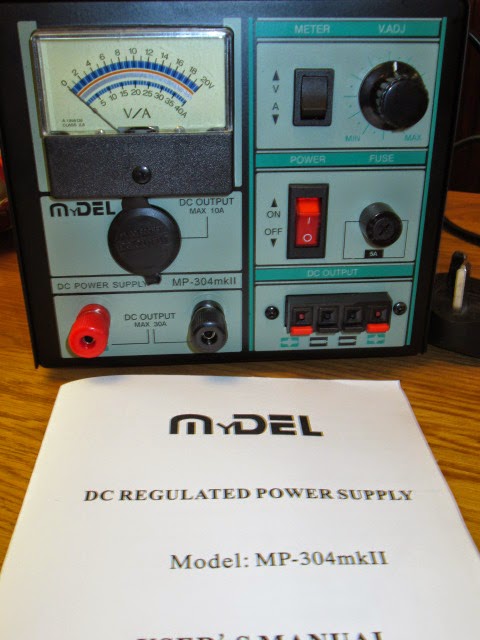
Ordering was quick which I did over over the phone, as normal with Martin Lynch & Sons, the faultless delivery was on time! Infact so quick! I had forgotten to tell the XYL, so she was surprised by the delivery.
The MP304 is sold as a 30A supply, that does 15A continuous, and 20A for 15minutes @13.8V. Supplied with a mains voltage of 230V 50Hz.
There are various output connections on the front, including a handy Cigar lighter socket that can supply 10A.
The supply is variable by an adjustable pot on the front panel, which is biased in the middle of its range to set the supply at the nominal 13.8V. The output is adjustable between 1.5V & 15V DC. With a sliding scale of V/I) (Don't expect 15A Max at 5V as this works out at about 7A)
The large easy to read analogue Meter is switchable either to Volts or Amps.
Supply regulation is better than 1% and a noise figure <10mV is quoted.
We will see how this performs when I will load it up and do a few measurements in the next day or so.
A short form manual is supplied, a circuit diagram would of been useful for servicing in the future. (I have not seen one on the web?)
First looks are good, and not bad for the money of £99!
Steve, G1KQH, is a regular contributor to AmateurRadio.com and writes from England. Contact him at [email protected].
RSGB Wortley-Talbot Trophy
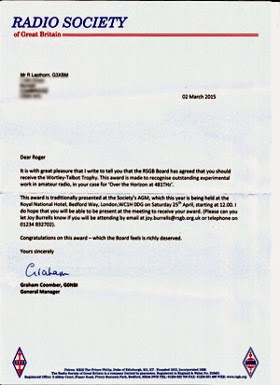
Well, I was delighted, honoured and surprised, to get a nice letter from the RSGB today. In it, it said I’d been awarded the Wortley-Talbot trophy for my experimental work on over the horizon work at 481THz and the article on this published in RadCom last year.
Sadly my continued ill health means I’ll be unable to pick up the award at the RSGB’s AGM in London in April. I just wish my health was better so I could do some field work again soon! Both VLF and optical field work are on hold until I feel better. This year I really really hope I’ll manage it.
To be honest this award came as a complete surprise, but I’d happily trade these lovely awards to be back to my old healthy self.

Roger Lapthorn, G3XBM, is a regular contributor to AmateurRadio.com and writes from Cambridge, England.
Nice.
 Without much (if any) advertising the Google+ ‘Chinese Ham Radio Equipment‘ community reached a 1000 members today. I intentionally made the community public, so there’s no need for a Google account in order to read there.
The downside of a community becoming larger is spam. Some of it is captured by Google itself and kept in a moderation queue, but some of it slips through and has to be deleted by the moderators. Because the moderators live in different time zones, spam never lives long.
What I still miss a bit there is the interactive part. If the community would be just another URL with the same content, it’s basically pointless. Questions about Chinese ham radio? Ask there, there’s a lot of knowledge and experience there.
Also nice: a carton box.
The carton box didn’t waste much time to cover the distance between the USA and Europe, but took almost the same amount of time to travel from Amsterdam Schiphol airport to my QTH — a one hour drive under the most challenging traffic conditions. Customs took their time…


Hans, PD0AC, is a regular contributor to AmateurRadio.com and writes from Almere, The Netherlands. Contact him at [email protected].
 Ham Radio Deluxe |
 W5SWL Electronics |
 Ham Radio Prep |
 KB3IFH QSL Cards  Hip Ham Shirts  HamRadioAuctions HamRadioAuctions Reliance Antennas Reliance Antennas Enigma Shop Enigma Shop |  morseDX  Ni4L Antennas  R&L Electronics R&L Electronics antennas.us antennas.us QRV QRV |
- Matt W1MST, Managing Editor
