 |
 Anytone Tech models, additional notes
 16 March 2015 | by
 Overall, reviewing these Anytones was a pleasant experience. After the reviews I looked into a few other things.
- The batteries of the ANILE-8R (1300 mAh) and the NSTIG-8R (1800 mAh) are exchangeable.
- The belt clips used on the ANILE-8R and NSTIG-8R are never a perfect fit. With the 1300 mAh battery there’s a gap (easy to lose a radio that way), with the 1800 mAh battery it’s too tight.
- The antenna on the NSTIG-8R heats up fast at maximum RF output; the behavior resembles that of a Baofeng UV-5R stock antenna. The antenna appears to be reasonably efficient though. More tests are in order.
- No such problems with the antennas of the ANILE-8R, the TERMN-8R or OBLTR-8R.
- The NSTIG-8R, TERMN-8R and OBLTR-8R can display the remaining battery voltage. Measurements show that the radios are surprisingly accurate. If the radios say “8.1 Volts”, it really is 8.1 Volts. The ANILE-8R will round it down/up to the closest integer.
- The TERMN-8R is difficult to use on SW because it defaults to 10 KHz steps. SW stations are 5 KHz apart, not 10 KHz. You can use the keypad to enter the correct frequency though. I had the bug confirmed by John; it’s now on the ‘to do’ list and will be fixed.
- The more I had the TX audio compared by other hams, the more impressed I (and they) became.
- There’s an odd problem concerning spectral purity with all x-band capable hand helds I reviewed. It only occurs when both VFOs are active; we (me and a few more knowledgeable RF lab gurus) are looking into that right now.


Hans, PD0AC, is a regular contributor to AmateurRadio.com and writes from Almere, The Netherlands. Contact him at [email protected].
Anytone Tech models, additional notes
Overall, reviewing these Anytones was a pleasant experience. After the reviews I looked into a few other things.
- The batteries of the ANILE-8R (1300 mAh) and the NSTIG-8R (1800 mAh) are exchangeable.
- The belt clips used on the ANILE-8R and NSTIG-8R are never a perfect fit. With the 1300 mAh battery there’s a gap (easy to lose a radio that way), with the 1800 mAh battery it’s too tight.
- The antenna on the NSTIG-8R heats up fast at maximum RF output; the behavior resembles that of a Baofeng UV-5R stock antenna. The antenna appears to be reasonably efficient though. More tests are in order.
- No such problems with the antennas of the ANILE-8R, the TERMN-8R or OBLTR-8R.
- The NSTIG-8R, TERMN-8R and OBLTR-8R can display the remaining battery voltage. Measurements show that the radios are surprisingly accurate. If the radios say “8.1 Volts”, it really is 8.1 Volts. The ANILE-8R will round it down/up to the closest integer.
- The OBLTR-8R is difficult to use on SW because it defaults to 10 KHz steps. SW stations are 5 KHz apart, not 10 KHz. You can use the keypad to enter the correct frequency though. I had the bug confirmed by John; it’s now on the ‘to do’ list and will be fixed.
- The more I had the TX audio compared by other hams, the more impressed I (and they) became.
- There’s an odd problem concerning spectral purity with all x-band capable hand helds I reviewed. It only occurs when both VFOs are active; we (me and a few more knowledgeable RF lab gurus) are looking into that right now.
Hans, PD0AC, is a regular contributor to AmateurRadio.com and writes from Almere, The Netherlands. Contact him at [email protected].
SFE S850UV-2 – VHF/UHF/1.25 Meters
This radio isn’t anywhere to be found except on Alibaba.com, which basically means that it isn’t available yet. The specs look familiar, except that that it also covers 200-260 MHz. American hams might want to keep an eye on this one.


Hans, PD0AC, is a regular contributor to AmateurRadio.com and writes from Almere, The Netherlands. Contact him at [email protected].
SFE S850UV-2 – VHF/UHF/1.25 Meters
This radio isn’t anywhere to be found except on Alibaba.com, which basically means that it isn’t available yet. The specs look familiar, except that that it also covers 200-260 MHz. American hams might want to keep an eye on this one.
Hans, PD0AC, is a regular contributor to AmateurRadio.com and writes from Almere, The Netherlands. Contact him at [email protected].
Wireless Mobile Radio Microphone
If it weren’t so expensive ($120 without the microphones) I might have picked one up.
It would only have left me with the problem of the frequencies these microphones use: 221 – 259 MHz. Not allowed here in NL.


- Freely move, easy communication
- Compatible with different brands mobile radio, like Icom, Yaesu, Motorola, Kenwood and so on
- Walkie talkie between hand-microphones
- 500 meters communication range between mobile radio and hand-microphone, between hand-microphones
- Torch light function
- Identification function
| ||||||||||||||||||||||||||||||||||


Hans, PD0AC, is a regular contributor to AmateurRadio.com and writes from Almere, The Netherlands. Contact him at [email protected].
Wireless Mobile Radio Microphone
If it weren’t so expensive ($120 without the microphones) I might have picked one up.
It would only have left me with the problem of the frequencies these microphones use: 221 – 259 MHz. Not allowed here in NL.
- Freely move, easy communication
- Compatible with different brands mobile radio, like Icom, Yaesu, Motorola, Kenwood and so on
- Walkie talkie between hand-microphones
- 500 meters communication range between mobile radio and hand-microphone, between hand-microphones
- Torch light function
- Identification function
| ||||||||||||||||||||||||||||||||||
Hans, PD0AC, is a regular contributor to AmateurRadio.com and writes from Almere, The Netherlands. Contact him at [email protected].
ET Call Home

Late last week I received an interesting e-mail from Thomas Pell in Winter Haven, Florida.
It seems that Tom has been doing some building after reading my series of blogs about my lightwave adventures and has started his own adventure. As he told me initially:
"... I'm retired with too much time on my hands, and I'm tired of the big gritty hobby projects ... after reading about Harvard U's optical SETI project, which looks for extraterrestrial laser signals with a 48 inch, then 72 inch mirror. I thought it would be fun to build a setup like theirs, but at audio frequencies instead of the RF laser signals ... my purpose was to get light signals from other amateur laser dx experimenters or even ET ... better than watching my wife's TV shows. Also a giant telescope that costs almost nothing is fun too."
Tom built up the PIN diode detector shown in my notes, which was a slight variation of the one developed by Roger, G3XBM (see his great lightwave notes here) and based on an earlier plan by K3PGP.
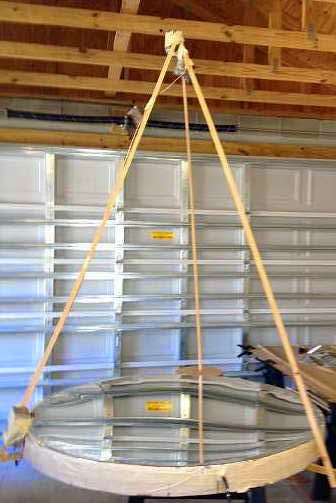
Along with the receiver, Tom built a substantial optical antenna ... a 48" Mylar-based parabolic mirror!
"... it is a wood structure ... round piece of 1/2 inch plywood, 48" in diameter ... around the perimeter a 4" wide strip of 1/8" plywood is wrapped and glued with epoxy putty. On the upper end of 1/8 ply is another circular plywood flange inside. This flange is to glue mylar sheet. The mylar is then tensioned with tape on the side. It is something like a round guitar in appearance... a box ... you suck the air out ... I use a shop vacuum with 1/4 in rubber tube taped to vacuum hose ... hose barb epoxied to hole inside of mirror ... not ideal but if you seal it up well with epoxy, it works..."
 |
| courtesy: Thomas Pell |
It seems that there is now an active movement amongst some SETI enthusiasts to search for optical beacons rather than radio beacons. When you think about it, it would seem to make just as much sense, if not more, to beacon with a modulated optical signal than with a radio signal ... and the optical signal might be far easier to detect. Some of the papers suggest that an optimum frequency would be in the near IR or deep red part of the spectrum, right where most optical amateur two-way work is presently being done.
During his first few tests of the new mirror, Thomas stumbled upon one signal (the only one) which came from just one single point in the sky ... almost directly overhead in Orion.
"At 9:30 pm 3/5/2015, using the amplifier circuit you use in your optical communication receiver connected to a 48 inch parabolic mirror, I received an apparently modulated optical signal originating in center of Orion constellation. Signal was audio frequency low to high pitch and lasted for more than an hour. I located the signal by moving the mirror back and forth across the sky for nearly an hour until I found a "blip", then focused the mirror exactly on the spot to listen to it, incredible experience."
"Received signal again last night from same location. I am becoming convinced it is information of some kind.Very irregular rapidly pulsed. This was only a test of amplifier ... I never expected this result, was totally unprepared. Meanwhile time is passing and I can't seem to contact anyone to have it confirmed before it disappears from the sky. It seems, no one has a setup like this ... this signal is either very important or it's nothing ... I think. Will let you know about outcome."
At this point, Tom is just trying to figure out what type of signal he has been hearing and will be attempting to get a better recording of it over the next few nights. I have heard his initial recording, just done with an I-pad held close to the amplifier's speaker output and it does sound suspiciously like a data train of clicking pulses. Hopefully Tom will solve the mystery soon!
Steve McDonald, VE7SL, is a regular contributor to AmateurRadio.com and writes from British Columbia, Canada. Contact him at [email protected].
 Ham Radio Deluxe |
 W5SWL Electronics |
 Ham Radio Prep |
 KB3IFH QSL Cards  Hip Ham Shirts  HamRadioAuctions HamRadioAuctions Reliance Antennas Reliance Antennas Enigma Shop Enigma Shop |  morseDX  Ni4L Antennas  R&L Electronics R&L Electronics antennas.us antennas.us QRV QRV |
- Matt W1MST, Managing Editor
