 |
 ET Call Home
 14 March 2015 | by
Late last week I received an interesting e-mail from Thomas Pell in Winter Haven, Florida.
It seems that Tom has been doing some building after reading my series of blogs about my lightwave adventures and has started his own adventure. As he told me initially:
"... I'm retired with too much time on my hands, and I'm tired of the big gritty hobby projects ... after reading about Harvard U's optical SETI project, which looks for extraterrestrial laser signals with a 48 inch, then 72 inch mirror. I thought it would be fun to build a setup like theirs, but at audio frequencies instead of the RF laser signals ... my purpose was to get light signals from other amateur laser dx experimenters or even ET ... better than watching my wife's TV shows. Also a giant telescope that costs almost nothing is fun too."
Tom built up the PIN diode detector shown in my notes, which was a slight variation of the one developed by Roger, G3XBM (see his great lightwave notes here) and based on an earlier plan by K3PGP.
Along with the receiver, Tom built a substantial optical antenna ... a 48" Mylar-based parabolic mirror!
"... it is a wood structure ... round piece of 1/2 inch plywood, 48" in diameter ... around the perimeter a 4" wide strip of 1/8" plywood is wrapped and glued with epoxy putty. On the upper end of 1/8 ply is another circular plywood flange inside. This flange is to glue mylar sheet. The mylar is then tensioned with tape on the side. It is something like a round guitar in appearance... a box ... you suck the air out ... I use a shop vacuum with 1/4 in rubber tube taped to vacuum hose ... hose barb epoxied to hole inside of mirror ... not ideal but if you seal it up well with epoxy, it works..."
 |
| courtesy: Thomas Pell |
It seems that there is now an active movement amongst some SETI enthusiasts to search for optical beacons rather than radio beacons. When you think about it, it would seem to make just as much sense, if not more, to beacon with a modulated optical signal than with a radio signal ... and the optical signal might be far easier to detect. Some of the papers suggest that an optimum frequency would be in the near IR or deep red part of the spectrum, right where most optical amateur two-way work is presently being done.
During his first few tests of the new mirror, Thomas stumbled upon one signal (the only one) which came from just one single point in the sky ... almost directly overhead in Orion.
"At 9:30 pm 3/5/2015, using the amplifier circuit you use in your optical communication receiver connected to a 48 inch parabolic mirror, I received an apparently modulated optical signal originating in center of Orion constellation. Signal was audio frequency low to high pitch and lasted for more than an hour. I located the signal by moving the mirror back and forth across the sky for nearly an hour until I found a "blip", then focused the mirror exactly on the spot to listen to it, incredible experience."
"Received signal again last night from same location. I am becoming convinced it is information of some kind.Very irregular rapidly pulsed. This was only a test of amplifier ... I never expected this result, was totally unprepared. Meanwhile time is passing and I can't seem to contact anyone to have it confirmed before it disappears from the sky. It seems, no one has a setup like this ... this signal is either very important or it's nothing ... I think. Will let you know about outcome."
At this point, Tom is just trying to figure out what type of signal he has been hearing and will be attempting to get a better recording of it over the next few nights. I have heard his initial recording, just done with an I-pad held close to the amplifier's speaker output and it does sound suspiciously like a data train of clicking pulses. Hopefully Tom will solve the mystery soon!
Steve McDonald, VE7SL, is a regular contributor to AmateurRadio.com and writes from British Columbia, Canada. Contact him at [email protected].
Amateur Radio Weekly – Issue 52

Motion sensing using the doppler effect
In order to measure the doppler effect for motion detection on a conventional computer, what you can do is send out a sinusoid at some known (inaudible) frequency, say, 20 kHz.
Daniel Rapp
Hidden CW in Tubular Bells recording
This was caused by a powerful VLF station located next to the recording studio, which interfered with the recording equipment. Because the signal is very weak nobody ever noticed it — until now.
PD0AC
FreeDV and Codec 2 2015 Road Map
VHF FreeDV mode(s) that demonstrates a TDMA repeater in a 5kHz channel, diversity reception, high bit rate audio/data, and operation at 10dB less C/No than analog FM or 1st generation DV systems.
Rowetel
FCC Enforcement Bureau field resources poised to shrink
The Bureau plans to ask the full Commission to cut two-thirds of its field offices and eliminate nearly one-half of its field agents.
ARRL
Amateur Radio Emergency Data Network
The AREDN project mission is to provide the Amateur Radio community with a quality solution for supporting the needs of high speed data in the Amateur Radio emergency communications field.
AREDN
Activation of North Korea
3Z9DX explains he has received a further letter from authorities in Pyongyang inviting him to a final meeting to discuss [and for he to accept] rules by the North Korean military and the relevant telecommunications department.
DX World
X-class solar flare causes radio blackout
Good news? There may be some HF band openings in the wake of this flare.
The SWLing Post
Single Sideband on 2 Meters: The other VHF mode
Using SSB instead of FM can be equivalent to having a beam antenna with 10 dB of gain, just by changing modulation types.
Ham Radio School
SOTA Mountain Goat award
After 2 years and 2 days my point total is now 1,007, hallelujah!
AD5A
Fldigi ported to Android
The multimode digital software package that many have used for years on the desktop, has now been ported to Android.
AmateurRadio.com
20-year-old military satellite explodes in orbit
A 20-year-old military weather satellite apparently exploded in orbit Feb. 3 following what the U.S. Air Force described as a sudden temperature spike.
SpaceNews
Video
Short video of K1N expedition
YouTube
Amateur Radio Weekly is curated by Cale Mooth K4HCK. Sign up free to receive ham radio's most relevant news, projects, technology and events by e-mail each week at http://www.hamweekly.com.
Amateur Radio Newsline Report 1956 March 13 2015
- ESA to make camera on the Mars Express available for limited public use in May
- Amateur Radio Parity Act of 2015 is introduced in the House of Representatives
- Commentary cutoff looms in possible restructuring of 77 to 81 Ghz
- Lawmakers say activating FM chips in smartphones a matter of public safety
- German hams bring back an abandoned shortwave station for amateur radio.
The Pi Day Contrarian
I may be the only person on the Internet who, despite its namesake, finds “Pi Day” on March 14th completely irrational. Here’s why: It’s completely arbitrary. Only we in the U.S. write the date with the month before the day and year like mm/dd/yy. This violates everything sacred about significance in number systems. Normally, digits are ordered from most- to least-significant left to right or least- to most-significance. So, Pi Day including the year actually wouldn’t occur until 3141/59/27 or 31/41/5927, neither of which are real dates anyway. Therefore, Pi Day doesn’t actually exist. I propose a rational alternative definition of Pi Day to be July 22nd (22/7) of every year. Besides, red raspberries are in season in July and not in March so I can enjoy my favorite pie.
Ethan Miller, K8GU, is a regular contributor to AmateurRadio.com and writes from Maryland, USA. Contact him at [email protected].
LHS Episode #142: GQRX and More
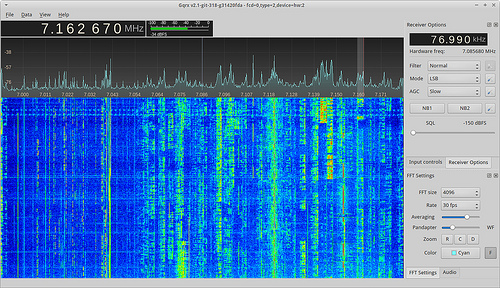 It's another installment of Linux in the Ham Shack! Yes, you heard right. In this episode we lose a co-host but gain a hacking cough. At the same time, we discuss a new digital mode, a new ham radio technology for cell phones, a new interface for SDRs and a lot more new stuff. Finally, we're down to the last two days for our
73 de The LHS Guys
Russ Woodman, K5TUX, co-hosts the Linux in the Ham Shack podcast which is available for download in both MP3 and OGG audio format. Contact him at [email protected].
Review Anytone OBLTR-8R
by John ‘Miklor’ K3NXU and Hans PD0AC
 I now get a chance to review the OBLTR-8R which is a slightly scaled down version of the TERMN-8R which is the top of the new 8R series offered by Anytone. The only outward difference between the two models is the absence of the orange keys on the left. Once again, when you get one in hand, it becomes very obvious that these radios are were not meant to be competition for the lower end brands, but more of a match for the Wouxun and existing Anytone radios.
This radio is FCC Part 90 certified (Commercial) applications, as well as Part 95A GMRS and 95J MURS services. For GMRS and MURS, the frequencies and power levels hard coded in the firmware. Anyone with dual licenses may now only need to carry a single radio.
What’s in the BOX
There you’ll find the radio, a nicely written and illustrated 104 page English manual, belt clip, wrist strap, Earpiece/Microphone, 7.25 inch (18cm) flexible antenna and hefty 2200mAh 7.4V battery with charger.

The side of the battery has a small charging jack for the optional 12V mobile charger is available for on the road charging.
First Impressions
The overall weight and feel of the radio is solid. The top of the radio has both a Volume/PowerOn switch and Channel Selector knob. The left side has the PTT button and well as two programmable function buttons. The right side has a 2 pin ‘K2’ Kenwood, Anytone, Wouxun, Baofeng style connector. Programming cables and Spkr/Micr for these radios will be totally compatible.
My prior Anytones have somewhat of a concave keypad, where the OBLTR-8R keypad buttons are level and easier to access. Also, the keypad numbers and definitions are illuminated making manual programming a bit easier.
Transmitter
The OBLTR-8R, like its big brother the TERMN-8R, also has 3 power levels that can be changed from the keypad. In the GMRS and MURS mode, the power levels are fixed, per certification requirements. Audio level and quality reports were excellent.
Receiver
The OBLTR-8R has a single Dual Watch receiver that covers
VHF – 136-174 MHz UHF – 400-520 MHz
FM Broadcast – 64-108 MHz (with 100 memory channels)
It incorporates Fast Scan with a scan rate of approximately 10 channels per second.
Some measurements
Power Levels on the test unit were as follows:
VHF – 5.6W, 1.9W, 0.9W
UHF – 4.75W, 2.3W, 1.2W
GMRS – 4.25W
MURS – 1.8W
Sensitivity
Sensitivity VHF (@ 145 MHz): -126 dBm (@ 50Ω, 12 dB SINAD).
Sensitivity UHF (@ 435 MHz): -125 dBm (@ 50Ω, 12 dB SINAD).
Harmonics
Good numbers: -57.54 dBm on VHF, -54.74 dBm on UHF.


When in the Dual Watch mode, the receiver continuously samples the main and sub-band for activity. To eliminate adjacent channel interference, the radio’s receiver reverts to true Narrowband when selected. A full 1W of audio makes the receive quality both loud and clear.
GMRS and MURS operation (FCC part 95A / 95J certified)
Like its big brother, the OBLTR-8R can be switched to operate on any of three modes. GMRS, MURS or Commercial/Normal. To eliminate the possibility of being on the wrong band, a Key Press at PowerOn selects either GMRS or MURS mode. Channel frequencies are hard coded in the firmware as well as their power levels, but allow for CTCSS/DCS tones can be added/changed via the keypad.
Commercial Application (FCC Part 90 certified)
For Commercial, Fire, EMS and EmComm use, the OBLTR-8R is fully certificated with 2.5kHz steps, and software which prevents Field Programming.
NOAA Weather Alert
The seven US NOAA weather alert frequencies are preprogrammed into the radio. There are 3 options to choose from. ON, OFF and ALERT. When WX Alert is chosen, the NOAA weather channel remains silent in the background until the 1050Hz emergency tone signal is received. This is especially useful in areas where severe weather conditions are prominent.
Dual PTT Capability / Programmable Function Keys
There are two PF keys below the PTT switch. Either can be programmed to function as a sub-channel (lower display) PTT button, while the PTT switch activates the upper channel.
The PF keys can also be used to select your choice of:
– Battery Voltage display
– Frequency display
– Tone Calling (DTMF/5TONE/2TONE)
– FHSS (Frequency Hopping)
– Tone Pulse (1750, 1450, 1000 or 2100Hz)
– Alarm Button
– Dual PTT
– MONI (Squelch off)
Channel Banks
The radio supports 200 channels and 10 memory banks. Scanning Group 0 will scan all programmed channels entered into the transceiver. Banks 1 > 9 can be assigned up to 32 channels each.
I found a nice added feature that isn’t on my 3318UV-A. If I want to remove a channel from a particular bank, I can dial in the channel, press two keys, turn the knob and it’s gone. Eliminates the need to me to use the computer to delete the bad ones.
2TONE Sequential Paging
This is extremely useful for the EMS user. I personally have used 2 tone pagers in the past. I can now monitor local EMS channels with one radio.
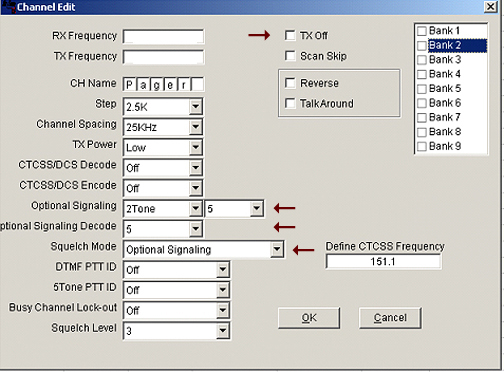 Detailed instructions on how to set up the 2-tone and 5-tone paging system can be found HERE.
Software
The OEM software is relatively easy to follow, and with a little practice, easy to navigate. Some areas may be a bit tricky, and I’ll try to address those area in the Miklor FAQ section. CHIRP developers are aware of the new Anytone 8R series, but it takes time to backward engineer a radios software.
As always, it is recommended to get a quality programming cable so you spend more time talking on the radio and less time loading special drivers to your PC. I personally use an FTDI cable that is Plug ‘n Play with no driver issues.
Upgradeable Firmware
The OBLTR-8R has Upgradeable Firmware. If features are added in the future, your radio is not obsolete. The firmware can be updated (re-flashed) by an authorized dealer so you will always be able to have the latest version available to you.
IMHO
The developers of the Anytone OBLTR-8R packed a lot of features in a small package. The inclusion of:
– Certified GMRS, MURS and Commercial in one radio
– Upgradeable Firmware
– 200 channels/10 Banks
– Dual PTT
– 2TONE / 5TONE / MSK Messaging
– Stun / Kill capability
at a price tag under $100 level is pretty darned impressive.
Comparison
There are four models in the 8R series. At the top is the TERMN-8R, followed by the OBLTR-8R, NSTIG-8R, and the ANILE-8R. Confusing? Here’s a hint. They are alphabetical. That’s the only way I can keep them straight.
For a comparison between the OBLTR-8R and the others in the 8R series, you can follow this LINK
Price: $98.89 USD (Amazon)
More Information: Anytone Tech, Miklor.com


Hans, PD0AC, is a regular contributor to AmateurRadio.com and writes from Almere, The Netherlands. Contact him at [email protected].
Review Anytone OBLTR-8R
by John ‘Miklor’ K3NXU and Hans PD0AC
I now get a chance to review the OBLTR-8R which is a slightly scaled down version of the TERMN-8R which is the top of the new 8R series offered by Anytone. The only outward difference between the two models is the absence of the orange keys on the left. Once again, when you get one in hand, it becomes very obvious that these radios are were not meant to be competition for the lower end brands, but more of a match for the Wouxun and existing Anytone radios.
This radio is FCC Part 90 certified (Commercial) applications, as well as Part 95A GMRS and 95J MURS services. For GMRS and MURS, the frequencies and power levels hard coded in the firmware. Anyone with dual licenses may now only need to carry a single radio.
What’s in the BOX
There you’ll find the radio, a nicely written and illustrated 104 page English manual, belt clip, wrist strap, Earpiece/Microphone, 7.25 inch (18cm) flexible antenna and hefty 2200mAh 7.4V battery with charger.
The side of the battery has a small charging jack for the optional 12V mobile charger is available for on the road charging.
First Impressions
The overall weight and feel of the radio is solid. The top of the radio has both a Volume/PowerOn switch and Channel Selector knob. The left side has the PTT button and well as two programmable function buttons. The right side has a 2 pin ‘K2′ Kenwood, Anytone, Wouxun, Baofeng style connector. Programming cables and Spkr/Micr for these radios will be totally compatible.
My prior Anytones have somewhat of a concave keypad, where the OBLTR-8R keypad buttons are level and easier to access. Also, the keypad numbers and definitions are illuminated making manual programming a bit easier.
Transmitter
The OBLTR-8R, like its big brother the TERMN-8R, also has 3 power levels that can be changed from the keypad. In the GMRS and MURS mode, the power levels are fixed, per certification requirements. Audio level and quality reports were excellent.
Receiver
The OBLTR-8R has a single Dual Watch receiver that covers
VHF – 136-174 MHz UHF – 400-520 MHz
FM Broadcast – 64-108 MHz (with 100 memory channels)
It incorporates Fast Scan with a scan rate of approximately 10 channels per second.
Some measurements
Power Levels on the test unit were as follows:
VHF – 5.6W, 1.9W, 0.9W
UHF – 4.75W, 2.3W, 1.2W
GMRS – 4.25W
MURS – 1.8W
Sensitivity
Sensitivity VHF (@ 145 MHz): -126 dBm (@ 50Ω, 12 dB SINAD).
Sensitivity UHF (@ 435 MHz): -125 dBm (@ 50Ω, 12 dB SINAD).
Harmonics
Good numbers: -57.54 dBm on VHF, -54.74 dBm on UHF.
When in the Dual Watch mode, the receiver continuously samples the main and sub-band for activity. To eliminate adjacent channel interference, the radio’s receiver reverts to true Narrowband when selected. A full 1W of audio makes the receive quality both loud and clear.
GMRS and MURS operation (FCC part 95A / 95J certified)
Like its big brother, the OBLTR-8R can be switched to operate on any of three modes. GMRS, MURS or Commercial/Normal. To eliminate the possibility of being on the wrong band, a Key Press at PowerOn selects either GMRS or MURS mode. Channel frequencies are hard coded in the firmware as well as their power levels, but allow for CTCSS/DCS tones can be added/changed via the keypad.
Commercial Application (FCC Part 90 certified)
For Commercial, Fire, EMS and EmComm use, the OBLTR-8R is fully certificated with 2.5kHz steps, and software which prevents Field Programming.
NOAA Weather Alert
The seven US NOAA weather alert frequencies are preprogrammed into the radio. There are 3 options to choose from. ON, OFF and ALERT. When WX Alert is chosen, the NOAA weather channel remains silent in the background until the 1050Hz emergency tone signal is received. This is especially useful in areas where severe weather conditions are prominent.
Dual PTT Capability / Programmable Function Keys
There are two PF keys below the PTT switch. Either can be programmed to function as a sub-channel (lower display) PTT button, while the PTT switch activates the upper channel.
The PF keys can also be used to select your choice of:
– Battery Voltage display
– Frequency display
– Tone Calling (DTMF/5TONE/2TONE)
– FHSS (Frequency Hopping)
– Tone Pulse (1750, 1450, 1000 or 2100Hz)
– Alarm Button
– Dual PTT
– MONI (Squelch off)
Channel Banks
The radio supports 200 channels and 10 memory banks. Scanning Group 0 will scan all programmed channels entered into the transceiver. Banks 1 > 9 can be assigned up to 32 channels each.
I found a nice added feature that isn’t on my 3318UV-A. If I want to remove a channel from a particular bank, I can dial in the channel, press two keys, turn the knob and it’s gone. Eliminates the need to me to use the computer to delete the bad ones.
2TONE Sequential Paging
This is extremely useful for the EMS user. I personally have used 2 tone pagers in the past. I can now monitor local EMS channels with one radio.
Detailed instructions on how to set up the 2-tone and 5-tone paging system can be found HERE.
Software
The OEM software is relatively easy to follow, and with a little practice, easy to navigate. Some areas may be a bit tricky, and I’ll try to address those area in the Miklor FAQ section. CHIRP developers are aware of the new Anytone 8R series, but it takes time to backward engineer a radios software.
As always, it is recommended to get a quality programming cable so you spend more time talking on the radio and less time loading special drivers to your PC. I personally use an FTDI cable that is Plug ‘n Play with no driver issues.
Upgradeable Firmware
The OBLTR-8R has Upgradeable Firmware. If features are added in the future, your radio is not obsolete. The firmware can be updated (re-flashed) by an authorized dealer so you will always be able to have the latest version available to you.
IMHO
The developers of the Anytone OBLTR-8R packed a lot of features in a small package. The inclusion of:
– Certified GMRS, MURS and Commercial in one radio
– Upgradeable Firmware
– 200 channels/10 Banks
– Dual PTT
– 2TONE / 5TONE / MSK Messaging
– Stun / Kill capability
at a price tag under $100 level is pretty darned impressive.
Comparison
There are four models in the 8R series. At the top is the TERMN-8R, followed by the OBLTR-8R, NSTIG-8R, and the ANILE-8R. Confusing? Here’s a hint. They are alphabetical. That’s the only way I can keep them straight.
For a comparison between the OBLTR-8R and the others in the 8R series, you can follow this LINK
Price: $98.89 USD (Amazon)
More Information: Anytone Tech, Miklor.com
Hans, PD0AC, is a regular contributor to AmateurRadio.com and writes from Almere, The Netherlands. Contact him at [email protected].
 Ham Radio Deluxe |
 W5SWL Electronics |
 Ham Radio Prep |
 KB3IFH QSL Cards  Hip Ham Shirts  HamRadioAuctions HamRadioAuctions Reliance Antennas Reliance Antennas Enigma Shop Enigma Shop |  morseDX  Ni4L Antennas  R&L Electronics R&L Electronics antennas.us antennas.us QRV QRV |
- Matt W1MST, Managing Editor
