 |
 Ham College episode 3
 30 March 2015 | by
Ham College episode 3 is now available for download.
Ham College, the new show for those new to the hobby and those wishing to get into Amateur Radio.
In episode 3 we talk about voltage, demonstrate using voltmeters and cover 14 more questions and answers from the Technical class question pool.
59:07
George Thomas, W5JDX, is co-host of AmateurLogic.TV, an original amateur radio video program hosted by George Thomas (W5JDX), Tommy Martin (N5ZNO), Peter Berrett (VK3PB), and Emile Diodene (KE5QKR). Contact him at [email protected].
Binding up!
I remembered there were 2 years worth of Practical Wireless magazines and a few Sprats scattered over the house. 14 were together, 2 were stuck in a drawer by the bed, and the rest were eventually found mixed up with several other piles of junk, which had been dumped together when the XYL had been on one of her recent mad cleaning rounds.

Someone had got me the binders for a present last year, again they took a bit of searching for? But I eventually found them, and set to work. After an hour or so, all were now together sorted and bound, ready for the bookshelf a real professional job!
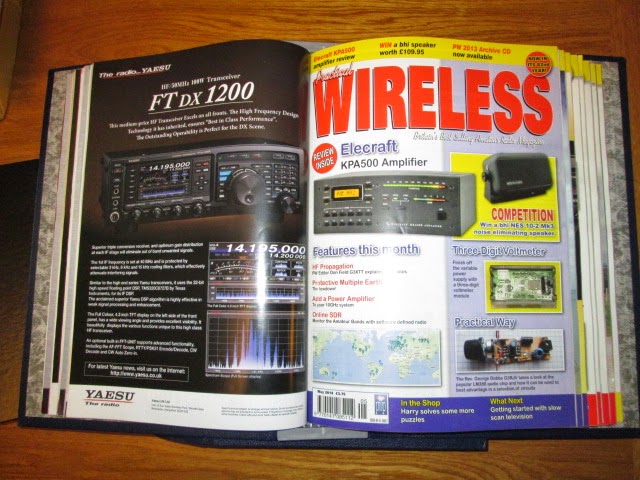
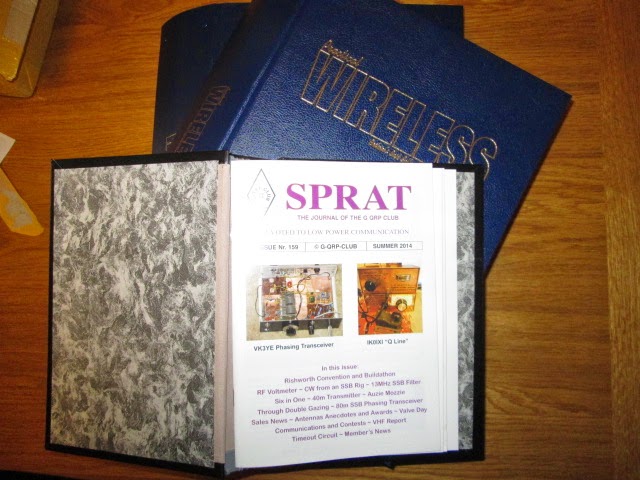
I like to keep my magazines bound together, making quick reference easy when I want to go back to an article. Todays effort will help with a bulk of projects on the list which you will hear about in the future .
Steve, G1KQH, is a regular contributor to AmateurRadio.com and writes from England. Contact him at [email protected].
What to do during a contest
With the exception of the UKAC events, weekends are the only time I get on the radio really. I occasionally sneak on during the week but it generally attracts a groan from ‘er indoors. This weekends CQWPX contest is a great opportunity to chase a bit of DX. I got my first and so far only VK contacts from home with my homebrew loft mounted Cobwebb during a contest so I can’t complain.
But what else is there. Well apart from the CW portions of the bands there are other things to do on the air. One of them is something I’ve never even looked at before Wefax.
Normally my weather information comes from t’internet nowadays and maybe this kind of thing is a bit legacy and perhaps not long for the airwaves but I’m sure it serves a purpose for shipping and perhaps far off places.
So how do you ‘do’ Wefax? In my case I tuned to 8,039.100 USB (Have a look here for a good primer and the frequencies and schedules are here) with the trusty Angelia SDR and coaxed the audio in fldigi with a less than ideal set of patch leads and a rather noisy Soundblaster USB souncard. The Angelia is a great receiver so it gave the best chance for this compromised solution. Fldigi will decde Wefax for you so its just a case of selecting the Wefax mode and aligning the signal on the waterfall, nothing to it.

After some awful screeching and scrawing that reminded me of when fax machines were in offices and hey presto images started coming through. Adjusting the slant and horizontal alignment is easy with fldigi and as you can see the raw images are pretty good.

And here is the output. I’m guessing its going to rain!

So if you’re thinking that SSB contesting isn’t for you and you’re at a loss as to what you might want to do with your expensive rig, then have a scout about the bands outside of the usual ham bands. You never know what you might find.
Alex Hill, G7KSE, is a regular contributor to AmateurRadio.com and writes from Cumbria, UK. Contact him at [email protected].
Special Notice: 661-296-2407 Dial In Newsfeed Back In Operation
Special Notice: I was able to get one of the old tape based machines kind of working for the 661-296-2407 dial-in line. I have no idea as to how long it will be functional as its a "make-do" repair. But for now its there for those who need it and Ill keep it going as long as I can. However, the best way to get the audio version is to download the MP3 file from here our website -- de Bill P. / WA6ITF
Amateur Radio Weekly – Issue 54

New technology may double radio frequency data capacity
A team of Columbia Engineering researchers has invented a technology—full-duplex radio integrated circuits (ICs)—that can be implemented in nanoscale CMOS to enable simultaneous transmission and reception at the same frequency in a wireless radio.
Columbia University
SARnet: Florida’s state-wide repeater network
SARnet utilizes the FDOT microwave system as a backbone.
Frugal Florida Fun
The origin of SOS
The first recorded use of SOS was Jan. 23, 1909, when a liner called the Republic and an Italian liner called the Florida collided in the dense fog while passing Nantucket.
TimesDaily
Swapping gamma rods for better SWR
I chose a point 10cm further at the radiator as resonance will be rising.
PE4BAS
China v. Japan
Within a few years we will see the amateur radio market flooded with quality products made in China with low prices.
AmateurRadio.com
Software Defined Receivers (SDRs) for the visually impaired
I can say that all the software packages delivered with SDRs have issues and challenges when it comes to using them along with a screen reader.
The SWLing Post
SDR Round-up
New software defined radio (SDRs) products are popping up every few months these days so we thought we’d compile a big list of available SDRs as there are a few people who were bitten by the RTL-SDR bug and are now looking to upgrade.
RTL-SDR.com
A serious rift in the core Arduino team
One of the founding team members has gone off on his own, claiming rights to Arduino and starting a separate operation.
Make:
What is Skip Signal Fade?
With long distance propagation using ionospheric skip received signals will often fade in and out, being stronger and weaker over the course of a few seconds. What’s the cause of this irregular fading?
Ham Radio School
Did the eclipse affect propagation?
For the full 24 hours of 20th March, Derek G4SWY took world map screen shots of propagation as reported on WSPRnet.org every 4 minutes on 600, 160, 80 and 40 Meters.
Southgate
Video
Comparing whip lengths
The end result is you can’t beat more wire in the air.
M0GVZ
20 meter contact with the Canary Islands
I came to find that the location I contacted was around 4,300 miles away! That is INCREDIBLE! What a great hobby we are involved in.
N5WXW
New product
Bluetooth microphone for mobile
Compatible with different brands of mobile radio, like Icom, Yaesu, Motorola, Kenwood and more.
PD0AC
Amateur Radio Weekly is curated by Cale Mooth K4HCK. Sign up free to receive ham radio's most relevant news, projects, technology and events by e-mail each week at http://www.hamweekly.com.
RaDAR March 28th 2015 with VE3FAL/PM
Temperatures this morning were still cool(-10c) when I got up but the sun was starting to shine nice through the tree’s.

I was looking forward to the RaDAR event as well as the regular gathering of HFPack, HFNow and RaDAR gang that will congregate on or near 18157.5
I once again donned my favorite rig, the PRC-104, with the Chameleon Whip, a 10’7″ counterpoise and headed out around the property.
 Once on 17 meters the first I heard was Greg N4KGL who was QRP with the KX3, he was maybe a 2×2 but was unable to hear me call him. I called a number of times but no joy. I then heard my friend Budd W 3 Fast Freddie calling and he worked Greg, I then called as well and when Budd was clear with N4KGL he called me and we were able to have a 2 way 5×9 exchange on the band. Budd then asked if anyone else was hearing me and Warren KD4Z in GA. came back to me with a great report, so we exchanged reports and had a good qso, Warren then worked Tom G0SBW who was very weak to me, I asked Warren to pass along to Tom that I said hello and that he was just audible here.
I then came in the house for a minute and noted that Paul W0RW was portable with his Green Radio on 18.088, so I tuned the PRC-104 down to 18.088 and put the leg key on and worked Paul, we were both 599 reports so great signals on 17 meters.
After about an hour outside I was happy with the contacts I made and the propagation conditions as well as teh weather outside as I was able to operate with no gloves on again today.
So thanks to Budd, Warren, Paul and of course the RaDAR gang for being on the air and playing radio and going portable, thus the Rapid Deployment Amateur Radio group.
Next weekend, April 3rd and 4th (0000z-2359z) will be the 24 Hr. RaDAR event and I will be out portable for that one as well operating SSB,CW and digital modes.
RaDAR Information Below:
1. Aim
The RaDAR “Challenge” is a unique event aimed at promoting the use of Rapidly Deployable Amateur Radio stations. This challenge is for all licensed radio amateurs not limited to South Africa. A RaDAR operator can take part in any of the three defined categories (see point 7) which may be changed at any time during the challenge. The
points system is so structured as to encourage portable RaDAR operations, especially moveable RaDAR stations. Moveable RaDAR stations rely on fixed and portable stations as a point of contact using channelised frequencies. “Search and pounce” techniques are also allowed.
2. Date and Time
From 00:00 UTC to 23:59 UTC on Saturday 4 April 2015 and from 00:00 UTC to 23:59 UTC on Saturday 7 November 2015 – 24 hours will give equal opportunity to the international community of RaDAR operators. RaDAR operators can define their own operating time schedule or remain active for the full 24 hours.
3. Bands and Modes
All amateur bands are allowed including cross band contacts via amateur radio satellites.
Modes – CW, SSB, AM, FM or any legal digital mode. QSOs via terrestrial repeaters will NOT be allowed.
4. Suggested HF calling frequencies
See http://zs6bne.wordpress.com/2013/03/06/radar-calling-frequencies/ for the latest international list of frequencies. The WARC bands can be used considering this is a RaDAR Challenge and not a contest as such. It provides better opportunities for Ra-
DAR contacts during difficult propagation conditions.
Recommended digital modes frequencies – Refer to the South African Radio League Contest Manual, General Rule 15.
5. Exchange
The RaDAR challenge requires more than a minimalistic information exchange. Accurate information exchange is considered more important than a large QSO count.
Call sign, name, RS(T) report, QTH and grid locator. Note the grid locator can change as RaDAR operators are allowed to move position at any time. The grid locator of six characters is acceptable but should preferably be accurate to 10 characters for higher
position accuracy. Smartphone applications are generally used to establish more than a 6-character grid locator. If working non-participating stations, call sign, name, RST and QTH is acceptable.
6. Scoring
1 point per QSO.
Individual QSOs – per mode, per band, per satellite, per call sign.
If the moving RaDAR station has moved the required distance (see point 7) contact can be made with a previously worked station, again.
7. Categories and multipliers
The following multipliers are applicable to determine the final score. If category/mode of transport changes were made during the challenge, than calculate accordingly.
X 1 – RaDAR Fixed station (At home or in another building)
X 2 – RaDAR Field station (Portable – away from home)
X 3 – Moving RaDAR station – See modes of transport below.
Modes of transport and required movement distances (moving RaDAR stations only)
Vehicles, motorcycles and motorboats etc. (Motorised transport) – 6 km
Bicycles – 2 km
On foot and paddle canoes – 1 km
Wheelchairs – 500 m
Aeronautical mobile stations are considered moving stations and can communicate at any convenient time.
Note: Moving RaDAR stations can move at any time but are required to move to the next destination after five contacts have been made from the present location. The move needs to cover the required distance before further contacts are allowed to be made. This requirement tests the ability to rapidly re-deploy your amateur radio field station.
9. Bonus points (All categories)
Five (5) points (The equivalent of five QSOs) for a minimum of one satellite or any digital modes QSO involving a computer, smartphone or digital modes device. (For clarity thereafter 1 point per Satellite / Digital modes QSO).
Five (5) points for the first successful same continent RaDAR to RaDAR QSO (As may be confirmed by the extensive information exchange.
Five (5) points for the first intercontinental (DX) QSO
Ten (10) points for the first successful inter continental (DX) RaDAR to RaDAR QSO (As may be confirmed by the extensive information exchange).
10. Log Sheets
Log sheets must be submitted by 14 April 2015 and 17 November 2015 and sent by e-mail to [email protected].
See https://zs6bne.files.wordpress.com/2015/03/11046905_10152762072212759_727315224761083499_n.jpg for a log sheet specifically designed for the 2015 RaDAR contest.
Note: A photo of the station (JPG format) MUST accompany every log entry. A photo is required for each new location that moveable stations visit. These photos are used to promote amateur radio and the RaDAR concept showing where amateur radio can be used to communicate from and in the many different ways.
Have a great weekend one and all and a good week coming up.
72/73
Fred
VE3FAL
The “Ice Man”
Fred Lesnick, VE3FAL, is a regular contributor to AmateurRadio.com and writes from Thunder Bay Ontario, Canada. Contact him at [email protected].
Crystals Go To War
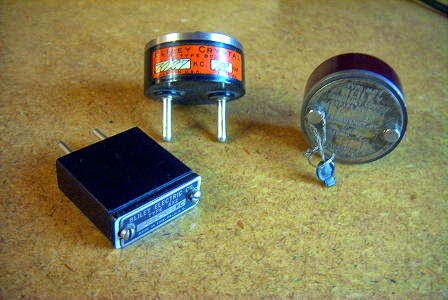
Thanks to a recent posting in the Yahoo ParasetBuilders Group, I have a new-found respect for my small collection of prewar crystals! If you've ever wondered how a rough chunk of quartz gets transformed into an accurate frequency-generating device, this 'cinema-style' documentary shows exactly how it was done ... truly an amazingly complex, yet delicate, labor-intensive process.
After viewing the documentary, I can't help but wonder what later health effects some of these workers may have undergone after seeing them handling some nasty-looking chemicals and working directly beside desktop X-ray machines. If you've used old WW2 crystals before, I think you'll enjoy seeing how much work went into their production.
Steve McDonald, VE7SL, is a regular contributor to AmateurRadio.com and writes from British Columbia, Canada. Contact him at [email protected].
 Ham Radio Deluxe |
 W5SWL Electronics |
 Ham Radio Prep |
 KB3IFH QSL Cards  Hip Ham Shirts  HamRadioAuctions HamRadioAuctions Reliance Antennas Reliance Antennas Enigma Shop Enigma Shop |  morseDX  Ni4L Antennas  R&L Electronics R&L Electronics antennas.us antennas.us QRV QRV |
- Matt W1MST, Managing Editor
