 |
 "QRL?" – please !!!!!
 17 March 2015 | by
 I was involved in a 2X QRP QSO on 14.060 MHz with Tom, KC9RXI in WI. He was about a 449 to me; and I'm sure I was no better to him, but we were having a QSO. I'm sure at times, that to people who may have been listening to the frequency, that it sounded like it was dead.
It wasn't.
All of a sudden, out of the blue, another QRPer started calling CQ/QRP on frequency! The call will be omitted to prevent embarrassment (but it is forever burned into my brain). Not so much as a single, solitary "QRL?"
Yes, I am sure that both Tom and I were weak, but we WERE in the middle of a QSO. Coming on to a frequency, plopping yourself down and commencing to call CQ without asking is just - arrgh! And to top it off, the CQer was calling CQ DE WXXXX/QRP !!!! I'm sorry, but QRPers, above all Amateur Radio ops, should know better. No excuse - period. If he had sent "QRL?" waited for a bit AND THEN had started calling CQ on top of us, I may still have been annoyed, but I would have thought to myself, "Well, he just didn't hear us."
Unfortunately, while Tom was trying to talk to me, I had to transmit "QRL. PSE QSY". He immediately QSYed (so he was able to hear me!), but at that point I had lost what Tom was trying to say. Shortly after that the QSB went off the Richter scale and the QSO came to a premature end. The "meat" that I could have copied was drowned out forever by needless QRM.
A bit after that debacle, I went to 12 Meters and tuned around for a bit. I heard 7QAA in Malawi quite loudly. He was loud enough to work - even QRP. I don't think I broke the pile up, as again there was a lot of QSB. If I had more time (lunch hour was running out) I'm pretty darn certain I would have worked him. This time I had the patience - I ran out of minutes.
So , even with the G4 geomagnetic disturbance, Malawi was coming in the best I've heard them so far. Go figure. Luckily, the station will be on the air until early April and I'm taking a vacation day on Friday. I just may make it into their logbook yet!
72 de Larry W2LJ
QRP - When you care to send the very least!
Larry Makoski, W2LJ, is a regular contributor to AmateurRadio.com and writes from New Jersey, USA. Contact him at [email protected].
Review Baofeng FF-12P (UV-5X)
Probably because Baofeng is running out of letters (although I didn’t see the Baofeng UV-5Y or Z yet), there’s a new numbers game in order. The FF-12P is essentially a UV-5X and my sample came in…. silver.
 The radio houses the latest chip set and firmware. Pressing various keys confirm this: pressing ‘0’ for a bit more than a second shows the battery voltage, pressing PTT + Band generates 2100 Hz, PTT + A/B generates 1750 Hz, and PTT + VFO/MR generates 1450 Hz.
The display is of the inverse type, the antenna the short one we all learned to hate, “FF-12P” is printed on both the left and right side of the radio. Batteries / accessories aren’t compatible with the standard UV-5R. While I could find enough suppliers of the FF-12P and UV-5X, not a single one appears to sell spare batteries or any other accessory.
Charger / battery combination
I wasn’t able to charge the battery at first, because the battery and charger don’t match: the two indentations of the battery prevented it from being inserted in the charger. After scraping away enough plastic in the charger I got it to fit.
CHIRP
CHIRP recognized the radio as being a UV-5R and squelch thresholds could be modified without a problem.
Scanning
A clip on YouTube suggested that the UV-5X / FF12P scans faster. This proves to be true: the FF-12P outperforms all other Baofeng radios I own, including the GT-3 Mark II. Scan speed is about 5-6 channels/sec.
Transmitter
Frequency accuracy of the sample: +2 Hz on VHF, -11 Hz on UHF.
Power output VHF: (@ 145 MHz): 4.1 Watts (high), 1.7 Watts (low)
Power output UHF: (@ 435 MHz): 3.6 Watts (high), 1.8 Watts (low)
TX Audio: Bright and loud. Very nice.
Harmonics: the usual peaks on VHF and UHF. Still not very impressive.


Receiver
RX Audio: good.
Front-end: surprisingly good, just like the GT-3 Mark II. Nice.
Sensitivity: -127 dBm (VHF), -125 dBm (UHF). These are good numbers.
Conclusion
The FF-12P aka UV-5X is the typical Baofeng: value for money, but not without its flaws. Harmonic suppression is a mixed bag and the lack of accessories is a potential problem.
The fact that I had to modify the charger to make the battery fit is a dumb factory mistake. The short stock antenna just doesn’t want to die — put a few bucks aside to buy a better one.
The positive side of the radio is the good receiver, good TX audio and faster scan speed. And, if you care about such things, it comes in shiny SILVER!


Hans, PD0AC, is a regular contributor to AmateurRadio.com and writes from Almere, The Netherlands. Contact him at [email protected].
Review Baofeng FF-12P (UV-5X)
Probably because Baofeng is running out of letters (although I didn’t see the Baofeng UV-5Y or Z yet), there’s a new numbers game in order. The FF-12P is essentially a UV-5X and my sample came in…. silver.
The radio houses the latest chip set and firmware. Pressing various keys confirm this: pressing ‘0’ for a bit more than a second shows the battery voltage, pressing PTT + Band generates 2100 Hz, PTT + A/B generates 1750 Hz, and PTT + VFO/MR generates 1450 Hz.
The display is of the inverse type, the antenna the short one we all learned to hate, “FF-12P” is printed on both the left and right side of the radio. Batteries / accessories aren’t compatible with the standard UV-5R. While I could find enough suppliers of the FF-12P and UV-5X, not a single one appears to sell spare batteries or any other accessory.
Charger / battery combination
I wasn’t able to charge the battery at first, because the battery and charger don’t match: the two indentations of the battery prevented it from being inserted in the charger. After scraping away enough plastic in the charger I got it to fit.
CHIRP
CHIRP recognized the radio as being a UV-5R and squelch thresholds could be modified without a problem.
Scanning
A clip on YouTube suggested that the UV-5X / FF12P scans faster. This proves to be true: the FF-12P outperforms all other Baofeng radios I own, including the GT-3 Mark II. Scan speed is about 5-6 channels/sec.
Transmitter
Frequency accuracy of the sample: +2 Hz on VHF, -11 Hz on UHF.
Power output VHF: (@ 15 MHz): 4.1 Watts (high), 1.7 Watts (low)
Power output UHF: (@ 435 MHz): 3.6 Watts (high), 1.8 Watts (low)
TX Audio: Bright and loud. Very nice.
Harmonics: the usual peaks on VHF and UHF. Still not very impressive.
Receiver
RX Audio: good.
Front-end: surprisingly good, just like the GT-3 Mark II. Nice.
Sensitivity: -127 dBm (VHF), -125 dBm (UHF). These are good numbers.
Conclusion
The FF-12P aka UV-5X is the typical Baofeng: value for money, but not without its flaws. Harmonic suppression is a mixed bag and the lack of accessories is a potential problem.
The fact that I had to modify the charger to make the battery fit is a dumb factory mistake. The short stock antenna just doesn’t want to die — put a few bucks aside to buy a better one.
The positive side of the radio is the good receiver, good TX audio and faster scan speed. And, if you care about such things, it comes in shiny SILVER!
Hans, PD0AC, is a regular contributor to AmateurRadio.com and writes from Almere, The Netherlands. Contact him at [email protected].
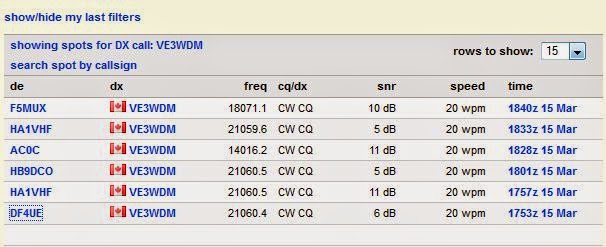
My QRP signal is spotted in Europe!
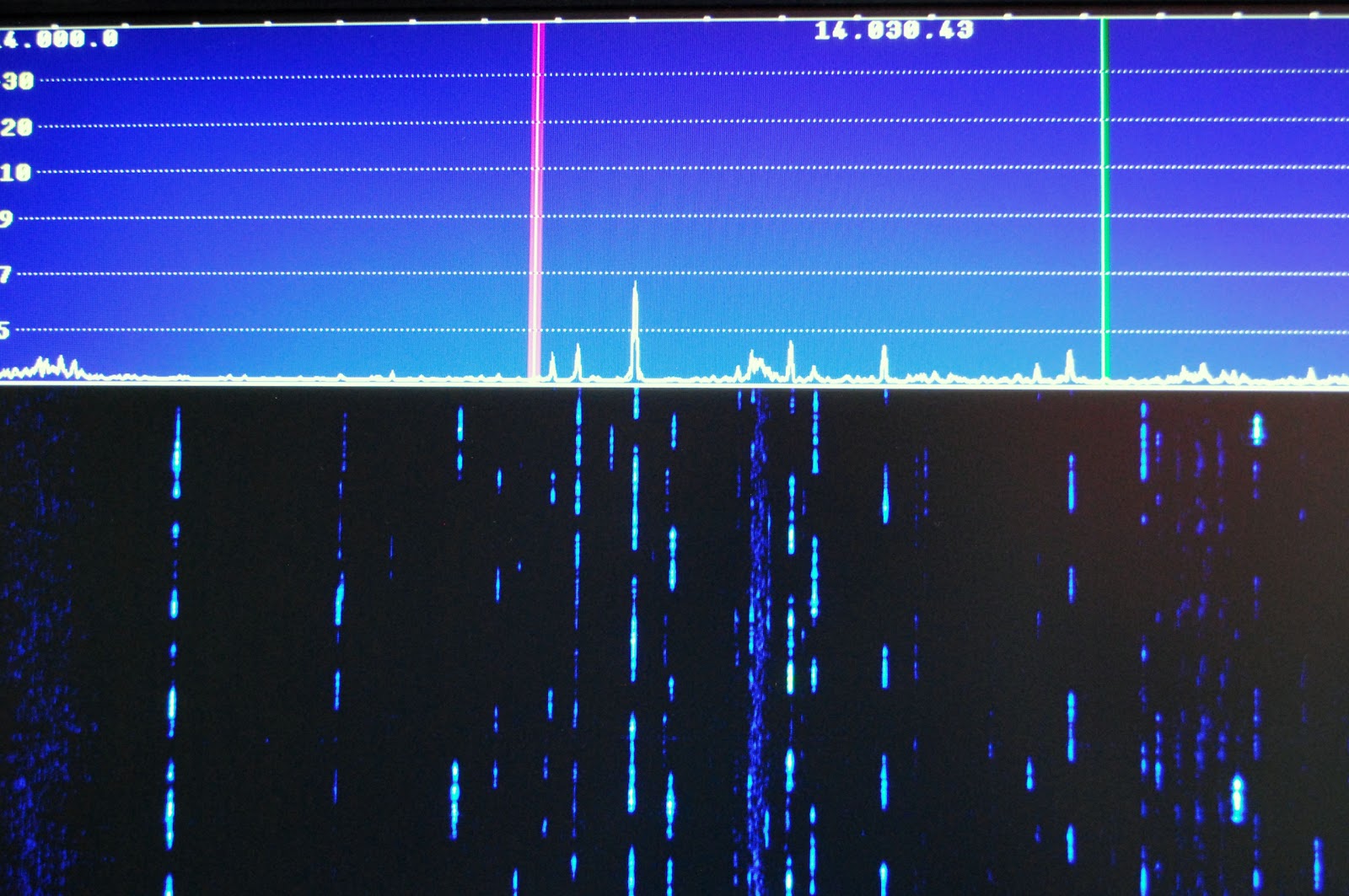 |
| P3 on 20m showing some signals |
Mike Weir, VE9KK, is a regular contributor to AmateurRadio.com and writes from New Brunswick, Canada. Contact him at [email protected].
Rockmite
As I’m moving towards CW as an operating mode I took the plunge and bought a Rockmite kit from Kanga. Lets just say its not working quite as I had anticipated. This time I was very careful to look at the various instructions. Lid everything out and then checked every component as I assembled it.
 Next time I’ll throw these things together in the usual manner. I might have a bit more success. Power on and I get little in the way of audio, a gentle hiss but not much else. So troubleshooting has to begin. Fortunately there is quite a bit of help for this but to be honest I’m not holding out much hope as I did such a thorough job of checking the first time round. Must be a faulty (insert component here)
All good fun and not as if the world will end if I have to spend some time on it.
Alex Hill, G7KSE, is a regular contributor to AmateurRadio.com and writes from Cumbria, UK. Contact him at [email protected].
Spurious Emissions

Anthony, K3NG, is a regular contributor to AmateurRadio.com.
Changing propagation
If proof were needed that we are now on the way down to the next minimum then take a look at the sunspot number graphs at http://www.solen.info/solar/ .
Although conditions are sliding, do not abandon the higher HF bands like 10m. There is (usually) quite a lot of good DX around still. In the last solar minimum I was still able to work well into southern South America on 10m with QRP SSB. WSPR should be even more reliable when conditions are edgy.
I really do hope a strong core of WSPR operators stick with 10m as, in many ways, in the poorer times are when WSPR will be most valuable as a tool. I am hoping that when not on traditional modes like SSB or CW people will still WSPR so we can catch fleeting openings, which are probably far more common than people expect on 10m. Remember, the F2 or transequatorial propagation has only to go above 28.126MHz for 120 seconds and someone on WSPR may spot it!

Roger Lapthorn, G3XBM, is a regular contributor to AmateurRadio.com and writes from Cambridge, England.
 Ham Radio Deluxe |
 W5SWL Electronics |
 Ham Radio Prep |
 KB3IFH QSL Cards  Hip Ham Shirts  HamRadioAuctions HamRadioAuctions Reliance Antennas Reliance Antennas Enigma Shop Enigma Shop |  morseDX  Ni4L Antennas  R&L Electronics R&L Electronics antennas.us antennas.us QRV QRV |
- Matt W1MST, Managing Editor
