 |
 Today’s Sun Seen at the 304-Angstrom Wavelength (30 March 2015)
 31 March 2015 | by
 Today’s Sun (artificially-colored in red) seen at the 304-angstrom wavelength (Extreme Ultraviolet, or EUV), as viewed by the Solar Dynamics Observatory (SDO), by the Atmospheric Imaging Assembly (AIA).
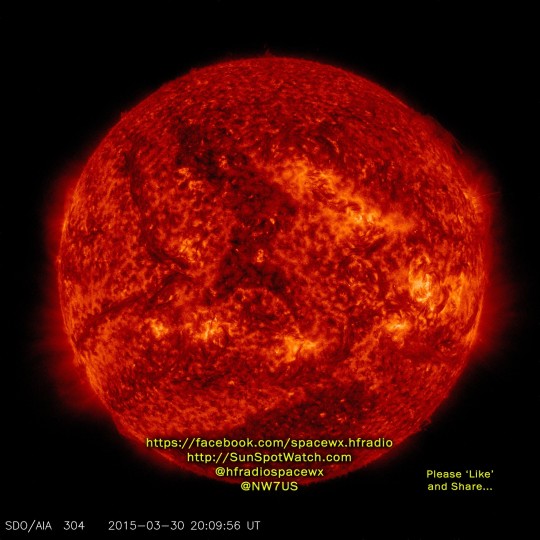
At this wavelength, at a wavelength not seen by the un-aided eye, we can see the Sun through the 30.4 nm (304 A) filter. This Extreme Ultraviolet (EUV) waveband is used to monitor the chromosphere and lower transition region. It is useful to see plasma and filament activity, including filamet eruptions and coronal mass ejections (CMEs).
The image is a “false color image”, meaning that observed data are in a range outside of what human eyes can see, so the data are digitally recast into colors that emphasize physically important features. This view is created from data gathered by the Solar Dynamics Observatory (SDO) satellite that flies above Earth”s atmosphere in an inclined geosynchronous orbit.
Emissions captured in this image come from helium (He), the second most abundant element in the solar atmosphere. Singly ionized Helium (He II) emits Extreme Ultraviolet (EUV) light when heated to temperatures of ~70,000 deg K. In the upper solar atmosphere the temperatures are so high that most chemical elements have lost many of their electrons. The remaining electron, which is still attached to the atom, emits EUV radiation in narrow wavebands or lines when it is in an excited state.
The 30.4 nm filter (also called channel or bandpass) is dominated by emissions from singly (once) ionized helium which has missing 1 electron–He II. The roman numeral descriptor is consistent with spectral notation: the level of ionization for a given roman numeral is one unit larger that the actual number of missing electrons. The temperatures associated with this level of ionization is range from 6 x 10^4 K to 8 x 10^4 K.
The bright regions in this image correspond to regions of closed magnetic field loops that trap the hot, emitting plasma. Large bright regions are often called active regions. The dark regions correspond to cooler temperatures and possibly to locations where magnetic field lines open into the heliosphere, and thus, do not trap hot plasma.
View live data and images at http://SunSpotWatch.com
Get the space weather and radio propagation self-study course, today. Visit http://nw7us.us/swc for the latest sale and for more information!
We”re on Facebook: http://NW7US.us/swhfr
Visit, subscribe: NW7US Radio Communications and Propagation YouTube Channel
The future of HF broadcasters
Deutsche Welle (DW) is closing its last relay station, which is in Kigali, Rwanda. In recent years DW like many shortwave broadcasters, has been facing financial cutbacks. Also there are far fewer broadcasters using shortwaves these days.
As a youngster in the 1960s, I recall shortwaves crowded with AM broadcast stations, many from all over the world transmitting in English, with their distinctive interval signals. There was a magic about shortwave broadcasting back then. Quite a few could be copied with very simple receivers too. There is something quite nostalgic about listening again to those long-gone interval signals from behind the Iron Curtain. I remember getting some excellent freebees from China back in the early 1980s. Of course, it was all to spread the propaganda. All I really wanted was their QSL card!
These days, users are often reached using the internet. Of course, it begs the question, “who is now filling the empty, vacated channels?” In the long run amateur radio might gain some allocations, although the noise floor on HF is increasing too. SMPUs, cable TV and numerous other sources are mainly to blame.
See http://www.dw.de/deutsche-welle-closes-kigali-outpost/a-18340960.

Roger Lapthorn, G3XBM, is a regular contributor to AmateurRadio.com and writes from Cambridge, England.
Pixie Files
 |
| My assembled 40m Pixie |
The Pixie is a very simple HF transceiver. Usual power out is in the 200-1000mW region, depending on band and DC power source. It was first developed some years ago but the basic concept is using a PA transistor as a mixer in a simple direct-conversion receiver. On TX this is used as the TX PA.
Being simple, it has a number of limitations but it certainly works. A major issue can be AM broadcast breakthrough, although my 40m version is perfectly usable. I was very impressed with my little kit that came with all parts including a silk-screened PCB, all sockets and a crystal. It needed low-Z Walkman type headphones, a morse key and battery – that was all. On 40m the sensitivity is pretty good with 0.5uV clearly audible and my RF power out is around 400mW. A lack of both RF and AF RX selectivity is also noticeable.
Kits are available from several sources at prices that are hard to beat. I recently bought a kit for $10 with free airmail from China. It is available for less than half this price I subsequently found out. Unbelievable for a fully functional HF transceiver. Of course, being so simple you may prefer just to build it dead-bug fashion. I bought a kit as I wanted to see how my building skills were.
As a mature design, it has been through several iterations, some improve the basic design, but most do so at the expense of increased complexity. You’d be hard pressed to find a circuit for a complete HF CW transceiver much simpler.
See www.gqrp.com/The_Sprat_Pixie_File.pdf .

Roger Lapthorn, G3XBM, is a regular contributor to AmateurRadio.com and writes from Cambridge, England.
Want a crowd
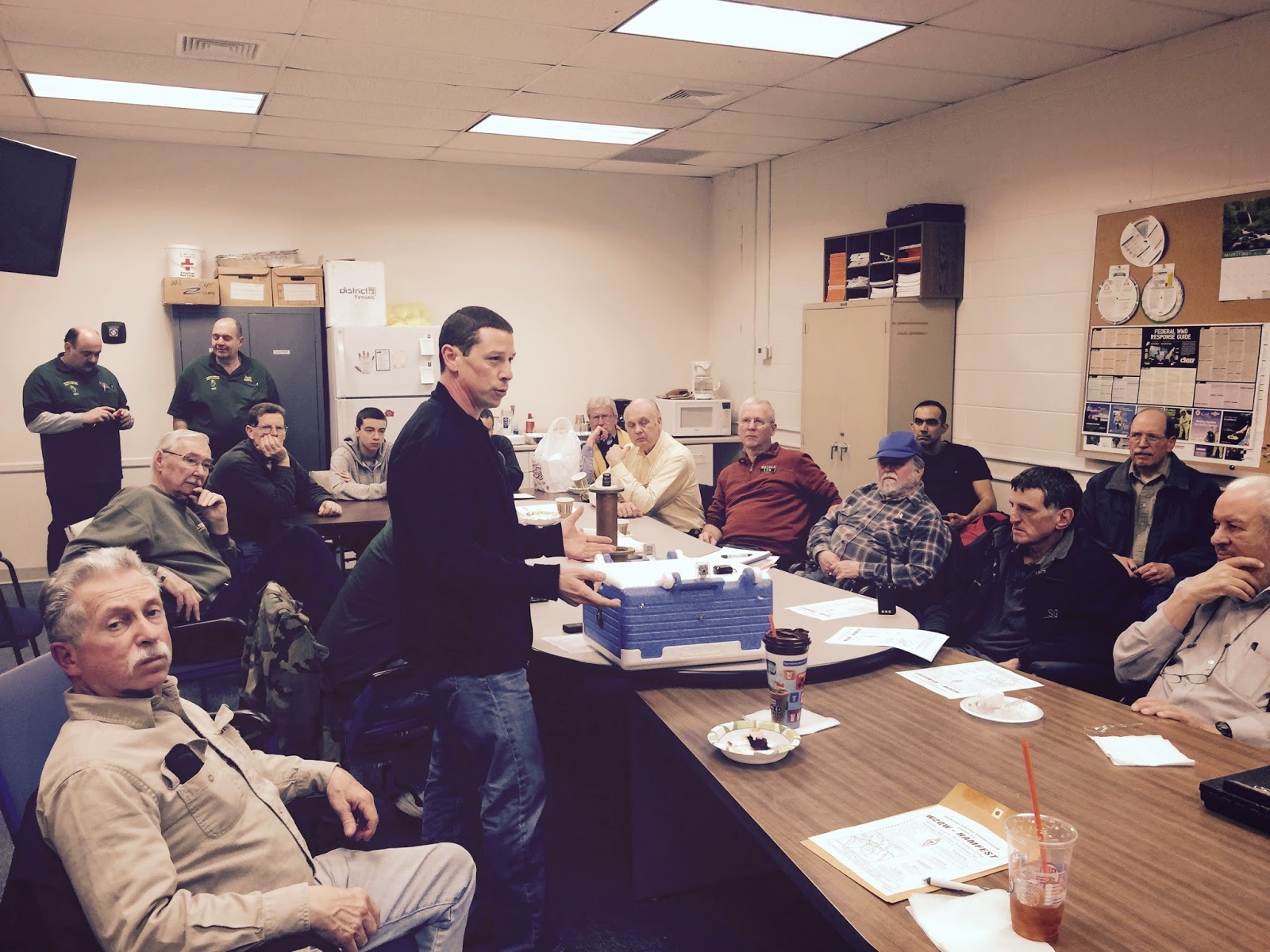
Thanks to Drew Moore W2OU for arranging for Mike Terruso WA4LOQ to come to our ETS of NJ meeting last Friday evening to talk about his high altitude ballooning experiments. What started out as a science project for his son is turning into a combination of ballooning and Amateur Radio for Mike. In fact, ballooning is what got Mike in gear to earn his Amateur Radio license, as he realized it's potential to help him in his endeavors.
The technology that he uses is interesting. A combination of radios, cameras, Raspberry Pi's, GPS devices, temperature and humidity sensors - it was all fantastic to listen to. I've embedded his YouTube video which is a compilation of stills (taken at 5 second intervals) of his maiden launch last October. The balloon was released near Lebanon, PA and landed in Boonton, NJ. It's an hour long video, but you can skip around it if you wish to see the "near space" photos which clearly show the black sky of space and the curvature of the earth's horizon. As Mr. Spock would say - "Fascinating!"
Mike is a "maker" in the sense that he did all his own research and started his project from scratch using materials purchased and/or cobbled together on his own. His next launch is scheduled for sometime in May. He is going to add Amateur Radio to the mix this time and will be getting cooperation from the local radio clubs in tracking and recovery.
Larry Makoski, W2LJ, is a regular contributor to AmateurRadio.com and writes from New Jersey, USA. Contact him at [email protected].
RTL SDR Filters
 |
| SDR Sharp GUI |
DXer John Bellini in Colorado, and maker of those informative Low Noise Vertical videos, has been at it again.
This time it's a good demonstration of a pair of filters that he built to mitigate the front end overload experienced on his SDR receiver.
John is one of many radio hobbyists that have been playing with the very inexpensive RTL 2832 SDR dongle receiver. Being very close to several high-powered broadcast stations has been a bit problematic for him when using the low cost SDR but his new video shows exactly what was needed at his location to solve the problem:
It looks like John is using the SDR Sharp GUI (graphical interface) to operate the dongle SDR receiver. Those wishing to learn more about this might find this 'getting started' page of interest.
Good stuff John.
Steve McDonald, VE7SL, is a regular contributor to AmateurRadio.com and writes from British Columbia, Canada. Contact him at [email protected].
‘USA 1776’ DMR Talk Group
 One of the nice things of D-Star and DMR is the ability to talk all over the world without the need of an HF rig and a bunch of big antennas. While this largely reduces a radio to a simple Internet-driven communication tool – just like Skype or other VoIP apps – it’s definitely nice to use.
There are a few problems surrounding DMR, one of which is the lack of more than two time slots. For example, if hams are using the Dutch Hytera network and occupying talk group 204 on slot 1, World Wide (which uses the same time slot) will be unavailable. Because 204-1 is a busy place, world wide QSOs are often impossible. It’s one of the reasons I thought of dumping DMR all together — I can talk to the same Dutch guys on analog while enjoying a much better quality audio.
There are reasons to keep DMR too. DMR is maturing; there are more than enough possibilities to put less pressure on the nation-wide network by going local. Now if only hams would do that…. but most don’t. Another reason to keep DMR for now is the gateway we recently added, which connects D-Star to our DMR network.
Not available on the Motorola network, sorry — some people responsible for that network appear to be so scared of such innovations that they will ban a repeater from the network if such a gateway is detected.
Talk group ‘USA 1776’ could add to the appeal of DMR. It’s unclear on which network this talk group will reside, but my best guess is that it will be the Motorola network. MITCON writes:
The “USA 1776″ (English preferred) Talk Group will be distributed worldwide to DMR networks upon request. The spirit of “1776” is to continue the Amateur Radio tradition of international friendship and to push the boundaries of technology in the new frontier of digital communications.
 USA 1776 is intended to be a flexible, politically neutral, unrestricted Talk Group that can be used as Push-To-Talk (PTT) or Full-Time (FT) to meet the operating requirements of a DMR Network. DMR subscribers are welcome to use 1776 as a universal meeting place to “Rag Chew” or as a jumping off point and QSY to an alternative Talk Group if desired. To add USA 1776 to your DMR Network please contact us to schedule a time for configuration & testing.


Hans, PD0AC, is a regular contributor to AmateurRadio.com and writes from Almere, The Netherlands. Contact him at [email protected].
‘USA 1776′ DMR Talk Group
One of the nice things of D-Star and DMR is the ability to talk all over the world without the need of an HF rig and a bunch of big antennas. While this largely reduces a radio to a simple Internet-driven communication tool – just like Skype or other VoIP apps – it’s definitely nice to use.
There are a few problems surrounding DMR, one of which is the lack of more than two time slots. For example, if hams are using the Dutch Hytera network and occupying talk group 204 on slot 1, World Wide (which uses the same time slot) will be unavailable. Because 204-1 is a busy place, world wide QSOs are often impossible. It’s one of the reasons I thought of dumping DMR all together — I can talk to the same Dutch guys on analog while enjoying a much better quality audio.
There are reasons to keep DMR too. DMR is maturing; there are more than enough possibilities to put less pressure on the nation-wide network by going local. Now if only hams would do that…. but most don’t. Another reason to keep DMR for now is the gateway we recently added, which connects D-Star to our DMR network.
Not available on the Motorola network, sorry — some people responsible for that network appear to be so scared of such innovations that they will ban a repeater from the network if such a gateway is detected.
Talk group ‘USA 1776′ could add to the appeal of DMR. It’s unclear on which network this talk group will reside, but my best guess is that it will be the Motorola network. MITCON writes:
The “USA 1776″ (English preferred) Talk Group will be distributed worldwide to DMR networks upon request. The spirit of “1776” is to continue the Amateur Radio tradition of international friendship and to push the boundaries of technology in the new frontier of digital communications.
USA 1776 is intended to be a flexible, politically neutral, unrestricted Talk Group that can be used as Push-To-Talk (PTT) or Full-Time (FT) to meet the operating requirements of a DMR Network. DMR subscribers are welcome to use 1776 as a universal meeting place to “Rag Chew” or as a jumping off point and QSY to an alternative Talk Group if desired. To add USA 1776 to your DMR Network please contact us to schedule a time for configuration & testing.
Hans, PD0AC, is a regular contributor to AmateurRadio.com and writes from Almere, The Netherlands. Contact him at [email protected].
 Ham Radio Deluxe |
 W5SWL Electronics |
 Ham Radio Prep |
 KB3IFH QSL Cards  Hip Ham Shirts  HamRadioAuctions HamRadioAuctions Reliance Antennas Reliance Antennas Enigma Shop Enigma Shop |  morseDX  Ni4L Antennas  R&L Electronics R&L Electronics antennas.us antennas.us QRV QRV |
- Matt W1MST, Managing Editor
