 |
 New Band For ZS Hams
 7 April 2015 | by
 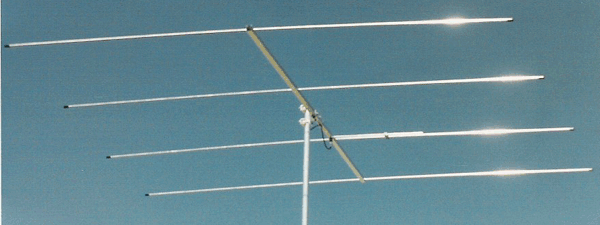 Sharp-eyed Roger, G3XBM, has brought attention to the recent news of a new amateur allocation granted to South Africa's amateur radio community! It's just a small slice of a band but in an exceptionally interesting part of the spectrum ... 40MHz!
 Amateurs have been given 'propagation studies' permission to transmit between 40.675MHz and 40.685MHz as 'primary users' and use up to 26dBW (400Watts) of power ... a healthy assignment.
I'm not sure where the push for this new band has risen from but no doubt from within the amateur radio community of South Africa ... and kudos to the SA radio authority for establishing this unique amateur band.
Myself and others, have often stated that an amateur allocation in the 40MHz region would be a wonderful part of the spectrum in which to experiment. Almost midway between the two "magic bands" (10m and 6m), the propagation opportunities of 40MHz would be most unique and abundant.
With Solar Cycle 24 being such a weak cycle, most of North America and particularly the western half, saw almost no F2 openings of any significance. Absent were the all-day long bone-crushing signals from the east coast, followed by the spotlight propagation-sweep down to South and Central America and finally over to Japan for another few hours of ear-shattering JA signals ... none of this for Cycle 24. Yet, in spite of the lower MUF's, I noted dozens and dozens of days when the F2 MUF would shoot up to the high 43MHz region and hang in for hours and hours ... just as it did on 6m in previous cycles.
Having even a small slice of spectrum at 40MHz would give amateurs a golden opportunity to follow some exceptionally interesting propagation trends during the next few cycles ... all predicted to be stinkers, some saying even worse than '24'. With 40MHz supporting the F2, Es, TEP and Auroral modes, there would be much exciting propagation to support activity in this region.
Maybe it's time North American amateur's start talking about a new slice of the 40MHz pie ... surely there is enough space to share.
Steve McDonald, VE7SL, is a regular contributor to AmateurRadio.com and writes from British Columbia, Canada. Contact him at [email protected].
Weekly Propagation Summary – 2015 Apr 06 16:10 UTC
Here is this week’s space weather and geophysical report, issued 2015 Apr 06 0133 UTC.
Highlights of Solar and Geomagnetic Activity
30 March – 05 April 2015
Solar activity was at low levels throughout the period. Region 2303
(N19, L=066, class/area=Hkx/400 on 17 Mar) produced low to mid-level
C-class activity early in the period while Regions 2318 (N10, L=199,
class/area=Dao/199 on 05 Apr) and 2320 (S12, L=212,
class/area=Dai/140 on 05 Apr) each produced only low-level C-class
flare activity throughout the remainder of the period.
A filament eruption centered near S29E28 was observed in SDO/AIA 193
imagery between 04/2225-2330 UTC. A long-duration C3/1f hyderflare
was measured during this event and had an associated Type-II radio
emission. The subsequent fast-moving coronal mass ejection (CME) was
first observed in SOHO/LASCO C2 coronagraph imagery beginning at
04/2336 UTC. WSA-ENLIL model output suggests a glancing blow arrival
of this CME late on 07 April.
No proton events were observed at geosynchronous orbit.
The greater than 2 MeV electron flux at geosynchronous orbit was at
normal levels on 30 Mar and normal to moderate levels on 31 Mar-05
Apr.
Geomagnetic field activity was at quiet to unsettled levels on 02-04
Apr with an isolated period of active conditions observed between
2100-2359 UTC on 02 Apr due to the effects of a positive polarity
coronal hole high speed stream. Quiet to unsettled levels were
observed on 30 Mar-01 Apr, and 05 Apr under a mostly nominal solar
wind environment.
Forecast of Solar and Geomagnetic Activity
06 April – 02 May 2015
Solar activity is expected to be low (below NOAA Scale event
thresholds) with a slight chance for M-class (R1-Minor) flare
activity throughout the outlook period.
No proton events are expected at geosynchronous orbit.
The greater than 2 MeV electron flux at geosynchronous orbit is
expected to reach high levels on 22-24 Apr and 02 May, moderate
levels on 06-08, 11-14, 17, 20-21 Apr, and 27 Apr-01 May, and at
normal levels for the remainder of the period.
Geomagnetic field activity is expected to be at G1 (Minor)
geomagnetic storm levels on 15-16, 18-19, and 25-27 Apr due to
coronal hole high speed stream effects. Active conditions are
expected on 07-09 Apr due to the anticipated arrival of the 04/05
Apr CME. Active conditions are expected on 17, 20 Apr, and 28 Apr-01
May due to coronal hole high speed stream effects with generally
quiet to unsettled levels likely for the remainder of the period.
Don’t forget to visit our live space weather and radio propagation web site, at: http://SunSpotWatch.com/
Live Aurora mapping is at http://aurora.sunspotwatch.com/
If you are on Twitter, please follow these two users:
+ https://Twitter.com/NW7US
+ https://Twitter.com/hfradiospacewx
Get the space weather and radio propagation self-study course, today. Visit http://nw7us.us/swc for the latest sale and for more information!
We’re on Facebook: http://NW7US.us/swhfr
Visit, subscribe: NW7US Radio Communications and Propagation YouTube Channel
UK price drop – FT817ND

I see that Martin Lynch is now selling the FT817ND for £449.95 (including VAT) which I guess is reflecting the exchange rate against the yen? Years ago it sold for less than £350 with VAT. I think the dealers are still making healthy profits? Why is this like fuel? When prices go up we soon hear about it. When price or exchange rates massively improve the suppliers are generally slow to respond.
Supply and demand? People are prepared to buy at silly prices and dealers are happy to make good profits whilst they can. At one time a few years ago £1 would get you about 125 Yen. Today £1 gets you more like 175 Yen. Have prices followed? Of course not! Don’t be silly – just a bit cheaper!
It would be nice if they were clearing stock ready for a newer model. Sadly, I doubt this is the case.
See https://sites.google.com/site/g3xbmqrp3/hf/ft817 .

Roger Lapthorn, G3XBM, is a regular contributor to AmateurRadio.com and writes from Cambridge, England.
More news on South African 8m band (40MHz)
Read it first hand in: www.icasa.org.za/Portals/0/Regulations/Working%20Docmuents/Radio%20Frequency%20Spectrum%20Regulations/RFSR2015.pdf
In South Africa the latest radio regulations permit the use by radio amateurs of 26dBW (400W) on a 10kHz wide band 40.675 – 40.685MHz “for propagation studies only”. Now this is exactly what OFCOM should have done in the interest of real radio-science research. Personally I think a wider band would be better, but how far sighted to allocate this at all. Well done S.Africa.
OK, I could pay £50 for a special research permit, but this is exactly what radio amateurs need for real self training and radio-science research. The take-up might be small, but real research would take place.
OFCOM/RSGB – how about it please? You have just allocated 2MHz (2 chunks of 1MHz) of spectrum that will be used by just a handful mainly for DTV tests. How about a much smaller slice somewhere really useful in the radio spectrum? 40MHz is mid-way between 10m and 6m, so ideal for Es tests and TEP tests over the equator.

Roger Lapthorn, G3XBM, is a regular contributor to AmateurRadio.com and writes from Cambridge, England.
FT991 Yaesu flagship "shack in a box"
 |
| http://www.hamradio.com/detail.cfm?pid=71-001812 |
The price here in the UK started out at £1279.95, (e.g. Martin Lynch and Waters and Stanton) which seemed high to me. The rig looks very attractive at the right price, but I think UK dealers are banking on “early adopters” who want a new radio at silly prices. Greed? Who said that? Surely not! Prices are a little cheaper in the USA but not sure of VAT and duty or guarantee. The usual guarantee from the big UK dealers on Yaesu products is 2 years, but it is wise to check. Also, further discounts may be offered if paying cash. I can wait and wait! £999 seems the right price, or even less.
The latest edition of Practical Wireless shows Haydon Communication now selling it at £1099.99. I assume this price includes VAT. I can see others matching or bettering this price when the “early adopters” have had their day.
The rig covers all modes 160m-70cms and includes a limited range internal ATU and a colour touch screen. It also supports Yaesu’s C4FM digital mode. Nice radio, at the right price. I expect the UK price will soon be £999. Wait.

Roger Lapthorn, G3XBM, is a regular contributor to AmateurRadio.com and writes from Cambridge, England.
LHS Episode #144: Amateur Radio Resources
 Hello, folks! We're happy to say that Pete has rejoined our crew for this episode of the show, and he brings with him some excellent information for all you listeners out there. We take a look at several great video and audio resources for amateur radio adventures this fortnight. On top of that, we give a detailed description of YFKtest in action during a contest, and an overview and introduction to the latest version of the Tucnak logger. Lots more news, reviews and excitement as well. Please enjoy!
73 de The LHS Guys
Russ Woodman, K5TUX, co-hosts the Linux in the Ham Shack podcast which is available for download in both MP3 and OGG audio format. Contact him at [email protected].
Series Eight Episode Seven – HF in Limited Space (05 April 2015)
Series Eight Episode Seven of the ICQ Amateur / Ham Radio Podcast has been released. In this episode, Martin M1MRB / W9ICQ is joined by Chris Howard M0TCH to discuss the latest Amateur / Ham Radio news. Colin M6BOY rounds up the news in brief, and this episodes feature is HF in Limited Space.
- RSGB Youth Committee Minutes Released
- Radio Ham Operator over the Moon at Decoding Space Message
- Radio Listening Declining among Young
- The World Wide Repeater Directory Bring Integrated Routing to Radio Programming!
- Ofcom Licence Emails
- 2015 Young Ham of the Year Award
- Did the Eclipse Affect Propagation?
- Camb-Hams to Operate from Isle of Mull
- Radio Ham Established World War 1 Listening Post
- Irish Amateur Radio Course Guide
Colin Butler, M6BOY, is the host of the ICQ Podcast, a weekly radio show about Amateur Radio. Contact him at [email protected].
 Ham Radio Deluxe |
 W5SWL Electronics |
 Ham Radio Prep |
 KB3IFH QSL Cards  Hip Ham Shirts  HamRadioAuctions HamRadioAuctions Reliance Antennas Reliance Antennas Enigma Shop Enigma Shop |  morseDX  Ni4L Antennas  R&L Electronics R&L Electronics antennas.us antennas.us QRV QRV |
- Matt W1MST, Managing Editor
