 |
 LHS Episode #145: Screaming Peanuts
 20 April 2015 | by
  Hello, friends! We're back with another fine episode of Linux in the Ham Shack. In this episode, we tackle topics like digital voice, the release of the 4.0 Linux kernel, installing or running Linux from a thumb drive, and a few rants from the peanut gallery. Please enjoy, and come back in a couple weeks for the next one!
73 de The LHS Guys
Russ Woodman, K5TUX, co-hosts the Linux in the Ham Shack podcast which is available for download in both MP3 and OGG audio format. Contact him at [email protected].
Rookie Roundup
Club member Dave KD2FSI, who qualifies as a Rookie by time, volunteered to set up the station. I say Dave qualifies as a Rookie by time, because by the rules of the contest, he does - he was licensed less than three years ago. However, he is certainly not a Rookie by experience. He has already upgraded to General and is a very busy Ham, diving headfirst into many different facets of the hobby, portable operations being one of his favorite. I wish I could take credit for steering him in that direction, but Dave discovered that joy on his own, without my help.
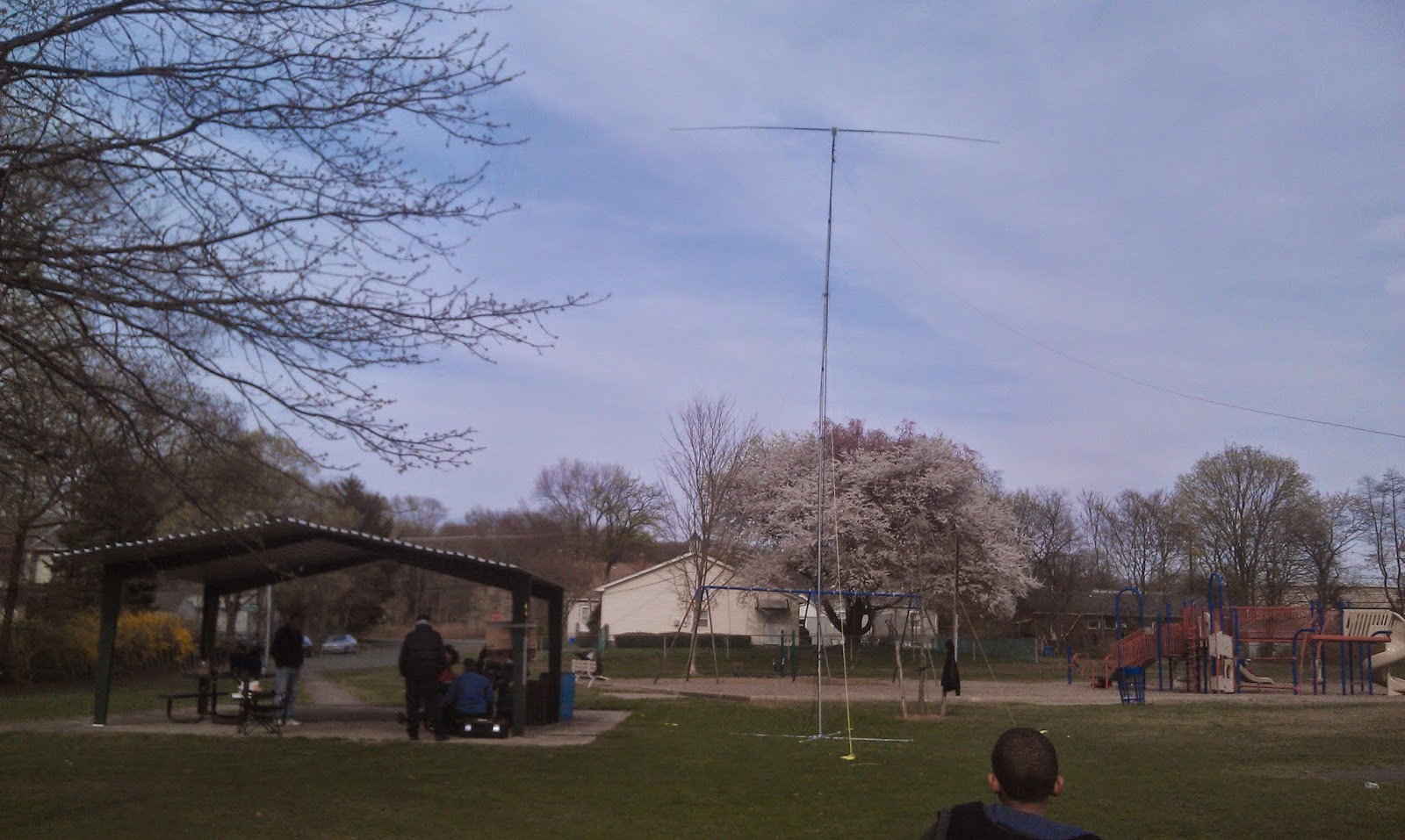
We had agreed to meet at Putnam Park in town at Noon, in order to set up for the 2:00 PM start. By the time I got there, Dave already had things quite well in hand.
Marv K2VHW and Drew W2OU served with distinction in the coaching perspective. Marv is quite the instructor. He has a gift and a natural talent for teaching and was able to make our Rookies feel like Old Pros in no time.
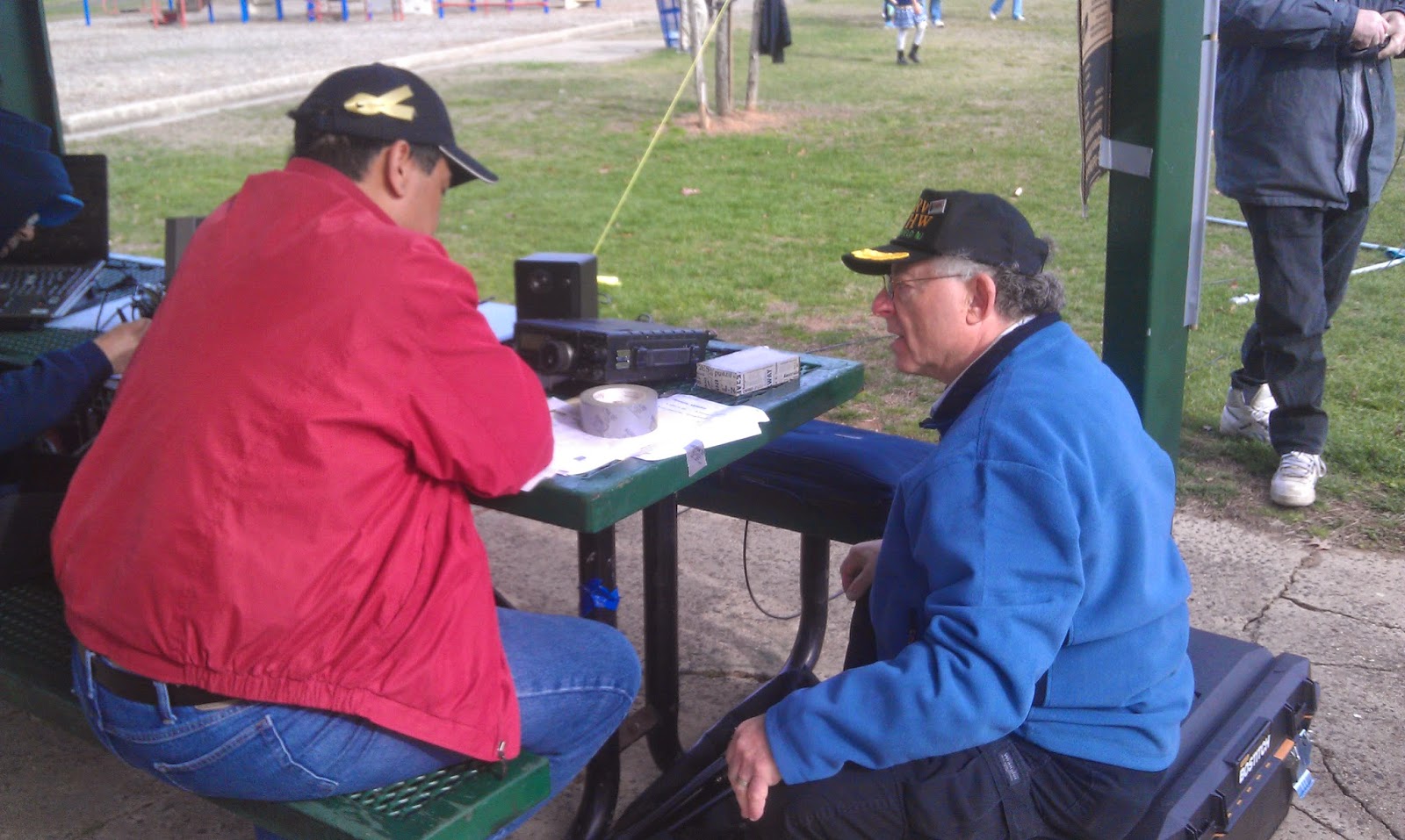
Here's a picture of Marv explaining to Mario the ins and outs of making a SSB Contest QSO. Mario made his very first HF QSO today, and the process was amazing to watch. The first few QSOs were halting and tentative, but due to Marv's excellent guidance, Mario was having a blast within short order.
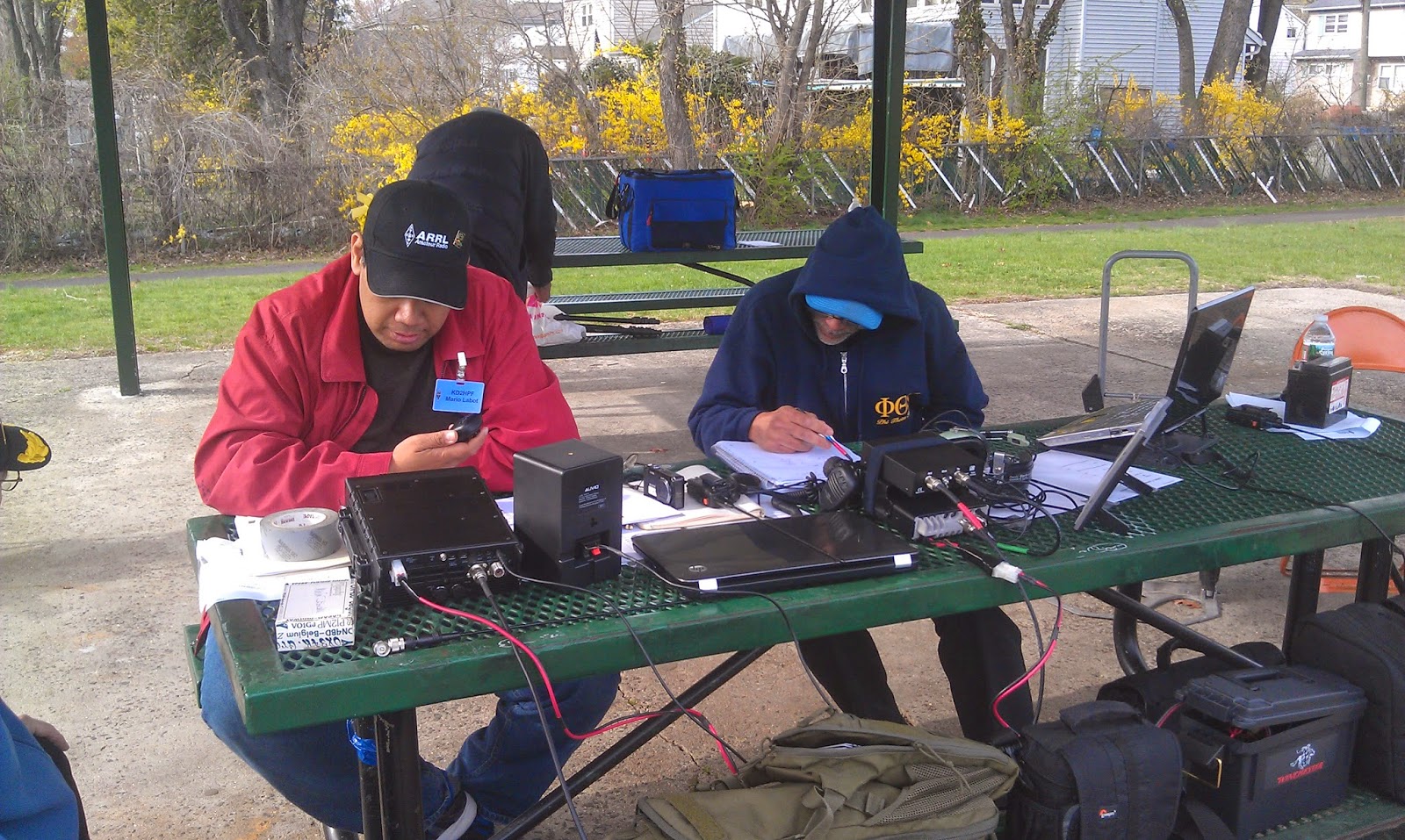
Within a short amount of time, our Rookies were able to handle QSO and logging chores while we stood in the background as control operators for NJ2SP.
The opportunity seemed golden. HF operating under portable ops conditions. With QRPTTF next weekend, how could I not bring the QRP gear along? It's always good to perform a test run, no?
I bungeed my 31' Jackite pole to a nearby post and set up the EARCHI antenna as a sloper.In between my stints as an HF coach, I went to town working stations on 20, 17, 15 and 10 Meters. A lot of the contacts were MM contest QSOs, but there was one ragchew in there, also. I worked
9A7R
ZW8T
OX3XR
CO8EH
WD4MSM - ragchew
KP2F
TM9B
EG8TRV - Special Event Station
HA8VK
Not bad for the time I had, in between helping with QSO procedures, serving as a helping set of ears, and talking with some of our other newly licensed Techs about equipment, making recommendations, etc.
The Rookies had a blast as well. 10 Meters was open to Texas and the West Coast and our newbies were amazed that "talking to a guy in Idaho" was as easy as talking to a guy on the local 2 Meter repeater - and that the guy in Idaho sounded better than the guy on the 2 Meter repeater!
In all it was a fun day. I'm not sure who had more fun - our new Techs in getting their feet wet in HF, or us veterans watching their fun and excitement. It was definitely rewarding, and I hope we pushed some people a little more deeper into this fine hobby.
72 de Larry W2LJ
QRP - When you care to send the very least!
Larry Makoski, W2LJ, is a regular contributor to AmateurRadio.com and writes from New Jersey, USA. Contact him at [email protected].
VLF field test tomorrow
Today I adjusted the turns ratio on my 8.976kHz VLF QRSS3 and 10wpm CW 5W beacon to better match my earth electrodes. At this QTH they look much greater than 50 ohms, which I measured at the “old” QTH and optimised for.
On the way I managed to blow up a TDA2003 IC, which I had to replace. The whole exercise was far more exhausting than I was expecting. It seems that after about 10-15 minutes of physical or mental effort I am done in. Before my cerebellum brain bleed everything today would have been trivial. Now trivial tasks feel like climbing mountains! Although I can see progress in my recovery there is still a long way to go. One of my aims (among many) is to be able to resume field tests as before, but time will tell if I am really up to this: it is quite hard when your brain is still foggy a lot of the time. Oddly, when sitting down at home or when driving things are fine. It is when I do something requiring real physical or mental effort that I get tired. I guess the radio work today was hard as I had not done this sort of thing for some time.
Anyway, the good news is that I hope to do a VLF field test tomorrow. Everything is ready and tested. It will not be until late afternoon as both my wife and I are busy before then. The XYL will be there at the test site if I get really tired. Setting up the gear will be especially tiring in my current state. The test site is not too far from home. I have soak tested the TX and it should be fine on QRSS3 using my loop and Spectran at the RX end. I shall report results tomorrow. This will be my first VLF field test in over 18 months. How I have looked forward to this. If the loop is successful I may try the E-field probe.

Roger Lapthorn, G3XBM, is a regular contributor to AmateurRadio.com and writes from Cambridge, England.
Series Eight Episode Eight – The RSGB Inspire Report (19 April 2015)
Series Eight Episode Eight of the ICQ Amateur / Ham Radio Podcast has been released. In this episode, Martin M1MRB / W9ICQ is joined by Ed Durrant DD5LP, Martin Rothwell M0SGL, and Chris Howard (M0TCH) to discuss the latest Amateur / Ham Radio news. Colin M6BOY rounds up the news in brief, and this episodes feature is - The RSGB_Inspire report (growing our Hobby)
- Teachers Wireless Lessons to Meet STEM Challenge
- Ofcom Agree 70.5-71.5 MHz
- Two New UK Repeaters
- International Marconi Day at Sandford Mill
- Amateurs and Vehicular Radars Can Play Nicely Together
- HB9AW Beacon Report
- International Achievement Award for Radio Ham
- Open Source CubeSat Projects
- UK Mobile Trading Regulations
- Nanaimo Club Celebrate Founding
Colin Butler, M6BOY, is the host of the ICQ Podcast, a weekly radio show about Amateur Radio. Contact him at [email protected].
Series Eight Episode Eight – The RSGB Inspire Report (19 April 2015)
Series Eight Episode Eight of the ICQ Amateur / Ham Radio Podcast has been released. In this episode, Martin M1MRB / W9ICQ is joined by Ed Durrant DD5LP, Martin Rothwell M0SGL, and Chris Howard (M0TCH) to discuss the latest Amateur / Ham Radio news. Colin M6BOY rounds up the news in brief, and this episodes feature is - The RSGB_Inspire report (growing our Hobby)
- Teachers Wireless Lessons to Meet STEM Challenge
- Ofcom Agree 70.5-71.5 MHz
- Two New UK Repeaters
- International Marconi Day at Sandford Mill
- Amateurs and Vehicular Radars Can Play Nicely Together
- HB9AW Beacon Report
- International Achievement Award for Radio Ham
- Open Source CubeSat Projects
- UK Mobile Trading Regulations
- Nanaimo Club Celebrate Founding
Colin Butler, M6BOY, is the host of the ICQ Podcast, a weekly radio show about Amateur Radio. Contact him at [email protected].
Hendricks Kits
These days, with dirt cheap kits from China often with free airmail, it is sometimes a wonder that any USA or UK kit companies exit at all. One of these I have mentioned before is Hendrick Kits, which always has a good selection on their website. These are best value if you live in the USA. Several kits are shown as “retired” which I guess means they did not sell well or they had problems with reproducibility. One favourite is the derivative of the BitX SSB design from Ashlan Farhan in India. This uses easily obtainable parts and has been a well proven design. Hendricks sell versions for 20m or 17m.
See http://www.qrpkits.com/bitx20a.html .
It looks like they have just moved so there might we a little delay until early May.
The power out, around 10W, should ensure plenty of contacts. These 2 bands are usually good even when the sun is quiet, so make a good choice. You have to choose either 20m or 17m SSB. I am sure Western kit companies would really value our business. “Use it or lose it”, is a phrase often used about bands. In this case it apples to amateur radio kit suppliers. If we don’t buy from them they will close their doors and cease trading. I am as guilty as anyone having recently bought a 40m Pixie kit from China.
From the Hendricks Kit website:
“The BitX20A and BitX17A are complete SSB kits with board, all parts, digital display and custom powder coated and punched case that is based on the BitX20 that was designed by Ashlan Farhan. The original version was built ugly construction, and you had to source all the parts. I discovered the BitX20 site on Yahoo in 2007, and decided that the BitX20 would be a neat kit for Hendricks QRP Kits. The problem was that it did not have a pcb. A team of Dan Tayloe, Jim Kortge and Arv Evans have worked countless hours making sure that the pcb version was stable and would meet United States F.C.C. Specs. We had to go through several revisions to get it right, and we are happy with the result, even though it took a long time. Some things just take time. The kit includes a commercial quality plated through, silkscreened, solder masked board, and all board mounted parts, plus the polyvaricon tuning capacitor, digital dial, custom powder coated and punched case, knobs and controls. Everything you need to build the kit is provided.
I encourage you to check out the BitX20 users group on Yahoo. They have agreed to provide support for the kits. There are hundreds of messages on there about the history and development of this kit. Our kit puts out about 10 watts, features dual IRF510’s as finals in a push-pull arrangement. The schematic is available at the Bitx20 site on Yahoo. Cost of the kit is $180.00 plus shipping and handling.“
The BitX looks a nice, useful radio. For a beginner it is just about all you need to get started.

Roger Lapthorn, G3XBM, is a regular contributor to AmateurRadio.com and writes from Cambridge, England.
Persistent Cycle 24
 |
| courtesy: http://sdo.gsfc.nasa.gov/ |
Our Sun's latest rotation is showing several new large sunspot groupings, all very capable of unleashing a new round of solar flares and associated disruption ... if nothing else, Cycle 24 is persistent!
 |
| courtesy: http://sdo.gsfc.nasa.gov/data/ |
 |
| courtesy: http://www.swpc.noaa.gov/ |

The software gurus at NOAA have been busy once again, this time revamping several of their visual models to an 'animated' mode. The Ovation Auroral map is particularly interesting when run in this mode as it shows the auroral field's activity visually over the past 24 hours. The display gives one a new appreciation for the dynamics of such large scale events:
 |
| courtesy: http://www.swpc.noaa.gov/communities/radio-communications |
 |
| courtesy: http://www.dxmaps.com/ |
Steve McDonald, VE7SL, is a regular contributor to AmateurRadio.com and writes from British Columbia, Canada. Contact him at [email protected].
 Ham Radio Deluxe |
 W5SWL Electronics |
 Ham Radio Prep |
 KB3IFH QSL Cards  Hip Ham Shirts  HamRadioAuctions HamRadioAuctions Reliance Antennas Reliance Antennas Enigma Shop Enigma Shop |  morseDX  Ni4L Antennas  R&L Electronics R&L Electronics antennas.us antennas.us QRV QRV |
- Matt W1MST, Managing Editor
