 |
 A lot better today!
 22 April 2015 | by
 That had me shaking my head even more.
I'm glad I didn't give in to the temptation to chuck it all for today, because I had the best QRP lunch time that I've had in a while - numbers and predictions be damned!
I started out on 17 Meters which seemed to be in great condition. Low noise level and some loud signals. I worked EA6NB, Jaime in the Balearic Islands. From there I wandered around a bit and worked W4B a Special Event Station for Earth Day in Florida.
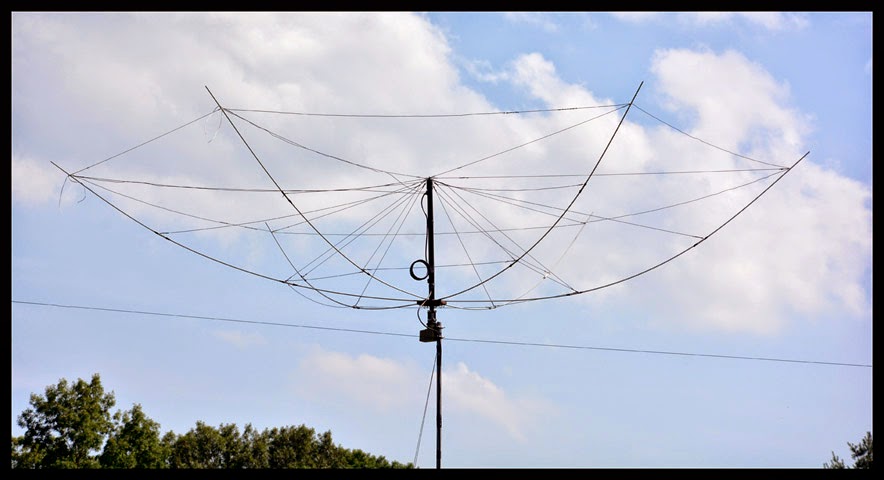
After that, I switched bands and called CQ near the 20 Meter QRP Watering Hole and was answered by Dick K5TF in Atlanta, GA. Dick had a gorgeous signal. He was pushing 5 Watts out of his K2 to a Hexbeam (secretly, I am lusting for one of these babies. Bob W3BBO and I always dream about getting one for our stations and my good friend and fellow DXer/QRPer Steve WX2S is in the process of installing one). Not only was Dick's signal excellent, but his fist was a dream to copy. The words were appearing in my brain as if I were reading a teleprompter. It was a very enjoyable, but short chat.
From there, I decided to spend the last bit of time that I could squeeze out of lunch break by calling CQ at the 15 Meter QRP Watering Hole on 21.060 MHz. I was greeted there by Alberto WP4L for another 2X QRP chat. Alberto was pushing 5 Watts out of his Yeasu FT-450 and sounded like he was just down the street. And I might add, another excellent fist that was bliss to copy.
If the flare that Marv e-mailed me about helped provide the kind of band conditions that I experienced today, then I hope we get them all the time! Loud signals, quiet background noise - what more could you want or ask for? The only bad thing was having to stop so that I could come back inside in order to finish the work day out.
72 de Larry W2LJ
QRP - When you care to senf the very least!
Larry Makoski, W2LJ, is a regular contributor to AmateurRadio.com and writes from New Jersey, USA. Contact him at [email protected].
Hunting For NDB’s In CLE193
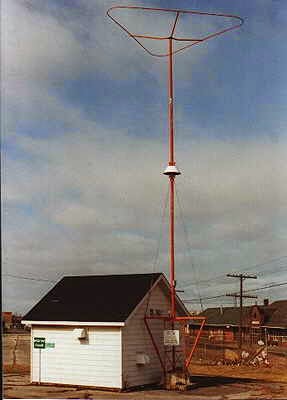 |
| SN-408 courtesy: Alex Wiecek |
It's CLE time once again! For you low-frequency buffs, another challenge awaits. This months frequency range covers the high end, 400-419.9 kHz. Perhaps you can log little 13-watt SN (St. Catherines, Ontario) on 408kHz, last logged here in February 2014.
Conditions have been up and down so lets keep our fingers crossed for some good propagation.
From CLE coordinator Brian Keyte (G3SIA) comes the following reminder:
"Our 193rd co-ordinated listening event starts on Friday. After the Navtex
Do join in even if you only have an hour or so to spare over the weekend.
Days: Friday 24 - Monday 27 April 2015
Times: Start and end at midday your LOCAL time
Range: 400 - 419.9 kHz
Just log all the NDBs you can identify with nominal (listed)
frequencies in the range - it includes 400 kHz, but not 420 kHz -
plus any UNIDs that you come across there.
Please send your CLE log to the List (no attachments and ideally in a
plain text email) with CLE193 at the start of its title. Show on each line:
# The Date (or Day No: 24 to 27)
# The Time in UTC (the day changes at 00:00 UTC).
# kHz - the nominal published frequency, if known.
# The Call Ident.
Please show those main items FIRST. Any other optional details such
as Location and Distance go LATER in the same line.
If you send any interim logs, please also send a 'Final' (complete) one.
And, of course, tell us your own location and brief details of the
equipment that you were using during the Event.
I will send the usual 'Any More Logs?' email soon after 17:00 UTC
on Tuesday so that you can check that your log has been found OK.
Do make sure that your log has arrived on the List by 08:00 UTC
on Wednesday 29 April at the very latest.
The combined results should be completed on that day.
You can find full details about current and past CLEs from the CLE page
http://www.ndblist.info/cle.htm including access to the CLE193 seeklists
for your part of the World prepared from the loggings on Rxx.
Good listening - enjoy the CLE.
Brian
----------------------------------------------------------
From: Brian Keyte G3SIA: <ndbcle'at'gmail.com>
Location: Surrey, SE England (CLE co-ordinator)
----------------------------------------------------------
(If you would like to listen remotely you could use any one remote
receiver such as http://websdr.ewi.utwente.nl:8901/ for your
loggings, stating its location and owner and with their permission
if required. A remote listener may NOT also use another receiver,
local or remote, to make further loggings for the same CLE)"
These listening events serve several purposes. They:
- determine, worldwide, which beacons are actually in service and on-the-air so the online database can be kept up-to-date
- determine, worldwide, which beacons are out-of-service or have gone silent since the last CLE covering this range
- will indicate the state of propagation conditions at the various participant locations
- will give you an indication of how well your LF/MF receiving system is working
- give participants a fun yet challenging activity to keep their listening skills honed
Final details can be found at the NDB List website, and worldwide results, for every participant, will be posted there a few days after the event. If you are a member of the ndblist Group, results will also be e-mailed and posted there.
The very active Yahoo ndblist Group is a great place to learn more about the 'Art of NDB DXing' or to meet other listeners in your region. There is a lot of good information available there and new members are always very welcome.
If you are contemplating getting started on 630m, listening for NDBs is an excellent way to test out your receive capabilities as there are several NDBs located near this part of the spectrum.
You need not be an ndblist member to participate in the CLEs and all reports, no matter how small, are of much value to the organizers. 'First-time' logs are always VERY welcome!
Reports may be sent to the ndblist or e-mailed to either myself or CLE co- ordinator, Brian Keyte (G3SIA), whose address appears above.
Please...do give the CLE a try....then let us know what NDB's can be heard from your location! Your report can then be added to the worldwide database to help keep it up-to-date.
Steve McDonald, VE7SL, is a regular contributor to AmateurRadio.com and writes from British Columbia, Canada. Contact him at [email protected].
Optical testing – too easy?
Before dark, I tried TXing from one side of the house to the other reflecting my 481THz optical beacon off the windmill. Even by ear in 600 ohm phones the signal was very clear and very easy to find. This was only about 100m path length, but I wanted to check the gear still worked as it is a long time since I used it. Not sure what to try next as I still feel very wobbly on my feet and tire easily. At least I know my homebrew optical gear all works still.

Roger Lapthorn, G3XBM, is a regular contributor to AmateurRadio.com and writes from Cambridge, England.
Ham College episode 4 Live Stream
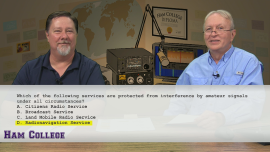
Episode 4 of Ham College is this Thursday, April 23rd at 7PM CDT, 000 UTC at live.amateurlogic.tv
George Thomas, W5JDX, is co-host of AmateurLogic.TV, an original amateur radio video program hosted by George Thomas (W5JDX), Tommy Martin (N5ZNO), Peter Berrett (VK3PB), and Emile Diodene (KE5QKR). Contact him at [email protected].
Next field test – optical?
After my very disappointing results on VLF earth-mode yesterday – I must get to the bottom of why results were quite so bad – I think my next test will be at the other end of the spectrum. We have a windmill very close so I may try bouncing optical signals off this to test my optical gear is working still. It is a long time since I have done any optical experiments.This will not be too far initially, more a test of the gear before venturing any distance.

Roger Lapthorn, G3XBM, is a regular contributor to AmateurRadio.com and writes from Cambridge, England.
VLF field test – a total failure!
Well, I did my first VLF earth-mode field test today since my brain bleed in Sept 2013. Sadly, it was a total failure. I am at a loss to explain the results.
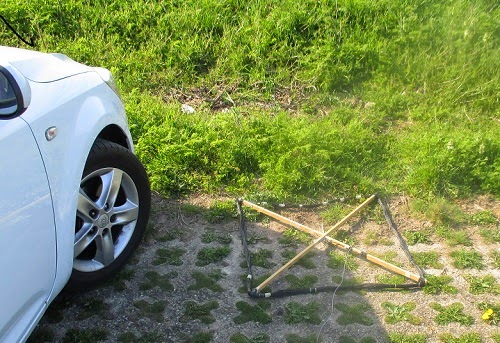 |
| Tuned VLF loop |
I put the 5W, 8.976kHz, beacon on into the same earth electrodes used successfully on 472kHz (best DX on TX over 1000km) and went about 1.6km to a car park where I always had strong signals using a tuned loop on RX and earth-electrodes on TX from the old QTH in the same village. Nothing at all copied today – absolutely nothing. I waited in case I was in a pause between QRSS3 callsign transmissions, but no absolutely nothing at all. Not even the tiniest hint of a signal.
So I parked in the road about 0.3km from this QTH and again nothing at all. At this point we drove home.
Sure enough, everything was still working at the TX end. I am using one remote ground and the mains ground as the shack end as for 472kHz. I did check this was grounded to real ground.
So, whatever utilities assistance I was getting before at the old QTH is not the same at this newer QTH. All very very odd. I was expecting to see something. In the past I received transmissions from the old QTH at the new QTH (about 0.3km away) using just an E-field probe on the car. From the old QTH I spanned 6km!
In summary, this VLF test was a total failure. I am at loss to explain things. Not only that, but the work has left me very exhausted. My brain is still foggy, but the results today were not due to any mistakes with the HW gear or PC Spectran settings.
I am not having much success today.

Roger Lapthorn, G3XBM, is a regular contributor to AmateurRadio.com and writes from Cambridge, England.
Weekly Propagation Summary – 2015 Apr 20 16:10 UTC
Here is this week’s space weather and geophysical report, issued 2015 Apr 20 0248 UTC.
Highlights of Solar and Geomagnetic Activity
13 – 19 April 2015
Solar activity was at very low to low levels. Numerous weak to
moderate level C-class flares were observed from Regions 2320 (S12,
L=211, class/area Dac/180 on 07 Apr), 2321 (N13, L=095, class/area
Ekc/620 on 13 Apr) and 2324 (N18, L=062, class/area Dko/410 on 15
Apr). The most significant event of the period occurred from Region
2321 on 18 April when the region produced a C5/1f flare at 18/1419
UTC. Associated with this event was a 7 degree long filament
eruption, centered near N05W16. The filament eruption resulted in an
asymmetric, faint full-halo CME, first visible in SOHO/LASCO C2
imagery at 18/1524 UTC.
No proton events were observed at geosynchronous orbit.
The greater than 2 MeV electron flux at geosynchronous orbit was at
normal levels on 13-15 April and high levels on 16-19 April.
Geomagnetic field activity began the period on 13-14 April at quiet
to active levels under the influence of a weak transient. By midday
on 15 April, field activity increased to active to minor storm
(G1-minor) levels as a co-rotating interaction region (CIR), in
advance of a negative polarity coronal hole high speed stream (CH
HSS), influenced the magnetic field of Earth. Geomagnetic activity
increased to major storm (G2-moderate) levels late on 16 April due
to CH HSS effects and continued at active to minor storm levels
through midday on 17 April. Field activity relaxed to quiet to
unsettled levels through the remainder of the summary period as CH
HSS effects waned.
During the period, ACE solar wind parameters measured a high wind
speed of 784 km/s on 17/0408 UTC with a low speed of 286 km/s on
14/0004 UTC. Total field (Bt) ranged from about 1-17 nT while the Bz
component varied between +13 to -12 nT. The phi angle was generally
in a negative (towards) orientation with intermittent periods of
rotation to a positive (away) sector.
Forecast of Solar and Geomagnetic Activity
20 April – 16 May 2015
Solar activity is expected to be very low to low with a slight
chance for moderate (R1-R2/minor-moderate) levels through 24 April
due to the flare potential from Region 2321. Very low to low levels
are expected from 25 April through 06 May. From 06-16 May, activity
levels are expected to increase to a chance for
(R1-R2/minor-moderate) levels upon the return of old Region 2321
(N11, L=092).
No proton events are expected at geosynchronous orbit, barring any
significant flare activity.
The greater than 2 MeV electron flux at geosynchronous orbit is
expected to be at moderate to high levels from 20 April-06 May,
normal to moderate levels from 07-12 May and moderate to high levels
from 13-16 May.
Geomagnetic field activity is expected to be at G1 (minor)
geomagnetic storm levels on 21 and 22 April due to CME effects.
Field activity is expected to be at G1 (minor) geomagnetic storm
levels on 14 May with unsettled to active conditions expected on 20,
25, 29-30 April and 01, 13 and 15 May, all due to CH HSS effects.
Quiet to unsettled field activity is expected for the remainder of
the outlook period.
Don’t forget to visit our live space weather and radio propagation web site, at: http://SunSpotWatch.com/
Live Aurora mapping is at http://aurora.sunspotwatch.com/
If you are on Twitter, please follow these two users:
+ https://Twitter.com/NW7US
+ https://Twitter.com/hfradiospacewx
Get the space weather and radio propagation self-study course, today. Visit http://nw7us.us/swc for the latest sale and for more information!
We’re on Facebook: http://NW7US.us/swhfr
Visit, subscribe: NW7US Radio Communications and Propagation YouTube Channel
 Ham Radio Deluxe |
 W5SWL Electronics |
 Ham Radio Prep |
 KB3IFH QSL Cards  Hip Ham Shirts  HamRadioAuctions HamRadioAuctions Reliance Antennas Reliance Antennas Enigma Shop Enigma Shop |  morseDX  Ni4L Antennas  R&L Electronics R&L Electronics antennas.us antennas.us QRV QRV |
- Matt W1MST, Managing Editor
