 |
 Ham Radio to the rescue!
 19 May 2015 | by
 http://kdvr.com/2015/05/17/littleton-snowshoer-rescued-after-falling-off-icy-ledge/
Thanks to Drew W2OU for pointing this one out.
But in all seriousness folks, portable ops can seem harmless, but they come with their own hazards and some can be life threatening.
Just a few basic things to keep in mind:
Don't go hiking alone if you're unfamiliar with the trail. It's too easy to get lost. I speak of this one from personal experience. Once I was out on a hike in the Adirondacks on an unfamiliar trail for the first time, and I took a turn I shouldn't have and found myself off the trail. Fortunately, I kept calm, retraced my steps and found my way back quickly and easily. However, if you panic, all bets may be off. Moral of the story - two or more sets of eyes are better than one when looking for trail markers.
Always take along extra water, food and appropriate clothing. While it may be hot and sunny when you start out, weather can and often does change in a heart beat, so keep weather conditions in mind. For good measure, always bring along your VHF/UHF handheld, it could literally save your life.
Let someone know where you're going and approximately how long you'll be gone.
This is an obvious one, but people sometimes forget. If you can hear thunder, shut the station down! A storm does not have to be right on top of you to be a lightning threat. Lightning bolts can touch down more than 10 miles away from a thunderstorm's leading edge.
Portable operating is about the most fun you can have in Amateur Radio, but you have to approach it in a common sense fashion.
72 de Larry W2LJ
QRP - When you care to send the very least!
Larry Makoski, W2LJ, is a regular contributor to AmateurRadio.com and writes from New Jersey, USA. Contact him at [email protected].
SOTA Mountain Goat Trophy Arrives
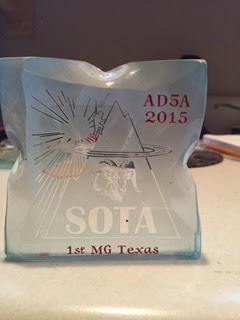 |
| My Ph.D. in Portable Mountain Ops |
Mike Crownover, AD5A, is a regular contributor to AmateurRadio.com and writes from Texas, USA. Contact him at [email protected].
SOTA Mountain Goat Trophy Arrives
|
| My Ph.D. in Portable Mountain Ops |
Mike Crownover, AD5A, is a regular contributor to AmateurRadio.com and writes from Texas, USA. Contact him at [email protected].
Yaesu FT7 HF transceiver
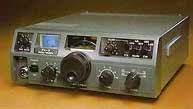 |
| Yaesu FT7 – a true classic |
Way back in about 1979 I owned a Yaesu FT7. This was a 10W HF rig using a modular construction. It was a beautiful radio with a lovely, quiet receiver. It is probably the best radio I have ever owned and used. It predates WARC bands and only covered one 500kHz part of the 10m band and the non-WARC bands from 80m-10m. Today, it looks large. It was an analogue radio – no memories, no synthesisers – just a very good HF radio transceiver. I worked all over the world with mine using QRP SSB and simple, low, wire antennas and no beams, mainly on 10m. In those days, most (all?) USA SSB was above 28.5MHz. Canadians were mainly below 28.5MHz.
My little FT817 has more bands and modes and is about 1/10th of the size.
I can thoroughly recommend the FT7, but they are very hard to find. A later version was 50W pep and had full 10m coverage in 4 x 500kHz sections. The FT7 was a “real” radio – no gimmicks, just a truly amazing rig. Many who owned them and sold them (like me) later regretted selling them. As they say, these rigs are “keepers”. If you find one you are unlikely to be disappointed. Also, the handbook was complete so you could service it and not an SMA component in sight!
See https://sites.google.com/site/g3xbmqrp3/hf/ft7 .

Roger Lapthorn, G3XBM, is a regular contributor to AmateurRadio.com and writes from Cambridge, England.
Miracle Whips and derivatives/copies
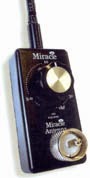
A 56 inch long whip can only behave like a 56 inch whip. This is a basic law of physics. What the Miracle Whip (MW) and its derivatives do is match this whip on the HF and VHF bands. With a decent ground or counterpoise wire the MW may be only a couple of S-points down on a “decent” antenna on the higher HF bands. They work reasonably well and, in the past, I used my MW quite a bit, even from indoors. They are definitely NOT a miracle antenna, although they are not too bad. Since the owner, a Canadian called Robert, died there have been a few newcomers in the market.
Would I buy one today? Probably not. I have had better results with small loops. As a simply deployed mainly RX antenna they make an ideal companion for an FT817 or similar. Their beauty is their simplicity. If you want optimum performance in a small antenna there are better solutions. Small loops seem to work better, but then bandwidth becomes very narrow although loops don’t need grounds or counterpoises to work well. Personally, at QRP levels I’d use a loop every time.
As Wheeler showed years ago, efficient small antennas are reactive and unless losses are minimised, efficiency suffers. This is a fundamental limitation. Although high permeability ferrites and high permittivity ceramics can help to alter the size of space near an antenna and “magnify” the effective size of small antennas, the effect is small unless there is a lot of ferrite with high permeability or a lot of ceramic with a high permittivity. In theory, a tiny antenna can be very efficient but you’d need superconductors and lossless capacitors! At the moment, sadly, neither are practical to mortals!
See https://sites.google.com/site/g3xbmqrp3/antennas/mwhip .

Roger Lapthorn, G3XBM, is a regular contributor to AmateurRadio.com and writes from Cambridge, England.
Weekly Propagation Summary – 2015 May 18 16:10 UTC
Here is this week’s space weather and geophysical report, issued 2015 May 18 0402 UTC.
Highlights of Solar and Geomagnetic Activity
11 – 17 May 2015
Solar activity was low from 11-15 May. The largest event of the
period was a C9/1n at 13/1838 UTC associated with a filament
eruption near Region 2345 (N16, L=113, class/area Axx/020 on 13
May). Region 2339 (N13, L=129, class/area Fkc/900 on 08 May) was the
most active region on the disk and produced 19 C-class events during
the period. There were several filament eruptions observed during
the period however, none of them turned out to be geoeffective.
Solar activity decreased to very low levels for 16-17 May.
The greater than 10 MeV proton flux at geosynchronous orbit was
enhanced on 12 May reaching a peak flux of 6 pfu at 12/0720 UTC but
never crossed alert threshold.
The greater than 2 MeV electron flux at geosynchronous orbit was at
normal to moderate levels on 11-13 May before reaching high levels
daily for the remainder of the period in response to effects from a
negative polarity coronal hole high speed stream (CH HSS).
Geomagnetic field activity was at unsettled to active levels on 11
May and mostly unsettled levels on 12 May due to extended periods of
negative Bz. On 13 May, geomagnetic field conditions increased to
active to major storm levels due to the onset of a recurrent
negative polarity CH HSS. Quiet to unsettled levels persisted on
14-15 May as effects from the HSS subsided. Quiet conditions
prevailed for the remainder of the period.
Forecast of Solar and Geomagnetic Activity
18 May – 13 June 2015
Solar activity is expected to be at very low levels with a chance
for C-class flares and a slight chance of M-class flares on 18 May
before decreasing further to only a chance for C-class flares once
Region 2339 rotates fully around the west limb on 19 May. The chance
for M-class activity increases on 25 May with the return of old
Region 2335 (S15, L=192) and remain elevated through the remainder
of the forecast period.
No proton events are expected at geosynchronous orbit.
The greater than 2 MeV electron flux at geosynchronous orbit is
expected to be at moderate to high levels from 18-28 May due to
residual effects from last weeks negative polarity CH HSS followed
by effects from an anticipated positive polarity HSS due to become
geoeffective on 18 May. Normal to moderate levels are expected to
prevail with the exception of 31 May-01 Jun, 04-06 Jun, and 10-12
Jun following various recurrent CH high speed streams.
Geomagnetic field activity is expected to be quiet to active on
18-19 May due to effects from a positive polarity CH HSS. Mostly
quiet conditions are expected from 20 May to 01 Jun. Quiet to
unsettled conditions with a chance for active periods are expected
on 02-03 Jun due to effects from a negative polarity HSS followed by
quiet conditions through 06 Jun. Unsettled conditions are expected
on 07 and 10 Jun as well as active to minor storm conditions on
08-09 Jun due to the anticipated return of the recurrent negative
polarity CH HSS that yielded major storm conditions this week.
Mostly quiet conditions are expected for the remainder of the
period.
Don’t forget to visit our live space weather and radio propagation web site, at: http://SunSpotWatch.com/
Live Aurora mapping is at http://aurora.sunspotwatch.com/
If you are on Twitter, please follow these two users:
+ https://Twitter.com/NW7US
+ https://Twitter.com/hfradiospacewx
Get the space weather and radio propagation self-study course, today. Visit http://nw7us.us/swc for the latest sale and for more information!
Check out the stunning view of our Sun in action, as seen during the last five years with the Solar Dynamics Observatory (SDO):
https://www.youtube.com/watch?v=zXN-MdoGM9g
We’re on Facebook: http://NW7US.us/swhfr
Visit, subscribe: NW7US Radio Communications and Propagation YouTube Channel
Microvert antennas and similar
It looks like the Microvert antenna may have originated in Japan? The Microvert is a very compact antenna. Some believe the coax is a major part of the radiating system. Having never tried this sort of antenna I am unable to comment. This was posted to the Microvert Yahoo group earlier:
Whether you believe it’s the coax radiating or not, this is still interesting:
The Super Rad Antenna (Induced Secondary Radiation Antenna)
There are other websites about SRA (secondary radiation antenna), but unfortunately all in Japanese. Its definetly a Japanese thing!
I have all the parts required here to make one of these. Whether you believe its the coax radiating or not the results will be interesting.
Rob
M0RZFPS. My old 10m/12m modified microvert gives a good SWR.
See http://t54979899.blogspot.co.uk/?view=classic.
Roger Lapthorn, G3XBM, is a regular contributor to AmateurRadio.com and writes from Cambridge, England.
 Ham Radio Deluxe |
 W5SWL Electronics |
 Ham Radio Prep |
 KB3IFH QSL Cards  Hip Ham Shirts  HamRadioAuctions HamRadioAuctions Reliance Antennas Reliance Antennas Enigma Shop Enigma Shop |  morseDX  Ni4L Antennas  R&L Electronics R&L Electronics antennas.us antennas.us QRV QRV |
- Matt W1MST, Managing Editor
