 |
 The scoop from Elecraft at FDIM
 14 May 2015 | by
 The new product is an enhanced K3 with many new features - here's a link to a .pdf which explains them all in detail. And here's a link to a FAQ.
It appears the new K3S will be approximately $500 more than the old version, and the original K3 has been "discontinued" or "replaced" - whichever you prefer. In addition, it appears most, but not all the enhancements will be retro-fittable to make a K3 a K3S. The new bezel and the attenuator, for instance, will not.

I wonder - how does the guy feel who took delivery on a brandy new K3, in the very recent past? Are they happy because they squeaked under the wire and got their K3 at the lower price? Or are they feeling a bit miffed because they ordered and received something that is no longer "the latest and the greatest"? Except for the cosmetics, it appears that you can pretty much turn your existing K3 almost into a K3S - and you do have a "system" that is continually upgradable. So if you're an Elecraft owner, you can take comfort in the fact that when you buy something, the company does its best to stand behind their product and you.
I for one, am quite happy with my KX3's. They're all the radio I need, and should Elecraft come out with a KX3S tomorrow, I would not be bothered in the least.
The morning UStream feed from FDIM was disappointing. If you attempted to watch it, you saw that only a portion of the video picture appeared and none of the audio. Basically, you missed the entire Elecraft K3S presentation. Things got straightened out during Rev. Dobb's presentation and we were able to hear that the good Reverend was inaugurated as QRP-ARCI's very first Lifetime Member.
The silver lining is that hopefully the feed will be up and running normally for the remaining sessions.
72 de Larry W2LJ
QRP - When you care to send the very least!
Larry Makoski, W2LJ, is a regular contributor to AmateurRadio.com and writes from New Jersey, USA. Contact him at [email protected].
Are You Going To Dayton?
This is a question I ask of vendors I order equipment and amateur radio goodies from. You should ask the same of your vendors. If your vendors don’t support Dayton, perhaps you should consider supporting different vendors. Why, you ask? Dayton is the largest amateur radio event in the US and perhaps the western hemisphere. It’s struggled over the years. However, the visual appearance and condition of Hara Arena tends to tarnish the state of the Dayton Hamvention, in my opinion. I think the Hamvention is actually doing well. Attendance was up last year. Looking at the schedule of seminars this morning, it’s a wonderful collection of varied topics, with something for everyone. The flea market is huge and it’s exhausting to cover the entire area in the three days. If your vendor is devoted to amateur radio, they should come to the Dayton Hamvention. If they can’t make a profit attending and selling products or generating sales leads, perhaps something is wrong with their products, marketing, or business model. If a vendor devotes the time and effort to come to Dayton with products to sell, buy their warez! The Hamvention is more than a hamfest, it’s a social event, a gathering, a celebration, and an economic ecosystem for amateur radio. See you at Dayton!

Anthony, K3NG, is a regular contributor to AmateurRadio.com.
Something new from Elecraft?
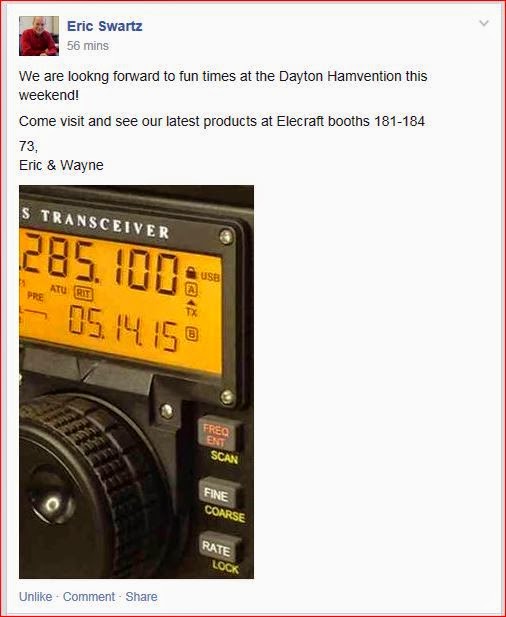
Notice the use of tomorrow's date in the display. Also - the current black chassis radios in the Elecraft line are the K3 and the KX3. Both use black screws on the bezel - not silver. AND the last character before the word "Transceiver" on both radios is a "3" ...... not an "s". Lastly, there's no current radio in the Elecraft line (that I'm aware of) that has that little "down arrow" above the VFO knob.
Seems to me that a major announcement is in the offing for tomorrow. I guess time will tell!
72 de Larry W2LJ
QRP - When you care to send the very least!
Larry Makoski, W2LJ, is a regular contributor to AmateurRadio.com and writes from New Jersey, USA. Contact him at [email protected].
It’s time
To explain what I mean ..... I went down to the shack last night to add some entries to my main logging program from the HamLog app I use when operating portable. I flipped the on switch at 9:30 PM and by the time it had booted up and the logging program had loaded it was about 9:47 PM. 17 minutes is not good. I wanted to start pulling out my hair by then. I think watching paint dry, or grass grow would have been less stressful and more entertaining.
That exercise in frustration drove me to start searching the Web. At work, IBM issued me a Lenovo T410. I still use this model every day. Yes, they are slowly being refreshed out with the newer T440 model, but mine has served me decently well at the job over the last few years. I have found a couple places where I can pick up a refurbed T410 with 4G of RAM, a 250 GB hard drive and Windows 7 Professional in the $150 neighborhood.
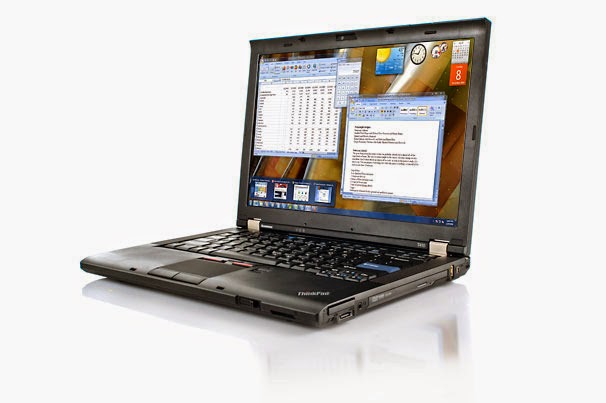
This model has everything I would need. It can hook up to the Internet wirelessly, it has 3 USB ports (need one for the KX3, one for a mouse, and one for an external keyboard), provisions for adding a second VGA monitor and the standard audio ports, so I can do the digital modes, should I ever be inclined to go down that road. Not planning to go there, but you never know. I'll have to dip into savings to acquire one, but having a computer in the shack has almost become a necessity.
Of course, I could always go native and log strictly with paper and pencil, but I don't think the ARRL would accept mailed in Xerox copies of my log for LoTW. Also, I like to keep my eye on QRPSPOTS as well as SOTAWatcher. Can't do that without some kind of computer, although I guess I could always just use my cell phone for those. And having a Telnet DX Cluster at my disposal for confirming that I correctly copied the call of that DX station who was sending at a blistering 45 WPM is a nice thing to have, too. (Was that an "H", or a "5" ? - 37 years of Hamming and my ears still wig out on those two, at times.)
This is another occasion where I'll just have to bite the bullet and take the plunge. Good thing I wasn't planning on going to Dayton.
Oh, and by the way, as long as I mentioned Dayton .... best wishes to all those heading to Ohio for FDIM and Hamvention. May the weather be good, the traffic light and travelling conditions safe - there and back!
72 de Larry W2LJ
QRP - When you care to send the very least!
Larry Makoski, W2LJ, is a regular contributor to AmateurRadio.com and writes from New Jersey, USA. Contact him at [email protected].
Don’t ask, just do
I was out running errands over lunch and I had my VHF radio scanning the local ham repeaters. It was almost noon, which meant it was time for all of the talking controllers to start telling me the time. It’s a bit annoying – some of these systems only transmit to tell the time, as their users have either passed away or moved away. Even more annoying to me was the fact that none of their clocks were synced to an accurate time source. And then one of the repeaters started rebroadcasting the NWS severe weather outlook for this afternoon.
What may be annoying to me is experimentation and fun for others. I’m sure that the repeater builder that did the NWS radio interfacing had a good afternoon, weekend, or even week of experimentation to get it all to work. And the ham that programmed his custom macros into his controller probably had a hoot getting it all setup and customized.
I got to wondering…are all of these automated and retransmissions legal? This led me down one of my favorite rabbit holes – www.repeater-builder.com. There I found this posting from WA6ILQ, The article is about weather radio interfacing to repeaters….but the fun part is near the bottom where he quotes an old ham about don’t asking for permission…just go do it.
> The words were "Don't even (expletive deleted) THINK about it".
> As in don't make that (expletive deleted) phone call, don't write
> that (expletive deleted) letter. Just build your wondertoy and use
> it - but do it carefully, and cleanly (as in spectrally clean), and
> make sure that you have your technical and legal arguments worked
> out well in advance. Make sure that you aren't doing the A, B, or C
> that the FCC forbids amateurs to do. If the FCC does't like your
> brand new wondertoy or it's effects or emmissions they will send a
> certified and return-receipt-requested cease-and-desist letter telling
> you to stop doing it. At that point you stop doing it and send a
> registered and certified and return-receipt-requested letter back
> the next day (call in sick to work if you have to). In that letter
> you say "I received  your letter on date (X) and at time (Y)
> and at time (Y+5 minutes) I shut off the offending transmitter and I am sorry,
> I didn't realize it was illegal and my thinking was (yadda yadda yadda)
> and (yadda yadda yadda) and (yadda yadda yadda) and how can we resolve this?".
> (and you thought that those creative writing classes in college and
> university were a waste of time...)
Words to live by. In ham radio, don’t ask, just do. And who am I to complain? I can always update my scan list. I’m glad I’m a part of a hobby that lets this stuff happen!
Michael Brown, KG9DW, is a regular contributor to AmateurRadio.com and writes from Illinois, USA. Contact him at [email protected].
Don’t ask, just do
I was out running errands over lunch and I had my VHF radio scanning the local ham repeaters. It was almost noon, which meant it was time for all of the talking controllers to start telling me the time. It’s a bit annoying – some of these systems only transmit to tell the time, as their users have either passed away or moved away. Even more annoying to me was the fact that none of their clocks were synced to an accurate time source. And then one of the repeaters started rebroadcasting the NWS severe weather outlook for this afternoon.
What may be annoying to me is experimentation and fun for others. I’m sure that the repeater builder that did the NWS radio interfacing had a good afternoon, weekend, or even week of experimentation to get it all to work. And the ham that programmed his custom macros into his controller probably had a hoot getting it all setup and customized.
I got to wondering…are all of these automated and retransmissions legal? This led me down one of my favorite rabbit holes – www.repeater-builder.com. There I found this posting from WA6ILQ, The article is about weather radio interfacing to repeaters….but the fun part is near the bottom where he quotes an old ham about don’t asking for permission…just go do it.
> The words were "Don't even (expletive deleted) THINK about it".
> As in don't make that (expletive deleted) phone call, don't write
> that (expletive deleted) letter. Just build your wondertoy and use
> it - but do it carefully, and cleanly (as in spectrally clean), and
> make sure that you have your technical and legal arguments worked
> out well in advance. Make sure that you aren't doing the A, B, or C
> that the FCC forbids amateurs to do. If the FCC does't like your
> brand new wondertoy or it's effects or emmissions they will send a
> certified and return-receipt-requested cease-and-desist letter telling
> you to stop doing it. At that point you stop doing it and send a
> registered and certified and return-receipt-requested letter back
> the next day (call in sick to work if you have to). In that letter
> you say "I received  your letter on date (X) and at time (Y)
> and at time (Y+5 minutes) I shut off the offending transmitter and I am sorry,
> I didn't realize it was illegal and my thinking was (yadda yadda yadda)
> and (yadda yadda yadda) and (yadda yadda yadda) and how can we resolve this?".
> (and you thought that those creative writing classes in college and
> university were a waste of time...)
Words to live by. In ham radio, don’t ask, just do. And who am I to complain? I can always update my scan list. I’m glad I’m a part of a hobby that lets this stuff happen!
Michael Brown, KG9DW, is a regular contributor to AmateurRadio.com and writes from Illinois, USA. Contact him at [email protected].
Inside the 802.11b/g/n Amazon Dash Button
My 99-cent Amazon Dash Button arrived today and I was excited to get a look at it. The little device feels very sturdy. Unfortunately, my wife told me she had no interest in ordering laundry detergent by pressing a button, so I had to figure out what to do with it.
I decided to open it up and do a teardown. For science, of course.
The FCC ID is 2ACBE-0610. Documents in the FCC filing appears to confirm that this is indeed an 802.11b/g/n device (not Bluetooth, as initially thought).

It has a large white button with a red/green LED.

FCC ID: 2ACBE-610 / Model JK76PL


Removing the back of the case reveals a Li-ion AAA battery

Can anyone identify the wireless radio chip?
Other interesting components?


Whether or not you find it useful to order your laundry detergent at the touch of a button, this has to be one of the least expensive 802.11 devices ever produced.
I wonder what the actual component costs are? I think it’s safe to say more than the 99 cents that I paid for it.
Update 5/12/15:
It looks like Matthew Witheiler @ Bit of Cents has figured it out:
At the heart of the Dash is a USI (Avnet) 850101. The 850101 is a combination wireless module (Broadcom BCM43362) and micro controller (ST Microelectronics STM32F205). This makes the Dash capable of connecting to 802.11 b/g/n networks with its 120MHz ARM Cortex-M3 processor. It also happens to be exactly the same chip used inside the $19 Spark Photon.
Matt Thomas, W1MST, is the managing editor of AmateurRadio.com. Contact him at [email protected].
 Ham Radio Deluxe |
 W5SWL Electronics |
 Ham Radio Prep |
 KB3IFH QSL Cards  Hip Ham Shirts  HamRadioAuctions HamRadioAuctions Reliance Antennas Reliance Antennas Enigma Shop Enigma Shop |  morseDX  Ni4L Antennas  R&L Electronics R&L Electronics antennas.us antennas.us QRV QRV |
- Matt W1MST, Managing Editor
