 |
 Tenbox 10m AM transceiver
 10 May 2015 | by
 See https://sites.google.com/site/g3xbmqrp3/hf/tenbox
This very simple 10m AM transceiver is based on the Fredbox and Sixbox transceivers. This is designed for local communications and NOT DX. Although the RX and TX have been breadboarded, illness has prevented the project being boxed. It would benefit from a 10dB TX linear and a RX LS amp such as an LM386 stage. More details on my main website.

Roger Lapthorn, G3XBM, is a regular contributor to AmateurRadio.com and writes from Cambridge, England.
Something that’s been bothering me
For a little while I’ve been pondering a problem on, or rather mostly off.
 My SOTAbeams SB270 is a 2m & 70cm antenna that used a fairly unique way of holding the antenna elements. There are a set of elements for 2m and a set for 70cm. Each element had a hollow nylon cap head screw with a knurled end that was screwed into the plastic antenna boom. Unfortunately Richard can’t supply these as spares.
My SB270 is useful for, well SOTA, and the occasional VHF contest but what is makes up for in portability it lacks in gain. So I’ve thought about making a single boom version that covers 6m, 2m and 7ocm. The idea seems reasonable but the crucial aspect of mounting the antenna elements is a sticking point. Here’s a brief design brief.
1. Doesn’t need tools to assemble in the field
2. Must stay in place once installed
3. Must be easy to replicate (Just in case anyone else wants a go). So no need for specialist fabrication skills.
4. Must keep with the ‘elements live in the tube when not in use’ principle, So no big bulky parts
I have used standard pipe clamps and they get knocked about and blown around in our strong winds. Stauff type clamps need tools so they’re out. Some 3D printed parts are available on thingiverse but they look like they are for permanent installations or don’t really float my boat.
So, here’s the plea. Any ideas other than the one below?
The current thinking is to use some thicker walled ABS pipe (like durapipe which is cheap and easily found) and some threaded inserts for the parasitic elements. Only feeding the driven element is making me think a bit. May need a cut out or permanent part which has feeder and (ugly) balun.
Thinking caps on!
Alex Hill, G7KSE, is a regular contributor to AmateurRadio.com and writes from Cumbria, UK. Contact him at [email protected].
FCC Closures – Bad timing
 |
| courtesy: http://en.wikipedia.org/ |
Complainants range from broadcasters and the cellular wireless industry to agencies relying heavily on communications such as police and fire agencies. Many of them are worried that interference cases will fall by the wayside with the FCC not able to keep up with mitigation issues.
One seemingly odd complaint of the broadcast industry was the effects that the closures would have on the agency's ability to track down pirate broadcasters! Surely that is not a huge issue in the grand scheme of things? Responding to this odd complaint, the new FCC enforcement chief, Travis Leblanc, issued a strange policy statement saying that he would take a "new" approach when it came to pirates by doing what is needed to keep pirates from even getting on-the-air in the first place! No details of this puzzling solution were forthcoming.
It would seem to me that most public broadcasters would be delighted at the thought of having less FCC oversight. At a time when more and more broadcasters appear to be "forgetting" to switch to nighttime power levels (lower) or to change antenna patterns, surely the FCC downsizing will lead to even more rogue behaviour.
Amateurs relying on any help in mitigating local interference issues, power line noise and complaints from neighbours will also be swept-away in the downsizing.
Unless more funding from Congress is forthcoming, it appears that the closures may really happen. Radio World reports that some of the affected industries are discussing potentially lobbying Congress to keep the field offices open but it appears the focus is on getting the agency to do things more efficiently and opponents argue that the FCC was able to run their offices under last year's budget.
It will be interesting to see how it all plays out but if the closures go ahead, it won't be good for any of us ... unless of course, you're a pirate.
Steve McDonald, VE7SL, is a regular contributor to AmateurRadio.com and writes from British Columbia, Canada. Contact him at [email protected].
Kearsarge Mountain Trip
A couple of friends and I did a trip to Kearsarge Mountain today. We had a fantastic time and made a couple of dozen nice contacts. Dave K1SWL, Tim W3ATB and I met at Kearsarge. The view was fantastic.

Dave brought his KX3 and put up a simple vertical wire 28 feet long. He sat at a picnic table directly under the wire and had a short counterpoise. The internal tuner managed the setup just fine. Dave made a dozen DX contacts mostly on 15 meters. I don’t have his log.

Tim brought his HB-1B and wanted to test out a 30 meter dipole he made. He plans to use it during an upcoming trip to Antigua. The antenna had a great SWR. After the test he switched to 20 meters and used his Par End Fed as a horizontal up about 25 feet. He made three stateside QSOs and was thrilled with the results.

I set up with a west facing view. I placed an inverted L up about 25 feet and across about 40 feet. I tuned the wire with the internal tuner on the KX3. I was hoping to make some SSB contacts in the military cross-band exercise and I had a mic out for awhile. But I abandoned that effort and went back to CW. Here’s my log:
9 May-15 1555 24.891 US5WE CW 599 599
9 May-15 1558 21.012 EA2NN CW 599 599
9 May-15 1600 21.026 SN7Q CW 599 599
9 May-15 1652 14.021 K3ZO CW 599 599
9 May-15 1655 18.087 AO150A CW 599 599
9 May-15 1657 21.021 HA3NU CW 599 599
9 May-15 1700 21.016 M0BEW CW 599 599
9 May-15 1701 24.891 US5WE CW 599 599
9 May-15 1705 18.082 R120K CW 599 599
9 May-15 1706 18.087 AO150A CW 599 599
I wasn’t paying attention and realized back home that I had several dupes.

We operated about an hour and a half and had a nice picnic lunch before heading down the mountain. Working DX was a lot easier today than battling the black flies. They were pretty thick and we were all glad to have a nice breeze and some bug spray handy. The little park area midway up the mountain makes a perfect place for operating on a beautiful day.
Jim Cluett, W1PID, is a regular contributor to AmateurRadio.com and writes from New Hampshire, USA. Contact him at [email protected].
Amateur Radio Newsline Report 1964 – MAY 8 2015
- Amateur radio continues its work in earthquake ravaged Nepal
- DL hams get 4 Meter acces for sporadic E season
- Digital Ham TV comes alive from the ISS
- Congress continues pressing the FCC on proposed Field Bureau closures
- Radio back on the farm
Release of Newscast 1964 Delayed
09;05 pdt; Due to technical problems the release of Amateur Radio Newsline report #1964 will be delayed a few more hours. We will post it as soon as editing is completed. -- Bill / WA6ITF
HF Mobile, A Different Kind of Radio Shack
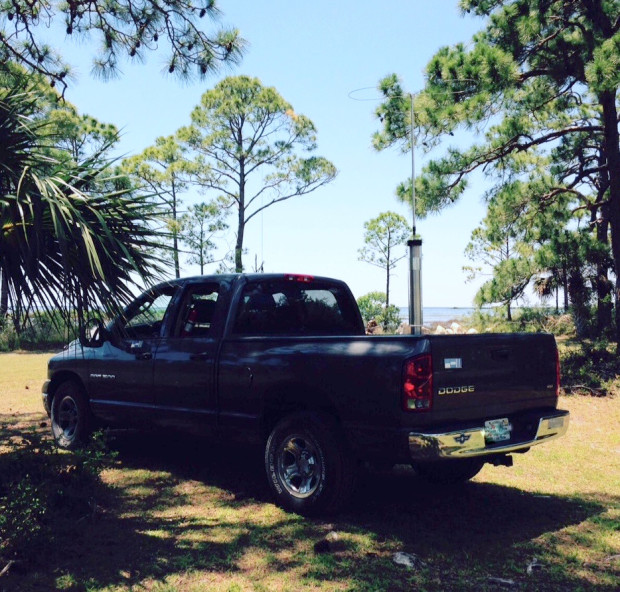
The Scorpion Antenna is mounted in a good spot in the rear of my pickup truck bed. Seen here at Hagen’s Cove in Perry Florida on the Gulf of Mexico in the ‘big bend area’!
Going Mobile, Rag Chews, Nets, CW, its all available and very doable when you are on the road!
Mobile HF radio adds yet another dimension to Ham Radio. This is my second go, at HF Mobile operation.
Years ago, when ‘real life’ happened to me, I had no home QTH to operate from so I bought a new (at that time) Icom 706 M II G radio. It was a great choice. A DC to daylight rig, and its still working 15 years later. This next episode of HF mobile is greatly improved over my previous one. A good antenna at the time, was made by High Sierra. It was a screwdriver type. (the original mobile antenna’s were nick named ‘screwdriver’ because they used an electric screwdriver for moving the coil)
High Sierra no longer makes mobile antennas, but the good news is there is a good company making them in Arizona, Scorpion antennas!
The Scorpion antenna is a heavyweight, at 18 pounds and it needs a very robust base to hold it. Breedlove Mounts
Its the Rolls Royce of Mobile screwdriver type antennas, and not just because I bought one, it is indeed, a very rugged and carefully crafted antenna.
I’m primarily a CW op so I incorporated a touch sensitive paddle to do CW on the move or sitting still in a local park like this one at Hagen’s Cove, on the Gulf of Mexico in the ‘big bend area of Florida!’

The cap hat ‘whip’ is a 3 foot rod of solid aluminum. It shortens the overall whip. This is nice for parking my truck in the breezeway without hitting the roof.
A motorized coil is moved up or down electrically! Listening for the greatest noise, depending on the band of choice, puts me in the ball park for checking the SWR. A 1:1 ratio is easily obtainable if care is taken during installation. Bonding straps are a must. All the parts of the truck body, door, tailgate, hood, fenders and truck bed, must be bonded together to from a good RF ground. Not a DC ground, mind you, but an RF ground plane. (The ‘other half’ of the antenna’)

All the body parts of the truck must be bonded together with straps. RF flows on the surface not the cross section of a conductor, so the wider the better. Copper flashing best carries RF current but a compromise is make for braid due to continuous flexing while opening and closing doors, and tail gates.
Bonding is one of the things that separates a good installation from a poor one. I had fun with the first truck and radio set up back in 2001 but I learned a lot about mobile HF radio since then and did things differently this time.
Location, location, location! It sells real estate and its very important for HF Mobile Antennas!
What makes a good location on a vehicle?
I’ve seen many examples of HF radio antenna installations that work, but some work much better than others. Besides bonding, another good trick for a good installation is to use a very good location; the main mass of metal must be Directly under, not near, the base of the antenna. Will a bumper mounted antenna work? Yes, but one with a mass of metal directly beneath the antenna will work better.
Its simply a case of, more bang for the buck!

Positioning the bottom of the movable coil above the truck side wall is best.
The Scorpion antenna movable coil still has the protective bubble wrap on it in this picture.
Clearance is important!
The bottom of the coil must have clearance from metal objects like the side wall of the truck.
Detailed installation instructions come with the scorpion antenna. This is very important. A good installation will insure good operation. Skimping on installation will only hurt you in the long run.
I installed an auxiliary battery in the back set compartment of the truck. Its a sealed lead acid 75 Ah battery made by Optima. I bought it trough Apex Battery.
Optima Blue Top from Apex Battery co.

Optima Blue Top 75 Ah Auxilliary Battery
I can use either the auxiliary battery or the truck battery or both at the same time, thanks to a marine dual battery manual switch.
See its picture below.
I used #4 wire to connect the truck battery in parallel with the auxiliary battery in the back seat area. This large gauge wire greatly reduces voltage drop between the batteries. For extended stays in one place, I can operate on the auxiliary battery, without running the engine. This insures that the separated truck battery will start the truck when I’m done operating.
I have not yet mounted this switch on a back board, but that is coming. I need both hands to operate the switch now and I want to be able to do it with only one hand!

Dual Battery Switch in the -Both-Battery- Position
The business half of the IC 7100 is mounted to the floor of the truck on the hump. The battery box can be seen with a power pole connection box on top.
The control box for the IC 7100 rides up front on the center console as does the touch sensitive paddle. The microphone hands on the cup holder.
I have a Warren Gregoire headset for SSB. It features a noise cancelling microphone. Warren Gregoire Headset (no relation to me)
(Special note here; its illegal to have both ears covered with a headset in Florida while you drive.)
Its a stupid law because you can legally drive in Florida even if you are stone deaf! So that kills the reasoning for ‘listening to sirens’ on emergency vehicles!
Okay, that rant is done! Back to the Mobile installation.

Battery Box, with Power Pole Box,-top, IC 7100-bottom

AA1IK, Using Warren Gregoire Headset 2
Join me on a new Yahoo Group for HF Mobile ops.
New HF Mobile Yahoo Group
Here I am using the Warren Gregoire headset. This headset has a noise cancelling mic so its a good fit for mobile HF radio. SSB is a new thing for me. I’ve been a CW op, for most of my ham life. I’m having a great time meeting new folks all around Florida on 40 Meter SSB. Ham radio has lots to offer and I’m glad I have not yet exhausted all the possibilities. I have not forsaken CW, but SSB is a fun mode, as I’m sure many of you already know.
The IC 7100 is a two part radio. You saw the ‘business end’ in a previous photo. This photo shows the control head and the touch sensitive paddles Touch Sensitive Paddles They are held in place with a bungee cord. The black plate that you see here is a small plastic clipboard with the clip removed. It is glued in place to the light brown plate, and that is also a clipboard with the clip removed. Both clipboards are held in place with bungee cords. This allows me to remove the control head and the paddles for security reasons.

IC 7100 and Touch Paddles

Remote Switch-top, SWR/RF PWR Meter-left, Speaker-right
The remote switch for moving the antenna up and down to tune in each band is show in the little cubby hole. The SWR/PWR meter is stuffed into a hole where the ‘never has been used-ashtray’ was. The speaker is mounted just above the cup holder.

Remote Switch Moves Antenna Up and Down to Tune Each Band
This photo shows the remote switch. It is hand held, and easily put away after the antenna is tuned.
So! That is pretty much the end of a walk through in my new mobile ham radio shack. So far, I’ve listened to CW on the road but have not called CQ or talked to anyone while driving. I became interested in CW Mobile early in my ham radio career.
The first requirement for operating CW Mobile, according to an article that I read on the subject, said to ‘become a dynamite CW operator! Its been almost 25 years since then and I’m still working on that first requirement.
I’ll keep trying!
De AA1IK
Ernest Gregoire
Ernest Gregoire, AA1IK, is a regular contributor to AmateurRadio.com and writes from Florida, USA. Contact him at [email protected].
 Ham Radio Deluxe |
 W5SWL Electronics |
 Ham Radio Prep |
 KB3IFH QSL Cards  Hip Ham Shirts  HamRadioAuctions HamRadioAuctions Reliance Antennas Reliance Antennas Enigma Shop Enigma Shop |  morseDX  Ni4L Antennas  R&L Electronics R&L Electronics antennas.us antennas.us QRV QRV |
- Matt W1MST, Managing Editor
