 |
 Kearsarge Mountain Trip
 10 May 2015 | by
 A couple of friends and I did a trip to Kearsarge Mountain today. We had a fantastic time and made a couple of dozen nice contacts. Dave K1SWL, Tim W3ATB and I met at Kearsarge. The view was fantastic.

Dave brought his KX3 and put up a simple vertical wire 28 feet long. He sat at a picnic table directly under the wire and had a short counterpoise. The internal tuner managed the setup just fine. Dave made a dozen DX contacts mostly on 15 meters. I don’t have his log.

Tim brought his HB-1B and wanted to test out a 30 meter dipole he made. He plans to use it during an upcoming trip to Antigua. The antenna had a great SWR. After the test he switched to 20 meters and used his Par End Fed as a horizontal up about 25 feet. He made three stateside QSOs and was thrilled with the results.

I set up with a west facing view. I placed an inverted L up about 25 feet and across about 40 feet. I tuned the wire with the internal tuner on the KX3. I was hoping to make some SSB contacts in the military cross-band exercise and I had a mic out for awhile. But I abandoned that effort and went back to CW. Here’s my log:
9 May-15 1555 24.891 US5WE CW 599 599
9 May-15 1558 21.012 EA2NN CW 599 599
9 May-15 1600 21.026 SN7Q CW 599 599
9 May-15 1652 14.021 K3ZO CW 599 599
9 May-15 1655 18.087 AO150A CW 599 599
9 May-15 1657 21.021 HA3NU CW 599 599
9 May-15 1700 21.016 M0BEW CW 599 599
9 May-15 1701 24.891 US5WE CW 599 599
9 May-15 1705 18.082 R120K CW 599 599
9 May-15 1706 18.087 AO150A CW 599 599
I wasn’t paying attention and realized back home that I had several dupes.

We operated about an hour and a half and had a nice picnic lunch before heading down the mountain. Working DX was a lot easier today than battling the black flies. They were pretty thick and we were all glad to have a nice breeze and some bug spray handy. The little park area midway up the mountain makes a perfect place for operating on a beautiful day.
Jim Cluett, W1PID, is a regular contributor to AmateurRadio.com and writes from New Hampshire, USA. Contact him at [email protected].
Amateur Radio Newsline Report 1964 – MAY 8 2015
- Amateur radio continues its work in earthquake ravaged Nepal
- DL hams get 4 Meter acces for sporadic E season
- Digital Ham TV comes alive from the ISS
- Congress continues pressing the FCC on proposed Field Bureau closures
- Radio back on the farm
Release of Newscast 1964 Delayed
09;05 pdt; Due to technical problems the release of Amateur Radio Newsline report #1964 will be delayed a few more hours. We will post it as soon as editing is completed. -- Bill / WA6ITF
HF Mobile, A Different Kind of Radio Shack
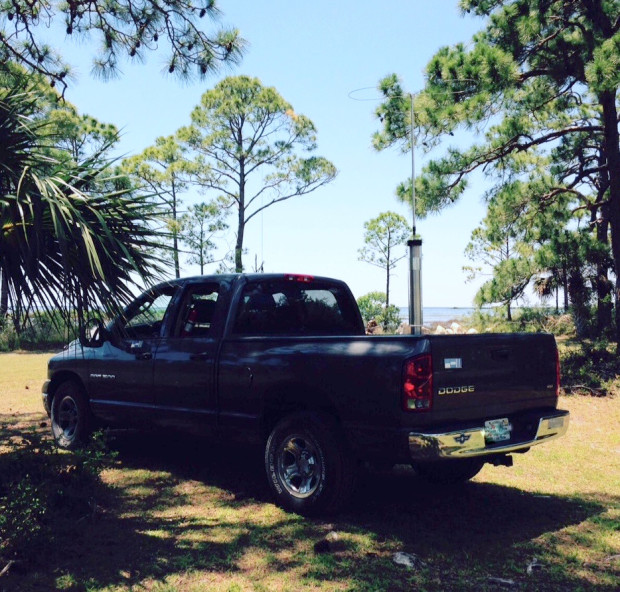
The Scorpion Antenna is mounted in a good spot in the rear of my pickup truck bed. Seen here at Hagen’s Cove in Perry Florida on the Gulf of Mexico in the ‘big bend area’!
Going Mobile, Rag Chews, Nets, CW, its all available and very doable when you are on the road!
Mobile HF radio adds yet another dimension to Ham Radio. This is my second go, at HF Mobile operation.
Years ago, when ‘real life’ happened to me, I had no home QTH to operate from so I bought a new (at that time) Icom 706 M II G radio. It was a great choice. A DC to daylight rig, and its still working 15 years later. This next episode of HF mobile is greatly improved over my previous one. A good antenna at the time, was made by High Sierra. It was a screwdriver type. (the original mobile antenna’s were nick named ‘screwdriver’ because they used an electric screwdriver for moving the coil)
High Sierra no longer makes mobile antennas, but the good news is there is a good company making them in Arizona, Scorpion antennas!
The Scorpion antenna is a heavyweight, at 18 pounds and it needs a very robust base to hold it. Breedlove Mounts
Its the Rolls Royce of Mobile screwdriver type antennas, and not just because I bought one, it is indeed, a very rugged and carefully crafted antenna.
I’m primarily a CW op so I incorporated a touch sensitive paddle to do CW on the move or sitting still in a local park like this one at Hagen’s Cove, on the Gulf of Mexico in the ‘big bend area of Florida!’

The cap hat ‘whip’ is a 3 foot rod of solid aluminum. It shortens the overall whip. This is nice for parking my truck in the breezeway without hitting the roof.
A motorized coil is moved up or down electrically! Listening for the greatest noise, depending on the band of choice, puts me in the ball park for checking the SWR. A 1:1 ratio is easily obtainable if care is taken during installation. Bonding straps are a must. All the parts of the truck body, door, tailgate, hood, fenders and truck bed, must be bonded together to from a good RF ground. Not a DC ground, mind you, but an RF ground plane. (The ‘other half’ of the antenna’)

All the body parts of the truck must be bonded together with straps. RF flows on the surface not the cross section of a conductor, so the wider the better. Copper flashing best carries RF current but a compromise is make for braid due to continuous flexing while opening and closing doors, and tail gates.
Bonding is one of the things that separates a good installation from a poor one. I had fun with the first truck and radio set up back in 2001 but I learned a lot about mobile HF radio since then and did things differently this time.
Location, location, location! It sells real estate and its very important for HF Mobile Antennas!
What makes a good location on a vehicle?
I’ve seen many examples of HF radio antenna installations that work, but some work much better than others. Besides bonding, another good trick for a good installation is to use a very good location; the main mass of metal must be Directly under, not near, the base of the antenna. Will a bumper mounted antenna work? Yes, but one with a mass of metal directly beneath the antenna will work better.
Its simply a case of, more bang for the buck!

Positioning the bottom of the movable coil above the truck side wall is best.
The Scorpion antenna movable coil still has the protective bubble wrap on it in this picture.
Clearance is important!
The bottom of the coil must have clearance from metal objects like the side wall of the truck.
Detailed installation instructions come with the scorpion antenna. This is very important. A good installation will insure good operation. Skimping on installation will only hurt you in the long run.
I installed an auxiliary battery in the back set compartment of the truck. Its a sealed lead acid 75 Ah battery made by Optima. I bought it trough Apex Battery.
Optima Blue Top from Apex Battery co.

Optima Blue Top 75 Ah Auxilliary Battery
I can use either the auxiliary battery or the truck battery or both at the same time, thanks to a marine dual battery manual switch.
See its picture below.
I used #4 wire to connect the truck battery in parallel with the auxiliary battery in the back seat area. This large gauge wire greatly reduces voltage drop between the batteries. For extended stays in one place, I can operate on the auxiliary battery, without running the engine. This insures that the separated truck battery will start the truck when I’m done operating.
I have not yet mounted this switch on a back board, but that is coming. I need both hands to operate the switch now and I want to be able to do it with only one hand!

Dual Battery Switch in the -Both-Battery- Position
The business half of the IC 7100 is mounted to the floor of the truck on the hump. The battery box can be seen with a power pole connection box on top.
The control box for the IC 7100 rides up front on the center console as does the touch sensitive paddle. The microphone hands on the cup holder.
I have a Warren Gregoire headset for SSB. It features a noise cancelling microphone. Warren Gregoire Headset (no relation to me)
(Special note here; its illegal to have both ears covered with a headset in Florida while you drive.)
Its a stupid law because you can legally drive in Florida even if you are stone deaf! So that kills the reasoning for ‘listening to sirens’ on emergency vehicles!
Okay, that rant is done! Back to the Mobile installation.

Battery Box, with Power Pole Box,-top, IC 7100-bottom

AA1IK, Using Warren Gregoire Headset 2
Join me on a new Yahoo Group for HF Mobile ops.
New HF Mobile Yahoo Group
Here I am using the Warren Gregoire headset. This headset has a noise cancelling mic so its a good fit for mobile HF radio. SSB is a new thing for me. I’ve been a CW op, for most of my ham life. I’m having a great time meeting new folks all around Florida on 40 Meter SSB. Ham radio has lots to offer and I’m glad I have not yet exhausted all the possibilities. I have not forsaken CW, but SSB is a fun mode, as I’m sure many of you already know.
The IC 7100 is a two part radio. You saw the ‘business end’ in a previous photo. This photo shows the control head and the touch sensitive paddles Touch Sensitive Paddles They are held in place with a bungee cord. The black plate that you see here is a small plastic clipboard with the clip removed. It is glued in place to the light brown plate, and that is also a clipboard with the clip removed. Both clipboards are held in place with bungee cords. This allows me to remove the control head and the paddles for security reasons.

IC 7100 and Touch Paddles

Remote Switch-top, SWR/RF PWR Meter-left, Speaker-right
The remote switch for moving the antenna up and down to tune in each band is show in the little cubby hole. The SWR/PWR meter is stuffed into a hole where the ‘never has been used-ashtray’ was. The speaker is mounted just above the cup holder.

Remote Switch Moves Antenna Up and Down to Tune Each Band
This photo shows the remote switch. It is hand held, and easily put away after the antenna is tuned.
So! That is pretty much the end of a walk through in my new mobile ham radio shack. So far, I’ve listened to CW on the road but have not called CQ or talked to anyone while driving. I became interested in CW Mobile early in my ham radio career.
The first requirement for operating CW Mobile, according to an article that I read on the subject, said to ‘become a dynamite CW operator! Its been almost 25 years since then and I’m still working on that first requirement.
I’ll keep trying!
De AA1IK
Ernest Gregoire
Ernest Gregoire, AA1IK, is a regular contributor to AmateurRadio.com and writes from Florida, USA. Contact him at [email protected].
Amateur Radio Weekly – Issue 59

Dayton Hamvention – Welcome to the Big Show
In amateur radio it doesn’t get any bigger, or any busier, than the Dayton Hamvention.
Icom
What will we see at Dayton 2015?
Hard to imagine that Dayton Hamvention 2015 is just a week away!
K9ZW
Dayton Hamvention livestream schedule May 13-17 2015
Wednesday May 13th 1300 UTC, we go live beginning with the drive from Memphis, Tennessee to Dayton, Ohio.
W5KUB.com
Extreme DX satellite contact between UK and Texas
On April 27, 2015 at 1901 GMT, Cuban radio amateur Hector Martinez W5CBF/CO6CBF achieved a 7537.8 km DX contact with UK amateur Peter Atkins G4DOL via FO-29, possibly a world record for the satellite.
AMSAT UK
ISS HamTV now transmitting on 2395 MHz
The Ham Video transmitter on board the Columbus module of the International Space Station was powered on and started transmitting in “Blank Transmission” (BT) mode.
AMSAT UK
Radio Buoys operating in the 160 meter Amateur band
It is an unfortunate situation that people who make a living from commercial fishing are caught in the middle of such a regulatory discrepancy.
KC4LMD
Arduino: Under the hood
Ever wonder how the Arduino IDE translates your code into instructions for the processor?
SparkFun
Android app tracks ADS-B signals
Track ADS-B signals from Android with a compatible SDR device.
Google Play
Digital Mode: SIM_PSK 31/63
Integrated Structured Message BPSK31
ON4NB
How to
How to build a 10 meter dipole
The Technician class has access to a part of the 10 meter amateur radio band. They can operate CW, digital and phone. Antennas for 10 meters are small and easy to build. A dipole antenna is one of the easiest antennas to build.
K7AGE
70cm Moxon Antenna
Contesting for beginners with a bent coat hanger.
G3XBM
A crude skew planar wheel antenna for GPS L1
The skew planar wheel antenna is a circularly polarised omnidirectional antenna, exactly what you want for satellite reception. It might not be as optimal as a QFH but it is definitely easier to construct even when you are in a pinch and only have gardening wire available.
/dev/thrash
Plans for 3D printing a QFH antenna
I designed this for 145mhz for ISS, and amateur radio. Great for satcom or APRS. It seems to work ok for NOAA APT sats as well.
Thingiverse
Video
Linrad waterfall and weak signals
Here Linrad is set up to produce waterfall graphs with high sensitivity for extremely weak signals. An RTL-SDR dongle is used to receive SK4MPI on 144.412 MHz.
sm5bsz
Amateur Radio Weekly is curated by Cale Mooth K4HCK. Sign up free to receive ham radio's most relevant news, projects, technology and events by e-mail each week at http://www.hamweekly.com.
Armed Forces Crossband Opportunities
 |
| Courtesy: http://swldx.us/blog/ |
Each station has a slightly different operating schedule and full details of operating times and crossband frequencies can be downloaded from here.
In addition to the usual SSB / CW modes, this year will see several digital modes such as MT63, AMTOR FEC, as well as two new modes ... MIL-STD and ALE.
The needed MIL-STD (Serial PSK) software can be downloaded for free from MS-DMT software.
The activity gives hams and SWL's the chance to exercise their technical and operating skills. All stations will provide a special QSL for contacts made or for reports of reception.
Join the fun and gather some unique wallpaper at the same time ... not many hams have a QSL from 'WAR' on the wall!
Steve McDonald, VE7SL, is a regular contributor to AmateurRadio.com and writes from British Columbia, Canada. Contact him at [email protected].
Roll your own valves (tubes)
A few weeks back – in the post about wartime crystal production – I made a tangential reference to my all time favourite YouTube video – Claude Paillard F2FO distilling down to less than 20 minutes his meticulous work making a triode valve, effectively by hand. Watching it again, this time I spent a bit more time looking over the many pages of background information he had posted on his website detailing his research into triodes of the 1920s, the techniques he used and the equipment he used or made to complete this project and create a very cute looking valve wearing blue shorts.

This prompted me to start a more methodical reading of the documents, and to work through the translations to ensure I understood what he had done. (Google translate is great, but it missed a significant amount.) If you’re vaguely interested in the technology of the earliest days of radio, and have ever wondered how these valves were made, the documents take you on a special journey through the eyes of an explorer with a brilliant workshop and skills to match. His research is comprehensive. By way of exploring how early valves were made he produces a full detailed and illustrated life story of the evolution of valve types and introduces important valve families like the 6L6 and its descendants like the 6V6 and the 807 of the late 1930s. He also takes you on an excursion to discover the history of creating an effective vacuum, critical in the creation of the valve aka the vacuum tube.
It’s also an enjoyable way to build up a French vocab for the terminology of valve radio gear. Along the way I stumbled across the Electropedia, a brilliant resource for translating technical terms from French to English with a number of other languages included. But some of the terms Claude Paillard uses reflect an earlier era and vocabulary. He talks about the plaque (plate) of a valve rather than l’anode. I’d love to find online versions of the French radio engineering references he cites from the 1920s.

Another plus of this experience is reading the history of radio from the perspective of a country other than Britain or the US. The French version of radio history introduces interesting characters and stories to the familiar names and places. An inspiration behind the work of F2FO is the history of the triode TM (Télégraphie Militaire). A good outline is at Michel Siméon’s website.

Paul Berché was another prolific author of French radio texts.
 Ham Radio Deluxe |
 W5SWL Electronics |
 Ham Radio Prep |
 KB3IFH QSL Cards  Hip Ham Shirts  HamRadioAuctions HamRadioAuctions Reliance Antennas Reliance Antennas Enigma Shop Enigma Shop |  morseDX  Ni4L Antennas  R&L Electronics R&L Electronics antennas.us antennas.us QRV QRV |
- Matt W1MST, Managing Editor
