 |
 ID-880H in the jeep
 27 May 2015 | by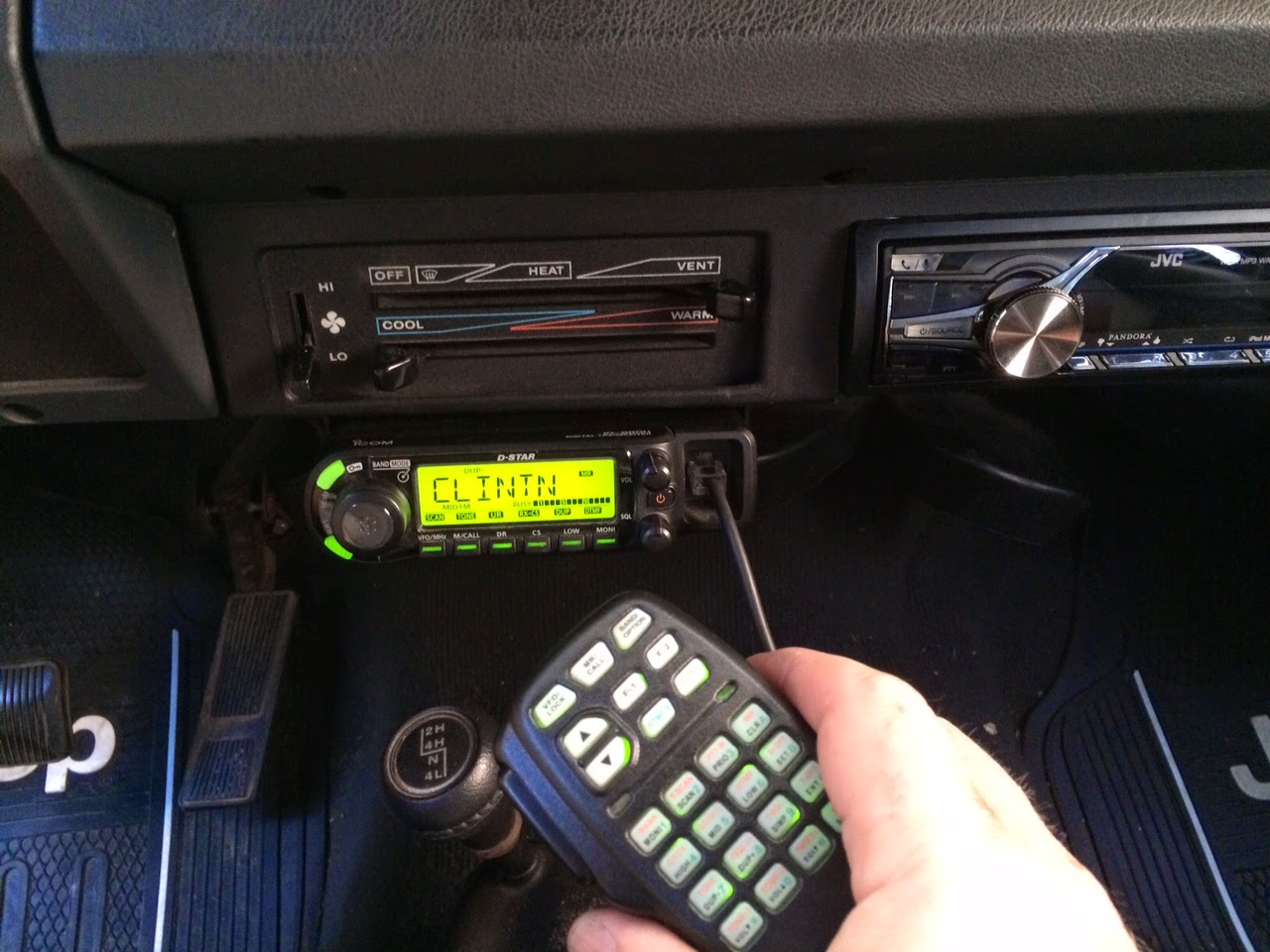
Michael Brown, KG9DW, is a regular contributor to AmateurRadio.com and writes from Illinois, USA. Contact him at [email protected].
10m BitX transceiver
I notice that someone has created a 10m (28MHz) version of the BitX transceiver. Yes, all would like more details but we don’t know who you are!
Anonymous said: “I have successfully designed and built a 28MHz version of the BITX transceiver. The main reason for this project was to drive homebrew transverters for 6, 4 and 2Metres. Contact me if you would like details.”

Roger Lapthorn, G3XBM, is a regular contributor to AmateurRadio.com and writes from Cambridge, England.
Fourbox transceiver
 |
| G7CKF’s Fourbox |
Jenny, G7CKF has now taken the 2m Fredbox design and created a 4m version called the “Fourbox”.
Hi Roger,
I feel I should drop you a line with my thanks and the link below, I’ve used your QRP AM transceivers as the basis for a 4M transceiver and published it on my blog. I’ve come back to amateur radio after a 20 year absence and since construction was always my main interest in the hobby I reached for the soldering iron.
http://thekeywordgeek.blogspot.co.uk/2015/05/a- transceiver-for-not-lot.html
There is no sparkling new insight to be had from it as it’s pretty much your fredbox with slightly bigger coils. There is no crystal because I am cheating and using a Raspberry Pi clock generator to make my 70.260MHz.
My QTH is IO91lw, between Bicester and Buckingham and rather low lying. Very little 4M activity hereabouts, sadly, so the chances of my actually working anyone with it are slim. But that’s not really the point of building, is it.
Anyway, hope you find it of interest, and thanks again for sharing your designs.Jenny, G7CKF

Roger Lapthorn, G3XBM, is a regular contributor to AmateurRadio.com and writes from Cambridge, England.
CLE 194 Results
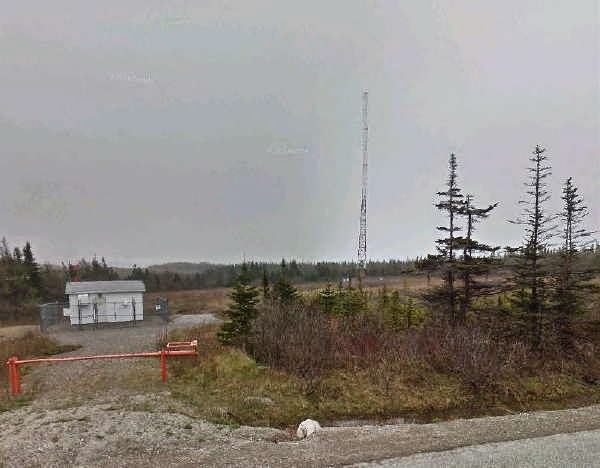 |
| JT-Stephenville, NL courtesy: www.google.ca/maps/ |
Conditions this past weekend were surprisingly good, considering the time of year. I must admit that I was expecting three nights of summer thunderstorm QRN combined with summer-like propagation. Happily I encountered neither.
The sun has been very quiet for the past couple of weeks, leading to low K and A indices and favorable DST numbers. Best catch was 'JT-390' in Stephanville, Newfoundland.
DD UTC kHz Call Location
--------------------------------------------------------------
23 08:00 385 WL Williams Lake, BC, CAN
23 08:00 385 UWL New Castle, IN, USA
23 08:00 385 QV Yorkton, SK, CAN
23 07:00 385 OCC Yakutat, ALS
23 08:00 385 MR Pacific Grove, CA, USA
23 10:00 385 EHM Cape Newenham LRRS Apt, ALS
24 07:00 385 3M Drayton Valley Industrial, AB, CAN
23 08:00 386 SYF St. Francis, KS, USA
23 06:00 386 HAU Helena, MT, USA
24 08:00 388 MM Fort Mc Murray, AB, CAN
23 08:00 388 JW Pigeon, AB, CAN
24 07:00 388 GLY Clinton, MO, USA
23 08:00 388 CRK Spokane, WA, USA
23 08:00 389 YWB Kelowna, BC, CAN
23 06:00 389 TW Twin Falls, ID, USA
24 08:00 389 CSB Cambridge Muni, NE, USA
24 06:00 390 JT Stephenville, NL, CAN
23 08:00 390 HBT Sand Point Apt, ALS
23 10:00 390 AES Northway, ALS
23 08:00 391 EEF Sisters Island, ALS
23 08:00 391 DDP Vega Baja, PTR
23 08:00 391 4W Kelsey, MB, CAN
23 08:00 392 ZFN Tulita, NT, CAN
23 08:00 392 PNA Ralph Wenz Field Apt, WY, USA
25 08:00 392 ML Charlevoix, QC, CAN
23 11:00 392 BAJ Sterling, CO, USA
24 08:00 392 AGZ Wagner, SD, USA
25 10:00 392 XVG Longville, MN, USA
25 10:00 393 TOG Togiak Village Apt, ALS
23 08:00 394 RWO Kodiak, ALS
23 08:00 394 DQ Dawson Creek, BC, CAN
23 08:00 395 YL Lynn Lake, MB, CAN
23 08:00 395 ULS Ulysses Apt, KS, USA
23 08:00 395 L7 Estevan, SK, CAN
23 08:00 396 YPH Inukjuak Apt, QC, CAN
23 08:00 396 CMJ Clam Cove - Ketchikan IAP, ALS
23 08:00 397 ZSS Yellowhead (Saskatoon), SK, CAN
23 08:00 397 SB Petis - San Bernardino, CA, USA
23 08:00 398 YOD Cold Lake, AB, CAN
23 08:00 398 3D Cumberland House, SK, CAN
23 05:00 399 ZHD Dryden, ON, CAN
23 05:00 399 SRI St George, ALS
Steve McDonald, VE7SL, is a regular contributor to AmateurRadio.com and writes from British Columbia, Canada. Contact him at [email protected].
IMPORTANT NOTICE TO THE HAM RADIO COMMUNITY 5/25/15
From Producer Skeeter Nash N5ASH: this is a Facebook post from Sunday, 5/24/15 by the Amateur Radio Newsline Facebook page administrator, James Pastorfield KB7TBT:
Hi folks, got some bad news to report:
A few days ago Bill Pasternak WA6ITF was admitted into the hospital. He is currently in ICU and stable. I have not directly talked to bill but i am in constant contact with Dave Booth KC6WFS who has been with him every day. Bill has said that "it was ok to mention his situation to you and to understand if the reports are a delayed".Bill is still listed under critical condition, please put him in your thoughts and prayers.
I will keep everyone updated...
73
James-KB7TBT
Bill's health is the most important thing right now. However, I know that he is also very concerned about the ongoing production of the weekly Newsline reports. During Bill's previous extended hospital stay earlier this year, he reached out for help with producing the newscast. I stepped forward, and we got it back up and going. At the time, it was not a problem for me to do, time-wise. I was doing the Morning Drive show on KTPK-FM (Country Legends 106.9) here in Topeka, and had time in the afternoon to devote a few hours to editing and producing the audio. Bill was able to write the scripts; first from the rehab facility, then from home once he was released.
However, in mid-March, I was promoted to Program Director of KTPK, in addition to still holding down Morning Drive. This has resulted in many 12+ hour days (as we are in a ratings period), which has severely limited the time I have available to produce Newsline. Now, with Bill in ICU for an indefinite amount of time, there is no way I would have time to write the script, assign the reports, etc., let alone edit and produce the finished newscast. Therefore, at least for now, Amateur Radio Newsline will be on hiatus.
With all that said, I am sending out an appeal for help. Bill has--over 37-plus years of production--set the bar very high in terms of quality, both in the writing and production of Newsline. The attempt has always been to produce a newscast that is on-par with any national radio network newscast, and this has been accomplished over 37 years by an all-volunteer staff. These volunteer hams include many, such as myself, who have worked as broadcast radio/TV professionals. We have looked upon Newsline as not only a service to the hobby we enjoy, but also as a "labor of love." It certainly has been for Bill, ever since its early days as the "Westlink Radio Report."
IN ORDER FOR NEWSLINE TO RESUME PRODUCTION, WE NEED VOLUNTEERS FOR THE FOLLOWING POSITIONS:
- WRITER/ASSIGNMENT EDITOR: This requires a time commitment to gather amateur radio-related news stories from our various sources, and re-write them for broadcast. You must be fluent in "ham-speak." This person would also network with our anchors and reporters all over the globe, assigning them as they are available to record the anchor track and "actuality" reports for each week's newscast. A background in broadcast news writing/production and a passion for amateur radio are must-haves. An ideal candidate might be a retired broadcasting pro who is a licensed, active radio amateur.
- PRODUCER/EDITOR: In this position, you would be responsible for gathering audio from our volunteer anchors and reporters, and edit together a seamless, network-style newscast that can run up to approximately 27 minutes in length. Audio files will be retrieved from a Dropbox folder. A background in broadcast audio production and digital editing, the ability to edit for time, and an ear for audio quality are required. Access to digital editing software (i.e., Pro Tools, Adobe Audition, Gold Wave, Audacity, etc.) is required. Time commitment would be approximately 2-4 hours per week, on average.
- ANCHOR/REPORTER: We would like to add a few voices to our current roster of volunteer anchors/reporters. As you can imagine, these positions require a clear, pleasant speaking voice, with the ability to deliver a natural-sounding, authoritative read. There is a rotating roster, which means you might be called upon once every few weeks to help. Anchors are sent the full script (usually by Wednesday each week), and record an approximate 20 minute (+/-) anchor track. A good quality microphone is needed for both anchors and reporters, as you may be asked to handle either task. Audio should preferably be recorded monaurally, and saved as a good-quality MP3 file.
Again, I must emphasize these are VOLUNTEER positions (no pay). In keeping with Bill's high standards for the quality of this production, I am asking for any amateur operators interested in joining the Newsline team to please submit a resume`, so that I can get an idea of your background/experience. Also, for those interested in the Producer/Editor position, a brief sample of audio you've edited would be helpful. For the Anchor/Reporter positions, I am also asking for a resume` and audio sample. If you would simply like to take a story from a previous Newsline report and read it as if you were anchoring or reporting, that would be fine. Scripts can be found in previous posts on this website. A minute or so of audio will suffice.
If you would like to be considered, please email your submissions to: [email protected], with "NEWSLINE HELP" in the subject line.
I realize that I'm asking a lot for unpaid, volunteer positions. I am treating this (somewhat) as if you were applying for a position at my radio station; the reason being, Amateur Radio Newsline has a tradition of being as close to a professional-sounding production as possible. Many hams have expressed how important Newsline is to them each week, so I am committed to maintaining the standards set by Bill Pasternak over these many years. Thanks for understanding that I am looking for serious inquiries, only. Please also understand that unless someone steps up to fill these positions, the Amateur Radio Newsline will cease production...possibly permanently. I know that's NOT what Bill, or any of the rest of us involved in it, would like to see happen...but that's just the reality of the situation. Thanks, and ~73~ from N5ASH.
Weekly Propagation Summary – 2015 May 25 16:10 UTC
Here is this week’s space weather and geophysical report, issued 2015 May 25 0854 UTC.
Highlights of Solar and Geomagnetic Activity
18 – 24 May 2015
Solar activity was at low levels from 18-23 May with very low levels observed on 24 May. Only low level isolated C-class flaring was observed during the period originating from Regions 2349 (S21, L=002, class/area Dao/060 on 24 May), 2351 (N22, L=330, class/area Cso/020 on 20 May), and 2353 (N07, L=344, class/area Dao/060 on 24 May). Region 2339 (N13, L=129, class/area Fkc/900 on 08 May), which was very productive last period, decayed as it quietly rotated around the NW limb on 18 May. Region 2349 emerged on the visible disk on 18 May, but did not show any significant growth until 23 May. Region 2353 emerged on 21 May and exhibited growth through the end of the period. However, both regions only managed 60 millionths of coverage by the end of the period. No Earth directed coronal mass ejections were observed.
No proton events were observed at geosynchronous orbit.
The greater than 2 MeV electron flux at geosynchronous orbit was at normal levels on 19 and 24 May, moderate levels from 20-23 May, and at high levels on 18 May.
Geomagnetic field activity ranged from quiet to major storm conditions. The period began under the influence of a co-rotating interaction region followed by a positive polarity equatorial coronal hole high speed stream (CH HSS). Total field increased to a maximum of 18 nT at 19/0052 UTC while the Bz component fluctuated between +13 nT and -15 nT late on 18 May through early on 19 May. Solar wind increased to near 575 km/s by midday on 19 May before slowly returning to nominal conditions by late on 20 May. The geomagnetic field responded with minor to major storm conditions late on 18 May through early on 19 May. Quiet to unsettled levels were observed on 20 May. A return to quiet conditions occurred on 21 May and persisted through the end of the period.
Forecast of Solar and Geomagnetic Activity
25 May – 20 June 2015
Solar activity is expected to be at very low to low levels. A chance for moderate levels exists from 30 May through 11 Jun with the return of Region 2339.
No proton events are expected at geosynchronous orbit.
The greater than 2 MeV electron flux at geosynchronous orbit is expected to be at normal to moderate levels with high levels possible from 31 May-01 Jun, 04-06 Jun, 10-12 Jun, and 16-20 Jun due to recurrent CH HSS effects.
Geomagnetic field activity is expected to be at unsettled to active levels from 28-30 May, 02-03 Jun, 07-11 Jun, and 13-15 Jun with possible minor storm levels on 08-09 Jun due to recurrent CH HSS effects.
Don’t forget to visit our live space weather and radio propagation web site, at: http://SunSpotWatch.com/
Live Aurora mapping is at http://aurora.sunspotwatch.com/
If you are on Twitter, please follow these two users:
+ https://Twitter.com/NW7US
+ https://Twitter.com/hfradiospacewx
Get the space weather and radio propagation self-study course, today. Visit http://nw7us.us/swc for the latest sale and for more information!
Check out the stunning view of our Sun in action, as seen during the last five years with the Solar Dynamics Observatory (SDO):
https://www.youtube.com/watch?v=zXN-MdoGM9g
We’re on Facebook: http://NW7US.us/swhfr
Visit, subscribe: NW7US Radio Communications and Propagation YouTube Channel
Optical communications over the horizon
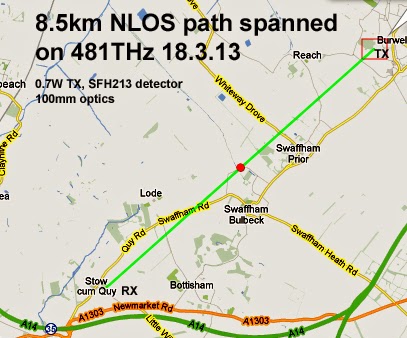
I have been too unwell to do this recently, but not long before my brain bleed (Sept 2013) I was amazed at optical communications over the horizon, non line of sight (NLOS) using clear air scattering.
The inspiration for all my optical experiments came from Stuart Wisher G8CYW who did a great series in RadCom a few years ago.
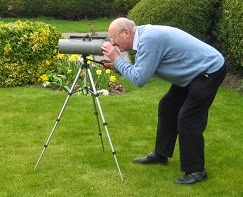 | |
| Testing optics |
My home made transmitter only consumed about 0.7W from a red LED bought on the internet. My homemade RX and TX used homemade optics based around cheap drain pipes and cheap magnifying glasses. The whole RX and TX were simple and low cost. Only simple test gear was needed too. It is a bit like microwaves, but easier to build and test.
There was no sign at all of the TX beam in the sky. All alignment used dead reckoning with some panning at the RX end to find the TX.
Using free PC software and QRSS3 helped as bandwidths as low as 0.37Hz were possible.
When fitter I want to try infra-red LEDs instead.
See https://sites.google.com/site/g3xbmqrp3/optical/481thz-nlos.

Roger Lapthorn, G3XBM, is a regular contributor to AmateurRadio.com and writes from Cambridge, England.
 Ham Radio Deluxe |
 W5SWL Electronics |
 Ham Radio Prep |
 KB3IFH QSL Cards  Hip Ham Shirts  HamRadioAuctions HamRadioAuctions Reliance Antennas Reliance Antennas Enigma Shop Enigma Shop |  morseDX  Ni4L Antennas  R&L Electronics R&L Electronics antennas.us antennas.us QRV QRV |
- Matt W1MST, Managing Editor
