 |
 MacLoggerDX
 4 July 2015 | by
 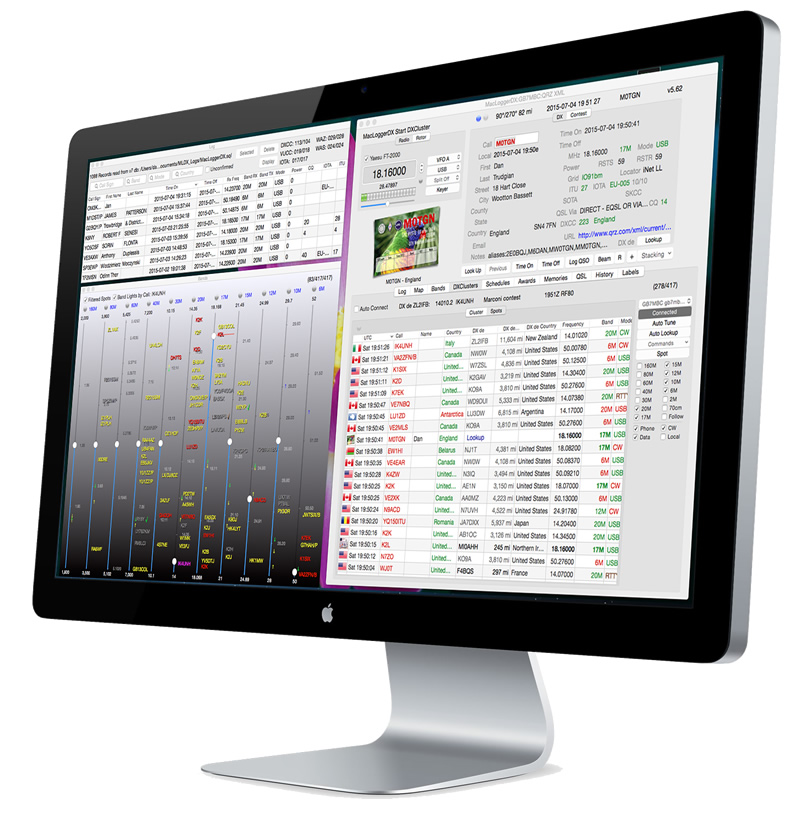 |
| The layout of MacLogger DX on my Mac |
I recently tweeted that I had dropped Ham Radio Deluxe in favour for MacLoggerDX. Amongst the re-tweets and comments i received, Danny (PA3DM) did mention that HRD is not just a logbook, but a full suite of digital modes, rotor and a rig control system. This I completely agree with, and my time using HRD was always a great experience and I would recommend the software to anyone.
My issue with HRD is this. I use a Mac. I transitioned from PC to Mac around 3 years ago, and have been using a Virtual PC to do my PC based tasks (including my day job) and this is the issue. HRD over a Virtual Machine, using RS-232 connectors is unpredictable, slow and frankly unusable. Its not the fault of HRD, nor is it the fault of the Virtual Machine, The RS-232 – USB connectors. It’s a combination of all the elements tethered together that makes the experience unusable.
So the solution ? well its not a solution to be fair. It’s a compromise. Its not HRD, its not an all in one solution, its a log book that can use the radios VFO, the rotor and DX cluster all together. That is basically what I used HRD for. And on the odd occasion I did venture into digital modes.
I will complete a review of MacLoggerDX in future posts, but for now I thought I would explain my rationale of making the switch. So far, so good.
Dan Trudgian, MØTGN, is a regular contributor to AmateurRadio.com and writes from Wiltshire, England. He's a radio nut, IT guru, general good guy and an all round good egg. Contact him him here.
MacLoggerDX
|
| The layout of MacLogger DX on my Mac |
I recently tweeted that I had dropped Ham Radio Deluxe in favour for MacLoggerDX. Amongst the re-tweets and comments i received, Danny (PA3DM) did mention that HRD is not just a logbook, but a full suite of digital modes, rotor and a rig control system. This I completely agree with, and my time using HRD was always a great experience and I would recommend the software to anyone.
My issue with HRD is this. I use a Mac. I transitioned from PC to Mac around 3 years ago, and have been using a Virtual PC to do my PC based tasks (including my day job) and this is the issue. HRD over a Virtual Machine, using RS-232 connectors is unpredictable, slow and frankly unusable. Its not the fault of HRD, nor is it the fault of the Virtual Machine, The RS-232 – USB connectors. It’s a combination of all the elements tethered together that makes the experience unusable.
So the solution ? well its not a solution to be fair. It’s a compromise. Its not HRD, its not an all in one solution, its a log book that can use the radios VFO, the rotor and DX cluster all together. That is basically what I used HRD for. And on the odd occasion I did venture into digital modes.
I will complete a review of MacLoggerDX in future posts, but for now I thought I would explain my rationale of making the switch. So far, so good.
Dan Trudgian, MØTGN, is a regular contributor to AmateurRadio.com and writes from Wiltshire, England. He's a radio nut, IT guru, general good guy and an all round good egg. Contact him him here.
PIXIE 2 QRP Transceiver build
Dan Trudgian, MØTGN, is a regular contributor to AmateurRadio.com and writes from Wiltshire, England. He's a radio nut, IT guru, general good guy and an all round good egg. Contact him him here.
PIXIE 2 QRP Transceiver build
Dan Trudgian, MØTGN, is a regular contributor to AmateurRadio.com and writes from Wiltshire, England. He's a radio nut, IT guru, general good guy and an all round good egg. Contact him him here.
Amateur Radio Weekly – Issue 67

Field Day 2015 round-up
All female amateur radio group on Field Day
The Southern Mississippi YL Amateur Radio Club formed in 2008 to encourage women to get more involved.
WLOX
W3AO Field Day
Wind and rain cannot stop us from broadcasting. Even a “little” rain, like close to four inches on Saturday. Our annual weekend emergency ops practice, aka Field Day, went on as planned.
W3AO
(photos) W3AO Field Day 2015
W3AO
(video) Field Day 2015 – QRP with the Yaesu FT-817 in the pouring rain
How many contacts can be made with QRP SSB during Field Day using a modest station in bad weather? Join me and let’s find out.
YouTube
Field Day Results
Field Day is not really about A-list operators, it’s an event for the every-man.
KE9V
(video) Chattanooga Amateur Radio Club practices in event of crisis
It’s mostly for fun, but this radio field day has a purpose too, and that’s to keep everyone prepared in the event of a crisis.
WRCB
Top links
FCC invites comments on rules for new LF and MF amateur allocations
The FCC is inviting comments on its recent proposals to authorize Amateur Radio operation on two new bands – an LF allocation at 135.7 to 137.8 kHz (2200 meters), and an MF allocation at 472-479 kHz (630 meters).
ARRL
FreeDV 700
We’ve just released FreeDV v0.98 GUI software, which includes the new FreeDV 700 mode. This new mode has poorer speech quality than FreeDV 1600 but is far more robust, close to SSB on low SNR fading HF channels. Mel Whitten and the test team have made contacts over 1000 km using just 1 Watt!
ROWETEL
Hawaii, Washington State QSO on 2 meters
The difficult and rare path between Washington state and Hawaii has been worked in the past … lastly in 1995, when some alert ‘7s’ found themselves in KH6HME’s logbook.
VE7SL
HamShield for Arduino (VHF/UHF transceiver)
The HamShield supports both voice and packet radio modes through a wide range of VHF and UHF frequencies: 2 meter (144-148 MHz), 1.25 meter (220-225 MHz), and 70 centimeter (420-450 MHz).
Kickstarter
A Maker’s introduction to Ham Radio
First, you’re a Maker, so you already have a lot in common with the ham radio community. Hams are tinkerers, builders, fixers, and inventors by nature.
Make:
RF Breakout Kit for the Raspberry Pi
An expansion board supplied as a self-assembly kit, designed for experiments with the Raspberry Pi as a radio frequency source or radio transmitter using the programmable clock generator built into the Pi’s processor.
Kickstarter
(podcast) 100 Watts and a Wire
100 Watts and a Wire is a program celebrating amateur radio through the eyes of a new ham. The show will feature topical conversation and interviews, news and an entertaining look at the adventures of a ham trying to figure it all out.
K0STH
Senate sponsor of Parity Act said bill promotes equality
US Senator Roger Wicker (R-MS), who sponsored “The Amateur Radio Parity Act of 2015” in the Senate, had said the bill he introduced, with original cosponsor Richard Blumenthal (D-CT), would allow for transparency and equality in the regulatory process.
ARRL
How to
Building an APRS IGate
Setting up an IGate is an easy way to contribute to the strength and utility of the APRS network without overwhelming the RF side of things.
WCARES
Using the RTL-SDR as a transmitter
After performing the hack the RTL-SDR is able to output a signal anywhere between 1.8 GHz to 3 GHz.
RTL-SDR.com
Amateur Radio Weekly is curated by Cale Mooth K4HCK. Sign up free to receive ham radio's most relevant news, projects, technology and events by e-mail each week at http://www.hamweekly.com.
Radio Programming: CHIRP vs. RT Systems

Two of the big names in radio programming are CHIRP and RT Systems. But which one should you choose?
CHIRP is free, open source software that’s used with a third-party programming cable. RT Systems makes commercial programming kits which include both software and a radio-specific cable.
CHIRP supports a large number of radios including:
- Anytone
AT-5888UV - Baofeng/Pofung
F-11, UV-3R, UV-5R and variants, UV-6, UV-82/82L/82X, GT-5, UV-82C, UV-B5/B6, BF-666S/777S/888S, GT-1, BF-F8HP - Icom
IC-80AD, IC-2820H, ID-800H, ID-880H, IC-208H, IC-2200H, IC-91/92AD, IC-V/U82, ID-RPx000V/RP2x, IC-2100H, IC-2720H, IC-T70, IC-T7H, IC-T8A, IC-Q7A, IC-W32A, IC-746, IC-7200, IC-7000, ID-31A, ID-51A - Kenwood
TH-D7A/G, TH-D72, TH-F6A, TH-F7E, TH-G71A, TH-K2, TK-7102/8102/7108/8108, TM-271A, TM-281A, TM-D700, TM-D710, TM-G707, TM-V7A, TM-V71A - Yaesu
FT-1D, FT-60R, FT-90R, FT-817/ND, FT-857/D, FT-897, FT-1802M, FT-2800M, FT-1900R/2900M, FT-7800R/7900R, FT-8800R, FT-8900R, FTM-350R, VX-170, VX-2R, VX-3R, VX-5R, VX-6R, VX-7R, VX-8R - Wouxun
KG-UVD1P, KG-UV2D, KG-UV3D, KG-UV6D, KG-UV6X, KG-UV8D
The RT Systems software supports a much larger array of radios:
- Alinco
DJ-A10, DJ-A40, DJ-100, DJ-175, DJ-G7, DJ-G29, DJ-V17, DJ-V27, DJ-V47, DJ-V57, DR-03, DR-06, DR-135, DR-138, DR-235, DR-435, DR-635, DR-638, DX-SR8 - Anytone
AT-398, AT-518UV, AT-588, AT-3208, AT-3318UV-A, AT-3318UV-C, AT-3318UV-D, AT-3318UV-E, AT-5189, AT-5888UV, ANILE-8R, NSTIG-8R, OBLTR-8R, TERMN-8R - Baofeng/Pofung
997-S, BF-F8, BF-F9, BF-388A, BF-530, BF-888, GT-1, GT-3, GT-5, UV-B5/B6, UV-5R, UV-E5, UV-8HX, UV-F11, UV-66, UV-82, UV-89, UV-920, UV-TEN4 - Icom
IC-R2, IC-T2, IC-R6, IC-Q7, IC-T7, IC-T8, IC-V8, IC-R10, IC-R20, IC-W32, IC-T70, IC-80, IC-V80, IC-T81, IC-U82, IC-V82, IC-V85, IC-T90, IC-91, IC-92, IC-208, IC-746, IC-756 PRO, IC-2100, IC-2200, IC-2300, IC-2720, IC-2730, IC-2820, IC-7000, IC-7100, IC-7200, IC-7410, IC-V8000, IC-9100, ID-31, ID-51, ID-51+, ID-800, ID-880, ID-5100 - Kenwood
TH-K2, TH-F6/F7, TH-D7G, TH-K20, TH-D72, TM-V7A, TM-V71, TM-271/281, TM-471, TM-D700, TM-G707, TM-D710, TM-D710G, TS-480, TS-590, TS-590G, TS-2000 - TYT
TH-UVF1, TH-UV3R, TH-UV6R, TH-UV8R, TH-UVF9, TH-UVF9D, TH-UVF8000D, TH-9000, TH-9800 - Wouxun
KG-UV23, KG-UV1DP, KG-UV5D, KG-UV6, KG-UV8D, KG-UV899, KG-UV920P, KG-UV950P - Yaesu
FT-1D, FT-50, FT-60, FT-90, FT-250, FT-270, FT-277, FT-450, FT-817/D, FT-847, FT-857/897/D, FT-950, FT-991, FT-1500, FT-1802, FT-1807, FT-1900, FT-1907, FT-2600, FT-2800, FT-2900, FT-3000, FT-7100, FT-7800, FT-7900, FT-8000, FT-8100, FT-8500, FT-8800, FT-8900, FT-DX3000, FT-DX1200, FTM-350, FTM-400, VR-160, VR-500, VX-1, VX-2, VX-3, VX-5, VX-6, VX-7, VX-8/D, VX-8G, VX-110/150, VX-120/170, VX-127/177
Both CHIRP and RT Systems support several other less popular radios not listed above.
Here are my questions:
Have you used CHIRP or RT Systems programming software? What are your thoughts?
If you’ve used both, is it worth spending $49 on the RT Systems programming kit if your radio is supported by CHIRP?
Leave your answer as a comment!
Matt Thomas, W1MST, is the managing editor of AmateurRadio.com. Contact him at [email protected].
KL7 Tropo?
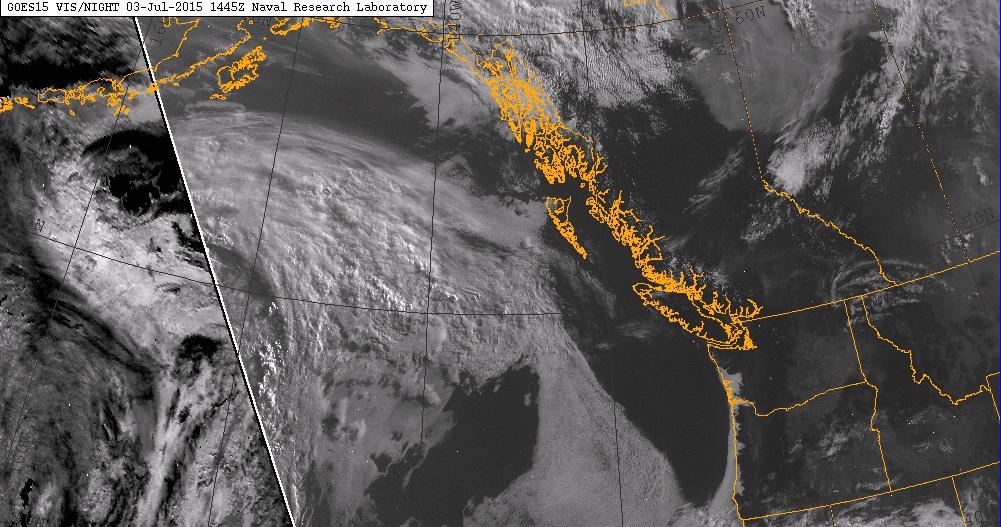 |
| courtesy: http://www.nrlmry.navy.mil/ |
Like our unprecedented early hot and stable weather pattern over the West coast, this path is fairly rare and has never really been explored ... this one appears to be forming a stable path towards Alaska. The predicted conditions can be viewed on Bill Hepburn's World Wide Tropospheric Ducting Prediction page. Select the Eastern North Pacific from the 'Region' drop-down menu and see the map for Saturday.
Perhaps there are some KL7s near the water, or not too far inland and with a clear shot towards the southeast, that would be interested in running some possible tropo tests over the next few days if the path shapes up as predicted in the Bill Hepburn maps for the weekend. Not ever having explored this possible path before might yield some interesting results ... and who knows how far south into Puget Sound a tropo signal from the north might reach? Maybe it's time to find out. Of course, any stations between here and northern KL7 (Prince Rupert?... Juneau? ... Ketchikan?) might also be interested in trying a possible 2m path.
Steve McDonald, VE7SL, is a regular contributor to AmateurRadio.com and writes from British Columbia, Canada. Contact him at [email protected].
 Ham Radio Deluxe |
 W5SWL Electronics |
 Ham Radio Prep |
 KB3IFH QSL Cards  Hip Ham Shirts  HamRadioAuctions HamRadioAuctions Reliance Antennas Reliance Antennas Enigma Shop Enigma Shop |  morseDX  Ni4L Antennas  R&L Electronics R&L Electronics antennas.us antennas.us QRV QRV |
- Matt W1MST, Managing Editor
