 |
 Radio Adventure on the Maine Coast
 12 July 2015 | by
 Last evening Dave K1SWL, Tim W3ATB and I were at Bailey’s Island in Maine. We were there for Lobstercon… an annual QRP gathering at Cooks Corner. After dinner we went to the shore at Lands End. I set up a quick wire and worked Italy, Greece, and the Czech Republic before the mosquitoes carried us away.
As the sun went down we ate dinner at Cook’s Lobster House. The view was the very best.

Then we drove a few miles east to where the sea meets the land… Tim parked the truck with the back toward the beach. The view is breathtaking.

We ran a wire from the tail gate down to the beach. At most the wire was only 3 or 4 feet off the ground. I put the KX3 on the rocks and stood on the sand. I tuned across 20 meters, but didn’t hear many stations… so I switched to 30 meters.

I1ULJ/8 in Italy was calling CQ. I answered Sal and he gave me a 559. I knew I wasn’t strong because I had to send my call a few times… but we completed a good exchange. I had smiles on my face and mosquito bites behind my ear. I didn’t care. Then I heard SV2/RW3AL in Greece finishing up a QSO and I called. This time I received a 339, but that was fine. Again we had a good exchange. The next QSO was the best.

Now I switched back to 20 meters to see if anything had changed. There was OK2RJC in the Czech Republic just booming in. Jiri was calling CQ and I knew he’d hear me. When I answered I received a 589 and I received a “congrats on UR QRP signal.” I folded up the log book and put everything back in the pack. The darker it got, the more mosquitoes showed up to feed. We were exuberant….. with the salt air, the smell of the sea, the view, and the cross-Atlantic QSOs.

Thanks to W3ATB and K1SWL for photos.
Jim Cluett, W1PID, is a regular contributor to AmateurRadio.com and writes from New Hampshire, USA. Contact him at [email protected].
Series Eight Episode Fifteen – Friedrichshafen Review Part Two (12 July 2015)
In this episode, Martin M1MRB / W9ICQ is joined by Ed Durrant DD5LP ,Martin Rothwell M0SGL and Chris Howards (M0TCH / N4CTH) to discuss the latest Amateur / Ham Radio news. Colin M6BOY rounds up the news in brief, and this episodes feature is the second part of our Ham Radio Friedrichshafen Review.
- Ham Radio Skills for Dresden Students
- Thai Licenses Invalidated
- Ofcom take action in Cambridge
- Disabled Teen Helped by Ham Radio
- WSPR station with RF Board and Raspberry Pi
- New World Distance records on 2.3 and 3.4 GHz Amateur / Ham Radio Bands
- Ham Radio Deluxe Team Grows - UK Member Added
- AREN Honoured by Cork County Mayor
Colin Butler, M6BOY, is the host of the ICQ Podcast, a weekly radio show about Amateur Radio. Contact him at [email protected].
Series Eight Episode Fifteen – Friedrichshafen Review Part Two (12 July 2015)
In this episode, Martin M1MRB / W9ICQ is joined by Ed Durrant DD5LP ,Martin Rothwell M0SGL and Chris Howards (M0TCH / N4CTH) to discuss the latest Amateur / Ham Radio news. Colin M6BOY rounds up the news in brief, and this episodes feature is the second part of our Ham Radio Friedrichshafen Review.
- Ham Radio Skills for Dresden Students
- Thai Licenses Invalidated
- Ofcom take action in Cambridge
- Disabled Teen Helped by Ham Radio
- WSPR station with RF Board and Raspberry Pi
- New World Distance records on 2.3 and 3.4 GHz Amateur / Ham Radio Bands
- Ham Radio Deluxe Team Grows - UK Member Added
- AREN Honoured by Cork County Mayor
Colin Butler, M6BOY, is the host of the ICQ Podcast, a weekly radio show about Amateur Radio. Contact him at [email protected].
Morse code training program uses cognitive science to speed learning and improve retention

When Aaron Parks KC8FQD was having trouble learning Morse code, he complained about some of his frustrations to his wife, Dr. Jessica Parks. As an expert in memory and cognition with a PhD in experimental psychology, she immediately recognized a few ways he could dramatically improve his learning speed and retention.
Working together they created Skilman Introduction to Morse Code with a companion program called Morse Code Speed Builder: 5 to 12 Words Per Minute.
Based on the Farnsworth method, they designed it from the ground up to be different than other programs on the market. “The course is structured to walk you through the learning process step by step so you don’t get lost along the way. The individual exercises are designed to encourage engagement and participation,” he says.
Since launching the program this spring, they’ve already managed to create quite a buzz. “We’re pleased to have more than 150 happy customers so far and sales continue to accelerate,” he says. “So far, the feedback has been strongly positive.”
The program comes on 6 compact discs and the files can be loaded into an MP3 player for convenient playback. When you buy the program, you also get the digital files to use immediately if you don’t want to wait for your CDs to arrive.
Whether you decide to use their program or study on your own, they’ve put together a few tips to help you learn Morse code more effectively:
1) Divide your study into chunks that will fit into short-term memory
Eventually you’ll want to commit Morse code to your long-term memory, but before that it’ll have to go through your short-term memory. Work on 3-4 characters at a time. Once you think you have those committed to long-term memory, go on to the next group.
2) Practice meaningful rehearsal
This may sound obvious, but you won’t get far by putting a code tape on in the background and hoping to learn by osmosis. You’ve got to be an active participant in learning. Meaningful rehearsal is what moves those characters from short-term memory to long-term memory. So favor interactive exercises over passive ones.
3) Stay engaged by using a variety of exercises
If you do the same thing over and over, it’ll get boring and your eyes will glaze over. At the very least, mix up sending and receiving practice. They’re both important if you plan to get on the air and they’ll reinforce each other. If you zone out, you’re wasting your time.
4) Commit to a couple of short study sessions every day
A short study session is about 20-30 minutes. It may seem crazy, but it’s well known that human attention only holds up about that long. Once your attention falls off, you’re not getting a good return on the time you’re investing. Cramming works in the short-term, but for long-term retention, it’s better to space out your learning evenly over time. If you make it a part of your routine and work on it a little every day, you’ll get a little better every day — but one or two daily sessions is enough.
5) Don’t get discouraged by the interference effect
When you start out learning Morse code, the first several characters you learn will come pretty easy, but all of a sudden it changes. Everything slows down like it’s a struggle just to learn a single additional character. And what’s worse, it may seem like the ones you already know are getting harder to recall. Lots of people give up at this point.
Surprisingly, this sudden drop-off in apparent learning is actually good news. The reason why the new characters don’t come as easy is because the ones you already know are interfering with learning them. You have to have really learned those characters to have them interfere with learning more so you know that you must have already made significant progress.
Interference effect goes both ways, though. The new characters you’re learning interfere with the old ones. While it seems like all progress has ceased, you really must be learning the new characters to be experiencing this type of interference. This is the point where having a good attitude, a solid routine, and engaging exercises will really help.
Editor’s note:
Aaron and Jessica have graciously allowed AmateurRadio.com to give away the first hour of their Introduction to Morse Code course to our readers at no charge to help you get started. Good luck!
Skilman Introduction to Morse Code – Lesson 1 (24:02) Download
[sc_embed_player_template1 fileurl=”http://static.skilman.com/learn-1.mp3″]
Skilman Introduction to Morse Code – Lesson 2 (24:32) Download
[sc_embed_player_template1 fileurl=”http://static.skilman.com/learn-2.mp3″]
Matt Thomas, W1MST, is the managing editor of AmateurRadio.com. Contact him at [email protected].
Sunspot Numbering System Revised

Although sunspot data has been recorded in one form or another for over 400 years, there have been few changes in the counting system since the introduction of the 'Wolf Number' in 1849. Recording of the sunspot 'Group Number' came into existence in 1998. It seems there were some strong differences in the two parallel series of systems and in 2011 a group of 40 experts undertook a full examination and revision of both systems in order to identify and fix the defects.
The new system, which became effective on July 1st, has brought both systems into alignment, with the most notable correction being in the lowering, by about 18%, of all numbers after 1947. The new Group Number has been corrected for a large underestimate of all values before the 20th century and has resulted in a fully reconstructed series of Group Numbers.
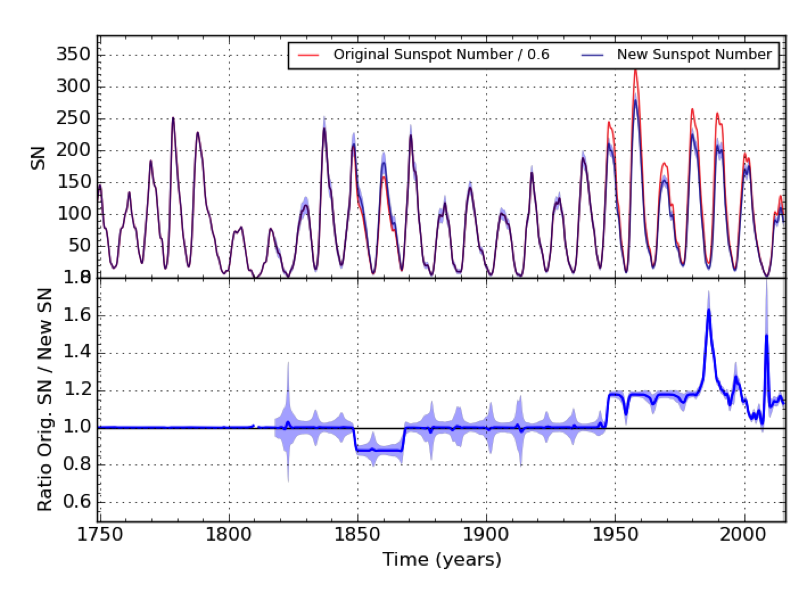 | |
| courtesy: http://www.sidc.be/ |
The graphic of Group Numbers shows significant increases for cycles up until the 1900's.
 |
| courtesy: http://www.sidc.be/ |
The new system brings the correlation of Group Numbers and Sunspot Numbers into harmony, unlike before.
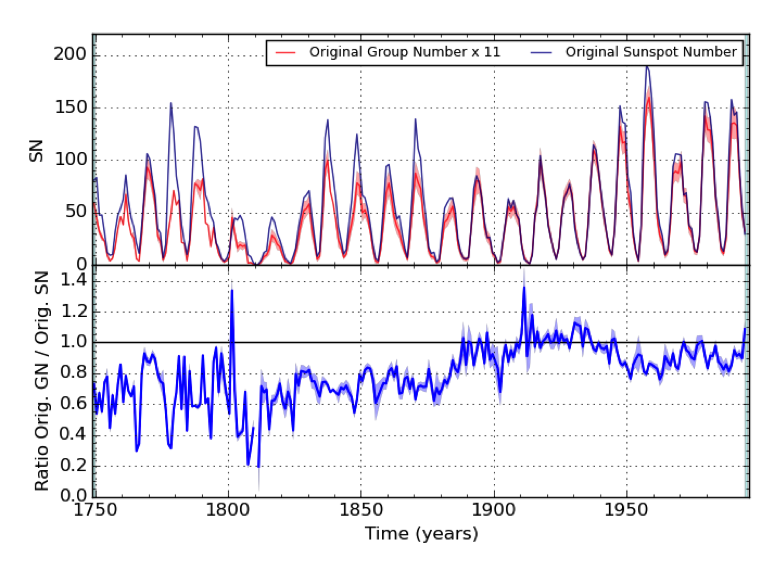 |
| courtesy: http://www.sidc.be/ |
Although these changes became effective on July 1st, the work is far from complete. According to the folks at SILSO (Sunspot Index and Long-term Solar Observations):
Still, as can be seen, significant deviations remain, mainly before 1825, when the observations become scarce and in periods of activity minima (low counts). So, more work definitely remains to be done for many years to come, but given the major improvements harvested at this stage, the WDC - SILSO is now going to proceed with the public release of this new version.
The preparation of this major operation is now almost completed. It required a huge organizational and programming work from the small SILSO team. Indeed, the release of the new past Sunspot series is just a starting point for the WDC-SILSO. Indeed, it requires a deep reworking of the operational software that will process the data from our worldwide network on July 1st and in the future. Indeed, various data products must be made seamlessly compatible with the new base total Sunspot Number series: the hemispheric Sunspot Numbers, the daily Estimated Sunspot Number, the 12-month solar-cycle forecasts, all data plots and the derivation of personal k coefficients for all stations of the network.
After a rather uneventful life over the past 166 years, the Sunspot Number will thus be reborn in a new incarnation on Wednesday July 1st. We hope that the science community will welcome this revived data set and will appreciate the considerable community effort accomplished over the past four years to produce a better reference for long-term solar and Sun-Earth studies.
Steve McDonald, VE7SL, is a regular contributor to AmateurRadio.com and writes from British Columbia, Canada. Contact him at [email protected].
Regenerative receiver based entirely on the LM386
I got a tip the other day that there is an interesting circuit over at the RadioBoards Forum where an LM386 IC is used as a regen receiver for the medium wave band. It is the user ‘Selenium’ who has come up with that circuit. I think it is quite an amazing application of this IC – so here it is:
 |
| LM386 as a medium wave regen receiver by user Selenium on RadioBoards Forum |
Interestingly, both the + and – inputs are tied together (pins 2 and 3). It is also quite unusual to connect pin 7 to anything but capacitors (for bypass or extra input as I have done), so that may change the bias of the input stage. Further, the smaller the impedance from pin 1 to ground, the larger the gain (here 10 uF in series with 1k for low frequencies and 100 pF for high frequencies).
If you want to read more about the regen circuit, go to the RadioBoards Forum here.
Sverre Holm, LA3ZA, is a regular contributor to AmateurRadio.com and writes from Norway. Contact him at [email protected].
Regenerative receiver based entirely on the LM386
I got a tip the other day that there is an interesting circuit over at the RadioBoards Forum where an LM386 IC is used as a regen receiver for the medium wave band. It is the user ‘Selenium’ who has come up with that circuit. I think it is quite an amazing application of this IC – so here it is:
|
| LM386 as a medium wave regen receiver by user Selenium on RadioBoards Forum |
Interestingly, both the + and – inputs are tied together (pins 2 and 3). It is also quite unusual to connect pin 7 to anything but capacitors (for bypass or extra input as I have done), so that may change the bias of the input stage. Further, the smaller the impedance from pin 1 to ground, the larger the gain (here 10 uF in series with 1k).
If you want to read more about the regen circuit, go to the RadioBoards Forum here.
Sverre Holm, LA3ZA, is a regular contributor to AmateurRadio.com and writes from Norway. Contact him at [email protected].
 Ham Radio Deluxe |
 W5SWL Electronics |
 Ham Radio Prep |
 KB3IFH QSL Cards  Hip Ham Shirts  HamRadioAuctions HamRadioAuctions Reliance Antennas Reliance Antennas Enigma Shop Enigma Shop |  morseDX  Ni4L Antennas  R&L Electronics R&L Electronics antennas.us antennas.us QRV QRV |
- Matt W1MST, Managing Editor
