 |
 Amateur Radio Newsline Report 1968 July 17, 2015
 17 July 2015 | by
 - BREAKING: FCC Closures
- Packed House at Hamvention
- Yukon Station shows remote possibilities
- An Alternate Satellite Frequency
- Stalking the latest Cubesat
- Report from Camp Courage
- New Balloting for Kosovo
- The World of DX
- Young Ham of the Year
CLICK THE LINKS BELOW FOR THIS WEEK'S NEWSCAST
A More Optimistic Cycle 25
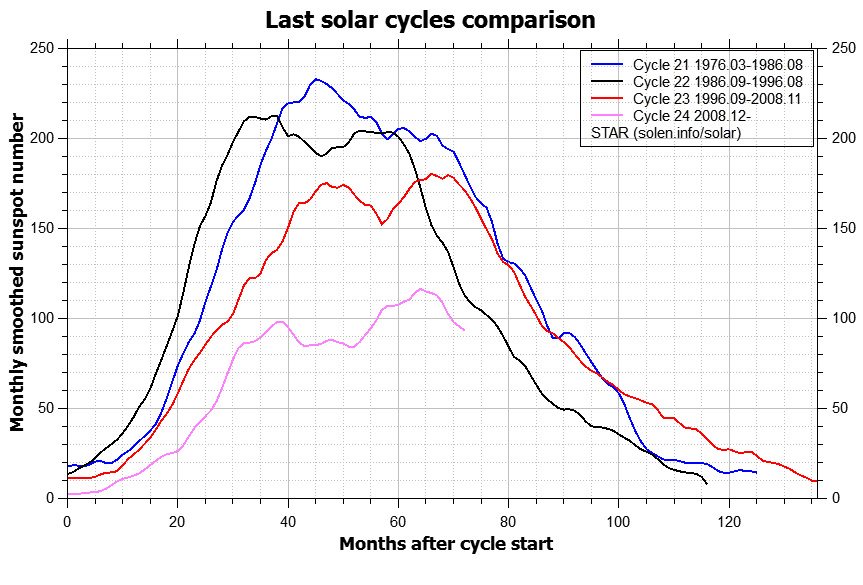 |
| courtesy: http://www.solen.info/solar/ |
With all of the doom and gloom forecasts for the upcoming solar cycles, I was reminded of the various prognostications that were made for our present Cycle 24. I recall one in particular, made in the winter of 2006 ...
Solar cycle 24, due to peak in 2010 or 2011 "looks like its going to be one of the most intense cycles since record-keeping began almost 400 years ago," says solar physicist David Hathaway of the Marshall Space Flight Center. He and colleague Robert Wilson presented this conclusion last week at the American Geophysical Union meeting in San Francisco.
So much for that prediction!
It seems that at least one group, led by Leif Svalgaard, got it right, as W4ZV recently reminded us on the Topband reflector ...
I had to do a memory refresh but finally recalled that Leif Svalgaard, et.al.
accurately predicted Cycle 24 in October 2004. He did not use conveyor
belt theory but polar field measurements:
"Using direct polar field measurements, now available for four solar
cycles, we predict that the approaching solar cycle 24 ( 2011 maximum) will
have a peak smoothed monthly sunspot number of 75 ± 8, making it
potentially the smallest cycle in the last 100 years."
http://www.leif.org/research/Cycle%2024%20Smallest%20100%20years.pdf
The actual smoothed sunspot peak for Cycle 24 was around 82 in early 2014
(blue line on the graph below). He missed the peak date because it
occurred during the cycle's second peak.
http://www.swpc.noaa.gov/products/solar-cycle-progression
73, Bill W4ZV
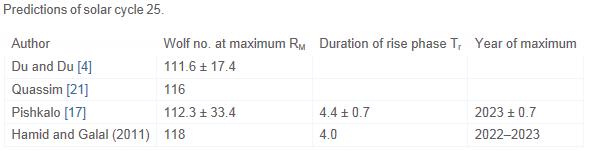
But Svalgaard wasn't the only one with an accurate forecast. Searching for a less-gloomy outlook for upcoming Cycle 25, I happened upon a paper by Hamid Helal and A.A. Galal of the National Research Institute of Astronomy and Geophysics, in Cairo. In "An early prediction of the maximum amplitude of the solar cycle 25", the authors cite a methodology that was bang-on for the last three cycles and gives a very optimistic outlook for Cycle 25.
Table 2 gives our prediction for cycle 25 in comparison with the published predictions of other authors in chronologic alphabetic order. It is obvious that our results agree with some contributions and disagree with others. In fact the differences of the predicted strengths by different authors may be attributed to the variety of the used techniques and methodology. Although some authors think that cycle 25 could be one of the weakest in centuries, in contrast, we think that the next cycle will be relatively stronger than cycle 24 and it will have nearly the same strength of cycle 23, i.e. the sunspot maximum may rebound in the near future.
 |
| courtesy: http://www.sciencedirect.com |
If Cycle 25 is comparable to Cycle 23 it will be happy days again ... it was a very robust cycle and provided several winters of high F2 MUFs, leading to day after day of amazing 50MHz propagation!
I'm somewhat vexed about which scenario I'd prefer, being both an LF'er (quiet, weak cycle) and a diehard 6m guy (chaotic, strong cycle). In any event, Cycle 25 will likely be the last one of any interest to me. I was born at the peak of Cycle 18 ... you do the math!
Obviously it will be a few years yet before we see who is right, but I'm kind of pulling for Helal and Galal's big numbers for one last 6m hoorah!
Steve McDonald, VE7SL, is a regular contributor to AmateurRadio.com and writes from British Columbia, Canada. Contact him at [email protected].
Quiz: How well do you know your Q codes?

[slickquiz id=2]
Matt Thomas, W1MST, is the managing editor of AmateurRadio.com. Contact him at [email protected].
Solar Cycle 25 and Beyond
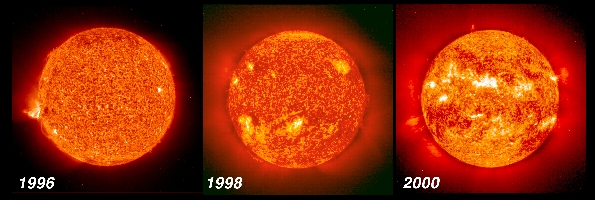 |
| courtesy: SOHO (ESA & NASA) |
If the model is correct, the outlook for the next several cycles does not look good. The modelling describes the interaction of two levels of the sun ... one near the surface and one much deeper.
Prof Valentina Zharkova and her colleagues, of Northumbria University, have:
"... found magnetic wave components appearing in pairs, originating in two different layers in the Sun's interior. They both have a frequency of approximately 11 years, although this frequency is slightly different, and they are offset in time. Over the cycle, the waves fluctuate between the northern and southern hemispheres of the Sun. Combining both waves together and comparing to real data for the current solar cycle, we found that our predictions showed an accuracy of 97%."
Zharkova's team analyzed data from California's Wilcox Solar Observatory, covering three solar cycles worth of activity from 1976-2008. All of their modelling predictions and observations were closely matched.
"Looking ahead to the next solar cycles, the model predicts that the pair of waves become increasingly offset during Cycle 25, which peaks in 2022. During Cycle 26, which covers the decade from 2030-2040, the two waves will become exactly out of synch and this will cause a significant reduction in solar activity."
This is not great news for HF DXers and 6 meter diehards as it sounds like the present wimpy cycle (Cycle 24) may have been a monster in comparison to what lies ahead. The one bright light is the likelihood of amazingly good low band (160, 80, 40m) conditions for many, many winters.
I recall just how good conditions became on 160m during the solar-quiet winters between Cycle 23 and the eventual late start of Cycle 24. Night after night, the band opened to Europe like clockwork. Many nights the skip was so long that no signals from the U.S. could be heard at all ... just Europeans, often reaching 599 on my FT-1000's S-meter. At times I had to shake my head and double check that it was really 160m that I was listening to.
LF and MF conditions were equally enhanced as the lack of D-layer absorption from a very quiet sun made tuning through the NDB band sound like 20m CW during the Sweepstakes Contest ... truly once-in-a-lifetime conditions ... but maybe not if Zharkova's model is as accurate as she claims.
I guess we'll just have to wait a few more years to find out.
Steve McDonald, VE7SL, is a regular contributor to AmateurRadio.com and writes from British Columbia, Canada. Contact him at [email protected].
Weekly Propagation Summary – 2015 Jul 13 16:10 UTC
Here is this week’s space weather and geophysical report, issued 2015 Jul 13 0408 UTC.
Highlights of Solar and Geomagnetic Activity 06 – 12 July 2015
Solar activity began at moderate levels. Region 2381 (N14, L=074, class/area Eko/550 on 08 Jul) produced a pair of M-class flares on 06 Jul; an M1/Sn at 06/0844 UTC and an M1/2n at 06/2040 UTC. Activity was low from 07-11 Jul. Region 2381 produced the majority of the low level C-class flares from 07-09 Jul while Region 2385 (N08, L=106, class/area Dao/110 on 11 Jul) produced the C-class flares on 10-11 Jul. Solar activity decreased to very low levels on 12 Jul. Several filament eruptions were observed throughout the week but none of them were on the Sun-Earth line.
No proton events were observed at geosynchronous orbit.
The greater than 2 MeV electron flux at geosynchronous orbit was at normal to moderate levels for the majority of the period with the exception of 09-10 Jul when high levels were reached due to effects from a coronal hole high speed stream (CH HSS).
Geomagnetic field activity began the week at active levels due to effects from a waning CH HSS on 06 Jul. Mostly quiet conditions were observed from 07-09 Jul with the exception of isolated unsettled periods on 07 and 09 Jul. Activity increased to active to minor storm levels from 10-11 Jul due to effects from a recurrent positive polarity CH HSS. Quiet to unsettled conditions finished out the period on 12 Jul as CH HSS effects began to subside.
Forecast of Solar and Geomagnetic Activity 13 July – 08 August 2015
Solar activity is expected to be at very low levels with a chance for C-class flares and a slight chance for M-class flares from 13-15 Jul. Very low to low activity is expected from 16-26 Jul after Region 2381 rotates around the west limb. Activity is expected to increase to low levels with a chance for M-class flares for the remainder of the period as old Region 2378 (S15, L=084) and Region 2381 return to the visible disk.
No proton events are expected at geosynchronous orbit.
The greater than 2 MeV electron flux at geosynchronous orbit is expected to be at normal to moderate levels on 13 Jul. Moderate to high levels are expected from 14-17 Jul following CH HSS effects. Normal to moderate levels are expected to return from 18 Jul-02 Aug. Moderate to high levels are expected again from 03-05 Aug followed by a return to normal to moderate levels from 06-08 Aug.
Geomagnetic field activity is expected to be at quiet to unsettled levels on 13-14 Jul due to residual CH HSS effects. Mostly quiet conditions are expected from 15-30 Jul. Quiet to active levels are expected from 31 Jul-02 Aug with minor storm levels expected on 01 Aug due to a recurrent negative polarity CH HSS. Mostly quiet conditions are expected to return from 03-05 Aug. Active to minor storm conditions are expected from 06-07 Aug due to a positive polarity CH HSS followed by quiet to unsettled conditions on 08 Aug as effects subside.
Don’t forget to visit our live space weather and radio propagation web site, at: http://SunSpotWatch.com/
Live Aurora mapping is at http://aurora.sunspotwatch.com/
If you are on Twitter, please follow these two users: + https://Twitter.com/NW7US + https://Twitter.com/hfradiospacewx
Get the space weather and radio propagation self-study course, today. Visit http://nw7us.us/swc for the latest sale and for more information!
Check out the stunning view of our Sun in action, as seen during the last five years with the Solar Dynamics Observatory (SDO): https://www.youtube.com/watch?v=zXN-MdoGM9g
We’re on Facebook: http://NW7US.us/swhfr
Visit, subscribe: NW7US Radio Communications and Propagation YouTube Channel
LHS Episode #150: The Sesquicentennial
 Well, folks, it's hard to put a description on this episode. We talk about our usual range of topics, but there is so much more thrown in that we can't even begin to enumerate it all. One thing that can be said, however, is that this episode was FUN. We hope you enjoy it all the way to the end. Apologies for the first 20 minutes or so of Pete's microphone audio. We promise, it does get better. THANK YOU for being a listener. We do this all for you.
73 de The LHS Guys
Russ Woodman, K5TUX, co-hosts the Linux in the Ham Shack podcast which is available for download in both MP3 and OGG audio format. Contact him at [email protected].
AmateurLogic 80: A Country Field Day
AmateurLogic.TV Episode 80 is now available for download.
George, Tommy and Wayne head back to the country for Field Day. We tried a few new things this year that worked out pretty well. Plus your viewer emails and more.
1:16:20
George Thomas, W5JDX, is co-host of AmateurLogic.TV, an original amateur radio video program hosted by George Thomas (W5JDX), Tommy Martin (N5ZNO), Peter Berrett (VK3PB), and Emile Diodene (KE5QKR). Contact him at [email protected].
 Ham Radio Deluxe |
 W5SWL Electronics |
 Ham Radio Prep |
 KB3IFH QSL Cards  Hip Ham Shirts  HamRadioAuctions HamRadioAuctions Reliance Antennas Reliance Antennas Enigma Shop Enigma Shop |  morseDX  Ni4L Antennas  R&L Electronics R&L Electronics antennas.us antennas.us QRV QRV |
- Matt W1MST, Managing Editor
