 |
 Amateur Radio Newsline Report 1969 July 24, 2015
 24 July 2015 | by
 - ARRL DUES GOING UP
- YOUNG HAM OF THE YEAR WINS AGAIN
- BRITISH HAMS LEND A HAND
- HITCHING A RIDE
- A-HUNTING WE WILL GO
- SOME MORE FOR MORSE
- REPEATER NEWS WORTH REPEATING
- WORLD OF DX
- CQ, CQ AND I DO
CLICK THE LINKS BELOW FOR THIS WEEKS NEWSCAST
CW Progress
Over 6 months ago I pretended to myself that I was going to learn CW. Just one QSO and then I can call myself a ‘real ham’.
Well I’ve had that QSO now and it seems reasonable to assume that I’ll have a few more now that I’m helping other local hams to learn CW. None of us are any good. I think I top out the speed tables at about 8-10wpm but now that there are a few more locals ready to take to the airwaves then I’m sure I’ll speed up to the target of 12-15wpm by Christmas.
So what? Well here’s the good news. 2m is as quiet as a mouse round here. Even the repeaters are empty so there’s no need to worry anyone with some troublesome sending.
Thursday nights are on air practice nights. Who knows, one day someone may not be part of the group and a real QSO might happen!
Alex Hill, G7KSE, is a regular contributor to AmateurRadio.com and writes from Cumbria, UK. Contact him at [email protected].
Comprehensive kit provider listing
http://radiokitguide.com
I'm also adding it as a permanent link in the links section.
72 de Larry W2LJ
QRP - When you care to send the very least!
Larry Makoski, W2LJ, is a regular contributor to AmateurRadio.com and writes from New Jersey, USA. Contact him at [email protected].
Vatican Magic
 |
| courtesy: K7CW |
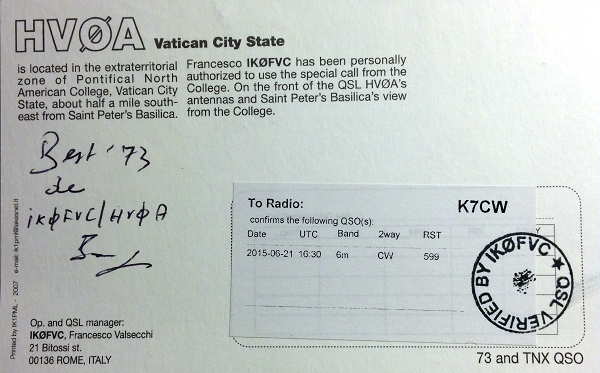
June 21st was one of the better days of this year's poor Sporadic-E season. Stations in the western part of North America had an early-morning opening to the Caribbean as well as to South America, when YV1KK was worked by stations in the PNW region.
 |
| courtesy: K7CW |
No magic for me that day but kudos to Paul and his fine station, as well as to Francesco, for the heads-up operating and being on top of the short propagation window that morning!
 |
| courtesy: K7CW and https://www.qrz.com/ |
These are the moments that 6m diehards live for, especially those on the west coast ... reminding us once again why the 'magicband' deserves its well earned moniker.
Steve McDonald, VE7SL, is a regular contributor to AmateurRadio.com and writes from British Columbia, Canada. Contact him at [email protected].
Ham Friendships Span Time and Space
 How many friendships have you developed through ham radio? If your answer is like most hams, it is many, probably even too numerous to recall all of them.
Just recently I’ve had some happenings that caused me to stop and ponder this very question. When I think about it, the number of people I’ve met and developed close friendships with is countless, spanning both time and space.
Several of those friendships started back when I was in Junior high school. Ron, K8OEY, and I met through an older ham, Leo, W8AJM, who knew both of us kids, and he knew we were both interested in electronics and were “ham wanta be’s.” So, Leo invited us out to his place so we could meet and get acquainted. From that meeting, Ron and I became best friends; we were inseparable. Leo was our Elmer. He first gave me my novice exam and a few months later he gave Ron his test too. Ron and I built all kinds of electronic circuits and kits, and yes, we even blew-up a few too. We remained friends over the years right up to Ron’s early death a few years ago.
In my 7th grade year, I switched from the public school system to the Michigan School for the Blind (MSB), located in Lansing Michigan and about 75 miles from my hometown of Sturgis. So, I lived on the campus of MSB most of the time, except for vacations. I lost most of my eyesight at age 8 from a pretty rare illness called Stevens – Johnson syndrome. I still had some useable sight, but I was really struggling in school because of my poor eyesight, and the medical and educational experts felt it was best if I switched to the School for the Blind. I was strongly opposed to this change; after all, my friends since kindergarten were all in Sturgis, and I didn’t know anyone at that “stupid school for the blind!” Besides, I wasn’t blind! This is an important part of my story because almost immediately I met several other kids at my new school who were also interested in electronics and becoming hams. Soon, I was fitting right in with my new pals, my “ham wanta be” buddies. We formed a study group led by one of the guy’s Dad. His name was George Woods, but we all just called him Woody. Woody and his son, Gary, lived near the MSB campus; so, it was easy to get over to their house. Woody was ahead of the rest of us, and he took and passed his novice exam first. Then, he held study sessions a couple times a week in the evenings to help the rest of us prepare for our Novice tests.
We all studied hard, the electronic theory, the rules and regulations, and oh, yes, the code. For most of the guys, the code was the easy part. Later, some of the guys developed code speeds of 40 words per minute and even faster. Over a few months we all passed our novice license exams and were officially real hams, no longer just ham wanta be’s! There was Ron Iser, KN8KLR, his Brother, Ronnie, KN8MEW; Ken Filter, KN8KIC; Gary Wood, KN8HLX; me, KN8HSY, and our Elmer, Woody, KN8HBX. We got to be really good friends, a tight little group. Woody let us use his Hallicrafters S-88 receiver and Heathkit AT-1 transmitter, running all of about 20 watts if we were lucky. Eventually, we all got our own gear. Together, we had quite a variety of receivers and transmitters, a Heathkit DX-40, Hallicrafters SX-71, Globe Scout, some military surplus gear like the BC-348, ARC-5’s, and even some homebrew gear. We strung antennas out our windows, and even tried loading up bed springs and window screens. As kids, we were up for trying anything, which also explains how we ended up blowing up a few pieces of gear too. Those old PI output networks would attempt to tune more than what was good for them! Those days were back in the late 1950’s and early 1960’s, and many of us who were members of that little group are still friends to this day, well over 50 years later.
After high school, we all went our separate ways, but we still stayed in contact on the air and through the grapevine we developed as graduates of MSB. I went on to attend Eastern Michigan University and then, into the business world, and eventually on the graduate school at Arizona State University for my MBA and Ph.D. degrees. All along the way I met new ham friends. Ham radio was the one unifying thread. No matter where you go if you are a ham, you can almost always find other hams who quickly become your friends.
My first professorial position was at the University of Texas at Arlington. Once again, I didn’t know anyone in Arlington. I went to a local Radio Shack store and ask if anyone was a ham or if they knew any hams in the area. Bingo! One of The fellows working in the store was a ham, and the customer he was helping was a ham. I introduced myself with my name and call, W7GPF. W7GPF was my call from Arizona, and I just moved to Texas and hadn’t filed that famous or infamous FCC Form 610 yet to change my address and get assigned a new call for the 5th call district. Anyway, we immediately struck up a lively conversation over something, probably antennas or the like. Anyway, One of the guys, Vern (I don’t remember Vern’s call.) invited me to their next ham club meeting. As it turned out, Vern and I were even neighbors; he lived just down the street from where I had just purchased a house. Vern invited me to attend the local ham club meeting with him. I was able, then, to meet lots of the other hams in the area. One fellow in particular came right up to me and said: “Ron, I’m Rick. I’m not a ham yet, but I’m working on it.” That fellow turned out to be Rick Hamilton who is now WB5VQW, and Rick and I have been ham buddies now for almost 40 years. We’ve gone to hamfest together, shopped the surplus stores together, and just this week Rick and his wife, Karen, who’s also a ham (WB5UFM), met with my wife and I to share some quality time together and talk ham radio and about the “good ol’ days.” Rick and Karen invited my wife, Palma, and me up to their FMCA’s Amateur Radio Chapter’s Rally/campout where I met up with several other ol’ ham friends from my days back in Arlington. We sat around the table and talked about how Rick and I managed to burn up something in one of my rigs and had to take it over to Bob to repair, and there Bob was sitting across the table from me. It was like those good ol’ days all over again!
A few years later, I moved from Texas to Louisiana where I accepted a position as Chair of the Marketing Department at Loyola University in New Orleans. As we were approaching New Orleans and getting close enough that I could hit the repeaters, I dropped my call on the one I was told was the most active repeater. Right away I have Wd5DWO come back to me. It was Althea. She welcomed us to New Orleans, and offered to meet us and help us get acquainted with the area. We actually met for lunch, and Althea became an immediate good friend. Over the next few weeks, she introduced us to many other hams that also became good friends.
A very similar thing happened when we moved to Kentucky, and I joined the faculty at Western Kentucky University. I was able to immediately connect up with the local hams here in Bowling Green, and they became our first friends, helping us get settled, answering questions about the area, and inviting me to join the local ham club, the Kentucky Colonels Amateur Radio Club. I’m also a member of the Princeton, Kentucky Amateur Radio Club. The guys in both clubs helped me get up my antennas and have become some of my best friends.
As you read this, I’m sure you can reminisce over very similar experiences. Like me, you’ve probably developed lots of good friends; some are probably even your very best friends and some you’ve known over many years. Whether you are a rag chewer, a DX chaser, someone who enjoys participating in nets, or a builder/experimenter, you can always find other hams that share your interest with whom you can develop close friendships.
Dr. Ron Milliman is a special contributor to AmateurRadio.com and writes from Kentucky, USA. Contact him at [email protected].
RadioKitGuide.com Updated

The Splinter from Breadboard Radio
Check out the updated RadioKitGuide.com HERE
I now have 64 different sources listed.
Sorry it’s been so long since the last update.
Additions:
Re-Adding: 4 State QRP Group which got lost in a previous edit (sorry guys!)
AE9RB (Peaberry SDR)
Hans Summers (Ultimate QRSS Kit)
Jackson Harbor Press
Third Planet Solar (HW8 add-ons)
Midnight Design (SDR Cube)
Peebles Originals
R3KBO
SOTABEAMS
Steven Weber
Lots of changes too! Too many to list. -NEW- items or changed items are marked as such. I also did a general cleanup. After all of the moving around between editors, and Blogger, and Word things were looking a bit messy. Hopefully the next version will be more of what I originally wanted and be more database style and searchable. I’m still verifying prices so they may not all be correct.
If you know of something that is missing please let me know in the comments.
–Neil W2NDG
Neil Goldstein, W2NDG, is a regular contributor to AmateurRadio.com and writes from New York, USA. Contact him at [email protected].
I’m going out on a limb
But did you know that if you're a paid up member of QRP-ARCI, that you can get QRP Quarterly as a .pdf file, sent to you? Yes. you can! And it's real easy to do - here's the actual snippet from the QRP-ARCI Website:

Personally, I think this is fantastic and I offer kudos to Steve and QRP-ARCI. I already get QST, CQ and the K9YA Telegraph in digital format, and now I can get the "Best of the Best" in digital format, too.
I know a lot of you prefer to have actual paper in your hands, but I like being able to have all four publications easily with me on my tablet. It takes up a lot less physical space, and I don't have to store back issues after the fact. And I've read so many books on my kindle and via the kindle app on other devices that swiping, enlarging, and dragging motions are almost like second nature to me now.
I suppose the fact that we save some trees in the process is a bonus too. Although, selfishly, I'm all in for the convenience! As far as storage goes, I have a dedicated USB memory stick where I already store back issues of the K9YA Telegraph. There's plenty of space on there for issues of QRP Quarterly.
Yes, I know there are downsides to digital formats of magazines. Of course, you need "juice" for the device's battery, and it's not as easy (or possible) to share or donate old issues to libraries or friends. But again, IMHO, these "cons" are minor compared to the "pros". Whether we like it or not, it's more economical for the providers not to have to purchase paper, ink, binding, postage, etc. I would never say that actual paper publications will disappear forever, but this is (to use an overused phrase) "the wave of the future". And besides, if you're as old as I am (or older) who can forget the astronauts in "2001: A Space Odyssey" reading their news on a tablet like device. Back in the 60s, when the movie came out, we all thought that would be so neat. That time is now, baby!
On another topic, remember how I mentioned in yesterday's post about FOBB that the weather forecast for Sunday would probably change between yesterday and then? It already has! Now it's looking like only clouds with no rain forecasted until well after FOBB 2015 is in the books. Looking better and better for heading out to Washington Rock State Park.
72 de Larry W2LJ
QRP - When you care to send the very least!
Larry Makoski, W2LJ, is a regular contributor to AmateurRadio.com and writes from New Jersey, USA. Contact him at [email protected].
 Ham Radio Deluxe |
 W5SWL Electronics |
 Ham Radio Prep |
 KB3IFH QSL Cards  Hip Ham Shirts  HamRadioAuctions HamRadioAuctions Reliance Antennas Reliance Antennas Enigma Shop Enigma Shop |  morseDX  Ni4L Antennas  R&L Electronics R&L Electronics antennas.us antennas.us QRV QRV |
- Matt W1MST, Managing Editor
