 |
 Self-serving post…but not entirely
 24 July 2015 | by
 Yes, I am trying to sell books. I admit that right up front. That is how I feed my family and pay for Ham gear!
But I also have another purpose in the two new Amateur Radio books I have just published. I continually meet folks who either have considered joining the Ham Radio ranks but simply never followed through. And others who did all the work to get a license, maybe bought a two-meter HT, but never really went any farther in getting the most from our wonderful hobby.
OK, I realize what we all love so much is not everybody’s cup of tea. But I also believe that many who never develop into active Hams drop by the wayside because of four basic roadblocks…real or perceived. (And I am NOT including trepidation about passing the license exam. Anyone too timid to try the test probably wouldn’t take the next steps anyway.)
They are:
1) Putting together a station that would offer a complete and satisfying on-air experience.
2) Putting up an outside antenna.
3) Knowing what to say and do once on the air that would not get them ridiculed.
4) The jargon that has developed over the first century of Ham Radio’s existence.
In my new book, GET ON THE AIR…NOW!, I try to give practical, realistic advice on each of these stumbling blocks. I hope I have been successful because I want to see our hobby continue to grow and prosper.

One way I tackled obstacle #4–the one about jargon and gobbledygook–was to include in the book a complete Amateur Radio dictionary. As I compiled that section, I came up with far more terms than I expected–more than 1400 terms, 1600 definitions, and hundreds of web links–so I decided to not only make the dictionary a part of GET ON THE AIR…NOW! but publish it as a separate stand-alone book. It is cleverly titled THE AMATEUR RADIO DICTIONARY and is, I am confidently claiming, the most complete ham radio glossary ever compiled.

You can see info on both books at www.donkeith.com/hamradio/amateur-radio. The books are available wherever books are sold and in all e-book formats as well as in paperback.
But please consider my thoughts on those four hurdles that I believe keep many prospective Hams on the sidelines. If you agree, jump in and become a mentor, advise newcomers (or old-timers who never get on the air) on overcoming them, and help our wonderful hobby to continue to grow as we dive head-foremost into its second century.
73,
Don N4KC
www.n4kc.com
www.donkeith.com
Don Keith, N4KC, is a regular contributor to AmateurRadio.com and writes from Alabama, USA. Contact him at [email protected].
Control of Your Transmitter?
Are you really in control of your transmitter? I visited another radio club last night. It was interesting to hear the discussion about two new repeater projects the club is working on, including swapping the RF and control decks out with Yaesu’s Fusion offer. I could write a book on the pros and cons of the Fusion offer…today’s post isn’t about that.
What was interesting to me is that the club wasn’t concerned that they wouldn’t have remote control of their repeater transmitters the way that they do today. They are planning on running the repeaters in analog mode for output, and maybe dual mode for input. The comment that stuck with me is that they didn’t see any need for the repeater controllers they have today. The ability to make remote changes to the configuration, or to be able to shut the system down (and turn it back on) were not of interest to any of the members.
I’ve only run repeaters for a couple of years now. It has been quite the adventure. During that time, I had a cheap controller go belly up in such a way that it held the transmitter keyed down. The transmitter would overheat, shut off, cool off, then key down. Rinse and repeat. Over and over. The controller wouldn’t respond to any commands. It was a week before I could get to the site to replace the defective board. Since then, I’ve got a remote controlled power strip like we use in corporate data centers that allows me to power cycle equipment over the internet.
The thought of putting a repeater on the air without being in positive control is crazy. Sure, it’s very unlikely that the FCC is going to find you and fine you. That’s not the point…is it good practice to throw a system on the air that you can’t control? There are plenty of great solutions here that can be used. Put a second radio with a dtmf decoder on receive side of cans that controls the power. Use the internet and a $50 remote control power strip. Whatever solution you choose, please do something!
In this club’s case, the repeater guys are all retired and have easy walk-in access to the sites. In my case, the three repeaters I work on all required coordinated access, can’t be reached without taking man lifts or elevators, and two can only be accessed during my work day. Remote control – and positive control of the transmitters – is extremely important.
Michael Brown, KG9DW, is a regular contributor to AmateurRadio.com and writes from Illinois, USA. Contact him at [email protected].
Control of Your Transmitter?
Are you really in control of your transmitter? I visited another radio club last night. It was interesting to hear the discussion about two new repeater projects the club is working on, including swapping the RF and control decks out with Yaesu’s Fusion offer. I could write a book on the pros and cons of the Fusion offer…today’s post isn’t about that.
What was interesting to me is that the club wasn’t concerned that they wouldn’t have remote control of their repeater transmitters the way that they do today. They are planning on running the repeaters in analog mode for output, and maybe dual mode for input. The comment that stuck with me is that they didn’t see any need for the repeater controllers they have today. The ability to make remote changes to the configuration, or to be able to shut the system down (and turn it back on) were not of interest to any of the members.
I’ve only run repeaters for a couple of years now. It has been quite the adventure. During that time, I had a cheap controller go belly up in such a way that it held the transmitter keyed down. The transmitter would overheat, shut off, cool off, then key down. Rinse and repeat. Over and over. The controller wouldn’t respond to any commands. It was a week before I could get to the site to replace the defective board. Since then, I’ve got a remote controlled power strip like we use in corporate data centers that allows me to power cycle equipment over the internet.
The thought of putting a repeater on the air without being in positive control is crazy. Sure, it’s very unlikely that the FCC is going to find you and fine you. That’s not the point…is it good practice to throw a system on the air that you can’t control? There are plenty of great solutions here that can be used. Put a second radio with a dtmf decoder on receive side of cans that controls the power. Use the internet and a $50 remote control power strip. Whatever solution you choose, please do something!
In this club’s case, the repeater guys are all retired and have easy walk-in access to the sites. In my case, the three repeaters I work on all required coordinated access, can’t be reached without taking man lifts or elevators, and two can only be accessed during my work day. Remote control – and positive control of the transmitters – is extremely important.
Michael Brown, KG9DW, is a regular contributor to AmateurRadio.com and writes from Illinois, USA. Contact him at [email protected].
Amateur Radio Newsline Report 1969 July 24, 2015
- ARRL DUES GOING UP
- YOUNG HAM OF THE YEAR WINS AGAIN
- BRITISH HAMS LEND A HAND
- HITCHING A RIDE
- A-HUNTING WE WILL GO
- SOME MORE FOR MORSE
- REPEATER NEWS WORTH REPEATING
- WORLD OF DX
- CQ, CQ AND I DO
CLICK THE LINKS BELOW FOR THIS WEEKS NEWSCAST
CW Progress
Over 6 months ago I pretended to myself that I was going to learn CW. Just one QSO and then I can call myself a ‘real ham’.
Well I’ve had that QSO now and it seems reasonable to assume that I’ll have a few more now that I’m helping other local hams to learn CW. None of us are any good. I think I top out the speed tables at about 8-10wpm but now that there are a few more locals ready to take to the airwaves then I’m sure I’ll speed up to the target of 12-15wpm by Christmas.
So what? Well here’s the good news. 2m is as quiet as a mouse round here. Even the repeaters are empty so there’s no need to worry anyone with some troublesome sending.
Thursday nights are on air practice nights. Who knows, one day someone may not be part of the group and a real QSO might happen!
Alex Hill, G7KSE, is a regular contributor to AmateurRadio.com and writes from Cumbria, UK. Contact him at [email protected].
Comprehensive kit provider listing
http://radiokitguide.com
I'm also adding it as a permanent link in the links section.
72 de Larry W2LJ
QRP - When you care to send the very least!
Larry Makoski, W2LJ, is a regular contributor to AmateurRadio.com and writes from New Jersey, USA. Contact him at [email protected].
Vatican Magic
 |
| courtesy: K7CW |
June 21st was one of the better days of this year's poor Sporadic-E season. Stations in the western part of North America had an early-morning opening to the Caribbean as well as to South America, when YV1KK was worked by stations in the PNW region.
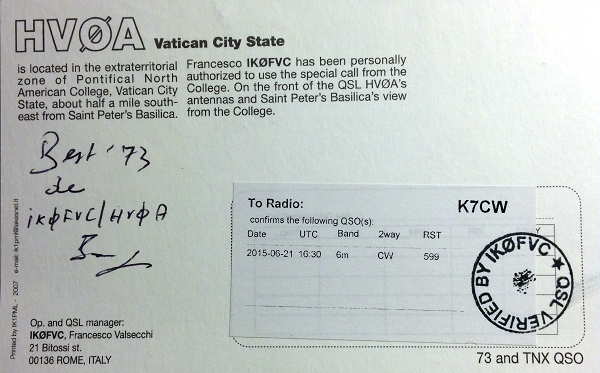 |
| courtesy: K7CW |
No magic for me that day but kudos to Paul and his fine station, as well as to Francesco, for the heads-up operating and being on top of the short propagation window that morning!
 |
| courtesy: K7CW and https://www.qrz.com/ |
These are the moments that 6m diehards live for, especially those on the west coast ... reminding us once again why the 'magicband' deserves its well earned moniker.
Steve McDonald, VE7SL, is a regular contributor to AmateurRadio.com and writes from British Columbia, Canada. Contact him at [email protected].
 Ham Radio Deluxe |
 W5SWL Electronics |
 Ham Radio Prep |
 KB3IFH QSL Cards  Hip Ham Shirts  HamRadioAuctions HamRadioAuctions Reliance Antennas Reliance Antennas Enigma Shop Enigma Shop |  morseDX  Ni4L Antennas  R&L Electronics R&L Electronics antennas.us antennas.us QRV QRV |
- Matt W1MST, Managing Editor
