 |
 CW Contesting
 3 August 2015 | by
  |
| courtesy: http://k1el.tripod.com/ |
It's been a few years since I've done any CW contesting, mainly because the laptop I have always used became slow and sluggish as well as developing a keying glitch when keying was done via the serial port connection. Apparently it is, or was, a fairly common problem with some operating systems when serial port keying was employed.
Last year I purchased and built the WinKeyer USB keyer, mainly to use as a USB keying interface, and hopefully kill the keying stutter. The stutter would manifest itself in the form of delayed element spacing. For example, the 'C' in a 'CQ' would sound like 'NN'- every once in awhile ... not every time, but often enough to drive me crazy. From lots of 'Googling', I learned that USB keying should solve the problem.
The first thing I did was to download and run 'CCleaner' to scrub the computer of unused files and clean up the registry. My contesting laptop uses Windows XP, which I've always liked but my old system was taking about eight minutes to boot-up from a cold start! Following the CCleaner run, I did a hard drive defragmentation, shut the system down, and pressed the 'on' button. This time the system booted completely in less than two minutes, the fastest in several years!
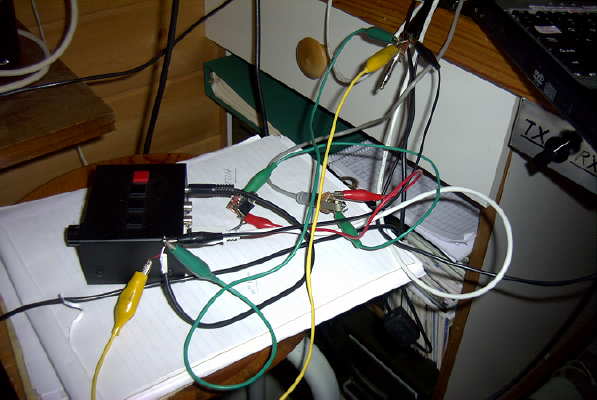
After, interfacing everything with a half-dozen clip leads (I didn't have the required cables), configuring the WinKeyer and setting up the N1MM logging software for this weekend's NA CW QSO Party, I cautiously waded into the fray.
 |
| Yikes! |
Like riding a bicycle, it all came back to me quickly. The NA guys are hardcore CW fans and send fast, typically 30WPM or better. I started in the 'Search & Pounce' (S&P) mode to ease into the logging software's required keystrokes but soon felt comfortable enough to change to the 'Run' mode.
Handling the pileups and typing fast enough to keep up was challenging yet exhilarating ... it had been a few years since my last test, the 160m Stew Perry Contest, my favorite. I could only take the heat for so long and after about two hours of steady operating decided to call it a day. It was nice to shake out the new interface and also test my own skills once again. I completed my short test with 137 QSO's and 5891 points ... not much by 'NA' standards but still, for me, a ton of fun and a good 'back-in-the-saddle' re-start.
Now that the software is working well (there were zero keying glitches during the test), I'm looking forward to getting back into some CW contesting again and to improve my ear-brain-computer skills.
Time to get busy and build some interfacing cables and get rid of the clip-lead rat's nest for the next exercise.
Contesting events can be found at WA7BNM's excellent WA7BNM Contest Calender website
Steve McDonald, VE7SL, is a regular contributor to AmateurRadio.com and writes from British Columbia, Canada. Contact him at [email protected].
Prices of Japanese radios?
I wonder when the next round of price drops will come on Japanese gear? The big Japanese players such as Yaesu, Icom and Kenwood have had an easy ride of late and been able to dictate prices. Now the competition is waking up, I expect they will be facing tougher times.
The latest exchange rates (UK pound to Japanese Yen) is £1 is worth about 193 Yen. Not many years ago it was less than 130 Yen to the pound. In real terms, Japanese goods should be much less expensive. At the moment both the UK dealers and Japanese are doing very well thank you from a customer base prepared to pay high prices. Expect big falls between now and the year end. This will be partly due exchange rates becoming much better (for those in the UK) and partly due to the increasing threat from the non-Japanese suppliers. Don’t you find it amazing how low cost some Chinese hand portables are compared with similar products from Japan? Rip-off come to mind – charge high prices for Japanese goods as long as the suckers pay.
No, the age of UK amateur radio consumers being taken for a ride is ending. The next time you discuss prices with UK dealers remind them of competition and exchange rates! At the moment their margins must be very high. Japanese goods are priced too high in the UK – fact. A few years ago I was more sympathetic, but not any more. UK consumers should pay a fair price with the dealers getting a fair margin, but please don’t take us all for mugs. I shall buy when the prices are fair and not before.
If I have this wrong, I shall be interested to hear the dealers viewpoint. Exchange rates have got vastly better and I do not see this reflected in end user prices here in the UK. Someone is making very handsome profits.
Consumers – vote with your wallets and do not buy overpriced radios. I have said before, the FT817 is classic example: all development costs were recovered years ago, so the price should be considerably lower than it is. Dealers have dropped the price somewhat, but it is nowhere near what it should be for a very mature design.

Roger Lapthorn, G3XBM, is a regular contributor to AmateurRadio.com and writes from Cambridge, England.
Sneeking off to track a HAB
Yesterday we were visiting my mother-in-law and I had seen that the University of Southampton Spaceflight Society were launching a High Altitude Balloon from the New Forest. I am never one to miss the chance to track them and decided at the last minute to throw the Alinco DJ-X10 receiver and an audio lead into the bag with the laptop which by happy coincidence we were taking since it contained the holiday photographs.
After an enjoyable Sunday lunch I dutifully did the washing up and then as the others succumbed to postprandial somnolence I sneaked off to see if I could receive anything as the flight was already well under way.
I put the Alinco on an upstairs windowsill with the W-881 Watson Super Gainer antenna fitted. The radio which has SSB capability was still tuned to 434.650MHz as this was the frequency I used on the EGG1 tracker and amazingly I heard clear RTTY telemetry of the CHRISHAB tracker and connecting it to the laptop with a simple earphone-to-microphone input lead was getting clear decodes.
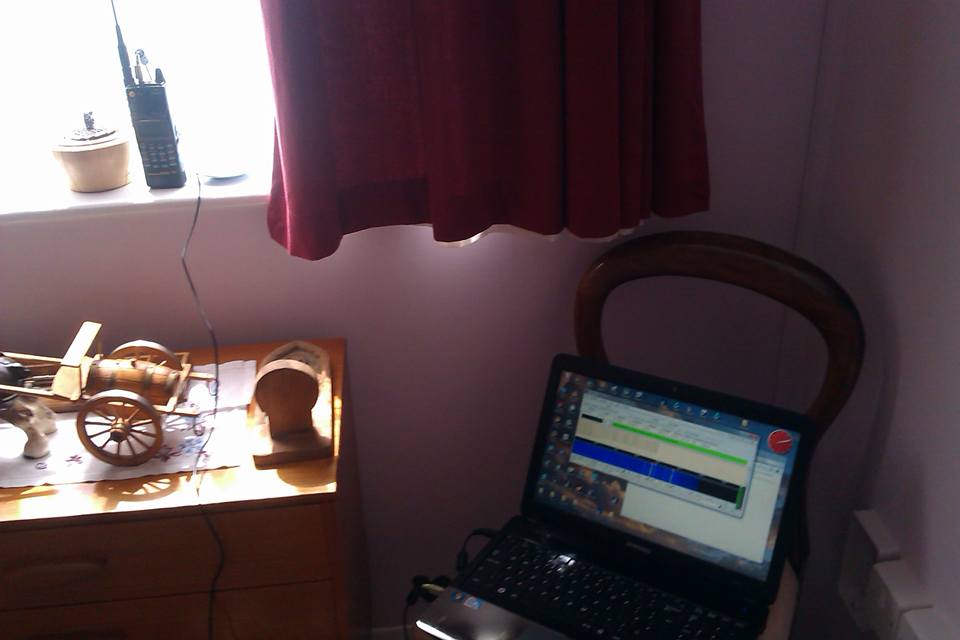
Being a silver surfer my mother-in-law has a broadband connection so was able to upload the packets to the tracker system.
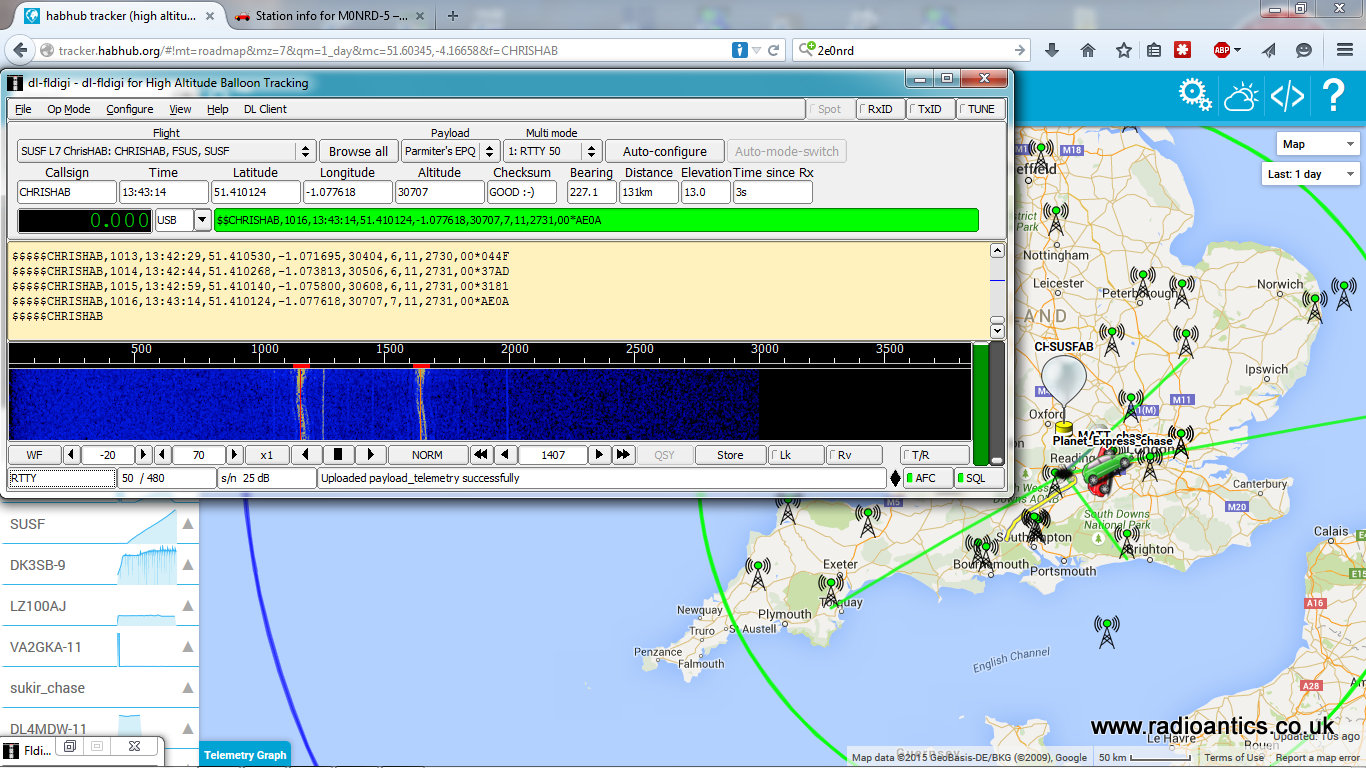
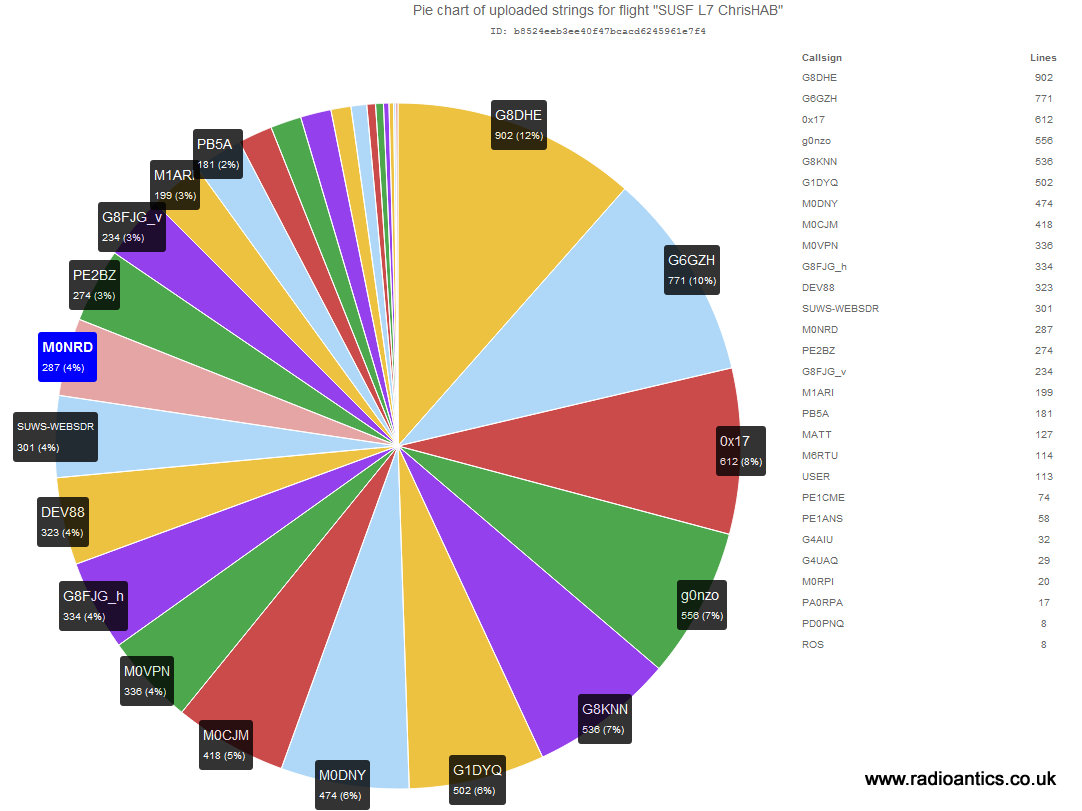
I left it running while I returned to be sociable. When I checked back later the flight had ended but I was more than happy with the number of decodes I had achieved with this modest set up and proves with all things radio it pays sometimes just to give it a try!
The previous day I visited my mother and got to try my brother's very nice new Yaesu VX-8R hand held. I made a short QSO with MX0PPC the Central Amateur Radio Circle (CARC) who were running some intermediate classes that afternoon. My brother is getting to grips with it and its in built APRS and GPS and soon hopes to be spotted by the International Space Station digipeater.
Andrew Garratt, MØNRD, is a regular contributor to AmateurRadio.com and writes from East Midlands, England. Contact him at [email protected].
Sneeking off to track a HAB
Yesterday we were visiting my mother-in-law and I had seen that the University of Southampton Spaceflight Society were launching a High Altitude Balloon from the New Forest. I am never one to miss the chance to track them and decided at the last minute to throw the Alinco DJ-X10 receiver and an audio lead into the bag with the laptop which by happy coincidence we were taking since it contained the holiday photographs.
After an enjoyable Sunday lunch I dutifully did the washing up and then as the others succumbed to postprandial somnolence I sneaked off to see if I could receive anything as the flight was already well under way.
I put the Alinco on an upstairs windowsill with the W-881 Watson Super Gainer antenna fitted. The radio which has SSB capability was still tuned to 434.650MHz as this was the frequency I used on the EGG1 tracker and amazingly I heard clear RTTY telemetry of the CHRISHAB tracker and connecting it to the laptop with a simple earphone-to-microphone input lead was getting clear decodes.
Being a silver surfer my mother-in-law has a broadband connection so was able to upload the packets to the tracker system.
I left it running while I returned to be sociable. When I checked back later the flight had ended but I was more than happy with the number of decodes I had achieved with this modest set up and proves with all things radio it pays sometimes just to give it a try!
The previous day I visited my mother and got to try my brother's very nice new Yaesu VX-8R hand held. I made a short QSO with MX0PPC the Central Amateur Radio Circle (CARC) who were running some intermediate classes that afternoon. My brother is getting to grips with it and its in built APRS and GPS and soon hopes to be spotted by the International Space Station digipeater.
Andrew Garratt, MØNRD, is a regular contributor to AmateurRadio.com and writes from East Midlands, England. Contact him at [email protected].
QRP from the Ashland Railroad Station
Judy and I stopped by the Ashland Railroad Station today after visiting a blueberry field. I worked eight stations in the NA QSO Party and a station in Bulgaria. It was a gorgeous afternoon.

The station is one of the stops along the Plymouth and Lincoln Railroad that runs between Northfield and Lincoln, New Hampshire. The old depot is a museum now. The train makes regular stops there during the foliage season in the fall when the passengers disembark to tour the museum.
I tossed a 28 foot wire into a maple tree on the other side of the tracks and sat down on the platform with the KX3. I work part-time on the railroad as a conductor and know the train schedules.

The caboose in the background belongs to Brian, KA1JOZ who also works on the railroad. I started out on 20 meters. There were plenty of signals and the propagation was pretty good for a change. The North America QSO Party was in full swing and it was easy to make contacts. I seemed to have a pipeline to Minnesota. Here’s my log:
1 Aug-15 2011 14.019 NA0N CW 599 599 MN
1 Aug-15 2014 14.030 N0AT CW 599 599 MN
1 Aug-15 2016 14.033 N2UT CW 599 599 NM
1 Aug-15 2017 14.027 WO4O CW 599 599 Fl
1 Aug-15 2019 14.024 W9IU CW 599 599 IN
1 Aug-15 2020 14.019 K0MPS CW 599 599 MN
1 Aug-15 2021 14.018 K0AD CW 599 599 MN
1 Aug-15 2024 18.076 LZ73TRC CW 599 599 Bulgaria
1 Aug-15 2027 14.027 WA4PHC CW 599 599 NC

At one point I switched to 17 meters to see how the activity was. I heard LZ73TRC calling CQ. He was strong, and we had no trouble making a nice QSO. I operated for about 20 minutes and packed up.

Jim Cluett, W1PID, is a regular contributor to AmateurRadio.com and writes from New Hampshire, USA. Contact him at [email protected].
More ‘Hydroponic’ RF
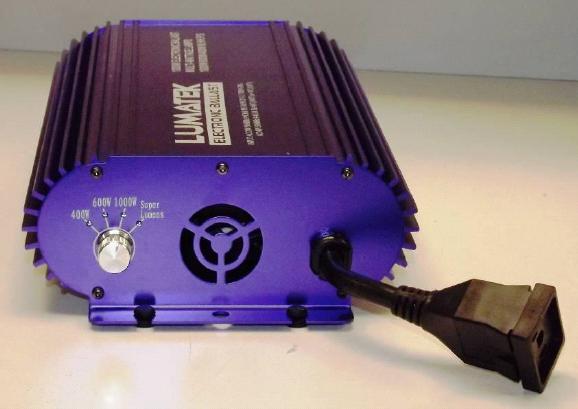 |
| courtesy: arrl.org |
Some of the test products were ordered and purchased through Amazon and through Sears ... the ARRL's thorough report makes it obvious that rules are being ignored and amateurs are paying the price.
“The level of conducted emissions from [these devices] is so high that, as a practical matter, one RF ballast operated in a residential environment would create preclusive interference to Amateur radio HF communications throughout entire neighborhoods,” ARRL General Counsel Chris Imlay, W3KD, wrote in each complaint. The devices exceeded conducted emission limits under all test conditions, “sometimes by extreme margins, throughout most of the HF range ...”
In a similar vein as its recent complaint about marketing of certain RF lighting devices by The Home Depot, the ARRL pointed out that there were no FCC labels on two of the devices mentioned nor any FCC compliance information “anywhere in the documentation, or in or on the box, or on the device itself,” in violation of FCC Part 18 rules.
The League asked the FCC to require removal of all such illegal “grow light” devices from retail sale and marketing and the recall of those devices already sold or available for retail sale, and it said the device importers should be subject to a forfeiture proceeding.
With the proliferation of both legal and illegal 'hydroponic' operations, this kind of QRN is probably just the tip of the iceberg. It's good to see the ARRL slowly pounding away at the rule-breakers on behalf of American amateurs.
I see these same devices being sold on E-Bay, where presumably, they could be purchased worldwide and installed anywhere. As well, several of the U.S. online dealers state "We ship to Canada" ... just great.
Hopefully Industry Canada and RAC are gearing-up for the fight.
Steve McDonald, VE7SL, is a regular contributor to AmateurRadio.com and writes from British Columbia, Canada. Contact him at [email protected].
Amateur Radio Weekly – Issue 71

Amateur Radio Parity Act has 93 cosponsors
ARRL Headquarters has forwarded 3,433 letters to 402 individual US House members, seeking their cosponsorship of H.R. 1301.
ARRL
Coming soon: 146.52 MHz in ARRL VHF contests
Brian Mileshosky N5ZGT, ARRL Director of the Rocky Mountain Division, reported that the ARRL has decided to remove the prohibition of 146.52 MHz in VHF contests.
K0NR
Why 30 Meter APRS?
A case study on 30m APRS vs the 2m APRS network.
The Kentucky Packet Network
Comparing RTTY, PSK and MFSK
Using the ARRL field day test message to compare RTTY, PSK and MFSK digital modes.
HamRadio.me
FUNcube Certificate of Achievement and QSL Card
Those who have successfully received telemetry from FUNcube-1 and uploaded it to the Data Warehouse are able to download these documents.
AMSAT UK
Understanding LF and HF Propagation (PDF)
This PDF is a series of features that formed a good introduction to the topic.
G0KYA, G3NYK
Raspberry Pi packet/digital mode open hardware
Ham Radio sound card interface for the Raspberry Pi or other microcontrollers.
Reddit
Android balloon tracker and modem app
Ground tracking app for high altitude balloons, complete with RTTY modem, offline mapping, online distributed listener integration, chase car location reporting and more.
Google Play
Arduino CW decoder
This is arguably the simplest part of the project. I simply downloaded the sketch and uploaded it to the Arduino.
Amateurradio.com
Icom America club station revealed
I’m pleased to report that a number of our employees are regularly getting on the air and we’re looking forward to activating a few contests as well.
Icom
How to
Google Earth with NWS and APRS using KML
I wanted to find an easy way to integrate mapping, radar data, and APRS tracking data for SkyWARN events.
Robert Andrews
Simple one-chip regenerative receiver
You might be surprised that you can convert an audio amplifier to a receiver using just a handful of components.
Hackaday
Amateur Radio Weekly is curated by Cale Mooth K4HCK. Sign up free to receive ham radio's most relevant news, projects, technology and events by e-mail each week at http://www.hamweekly.com.
 Ham Radio Deluxe |
 W5SWL Electronics |
 Ham Radio Prep |
 KB3IFH QSL Cards  Hip Ham Shirts  HamRadioAuctions HamRadioAuctions Reliance Antennas Reliance Antennas Enigma Shop Enigma Shop |  morseDX  Ni4L Antennas  R&L Electronics R&L Electronics antennas.us antennas.us QRV QRV |
- Matt W1MST, Managing Editor
