 |
 156th Anniversary
 2 September 2015 | by
This was a coronal mass ejection that occurred during Cycle 10. It was a solar storm of such great intensity that reportedly, people as far south in Florida and Cuba were able to see aurora. In the Rockies, gold miners woke up in the middle of the night and started preparing breakfast because they thought it was daybreak. The aurora was so bright here in the northeast, that people outside were able to read newspapers by the aurora's glow.
Telegraph stations (our forerunners) were hit particularly hard. It was reported that some telegraph poles threw sparks into the air. Telegraph operators reported that not only did they receive shocks when they tried to operate, but that they were also able to continue to operate their telegraph apparatus after disconnecting it from the power supply.
I can only imagine the damage that would occur today if we suffered a direct blast from the sun as we did in 1859. I'm pretty sure that not only would the power grid be very badly affected, but that telephone and radio communications of all types would probably be non-existent, and much, much more.
Here are some interesting links:
http://news.nationalgeographic.com/news/2011/03/110302-solar-flares-sun-storms-earth-danger-carrington-event-science/
http://science.nasa.gov/science-news/science-at-nasa/2008/06may_carringtonflare/
http://www.history.com/news/a-perfect-solar-superstorm-the-1859-carrington-event
72 de Larry W2LJ
QRP - When you care to send the very least!
Larry Makoski, W2LJ, is a regular contributor to AmateurRadio.com and writes from New Jersey, USA. Contact him at [email protected].
The Spectrum Monitor — September, 2015

Stories you’ll find in our August, 2015 issue:
AFN: The Biggest Network You’ve Never Heard or Seen
By Richard Fisher KI6SN
Originally begun as Armed Forces Radio Service (AFRS) in 1942 and intended to provide news and entertainment from “back home” to US service personnel stationed in the war zones of World War II, the American Forces Network (AFN) now provides 12 music, news and sports audio services, seven TV services and a program guide to US bases globally. Over the years, AFN’s mission has evolved along with the technology used to deliver the programming. With headquarters in Riverside, California, Richard Fisher took a tour of AFN facilities that produce programming seen only by those in uniform and discovered close connection between AFN and Hollywood.
Ultra-light Radio: Doing more with Less
By Gary Donnelly KC8IQZ
Many shortwave listeners scoff at low-ticket, shirt-pocket sized, no-frills portable radios as inadequate at best for the job of DXing the AM and HF bands. But, a loyal group of adherents to Ultra-light Radios (ULR) are finding that these insignificant seeming radios deserve space in any listening post. Gary shows us the ins and outs of ULR DXing and how these diminutive receivers can deliver surprising results with and without modifications.
MultiPSK: A Digital Diamond in the Rough
By Robert Gulley AK3Q
There are many digital programs available for amateur and shortwave radio listeners, from individual modes to all-in-one packages, but with MultiPSK, Robert has found a real treasure. He calls this a “diamond in the rough” because, for many folks, the initial configuration and program screens seem, at best, awkward. We have become used to very glamorous graphical user interfaces, with ribbon bars and lots of bells and whistles. By comparison, MultiPSK seems rather barren but, Robert tells us, nothing could be further from the truth!
Outernet: Bringing Free, Global, One-way Internet Content to the World via FTA Satellite
By Kenneth Barbi
Calling itself “Humanity’s Public Library,” Outernet is an ambitious public service project designed to provide free access to information to those not served by extensive Internet infrastructure. To do so, Outernet founder, Syed Karim, has implemented a global data delivery system using existing Ku-band geosynchronous satellites. He says, the concept is a repurposing of existing computer and Free-to-Air (FTA) satellite technology—“a mix between modern day shortwave radio and BitTorrrent from space.”
Summer Radios and Some are Not
By Cory GB Sickles WA3UVV
A few new digital-capable 2-meter/70-cm transceivers have made their debut this summer, but Cory finds that there is more than one way to get into digital voice on amateur radio, including a mash up of various low cost digital devices you might already have around the house. He also makes sense of the alphabet of digital voice modes: DMR, LMR, D-STAR, NXDN, NXREF, WIRES-X and the use of DV Dongles.
Scanning America By Dan Veenaman
Maine’s Statewide MSCommNet
Federal Wavelengths By Chris Parris
Navy Enterprise System in the Pacific Northwest
Utility Planet By Hugh Stegman NV6H
This isn’t your Father’s COTHEN
Digital HF: Intercept and Analyze By Mike Chace-Ortiz AB1TZ/G6DHU
Listening in to US Embassies and Consulates on HF Radio
HF Utility Logs By Mike Chace-Ortiz and Hugh Stegman
Amateur Radio Insights By Kirk Kleinschmidt NT0Z
The Great Equalizer
Radio 101 By Ken Reitz KS4ZR
The $80 E-reader/Ham/SWL Decoder, that comes with a Free Camera
Radio Propagation By Tomas Hood NW7US
Let’s Talk about this Hot Sun
The World of Shortwave Listening By Jeff White, General Manager WRMI
Another One Bites the Dust: International Radio Serbia closes its doors for good, but is shortwave really doomed?
The Shortwave Listener By Fred Waterer
Radio Tirana, Radio Serbia Remembered
Amateur Radio Astronomy By Keith Baker KB1SF/VA3KSF
Yet More Flight Opportunities
The Longwave Zone By Kevin O’Hern Carey WB2QMY
Comings and Goings
Adventures in Radio Restoration By Rich Post KB8TAD
A Classic Pair of Heath Hi-Fi Twins Part 2: The AA-151 Amp
The Broadcast Tower By Doug Smith W9WI
More on WOWO; New FMs and Coax
Antenna Connections By Dan Farber AC0LW
Stealthy Green Jolly Loop: At Last
The Spectrum Monitor is available in PDF format which can be read on any desktop, laptop, iPad®, Kindle® Fire, or other device capable of opening a PDF file. Annual subscription (12 issues, beginning with the January 2015 issue) is $24. Individual monthly issues are available for $3 each.
Ken Reitz, KS4ZR, is publisher and managing editor of The Spectrum Monitor. Contact him at [email protected].
August came and went…
August is always a month when we have to entertain our youngest daughter, keeping her active during the school holiday proves harder each year as she gets older, especially when it doesn't seem we have had any real Summer to help us along.
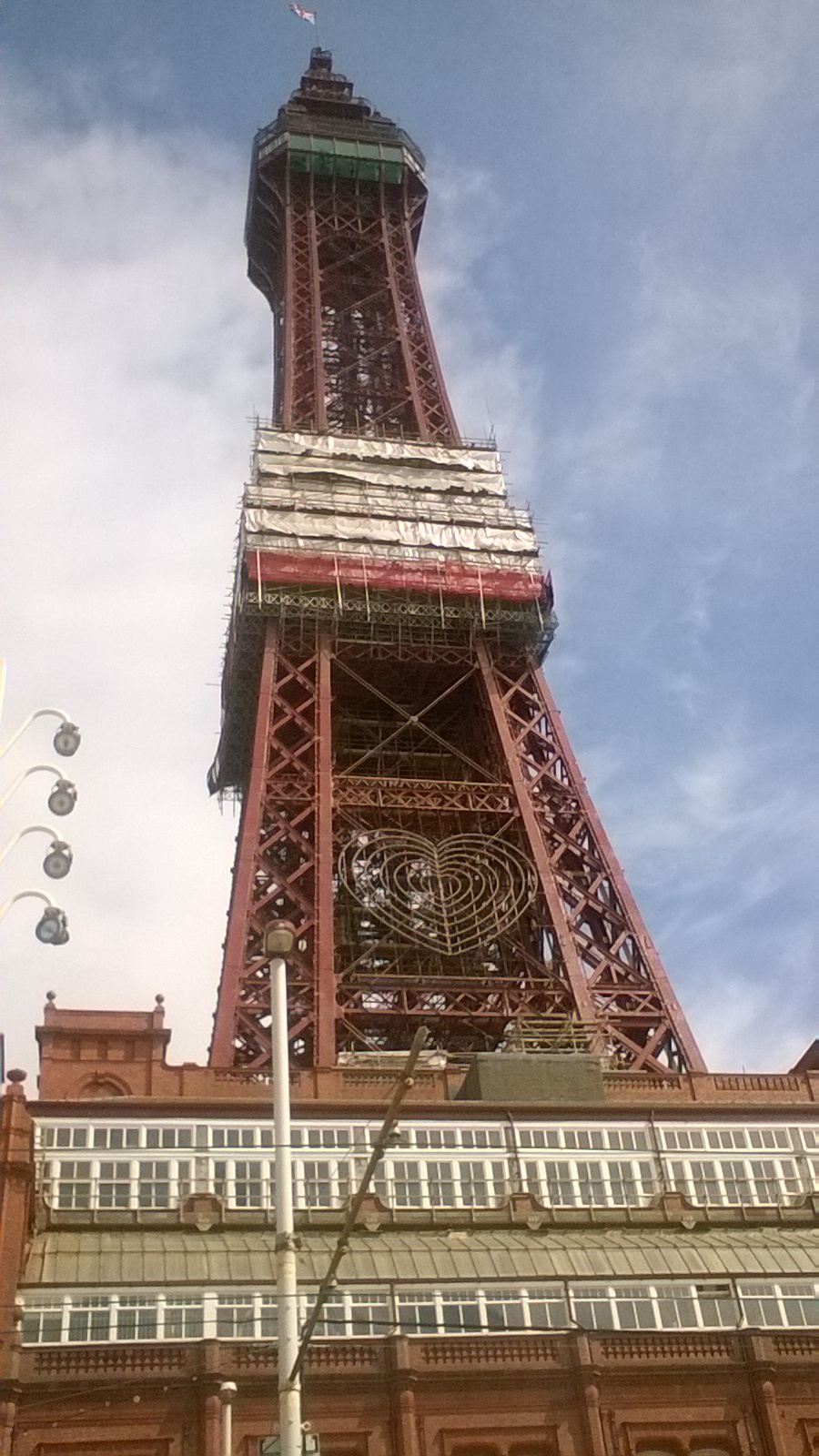
The best day out was a trip up to Blackpool, we do this trip every year, taking the train from Stafford, and heading North, changing at Crewe, and on to Preston.
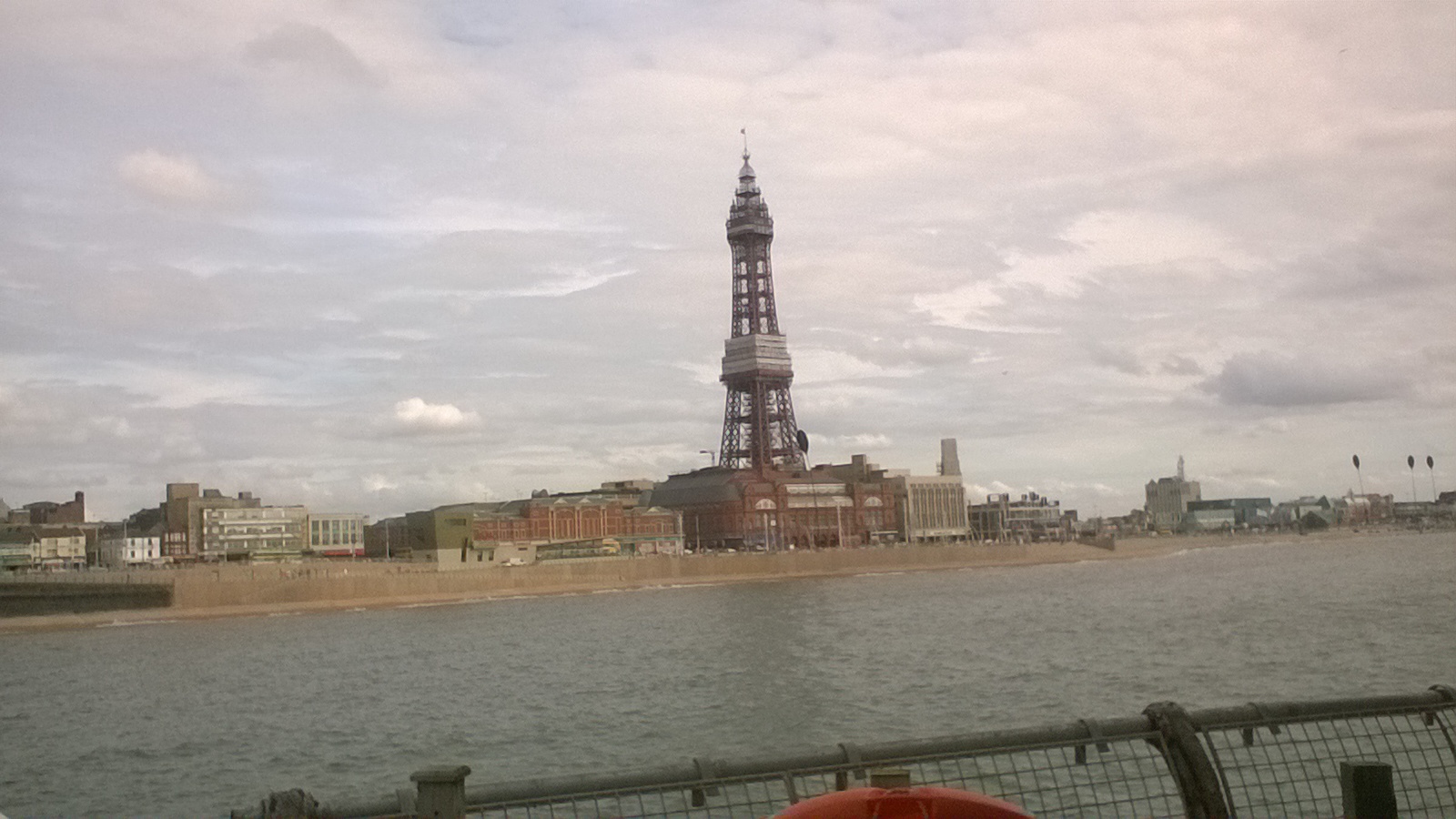
We like it up here spending the day walking the Golden Mile, the people are always friendly and the food great! There are lots of interesting little shops not just on the sea front, but also in the back streets which we like to peruse at our leisure. I know there is Amateur Radio activity up here from the front sometime close to the water, but I didn't see any sign of anyone.

Getting back into Amateur routine along with other chores the Autumn approaches and the MDT kit has to be built during the next few weeks. I have no planned visits to any rally in the next few months, so I decided to make a little purchase from Martin Lynch & Sons the Wouxun KG-UV8D, Handheld, 2.5K step version has been dropped in price making it a very attractive purchase for £69 including FREE shipping to UK. This beats any best ebay price I have seen, and makes it easier should it have to be returned under warranty. I ordered one at the weekend, I expect it will arrive about Wednesday, as today is a Bank holiday here in the UK when most take a rest, or extend their weekend break, as it is the last Bank holiday now before Christmas.
I look forward to making a few tests with the Wouxun comparing it with one or two other handhelds, taking it out on location.
Steve, G1KQH, is a regular contributor to AmateurRadio.com and writes from England. Contact him at [email protected].
Lakeland APRS

The picture on the left, from APRS.fi shows the level of coverage by APRS iGates in Wasdale (A lake district valley that is home to Scafell Pike, England’s tallest mountain). You can see that the coverage is fairly limited to heights above about 400m. That really isn’t very good.
I had walked from the road north of the river Irt and up what was a quite steep hill to Whin Rigg. What makes the lack of gates even more disappointing was that there is a clear view of the Isle of Man as well as southern Scotland as you move up the ascent.
So why is it so bad? Well the geography doesn’t help. Like many hilly areas the western lakes is a series of valley that lead out to sea so when you are low there is not much scope for RF to go anywhere. this also explains the patchy mobile phone coverage. Another aspect was the stock antenna on my vx-8. It really isn’t that good compared to other larger aftermarket options.
So what? well first off we hams aren’t the only people to us APRS or a similar protocol. The mountain rescue also use a proprietary system. They must suffer with the same lack of coverage despite a sizeable array at the head of the valley.
So what do other areas use? do they use APRS in hilly areas? are there low cost self powered digipeaters or iGates about? is APRS out-dated now that digital modes are so popular (not here mind you)? I’d like to know simply because I like APRS and think its a under utilised system here in IO84, perhaps elsewhere.
Alex Hill, G7KSE, is a regular contributor to AmateurRadio.com and writes from Cumbria, UK. Contact him at [email protected].
Lightwave Scatter
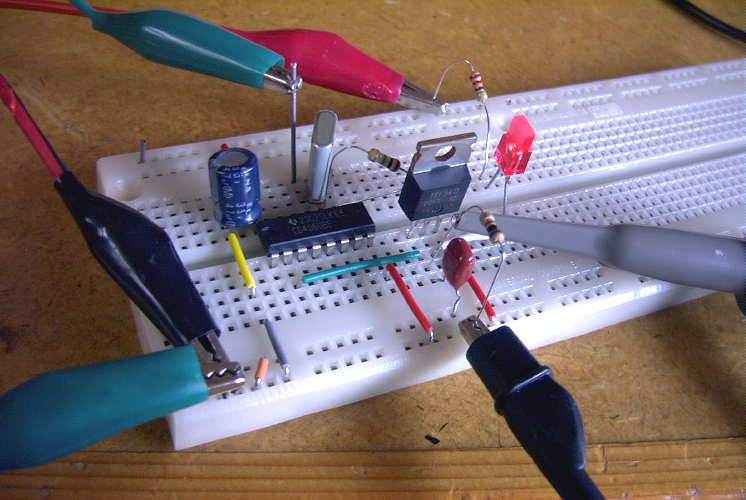
As it is at present, the modulator consists of a 556 tone generator, capable of either a steady tone for CW keying or a two-tone FSK 'beaconing' signal used to help the other station in aiming alignment.
For the slow QRSS CW narrow-bandwidth modes required for the scatter tests, I've always known that a tone which is much more stable and of precisely known frequency would be needed. The tone from the 556 does well as an aural CW keyed tone but would probably be all over the place when viewed in a very narrow-bandwidth and not nearly as stable as it sounds by ear.
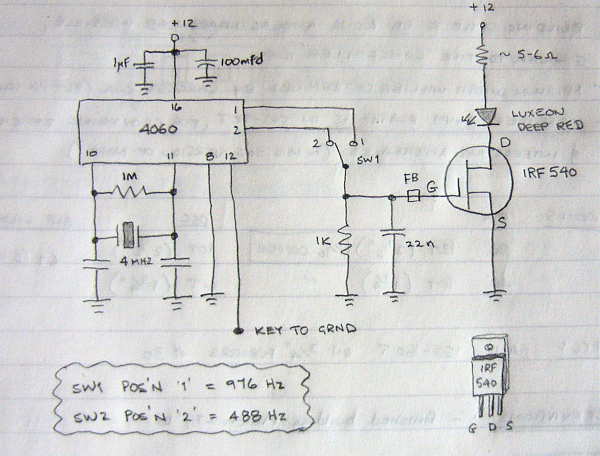
The little modulator uses a 4500 KHz crystal (pulled from a old VCR several years ago) in a 4060 oscillator-divider. In this case, output from the chip is taken from either the 'divide-by-8192' pin 2, which outputs a precise frequency of 549 Hz or from the 'divide-by-4096' pin 1, which outputs a frequency of 1099Hz.
 |
| courtesy G3XBM: http://g3xbm-qrp.blogspot.ca/search/label/nlos |
This tone is then used to drive an IRF 540 power MOSFET which controls current through the 1W Luxeon Deep Red LED in the transmitter. The 4060 modulator will be keyed via a QRSS software keying program that I have used for many years to key my LF transmitter.
The lightwave receiving station will look for the QRSS audio signal with an audio spectrum viewer such as Argo or Spectran. The ability to make automatic overnight screen captures will allow the receiving operator to get a good night's sleep while the system diligently watches for any traces of a signal.
An example of a strong signal capture showing a repeating "SL" identification is shown below, as it would appear in a perfect world. In this case (QRSS3), the short 'dots' are 3 seconds long while the 'dashes' are 9 seconds.

Huge signal gains (the ability to dig into the noise for signals) can be had by slowing things down and using narrower receiving bandwidths. Just going from a normal 12WPM speed CW (aural copy) to QRSS3 yields a gain of ~15db. At QRSS10 (10 second dots), an additional 5db is gained while slowing to QRSS60 (60 second dots), a whopping 28 db over 12WPM CW is gained!
Of course all of this extra 'hearing power' comes at a cost and in this case, the cost is 'time'. On an overnight of automated computer monitoring, time is not much of an issue ... it only becomes critical in 'QSO mode' when some QRSS QSOs can take several hours to complete. In any case, it will be interesting to see if any traces of lightwave signals will show up while bouncing around in the clouds.
The Georgia Strait scatter tests will not take place for some time but in the meantime, I hope to do some local tests here, from one side of my island to the other but will build a new portable receiver for these tests and leave my main system intact.
Steve McDonald, VE7SL, is a regular contributor to AmateurRadio.com and writes from British Columbia, Canada. Contact him at [email protected].
Creating open-source ham radio hardware with Kickstarter
When I started my company last year, it was mainly set up as a design consulting outfit to pick up a few jobs on the side. At the end of 2014, it became much more when I decided to plunge full-time into my own work. At the time, one of my respected friends and colleagues, Don Powrie of DLP Design, said to me that the only way to make consistent money is to have a product line rather than rely on consulting work. I’ve been thinking of how to bring that to market ever since. I could certainly design some familiar products to me, but they would get lost in the plethora of similar items. I needed something unique.

I started out with a 5V @ 5A design. I drew the schematic and completed the PCB layout and started to check pricing and availability of the parts. Most everything was available at Digi-Key, and the Anderson Connectors from Mouser, but the total was getting close to where I wanted the selling price to be. For a $35 computer, I couldn’t justify a $70-$80 power board!! The DC-DC converter also had a very large ground pad for heat dissipation. I wanted this project to be able to be hand-soldered and started wondering about that large pad. That design got scrapped and I started looking for another buck converter. There were several TI and Linear products I considered, but they would have required a reflow oven – either with a center pad, as a BGA, or leadless formats. Then I found the Alpha & Omega AOZ1031AI. This is a 8-pin SOIC without any special pad. The only heat-dissipation suggestion was that pins 7 and 8 do not have any thermal relief, but connect fully to the surrounding plane. I selected larger commodity parts (0805) that could be seen without a microscope and created the layout, and all parts were in stock at either Digi-Key or Mouser Electronics. I got everything on order, and even managed to get a couple free PCBs from Pentalogix. I had attended a Pentalogix-sponsored Cadsoft Eagle webinar at Newark and the perk was a code for two boards. I just had to cover shipping.
I did other tests: Let it run for 8 hours (check), ramp voltage from 6 to 18V input (check). At 7V input, the Pi kept rebooting. At 8V, it was solid – well past the design spec. Same at 18V.
Next up was the load test. With 2A going direct to load resistors, I was still able to run the Pi with all four USB ports occupied. I even dipped the supply to 8V. The bench supply showed about 1.8A output. Based on an approximate 80% efficiency of DC-DC converter, I calculated I was drawing about 3.5A on the 5V side – a little past its limit, so backed off the load. I’ve been running this directly from my radio supply now for several days, and the Pi keeps chugging along.

I’m a believer in open-source hardware and software. This project will be published in the coming days, probably on GitHub. Eagle uses XML design files, so version control should work just fine. I still need to write the manual, but everything will be made available as soon as I get the proper README and LICENSE files in place. All of my work for this project is published under the Creative Commons Attribution and Share-Alike license. The hardware itself is published under the TAPR Open Hardware License.
Bob Recny, N8SQT, is a special contributor to AmateurRadio.com.
Colorado 14er Event: Mount Antero (W0C/SR-003)
For the 2015 Colorado 14er Event, Joyce K0JJW and I activated Mount Antero (W0C/SR-003) on the 2m and 70 cm bands. Alan NM5S joined us on the summit, operating mostly HF plus some 2m fm.
We took our Jeep Wrangler up the moderate 4WD road and parked at 13,800 feet. This makes for a very manageable hike to the 14,269 foot summit. Of course, you can always choose to start the hike from lower on the mountain, but you’ll end up walking along the road. This web site provides a good overview of the 4WD road. The 14ers.com web site and summitpost.org are additional sources of summit info.
Here’s a short video of our operation on the summit.
Here’s the K0NR log on the 2m band, fm and ssb:
August 2, 2015 K0NR Log, time in UTC
15:09     144MHz     FM     K0JJW
15:13     144MHz     FM     W0CP
15:16     144MHz     FM     KC5JKU     Mt Elbert
15:17     144MHz     FM     KD0WHB     Grays Peak
15:21     144MHz     FM     N0XDW      Pikes Peak
15:37     144MHz     FM     KD5HGD     Mt Elbert
15:42     144MHz     FM     KD0MRC
15:42     144MHz     FM     KE0DMT
15:44     144MHz     FM     NQ0L       Franktown
15:45     144MHz     FM     KE0EUO     Mt Democrat
15:46     144MHz     FM     K7SO       Mt Democrat
15:50     144MHz     SSB    KD0YOB     W0C/PR-005
15:53     144MHz     SSB    W0BV       Buena Vista
15:53     144MHz     SSB    K0YV       Buena Vista
15:57     144MHz     SSB    W0STU      Monument
16:06     144MHz     FM     KD0WHB     Torreys
16:13     144MHz     FM     KI6YMZ     Mt Elbert
16:19     144MHz     FM     KE0EKT     Mt Elbert
16:29     144MHz     FM     WZ0N
16:29     144MHz     FM     KE0DAL
16:31     144MHz     FM     WO9S
16:33     144MHz     FM     K0UO
17:10     144MHz     FM     KD2FHB     Pikes Peak
It was a great day on the mountain with quite a few Summit-to-Summit (S2S) SOTA contacts. See you next year on a Colorado mountaintop!
73, Bob K0NR
The post Colorado 14er Event: Mount Antero (W0C/SR-003) appeared first on The KØNR Radio Site.
Bob Witte, KØNR, is a regular contributor to AmateurRadio.com and writes from Colorado, USA. Contact him at [email protected].
 Ham Radio Deluxe |
 W5SWL Electronics |
 Ham Radio Prep |
 KB3IFH QSL Cards  Hip Ham Shirts  HamRadioAuctions HamRadioAuctions Reliance Antennas Reliance Antennas Enigma Shop Enigma Shop |  morseDX  Ni4L Antennas  R&L Electronics R&L Electronics antennas.us antennas.us QRV QRV |
- Matt W1MST, Managing Editor
