 |
 Hamfest HAB – "Pigs In Space" Preparations
 7 September 2015 | by
 The balloon and parachute have been purchased from Steve Randall (G8KHW) at Random Engineering, using the same size as I did for the Eggsplorer-1
I had joked about sending some "Ham into space" on this flight but following the smelly end to Eggsplorer-1 have opted to play it safe and avoid food! Instead will be sending up a toy pig (well a small squeaky dog toy)
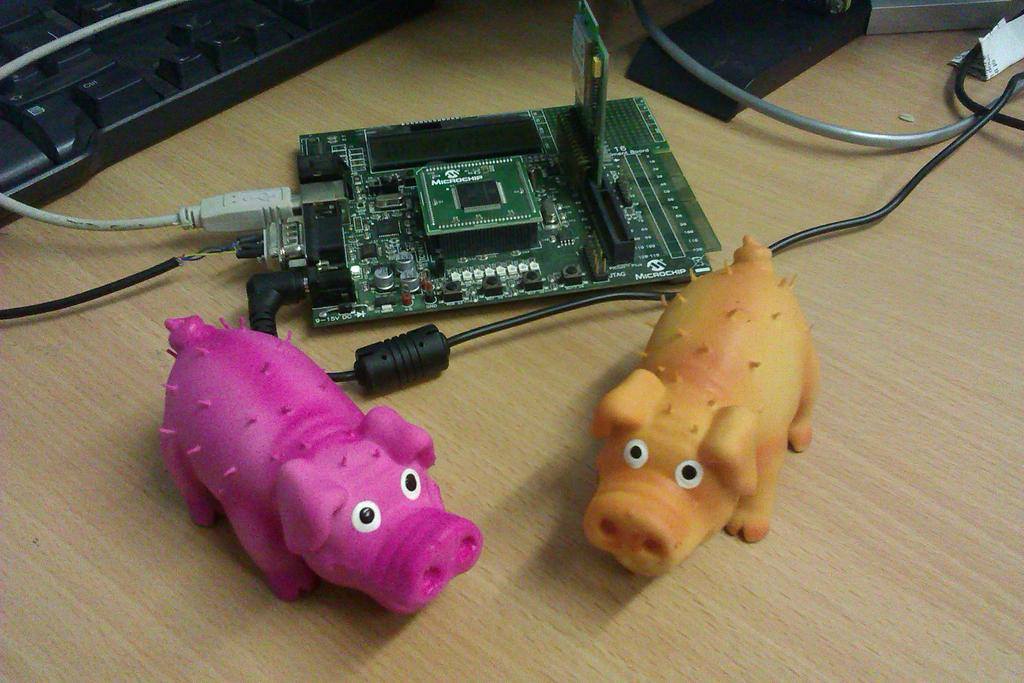
Similar to the Eggsplorer-1 the main tracker will be a Raspberry Pi fitted with a camera and two transmitters.
The tracker is based on the "Pi In The Sky" code base/design by Dave Akerman (M0RPI) and Anthony Stirk (M0UPU) with some modifications since I am building on simple strip board using a different GPS module/interface and omitting any power supply monitoring.
On the Eggsplorer I used an old Pi Model B but was forced to butcher it to reduce the power demand by desoldering the network/usb chip. This time I am using a Model A+ which is smaller/lighter and has a much reduced power demand and with the locking micro-SD card socket will hopefully prevent a repeat of Eggsplorer-1's failure mode.
PINKY & PERKY are progressing well, just waiting delivery of some strip board and they should be completed in the next day or so.
PINKY will be 300-Baud RTTY, sending telemetry along with SSDV image packets using the UKHAS format.
PERKY will be using one of the LoRa modules again sending telemetry and SSDV but with greater resolution and speed, but will require a LoRa receiver/gateway (see Dave Akerman's website).
While the SSDV is attractive to tracker enthusiasts the high speed RTTY is more difficult to receive, so I will be flying a secondary 'backup' tracker. The use of a backup proved invaluable on the Eggsplorer when the main tracker failed.
PIGLET will be a 50-baud RTTY transmission with telemetry and should prove easier to receive.
I finished PIGLET at the weekend
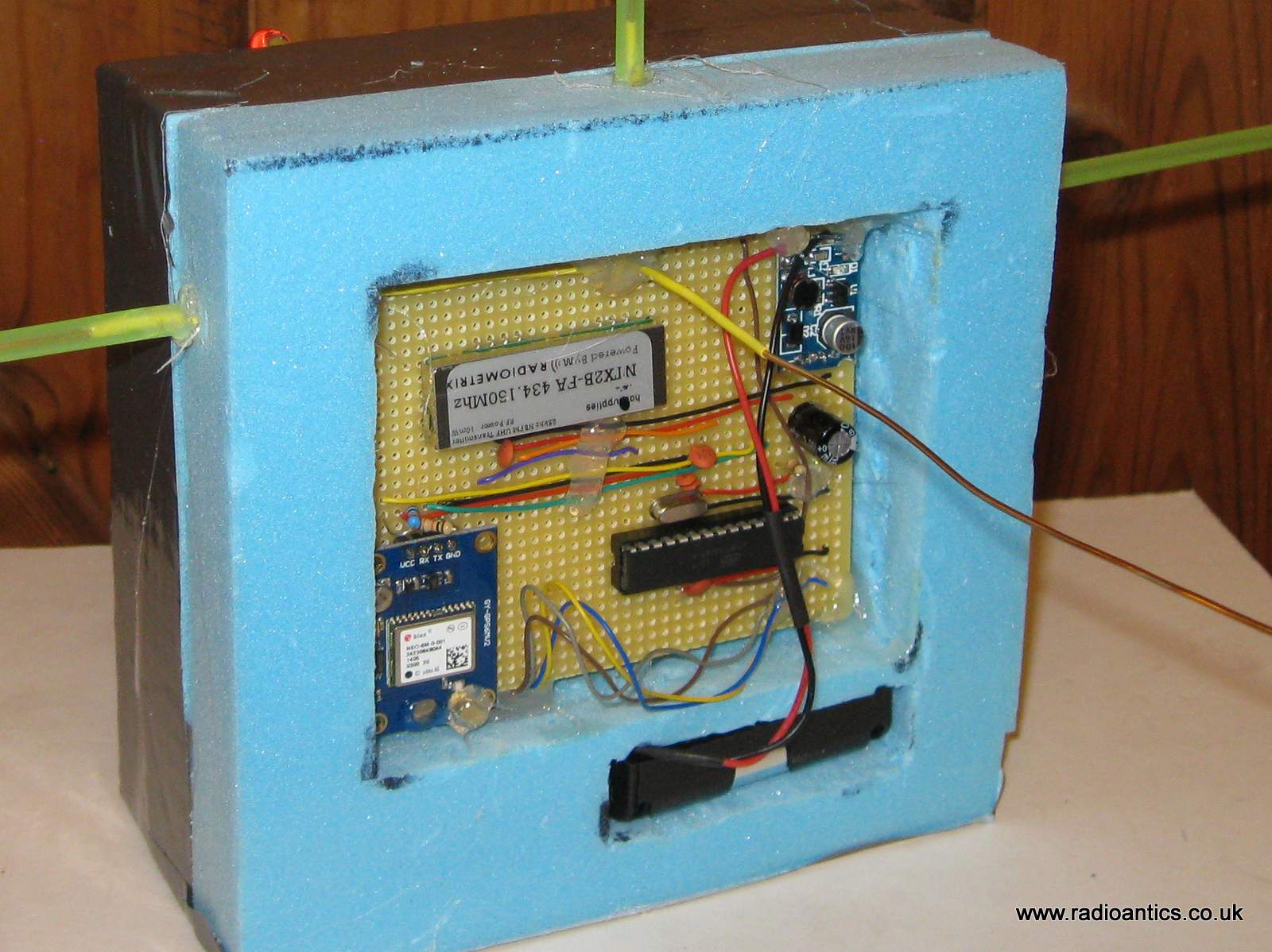
Again built on strip board it is based around the ATMEL ATMega128 micro-controller using the Arduino system with a number of off the shelf modules connected to it.
It has one of the GY-GPS6MV2 GPS modules I blogged about last year feeding into the UART. The NTX-2B transmitter (frequency agile version from Hab Supplies) and a I2C BMP180 pressure/sensor module (not visible as mounted to measure external conditions) It also has a small boost converter to supply 5V and extract all the available power it can from the 3-AA lithium battery pack.
One change compared to the EGG1 tracker is to use a PWM output from the Arduino to generate the RTTY tones rather than a register voltage divider (guide here) which seems to give a cleaner signal.
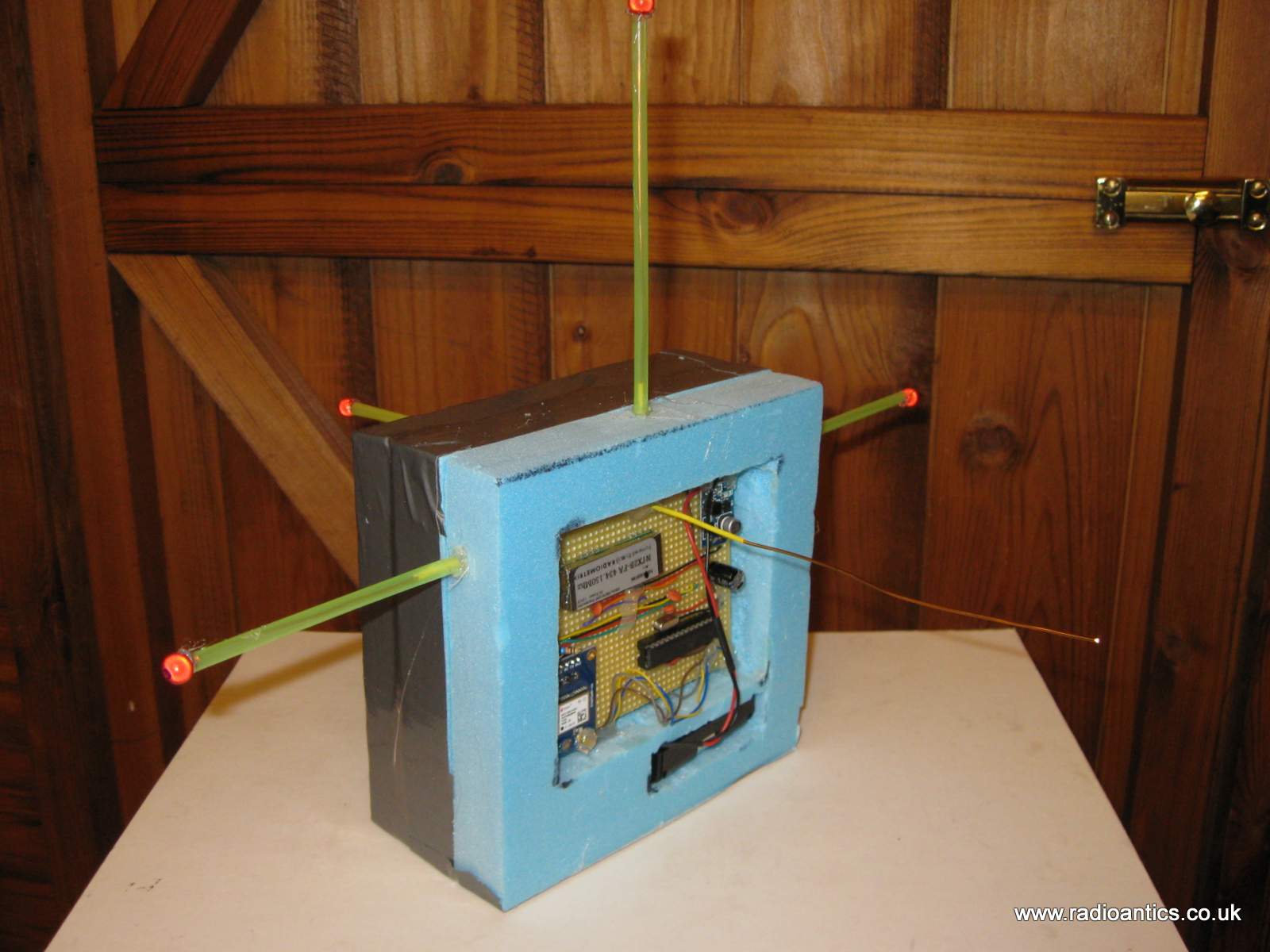
The antenna is simply copper wire making a 1/4 wave ground plane. The 'box' are some layers of styrofoam glued together with UHU-Por with duct tape, some straws and beads for safety. Just needs the batteries fitting and the lid fixing with more duct tape and PIGLET is ready to fly.

Full details of frequencies will be posted nearer the time.
Andrew Garratt, MØNRD, is a regular contributor to AmateurRadio.com and writes from East Midlands, England. Contact him at [email protected].
LHS Episode #153: Pack a Ladder
 Once again, time has gotten away from us. We're so busy with traveling, projects and so forth that we're finding it hard to get the episodes out. We're still recording them on schedule, just the releases are a bit erratic. We still do our live streaming so if you want to catch up quickly, come visit with us on Monday nights when we record. Lots of great stuff in this episode, though. Please enjoy.
73 de The LHS Guys
Russ Woodman, K5TUX, co-hosts the Linux in the Ham Shack podcast which is available for download in both MP3 and OGG audio format. Contact him at [email protected].
Web designers of the world
You have no competition from W2LJ - whatsoever. I have finished the 2015 Skeeter Hunt Soapbox and have posted it to the Web. A bona fide Web designer probably could have done in an hour what took me a lot longer to accomplish. And I bet it would look a lot better, too. Mr. Originality or Mr. Creativity, I am not!
In all their non-glory, they are there for your perusal. Just click and go!
2015 Scoreboard
2015 Soapbox
72 de Larry WLJ
QRP - When you care to send the very least!
Larry Makoski, W2LJ, is a regular contributor to AmateurRadio.com and writes from New Jersey, USA. Contact him at [email protected].
Satellite Operation @ WØLFA
I recently set up a satellite station at WØLFA to see how well the GØKSC-designed InnovAntennas LFA Yagis, which work so well on VHF and UHF terrestrial weak signal modes, would work with the amateur radio satellites. Up went a five element LFA for 2m (2 LFA 5) and a ten element LFA for 70cm (70 LFA 10). The 2m LFA was tuned for 146 MHz and the 70cm LFA was tuned for 436 MHz to put them near the center of the satellite subbands, simple adjustments of the LFA driven element loop in each case. The LFAs were mounted vertically so that the aluminum cross-arm would not disrupt their highly-optimized, low sidelobe designs.

Both Yagis are relatively compact and sit about eight feet above ground on a Glen Martin Engineering ‘Quadpod’ tower mounted just behind the WØLFA shack. SSB-Electronic LNA SP-200 & SP-70 preamps with VOX sensed T/R relays are mounted on the tower close to the antennas to optimize system performance. Since satellite operation is low power, I opted for the simplicity of the VOX capability built into the SSB LNAs; less wires is always a good thing!
Positioning is provided by an AlfaSpid RAS rotator controlled by a rack-mounted AlfaSpid MD-01 controller. Rig is a Yaesu FT-847, the only non-SDR radio @ WØLFA, which I kept around solely for satellite use as our SDR rigs, as much as I love them, don’t (yet) have the full-duplex features needed for serious satellite operation. Satellite tracking is handled by SatPC32 software running on a Windows 7 64 PC. SatPC32 communicates with the FT-847 via a serial port null modem cable and with the MD-01 via a standard straight-through serial cable on a second serial port.
Here is what the XW-1 (Xi Wang 1 aka Hope OSCAR or HO-68) ham satellite sounded like at WØLFA on Aug 10, 2015 at around 03:30 UTC. XW-1 was launched in 2009 from the Taiyuan Satellite Launch Center in Shanxi province, China. After about a year, the transponder failed, however, the little ‘bird’ (68 x 48cm) continues to orbit and its 200 mW (2/10th of one Watt!) Morse code beacon continues to transmit. Note the manual Doppler correction! (I have since enabled the automatic Doppler correction feature in SatPC32.)
All of the antenna system items used here, from InnovAntennas, AlfaSpid, and SSB-Electronic, are available from the Force 12 Superstore.
Bill Hein, AA7XT, is a regular contributor to AmateurRadio.com and writes from Colorado, USA. He is co-owner of Force 12 and InnovAntennas. Contact him at [email protected].
TX Factor Episode 9 is Ready to Watch
The popular UK TV show dedicated to amateur radio is back on the air with episode 9 featuring ham radio Essex-style!
We visit the south east of England to report on the work of Chelmsford ARS, Essex Repeater Group and Essex Ham.
And we’re giving away a CG-PK4 Pocket Memory Keyer in our free-to-enter draw.
Hope you enjoy the show!
Nick Bennett 2EØFGQ co-hosts TX Factor with Bob McCreadie GØFGX and Mike Marsh G1IAR. Contact the team at [email protected]
Series Eight Episode Nineteen – Microphones in Amateur / Ham Radio (06 September 2015)
In this episode, Martin M1MRB / W9ICQ is joined by Ed Durrant DD5LP and Matthew Nassau M0NJX to discuss the latest Amateur / Ham Radio news. Colin M6BOY rounds up the news in brief, and this episodes feature is a review of a Microphones in ham radio
- Secondary School Students Decode ISS Images
- South African 40 MHz (8m) ham radio contact
- FreeDV digital HF Voice Mode QSO Party
- Senator Thanks Radio Amateurs
- FCC Considering Proposal to End Modification of IT devices
- Expected September Release of 5 MHz in Netherlands
- Outcome for 5 MHz at WRC-15 Remains in Limbo
- Improving Amateur / Ham Radio Club Websites
Colin Butler, M6BOY, is the host of the ICQ Podcast, a weekly radio show about Amateur Radio. Contact him at [email protected].
Series Eight Episode Nineteen – Microphones in Amateur / Ham Radio (06 September 2015)
In this episode, Martin M1MRB / W9ICQ is joined by Ed Durrant DD5LP and Matthew Nassau M0NJX to discuss the latest Amateur / Ham Radio news. Colin M6BOY rounds up the news in brief, and this episodes feature is a review of a Microphones in ham radio
- Secondary School Students Decode ISS Images
- South African 40 MHz (8m) ham radio contact
- FreeDV digital HF Voice Mode QSO Party
- Senator Thanks Radio Amateurs
- FCC Considering Proposal to End Modification of IT devices
- Expected September Release of 5 MHz in Netherlands
- Outcome for 5 MHz at WRC-15 Remains in Limbo
- Improving Amateur / Ham Radio Club Websites
Colin Butler, M6BOY, is the host of the ICQ Podcast, a weekly radio show about Amateur Radio. Contact him at [email protected].
 Ham Radio Deluxe |
 W5SWL Electronics |
 Ham Radio Prep |
 KB3IFH QSL Cards  Hip Ham Shirts  HamRadioAuctions HamRadioAuctions Reliance Antennas Reliance Antennas Enigma Shop Enigma Shop |  morseDX  Ni4L Antennas  R&L Electronics R&L Electronics antennas.us antennas.us QRV QRV |
- Matt W1MST, Managing Editor
