 |
 Simple 28MHz WSPR (or PSK31) RX
 12 September 2015 | by
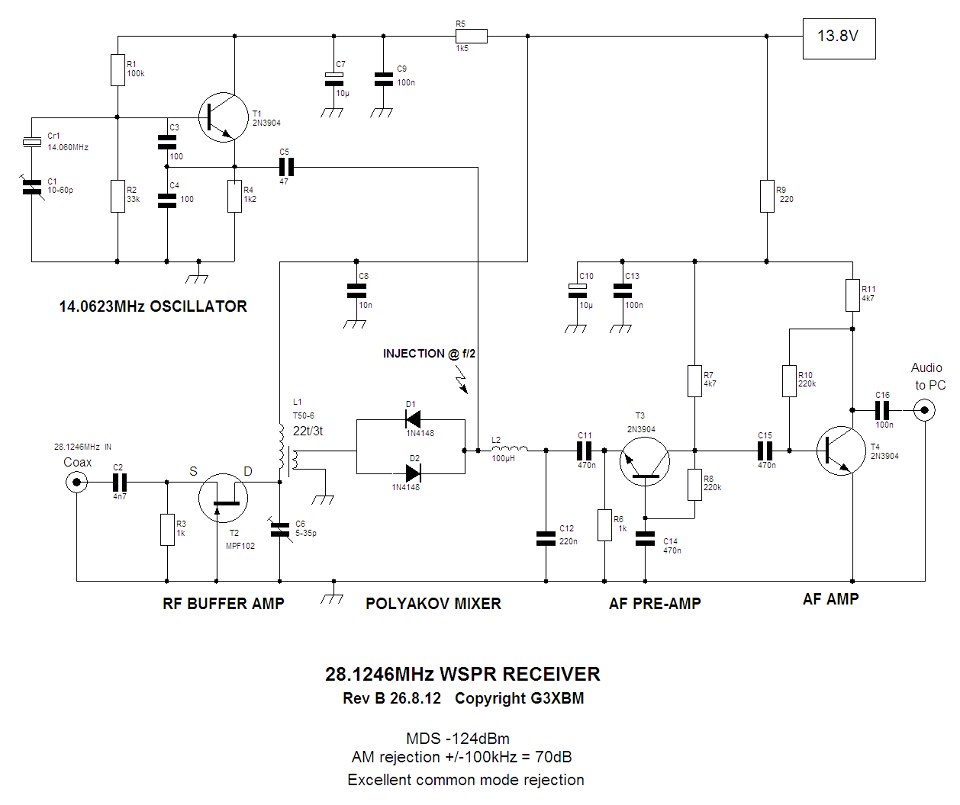
 Facebook is throwing up memories from 3 years ago and one of these was a schematic for my WSPR RX for 10m, using low cost 14.060MHz crystals with a Polyakov mixer (injection at half signal frequency) The circuit worked well and could also be used for PSK31. Essentially this is a direct conversion receiver, but it mattered not. Even if you bought all parts new it is very inexpensive. 3 years later I would replace the 2 diodes by Schottky ones as these are now low cost and need less injection than the silicon ones shown.

Roger Lapthorn, G3XBM, is a regular contributor to AmateurRadio.com and writes from Cambridge, England.
How can we get more women involved in ham radio?
So, a couple of days ago there was a bit of a flap over on Reddit.
A club called FBOM International which specializes in digital modes created a ham radio promotional video (embedded above) and it was posted (and stickied) to the /r/AmateurRadio subreddit.
Then came a reply from Yvette Cendes, KB3HTS, a student at the University of Amsterdam working on a Ph.D in Astronomy. Here is a portion of her post:
…Let me explain why I find it offensive that this video is now being touted as the ad for our subreddit: it objectifies women and relies on gender stereotypes that would make no woman feel welcome here. We are currently dealing with a hobby that is only 15% women that keeps fretting about getting more people involved in it, so why do we allow things that would drive half the population away? I don’t pretend to have all the answers on a complex issue, but I do know this stickied post is far from what we should want to represent the community. And it goes to show that if we ever have a crack at attracting more women into this hobby we have a long way to go.
I believe the folks who made this video did so with good intentions and without any ill intent whatsoever. In fact, I’m glad they posted it — because it gave Yvette a chance to show that what seemed perfectly fine to some people can offend others looking at it from a different perspective.
Her reply gives us the opportunity to think about why we’re not attracting more women to ham radio and to STEM (science, technology, engineering and math) fields in general. This is a big deal and regardless of whether you agree with her position or feel she overreacted, it’s a discussion worth having.
I’m middle-aged and male. If we’re trying to attract more old guys like me to this hobby, then maybe we can just keep on doing what we’re doing. But if we hope to add more folks outside of this demographic, then we may need to rethink our promotional strategy a little bit.
What are your thoughts?
Matt Thomas, W1MST, is the managing editor of AmateurRadio.com. Contact him at [email protected].
Quiet Sun Not Enough
 |
| courtesy: http://sdo.gsfc.nasa.gov/ |
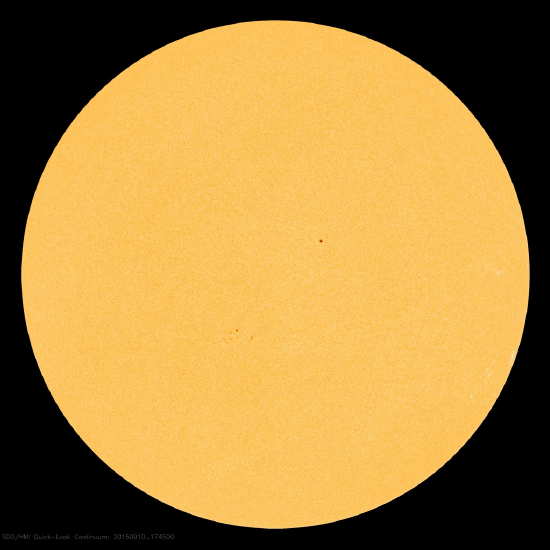
... the sun has been deathly quiet, as can be seen in yesterday's solar disk image.
It seems that just the 'normal' solar wind can disrupt things all on its own, without any solar flares or coronal mass ejections. In the late 70's, 'cracks' in the earth's magnetosphere were first observed... cracks that allowed even a quiet solar wind to actively interact with the earth's (normally protected) upper atmosphere. Apparently this is the present condition that has been disrupting normal propagation for the past many days.
The spaceweather.com web site has a nice explanation of how these cracks allow the Sun's Interplanetary Magnetic Field (IMF) to interact with the earth's field:
"Earth has a magnetic field, too. It forms a bubble around our planet called the magnetosphere, which deflects solar wind gusts. (Mars, which does not have a protective magnetosphere, has lost much of its atmosphere as a result of solar wind erosion.) Earth's magnetic field and the IMF come into contact at the magnetopause: a place where the magnetosphere meets the solar wind. Earth's magnetic field points north at the magnetopause. If the IMF points south -- a condition scientists call "southward Bz" -- then the IMF can partially cancel Earth's magnetic field at the point of contact.
When Bz is south, that is, opposite Earth's magnetic field, the two fields link up," explains Christopher Russell, a Professor of Geophysics and Space Physics at UCLA. "You can then follow a field line from Earth directly into the solar wind" -- or from the solar wind to Earth. South-pointing Bz's open a door through which energy from the solar wind can reach Earth's atmosphere!"
Earth's Bz has been pointing south during this entire period of poor propagation. Heavy ionization of the daylight D-layer, normally an 'absorber' of LF signals, has allowed reception of several NDB signals normally only heard at night. In fact, one of my favorite NDB propagation indicators, 25-watt YLJ in Meadow Lake, Saskatchewan, has been heard all day long on 406KHz for the past week as its signal skirts along the underside of the dense D-layer. These auroral conditions however, often enhance the path to the south Pacific and several western BCB DXers have reported excellent propagation to Australia and New Zealand in the pre-dawn hours.
Another indicator of LF propagation disturbance is the DST or Disturbance Storm Time index. This number gives an indication of the severity of the weakness in the magnetosphere, with numbers going further and further negative as the charged particles trapped in the magnetosphere increase in numbers.
 |
| courtesy:http://wdc.kugi.kyoto-u.ac.jp/dst_realtime/presentmonth/index.html |
The DST has been having a rough ride since the beginning of the month and as these numbers grow more positive and remain there, propagation will return to normal. With late September and October often being among the best months of the year for LF propagation, and with the sun now doing its part by remaining quiet, let's hope that the earth's magnetosphere will also co-operate and seal-up those propagation-killing cracks.
Steve McDonald, VE7SL, is a regular contributor to AmateurRadio.com and writes from British Columbia, Canada. Contact him at [email protected].
The Magic Word
How can you pass up something for free?
You can't.
In case you are not aware, you can pick up Bill Meara's book, "Solder Smoke" for free from Amazon.com. The actual "in your hands" paperback book is $19.99 (from Amazon), but the kindle edition is free.

You don't need to own a kindle to read this, which is the beauty of it. The kindle app is also free, and you can load it onto any Windows PC or Android device. Sorry, I'm not up on Apple devices, but something tells me that the kindle app is probably available for them, too.
So how can you pass this up?
You can't.
72 de Larry W2LJ
QRP - When you care to send the very least!
Larry Makoski, W2LJ, is a regular contributor to AmateurRadio.com and writes from New Jersey, USA. Contact him at [email protected].
Amateur Radio Newsline Report 1976 September 11, 2015
- SOLAR FLARES AND PROPAGATION
- INDIA'S NEXT GENERATION OF HAMS
- NOT-SO-POETIC LICENSE
- THE BEST FESTS
- SATELLITES: TWO THAT SIZZLE ONE THAT FIZZLE
- CRAZY LIKE A FOX HUNT
- NO BRIDGE TOO FAR
- SWAPMEET FOR DAYTON AREA HAMS
- KICKS ON ROUTE 66
- NY GETS READY TO PARTY
- BOY SCOUTS ARE PREPARED
- THE REAL THING: ERIKA'S STORM OF DAMAGE
- THE SIMULATION: 'EARTHQUAKE' IN MALTA
- THE WORLD OF DX
- LIVE LONG AND PROPAGATE
Project updates
The last few weeks have been very productive on the ham radio front! I cleaned up the coax routing for my Icom 2820 I had installed in the new pickup. While it was only slightly messy, the extra tie wraps and cable management make me feel better. I also installed a GPS puck antenna so the 2820 now shows my position on every D-STAR transmission I make. I had this setup with the 880 in the previous truck, but never had this setup on the 2820. It was very simple – plug in the antenna, change a few settings, and you’re good to go. I used a $10 antenna from Amazon.
I moved the antenna for my FlightRadar24.com ADS-B feed radio to a higher location at the end of the pole barn. This required also moving the ubiquiti 2GHz data radio I use to provide internet access to the radio. Luckily I had enough spare mast clamps and hardware to turn this into a nice afternoon project.
At the WX9WX D-STAR homebrew repeater site, the building owner called and wanted our AREDN mesh antenna moved a bit higher. The initial request was for the antenna to be low enough that it couldn’t be seen from the road. Now we needed to move it higher so that workers on the roof wouldn’t be at eye level with the transmitter. Having worked in the corporate world for quite some time, changing requirements or expectations is something I’m used to. So up to the roof we went, and up another 6 feet went the antenna!
This week Tom KJ9P and I moved the repeater to its newly coordinated frequency. Changing the frequencies on the Motorola radios was a piece of cake thanks to software and a laptop. Re-tuning the duplexer at the site was more of a challenge. I’ve tuned quite a few duplexers in the last three years, but never one at a site. I found that without a portable signal generator that could go down in the microvolts, it was difficult to do the precise tuning I normally do on the bench. Luckily a quick phone call to Fred KC9REG, who was 27 miles away, resulted in an EXCELLENT weak signal for final testing!
The next projects involve cleaning up the shack. Does anyone ever finish cleaning up the shack? Maybe I should lower my expectations. Finally, I must get an antenna up for 160m before the winter. Plans for a skywire loop are underway. Now to find 600′ of 12 gauge wire and some ladder line…
Michael Brown, KG9DW, is a regular contributor to AmateurRadio.com and writes from Illinois, USA. Contact him at [email protected].
Project updates
The last few weeks have been very productive on the ham radio front! I cleaned up the coax routing for my Icom 2820 I had installed in the new pickup. While it was only slightly messy, the extra tie wraps and cable management make me feel better. I also installed a GPS puck antenna so the 2820 now shows my position on every D-STAR transmission I make. I had this setup with the 880 in the previous truck, but never had this setup on the 2820. It was very simple – plug in the antenna, change a few settings, and you’re good to go. I used a $10 antenna from Amazon.
I moved the antenna for my FlightRadar24.com ADS-B feed radio to a higher location at the end of the pole barn. This required also moving the ubiquiti 2GHz data radio I use to provide internet access to the radio. Luckily I had enough spare mast clamps and hardware to turn this into a nice afternoon project.
At the WX9WX D-STAR homebrew repeater site, the building owner called and wanted our AREDN mesh antenna moved a bit higher. The initial request was for the antenna to be low enough that it couldn’t be seen from the road. Now we needed to move it higher so that workers on the roof wouldn’t be at eye level with the transmitter. Having worked in the corporate world for quite some time, changing requirements or expectations is something I’m used to. So up to the roof we went, and up another 6 feet went the antenna!
This week Tom KJ9P and I moved the repeater to its newly coordinated frequency. Changing the frequencies on the Motorola radios was a piece of cake thanks to software and a laptop. Re-tuning the duplexer at the site was more of a challenge. I’ve tuned quite a few duplexers in the last three years, but never one at a site. I found that without a portable signal generator that could go down in the microvolts, it was difficult to do the precise tuning I normally do on the bench. Luckily a quick phone call to Fred KC9REG, who was 27 miles away, resulted in an EXCELLENT weak signal for final testing!
The next projects involve cleaning up the shack. Does anyone ever finish cleaning up the shack? Maybe I should lower my expectations. Finally, I must get an antenna up for 160m before the winter. Plans for a skywire loop are underway. Now to find 600′ of 12 gauge wire and some ladder line…
Michael Brown, KG9DW, is a regular contributor to AmateurRadio.com and writes from Illinois, USA. Contact him at [email protected].
 Ham Radio Deluxe |
 W5SWL Electronics |
 Ham Radio Prep |
 KB3IFH QSL Cards  Hip Ham Shirts  HamRadioAuctions HamRadioAuctions Reliance Antennas Reliance Antennas Enigma Shop Enigma Shop |  morseDX  Ni4L Antennas  R&L Electronics R&L Electronics antennas.us antennas.us QRV QRV |
- Matt W1MST, Managing Editor
