 |
 1000
1000
 17 September 2015 | by
 The Radio Artisan group reached a milestone recently, surpassing 1000 members. While I acknowledge some of these 1000 are undoubtedly inactive or spammer accounts, I consider this an accomplishment after starting this discussion group three years ago. Originally intended as a support group for my Arduino open source amateur radio projects, I’m hoping to continuing expanding the group into general discussions involving DIY projects involving amateur radio and software code, Arduinos, Raspberry Pis, and open source, and in cutting edge areas such as satellites and DSP. I’m seeing more discussions in areas like this, especially with using Arduinos to automate shack functions. My ultimate goal is to have this group continue regardless of my projects or participation.
I’m pleased that I’ve been able to keep the group friendly, civilized and free of mode wars, politics, and other nasties that tend to pollute some amateur radio forums. There are a lot of smart and creative people from all around the world. It’s great when we can all share in this great hobby. (What is a radio artisan?)

Anthony, K3NG, is a regular contributor to AmateurRadio.com.
Day the Earth Stands Still
Steve Weinert, K9ZW did a nice job sharing his take on comments from keynote speaker and ex-FCC General Counsel Riley Hollingsworth, K4ZDH from the W9DXCC convention.

Riley spoke about the need for compassion, even for those who intentionally disrupt our communications, and hinted that many disturbed individuals are veterans dealing with mental health issues. Given his previous position, he doubtless speaks from experience.
The vulnerabilities from our dependence on networked systems and the concern this is causing lawmakers fretting about a ‘Digital Pearl Harbor’ was another topic covered by Hollingsworth.
Stop by Steve’s blog and check out both thought-provoking posts.

Jeff Davis, KE9V, is a regular contributor to AmateurRadio.com and writes from Indiana, USA.
This Spewed Out of the Internet #31
 This is another update on important stuff spewing forth from the interwebz. It has been a while since I’ve done this, so we’ve got some catching up to do.
The KØNR Radio Site has expanded to Facebook. “Like” us there.
There is a statewide email list available to Colorado radio amateurs. Join us there to stay informed about regional events.
Grid locators are important for VHF/UHF operating. I came across this web site that does a good job of mapping the grids. I wrote a Shack Talk article over at HamRadioSchool.com that explains Simplex, Duplex, Offset and Split. Stu WØSTU posted a very helpful article explaing NVIS (Near Vertical Incidence Skywave) Antennas.
In June, Keysight Technologies donated some professional measurement software to the ARRL. Yeah, I had something to do with that.
From the Cheaters Gonna Cheat Department:
- CQ Magazine busts UT5UGR for padding his log in CQ WW contest
- The FCC fines David J. Tolassi, W4BHV, for failing to identify properly
- The FCC also went after Michael Guernsey, KZ8O, with a $22,000 fine. Ouch.
- The FCC also fined Daniel R. Hicks, KB8UYZ, for malicious interference to VHF repeaters.
The Ham Hijinks crew contributed some outstanding literary works to the ham radio community. Recently, they’ve latched onto the theme of hams using cheap radios to not make any contacts on VHF:
- Club Votes: Bob Should Buy New Radio
- No One, Anywhere, Having Good VHF QSOs
- Optimistic 6m DXer Ready for Opening of the Year
- New Ham Unsure If He Really Needs to Stand When Told To Stand By
Dodge uses Morse Code in one of their car commercials. Speaking of cars, check out Wired’s article: Hackers Remotely Kill a Jeep on the Highway.
Steve WGØAT created another SOTA video, this one with Clay NF1R on Mount Herman.
I heard this song by Phil Collins on a the radio recently and I’m convinced its about the heartbreak of trying to work a rare DXpedition. Give a listen.
And then there’s this…a very well done video about ham radio that has lots of people talking.
Well, that’s all for now.
73, Bob K0NR
The post This Spewed Out of the Internet #31 appeared first on The KØNR Radio Site.
Bob Witte, KØNR, is a regular contributor to AmateurRadio.com and writes from Colorado, USA. Contact him at [email protected].
2m big-wheel – 3dBd gain without rotating
Since its erection yesterday in its proper home by David G0LRD all seems to be working well.
A quick check this morning and I am able to copy the Kent, Dutch and Belgium beacons on 2m and GB3LEU (NW of Leicester) beacon on 70cm with the FT817 and 2m big-wheel. This is a single 2m big-wheel (not a stack) from Wimo in Germany.
It has 3dBd horizontal gain and is omni-directional. It is an ideal SSB/CW/data antenna for casual operators like me. “Real” operators would use it and a beam: the big-wheel to watch all 360 degrees and a big gainy beam to pounce in the choice direction. Being one who does not take the hobby too seriously just the big-wheel suits me and my style of operating! I did not look for other beacons. It is nice not having to worry about a beam and rotator.
I have still to try this antenna (and feeder) as an HF vertical via my ATU. It should work on at least some HF bands.

Roger Lapthorn, G3XBM, is a regular contributor to AmateurRadio.com and writes from Cambridge, England.
K1 Sold
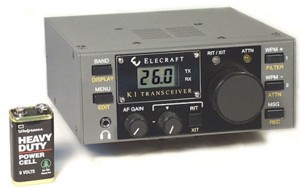 |
| Elecraft K1 |
Today I will get my K1 off to its new owner in Holland. It worked well, but I have not used it since before my stroke. I prefer that someone has it who will use it.
There is one minor fault (which has just occurred) in that the menu button no longer seems to work as it did. I think this is a minor fault and I have declared this to the new owner, who still wants it.
In the past the rig has been used to work lots of DX including the USA on 40, 30, 20 and 15m. The rig is a 4-band version with internal auto-ATU. The K1 is a decent little radio.

Roger Lapthorn, G3XBM, is a regular contributor to AmateurRadio.com and writes from Cambridge, England.
Chuck Adams, K7QO on a Mission
Charming audio interview with Chuck Adams, K7QO on a recent QSO Today podcast. Chuck’s infectious enthusiasm for the hobby, CW, and especially his austere approach to getting on the air will delight many, especially dedicated low-power enthusiasts.

Don’t miss it and be sure to visit the program Web site as there are many links referenced from the interview. This episode highlights precisely why Eric Guth, 4Z1UG and his program are firmly affixed at the top of the ham radio podcast pile.

Jeff Davis, KE9V, is a regular contributor to AmateurRadio.com and writes from Indiana, USA.
Hunting For NDBs In CLE 198
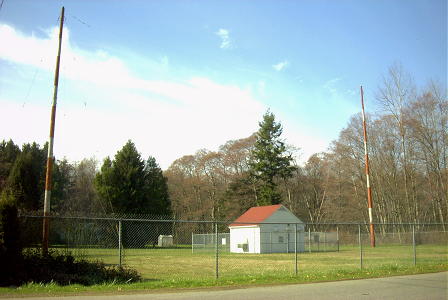 |
| 'WC' - 332 kHz White Rock, B.C. |
A list of all of the North American targets in this range can be found in the RNA database, while targets for European DXers will be found here ... specify the frequency range wanted and check 'show all results'.
An excellent target for this CLE is 'WC' (332kHz) shown here. Its 25W signal gets out very well and has been heard as far as Texas. It is unusually-located in the middle of a quiet residential street, nestled between homes on each side.
From CLE coordinator Brian Keyte (G3SIA) comes the following reminder:
It is an ideal one for new listeners as well as for regulars:
Days: Friday 18 September - Monday 21 September
(a week earlier than originally planned)
Times: Start and End at midday, your LOCAL time
Range: 320.0 - 334.9 kHz
It's straightforward - just log the NDBs that you can identify having their
nominal frequencies in the range, plus any UNIDs that you come across
there. We last concentrated on these frequencies during CLE183 in June
2014.
We'll be near the DGPS beacons range and some of us, especially in North
America, may hear a few. I suggest that we don't seek out or report these
in this CLE.
Send your CLE log to the List, if possible as a plain text email and
not in an attachment, with CLE198 at the start of its title.
Show on EVERY LINE of your log:
# The Date (or day 'dd') and UTC (the day changes at 00:00 UTC).
# kHz - the beacon's nominal published frequency (if you know it).
# The Call Ident.
Please show those main items FIRST on each line, then any optional details
such as Location, Offsets, Distance, etc.
If you send interim logs, do make sure that you also send a 'Final' log
containing all your loggings. As always, please make your log useful and
interesting to everyone by including your own location and brief details
of your receiver, aerial(s) and any recording equipment that you used.
You can find CLE-related information from the CLE page,
http://www.ndblist.info/cle.htm , including access to the seeklists
that have been made for the event from REU/RNA/RWW.
(NB: To also see a MAP of the seeklist NDBs around you, just change
'List' to 'Map', select 'All Results' and uncheck 'Clustering')
Good listening
Brian
----------------------------------------------------------
From: Brian Keyte G3SIA ndbcle'at'gmail.com
Location: Surrey, SE England (CLE co-ordinator)
----------------------------------------------------------
(Reminder: You could use any one remote receiver for your loggings,
stating its location and owner - with their permission if required.
A remote listener may NOT also use another receiver, whether local or
remote, to obtain further loggings for the same CLE).
These listening events serve several purposes. They:
- determine, worldwide, which beacons are actually in service and on-the-air so the online database can be kept up-to-date
- determine, worldwide, which beacons are out-of-service or have gone silent since the last CLE covering this range
- will indicate the state of propagation conditions at the various participant locations
- will give you an indication of how well your LF/MF receiving system is working
- give participants a fun yet challenging activity to keep their listening skills honed
Final details can be found at the NDB List website, and worldwide results, for every participant, will be posted there a few days after the event. If you are a member of the ndblist Group, results will also be e-mailed and posted there.
The very active Yahoo ndblist Group is a great place to learn more about the 'Art of NDB DXing' or to meet other listeners in your region. There is a lot of good information available there and new members are always very welcome.
If you are contemplating getting started on 630m, listening for NDBs is an excellent way to test out your receive capabilities as there are several NDBs located near this part of the spectrum.
You need not be an ndblist member to participate in the CLEs and all reports, no matter how small, are of much value to the organizers. 'First-time' logs are always VERY welcome!
Reports may be sent to the ndblist or e-mailed to either myself or CLE co-ordinator, Brian Keyte (G3SIA), whose address appears above.
Please ... give the CLE a try ... then let us know what NDB's can be heard from your location! Your report can then be added to the worldwide database to help keep it up-to-date.
Steve McDonald, VE7SL, is a regular contributor to AmateurRadio.com and writes from British Columbia, Canada. Contact him at [email protected].
 Ham Radio Deluxe |
 W5SWL Electronics |
 Ham Radio Prep |
 KB3IFH QSL Cards  Hip Ham Shirts  HamRadioAuctions HamRadioAuctions Reliance Antennas Reliance Antennas Enigma Shop Enigma Shop |  morseDX  Ni4L Antennas  R&L Electronics R&L Electronics antennas.us antennas.us QRV QRV |
- Matt W1MST, Managing Editor
