 |
 Amateur Radio Newsline Report 1981 October 16 2015
 16 October 2015 | by
 - QSOs IN CUBA
- A HOSPITAL HAM SHACK
- YES, YOU CAN SURPRISE A HAM OR TWO OR THREE
- JAM SESSION
- POPE SPECIAL EVENT BLESSED BY BIG NUMBERS
- IARU SPEAKS OUT FOR ANTENNAS
- RUNNING FOR THE WARRIORS
- FCC TO WEIGH IN ON TINKERING
- COASTING TO ANOTHER ANNIVERSARY
- DOLLARS FOR SCHOLARS
- HAMS REVISIT NEPAL'S EARTHQUAKE
- THE WORLD OF DX
- HAM SCHOOL
Religion and Ham Radio
 We need to get the religion out of ham radio. No, I am not talking about the HF nets that support missionaries or similar activities. (Those people might actually be doing something good for the world.) I am talking about the religious debates concerning new technology…this technology is better than that technology.
Amateur radio is a technical hobby, one based on technology, hobbyist pursuits and mutual interest. One might think that this means issues are looked at objectively and discussions are based on logic, scientific principles and facts. Of course, this is completely wrong. What often shows up in ham radio are religious debates about technology or operating modes.
Here’s a definition of Religion:
a specific fundamental set of beliefs and practices generally agreed upon by a number of persons or sects: the Christian religion; the Buddhist religion.
You can tell when you are stuck in a religious debate…the facts quickly fade and statements like “this is the right way to do it” become louder. Underneath this is a fundamental belief trying to come out that the person may not even be aware they have.
A long running example of a religious debate is Linux versus Windows. On the surface, people argue about which one has more defects, which one is more secure and which one ultimately serves their needs better. Underneath the surface is the religious belief: software should be free, Microsoft is evil, etc. Then there are those Mac enthusiasts (you know who you are)….these folks tend to act like a cult as they attempt to convert other people to their group. (Where is the line between enthusiast and cult member?)
The latest one on the ham radio front is the debate over digital technology in the VHF and higher bands: D-STAR versus DMR (and now Fusion). The debate starts out rational with a discussion of the merits of each but soon the deeply-held beliefs come out: D-STAR is bad because ICOM is pushing it, DMR is good because it is the commercial standard, D-STAR is good because it is an amateur radio standard, D-STAR uses a proprietary vocoder chip so it is bad, etc. Then don’t forget the guys that say “all digital is bad, analog FM is good.”
Again, you can tell when the religion kicks in because the facts start to fade and the beliefs rise to the surface. Usually, these arguments can’t be resolved because you can’t really debate beliefs. What you get instead are flame wars on the various email groups.
What other religious debates are out there? Android versus iOS, Open Source Software versus Commercial Software, My favorite rig versus Your favorite rig, … what else?
-73, Bob K0NR
This post is recycled and updated from a 2007 post. Some things never change.
The post Religion and Ham Radio appeared first on The KØNR Radio Site.
Bob Witte, KØNR, is a regular contributor to AmateurRadio.com and writes from Colorado, USA. Contact him at [email protected].
630m Crossband Schedule
 |
| VO1NA Torbay, Newfoundland |
There are now five Canadian amateurs slated to operate over the course of the two-night event (Friday & Saturday) and they will be looking for two-way crossband contacts with amateurs in the U.S. and Canada. Here is the schedule of frequencies and times:
Station: VO1NA (Joe) GN37 Torbay, Newfoundland
Time: 2130Z - 0130Z both Friday night (Nov 13-14Z) / Saturday night (Nov 14-15Z)
TX Frequency: 477.7 kHz
RX (QSX) Frequency: 3562 kHz
Station: VE7SL (Steve) CN88 Mayne Island, B.C.
Time: 0200Z - 0700Z both Friday night (Nov 14Z) / Saturday night (Nov 15Z)
TX Frequency: 473.0 kHz
RX (QSX) Frequency: 3566 / 7066 kHz
Station: VE7BDQ (John) CN89 Delta, B.C.
Time: 0430Z - 0700Z both Friday night (Nov 14Z) / Saturday night (Nov 15Z)
TX Frequency: 474.0 kHz
RX (QSX) Frequency: 3536 kHz
Station: VA7MM (Mark) CN89 Coquitlam, B.C.
Time: 0500Z - 0700Z Friday (Nov 14Z)
0400Z - 0800Z Saturday (Nov 15Z)
TX Frequency: 475.0 kHz
RX (QSX) Frequency: 3570 kHz
Station: VE7CNF (Toby) CN89 Burnaby, B.C.
Time: 0300Z - 0700Z both Friday night (Nov 14Z) / Saturday night (Nov 15Z)
TX Frequency: 476.0 kHz
RX (QSX) Frequency: 3558 kHz / 7062 kHz
These stations will be calling CQ on CW at regular intervals throughout the evening, and listening for answers on the allocated HF call-back (QSX) frequency. The sequence that I will be using (and others in a similar fashion) is:
"CQ CQ CQ de VE7SL VE7SL VE7SL QSX 3566 and 7066kHz K". After listening for callers on either QSX frequency for approximately 30 seconds, the CQ will be repeated if no callers are heard.
With good conditions, propagation can often span the continent, so please consider taking part in the activity from wherever you might be located in North America. Last year, crossband contacts were made between here and W3 / W5 and many points in between.
For eastern stations, VO1NA, in Newfoundland, should be a tantalizing target with coverage throughout the eastern states while the four VE7 stations should prove workable for central and western North American amateurs.
Those that might wonder about the 'legality' of crossband contacts need not worry. Canadian amateurs have had legal access to 630m for almost two years now and crossband contacts with any stations in the amateur radio service are the same as a two-way QSO on any other band. Unfortunately, amateurs are not allowed to contact any of the experimentally-licenced stations ... they are permitted to work each other only.
Hopefully you will print out the operating schedule and consider participating in the November crossband activity weekend ... the more the merrier! It would be great to see even more contacts than last year, which was a great start, considering the less than optimum conditions. I will post more details as the event weekend draws closer. We hope to see you there!
Steve McDonald, VE7SL, is a regular contributor to AmateurRadio.com and writes from British Columbia, Canada. Contact him at [email protected].
DX and Fall Colors
Judy and I took a walk near Hunkins Pond this afternoon. The fall colors were at their best! 20 meters was pretty good too. I worked Cuba, the UK and Rhode Island.

We hiked west and north on the old range road. When we got to David Swain’s north field, we turned in. The view was stunning. Even though the true temperature was 55F, in the sun it was almost 75F. I set up the Par 3-band end fed wire as an inverted vee over a maple branch and sat down in the sun. It was glorious.

I was running the KD1JV Mountain Topper at 3 watts. As I tuned down the band, I heard T47GDXC calling CQ. This is a special event station from Cuba. We exchanged quick 599’s and I was glad to have one contact under my belt. I had an ear to stations on the band and both eyes on the fantastic view.

Tom G3HGE from England was working one station after another. He and I are old friends and I was anxious to work him again. I called several times but other stations beat me to it. Finally, I got my chance and called him in the clear. “PID?” he sent and I returned with my call sign several times. At last he copied my call and we had a wonderful exchange. He was a solid 569, but I was only 339 to him. “UR signal is dropping to S1,” he sent as I told him I was operating portable in the beautiful outdoors. We signed after a couple of minutes, but I was thrilled to complete a QSO with him for the first time in a month or so. My little Mountain Topper sat in my lap with a notebook on my knee. You’ll see Tom’s call sign in the notebook.

I switched to 40 meters to see how that band was and heard Joe N1EFX in Rhode Island right away. He was calling CQ with a solid 589. He gave me a 449, but copied well, and we chatted for several minutes before signing.
I was satisfied with the contacts and wanted to hike down through the fields a bit before heading home. We headed east and south on the range road and came to Dearborn’s Farm. What a wonderful spot. Shimmering green grass, trees aflame in gold and corn over 8 feet high. We headed into a quiet glen and I took a quick snapshot.

These glorious days are so fleeting. Tomorrow and the next day it’s supposed to rain. We may lose much of the color.
Jim Cluett, W1PID, is a regular contributor to AmateurRadio.com and writes from New Hampshire, USA. Contact him at [email protected].
Better with SMA
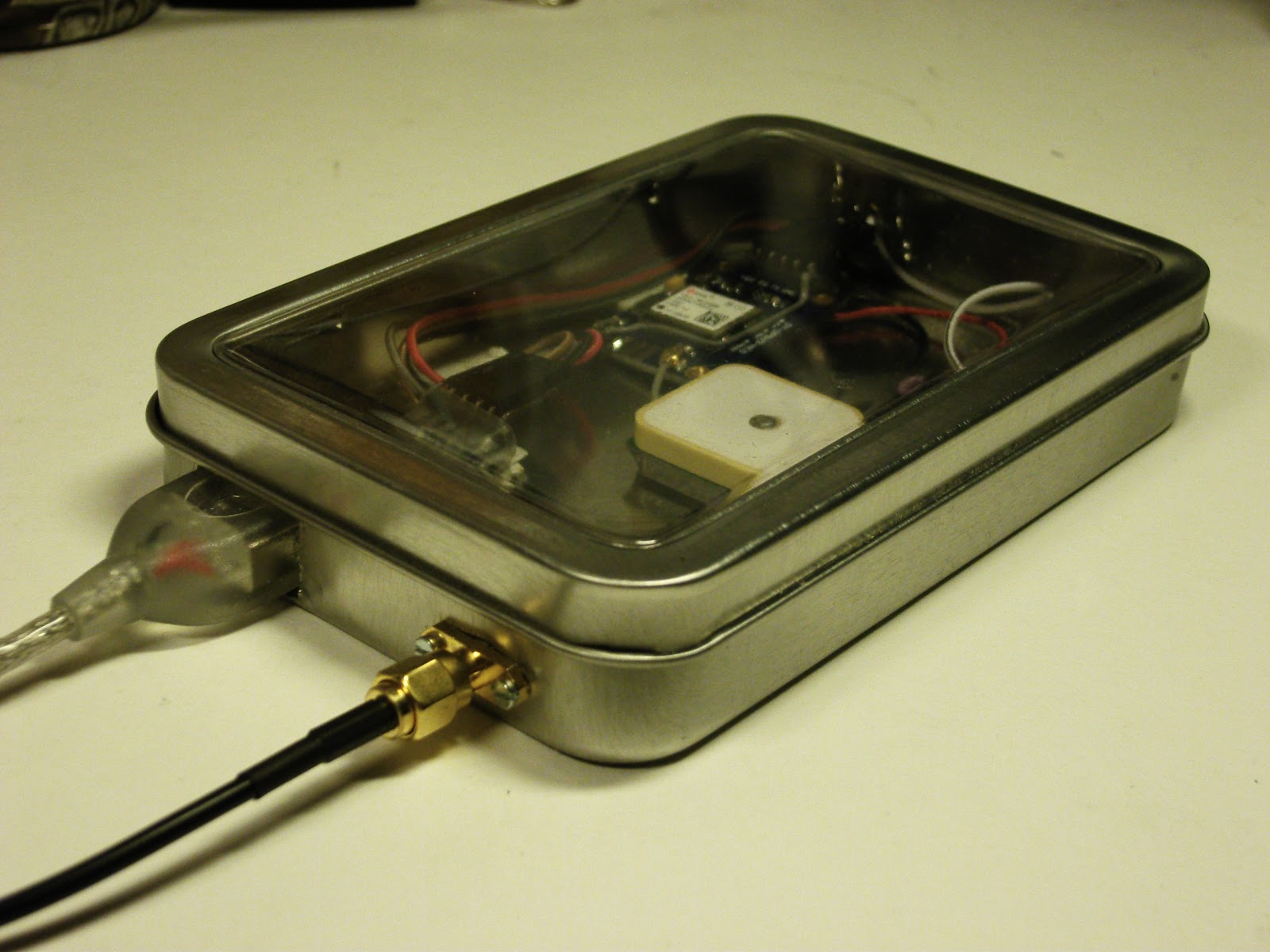
I had some trouble closing the lid on the “Just good enough 10 MHz GPS reference” due to the size of the BNC jack. Therefore I changed it to an SMA (SubMiniature version A) female jack. A thin cable connects it to the K3’s SMA input and there is no need for any SMA-BNC adapter on that end.
At the same time I moved the GPS antenna to a more central location in the tin, in the hope that the walls of the tin would interfere less with GPS reception. That’s the theory anyway, if it matters much in practice is a different story.
 Actually, I think I’m going to use SMA more often with these clear top tins and also Altoids tins. They take up much less space and are easier to install and to work with.
There aren’t any high power applications for circuitry in such tins, so I cannot so any reason why the SMA won’t work just as well or even better than the BNC.
Other related posts about the 10 MHz reference:
- Just good enough 10 MHz reference (3 Oct 2015)
- Curing amnesia in the 10 MHz GPS reference (19 Nov 2015)
- Improved GPS reception with a ground plane (11 April 2016)
Sverre Holm, LA3ZA, is a regular contributor to AmateurRadio.com and writes from Norway. Contact him at [email protected].
Better with SMA
I had some trouble closing the lid on the “Just good enough 10 MHz reference” due to the size of the BNC jack. Therefore I changed it to an SMA (SubMiniature version A) female jack. A thin cable connects it to the K3’s SMA input and there is no need for any SMA-BNC adapter on that end.
At the same time I moved the GPS antenna to a more central location in the tin, in the hope that the walls of the tin would interfere less with GPS reception. That’s the theory anyway, if it matters much in practice is a different story.
Actually, I think I’m going to use SMA more often with these clear top tins and also Altoids tins. They take up much less space and are easier to install and to work with.
There aren’t any high power applications for circuitry in such tins, so I cannot so any reason why the SMA won’t work just as well or even better than the BNC.
Sverre Holm, LA3ZA, is a regular contributor to AmateurRadio.com and writes from Norway. Contact him at [email protected].
Xiegu X108G Review Continued

Xiegu X108G Outdoor Version
Continued Review: October 14, 2015
Having played with the radio mostly doing some CW operations and some shortwave listening I have stumbled across a few little issues that I am hoping can alos be fixed by Xiegu by way of firmware issue.
I have to say once again that this little radio does pack quite a punch for what is in the box, and at the same time this radios performance is guaranteed inside the amateur radio bands, anything else like expecting a hard headed shortwave radio or am broadcast band radio for DXing might be just a bit naive.
Again I have operated this unit on cw and have still to test it on SSB. But in my cw tests I can tell you that the cw tone tested against other radios seems to be spot on. When up against the FT-857 the blue light flashes right along on the same frequency. The 500hz filter also works extremely well and takes all that noise out and allows working the intended station easy. I run the radio with the ATT off and signals are clearly heard without a problem on my windom. I used straight key for my operations but there appears to be an issue with the built in keyer, it wants to add extra characters so until this is fixed stay with a straight key.
So what have I found that needs to be addressed on this radio, let me start:
I was attempting to check into a voice net on 40 meters one evening as they were looking for checkins on phone or cw. So I figured I would test the split function out and set one VFO to cw and the other to SSB, well I was surprised to find that the radio will not transmit cross mode, I would have to have both VFO’s in the same mode to do anything which did not work obviously.
The second issue that brought me to this split mode was the fact that no CWR (CW Reverse) is present that will allow me to listen to the required SSB while in cw mode to check into the same net.
This has been addressed with Xiegu to see if there is a firmware fix for the issues stated, including the Iambic keyer problem. As the radio is now it would make a good SSB rig, but performance as a dedicated cw rig and not being able to check in using CWR kind of takes away the joy of portable use and using the radio as a go-kit emcomm rig. The 20 watts of power and its size is nice when you need that extra bit of punch.
The multikey microphone as well as the two programmable keys makes the mike a handy addition to this radio. HRD can be used and the IC7000 is the settings that are used in HRD to use the radio. We are still working on pin outs for the ACC jack to figure out if full PTT and audio in and audio out are present for digital operations and HRD.
Voltage Test: I did a voltage test to see what the minimum lowest power was to allow this rig to operate, this was asked of me by another portable radio operator. So I found 11 volts is the absolute minimum that the X108G will operate, once 11 volts is reached the radio will then start to motorboat and funny things happen to the radio, many of my battery packs I use for portable operations and teh other radios I use will cut off at 10.6 volts.
The other test that I want to do is to test the radio against an SDR radio like my KX3 or even by SDR dongle to see if any transmit spurs exist outside of the ham bands while in cw. This radio has attained FCC Certification so I know it has already gone through some hoops and hurdles.
So while I await a response from Xiegu I will continue to enjoy this little radio that has been designed as a minimalist radio with no extra bells and whistles attached to it.
Fred Lesnick, VE3FAL, is a regular contributor to AmateurRadio.com and writes from Thunder Bay Ontario, Canada. Contact him at [email protected].
 Ham Radio Deluxe |
 W5SWL Electronics |
 Ham Radio Prep |
 KB3IFH QSL Cards  Hip Ham Shirts  HamRadioAuctions HamRadioAuctions Reliance Antennas Reliance Antennas Enigma Shop Enigma Shop |  morseDX  Ni4L Antennas  R&L Electronics R&L Electronics antennas.us antennas.us QRV QRV |
- Matt W1MST, Managing Editor
