 |
 CW Practice With RufzXP
 21 November 2015 | by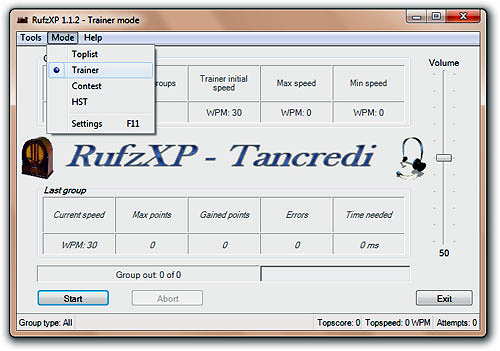
Lately I've been playing with a very helpful piece of CW-training freeware called 'Rufz', an abbreviation of a German word meaning 'Listening to Callsigns'. Rufz is the brainchild of Mathias Kolpe (DL8MM) and Alessandro Vitiello (IV3XYM).
RufzXP is the latest version, compatible with most operating systems from Windows 98 to Win 8.1.
RufzXP is not a contest simulator with QSB and QRM. The program simply sends 50 calls at random, one at a time, starting at your chosen speed. If you correctly type the call, it will increase speed slightly to send the next call. The speed will continue to increase as long as you correctly copy and type the call ... if not, the speed will decrease to the previous level.
This pattern continues until all 50 calls have been sent. The program then displays all of the calls sent, along with the calls that you typed, as well as the speed. You very soon realize the threshold level between copying comfortably at near 100% and where you start to drop off quickly. It really is a great eye-opener and a wonderful way to increase your copying (and typing) ability.
The highest that I have been able to log a few correct calls is at 54 WPM but I can see that with a few minutes of practice each day, this number should continue to improve. Hopefully my ability to type the calls will also improve as my present keyboarding skills are probably being stifled by my 'hunt and peck' style of typing ... I really should have taken typing in high school and have regretted it ever since.
The website for RufzXP contains a wealth of inspiring data, from sound files of various speeds to lists and photos of various high-speed aficionados ... with an impressively large number being European teenagers. It seems that High Speed Telegraphy World Championships are very popular in Europe and many of the champions are quite young. Have a look at some of the teens, aged 16 or younger (both boys and girls) who are copying over 100 WPM ... several of them not even hams.
A particularly interesting page lets you play the word 'PARIS' at various speeds.
Here it is at 20 WPM:
PLAY
... and again at 50 WPM:
PLAY
... yet again at 100 WPM:
PLAY
Now....listen to 'PARIS' being sent at the present record-holding speed of 200 WPM:
PLAY
I have no idea how anyone could copy CW at this speed but apparently YT7AW was able to correctly copy one call out of seven, sent at this speed ... incredible! Perhaps it is the subconscious mind operating at this level.
You may be interested to see someone copying at just over 140 WPM!
If your CW skills need honing, RufzXP might be just the thing you need.
Steve McDonald, VE7SL, is a regular contributor to AmateurRadio.com and writes from British Columbia, Canada. Contact him at [email protected].
Amateur Radio Weekly – Issue 86

5MHz amateur band – it is now official
WRC-15 has ratified the first new HF amateur allocation since 1979.
amateurradio.com
National Parks on the Air map
In cooperation with the American Radio Relay League (ARRL) CQmaps is pleased to offer the 2016 National Parks on the Air (NPOTA) map. Your map is the ticket to all 432 parks that the ARRL has included in the 2016 Centennial.
CQmaps
The Sproutie “SPT” Beacon – A legal, unlicensed HiFER beacon
This blog-post discusses the use of the 13553 – 13567KHz band under FCC Part 15 regulations in the US.
AA7EE
Extreme milliwatting
WSPR on 80m with only 10mW (on the horizontal 80m loop).
PE4BAS
State ousts leader of Oregon Amateur Radio Service
The state has an agreement with amateur radio enthusiasts to provide a backup system.
OPB
Arduino pocket lightning detector
This sensor watches for the particular waveform of lightning at 500Khz and gives a distance approximation.
Instructables
TV going the distance: Propagation
At shortwave frequencies, distant propagation is much more common. Shortwaves travel via ground wave (short distance) and sky wave.
Hack A Day
HF Underground
Shortwave Pirate Radio Forums in North America and Around The World. (And other stations that go bump in the night.)
HF Underground
Ham history
Radio hams do battle with ‘Russian Woodpecker’
From their own homes, many ham radio operators have quietly carried on an electronic war with the Soviet Union .
Miami Herald
Duga radar (Russian Woodpecker)
Duga-1 was a Soviet over-the-horizon (OTH) radar system used as part of the Soviet ABM early-warning network.
Wikipedia
Sound clip of Russian Woodpecker
It sounded like a sharp, repetitive tapping noise, at 10 Hz, giving rise to the “Woodpecker” name.
YouTube
Video
Delta loop vs Cobwebb antenna
Amateur Radio Guy!
Amateur Radio Weekly is curated by Cale Mooth K4HCK. Sign up free to receive ham radio's most relevant news, projects, technology and events by e-mail each week at http://www.hamweekly.com.
Ham Radio & PLT devices

Over the past few years and again recently I have heard a lot of chatter regarding PLT interference. Especially with Ham radio and shortwave bands. These devices plug into a power wall socket in your house and allow you to create a wired network via your mains wiring in the property. It’s a perfect solution for properties that cannot send a wireless signal from one end to another (Just like mine). It does however have a draw back. In creating a wired network these PLT devices create a lot of mains born interference and this can effectively block out any amateur radio bands.
In recent stories I have heard audio samples and read stories of how these devices can create S9+20db of noise. Thus reducing the amateur bands unusable.
I wanted to see for myself the effect of using PLT devices in my property. So I visited PC World and purchased 2 devices from NetGear. The Powerline 500 promise 500Mbit/s and this would solve a huge problem I have in my home right now, but feared for what it would do to my beloved radio.
The results were interesting and nothing what I expected. You can see my full test in the video below – but for a spoiler alert keep reading….
The moral ? – Don’t believe the hype.
Dan Trudgian, MØTGN, is a regular contributor to AmateurRadio.com and writes from Wiltshire, England. He's a radio nut, IT guru, general good guy and an all round good egg. Contact him him here.
Ham Radio & PLT devices
Over the past few years and again recently I have heard a lot of chatter regarding PLT interference. Especially with Ham radio and shortwave bands. These devices plug into a power wall socket in your house and allow you to create a wired network via your mains wiring in the property. It’s a perfect solution for properties that cannot send a wireless signal from one end to another (Just like mine). It does however have a draw back. In creating a wired network these PLT devices create a lot of mains born interference and this can effectively block out any amateur radio bands.
In recent stories I have heard audio samples and read stories of how these devices can create S9+20db of noise. Thus reducing the amateur bands unusable.
I wanted to see for myself the effect of using PLT devices in my property. So I visited PC World and purchased 2 devices from NetGear. The Powerline 500 promise 500Mbit/s and this would solve a huge problem I have in my home right now, but feared for what it would do to my beloved radio.
The results were interesting and nothing what I expected. You can see my full test in the video below – but for a spoiler alert keep reading….
The moral ? – Don’t believe the hype.
Dan Trudgian, MØTGN, is a regular contributor to AmateurRadio.com and writes from Wiltshire, England. He's a radio nut, IT guru, general good guy and an all round good egg. Contact him him here.
Rock ‘N Radio — QRP Style
Operating QRP
Can mean operating from a "Quiet Restful Place"
I had the day off today and it was a beautiful morning. I decided to spend part of it at Lake Wheeler Park in Raleigh, NC operating QRP from a stone bench under a tall oak tree. |
| rock 'n radio |
I threw a line over a tree using a throwing weight. I hit my mark the first time, untied the weight, tied on the end of the antenna, and hoisted the 31 foot end-fed up exactly where I wanted it with the feed point a couple of feet off the ground.
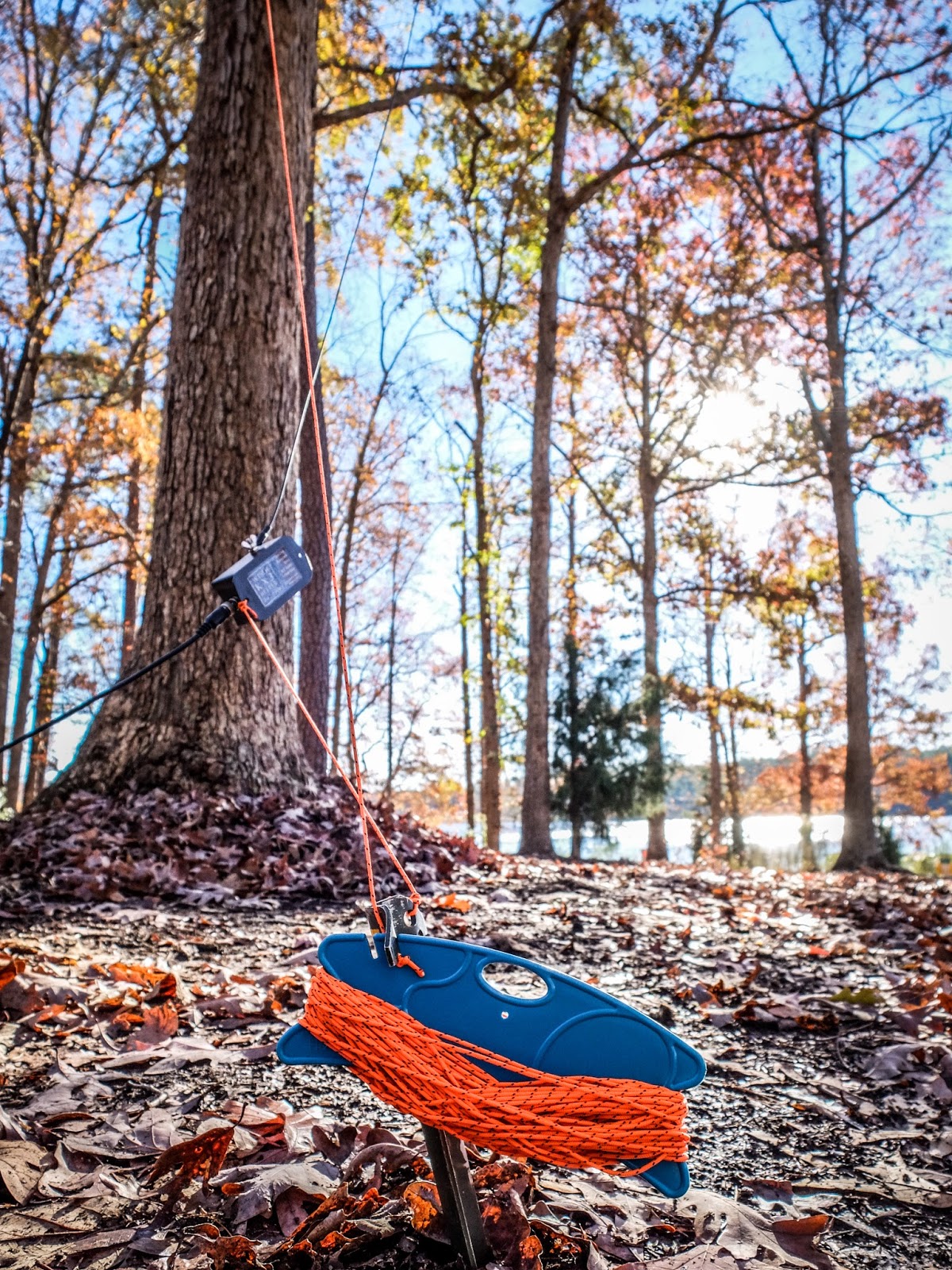 |
| 31 feet of wire end-fed by a 9:1 balun. A kite string winder holds the throwing line A metal stake with a bit of rope anchors the balun and the other end of the rope |
 |
| Another view of the end-fed with 9:1 balun, stake and coax |
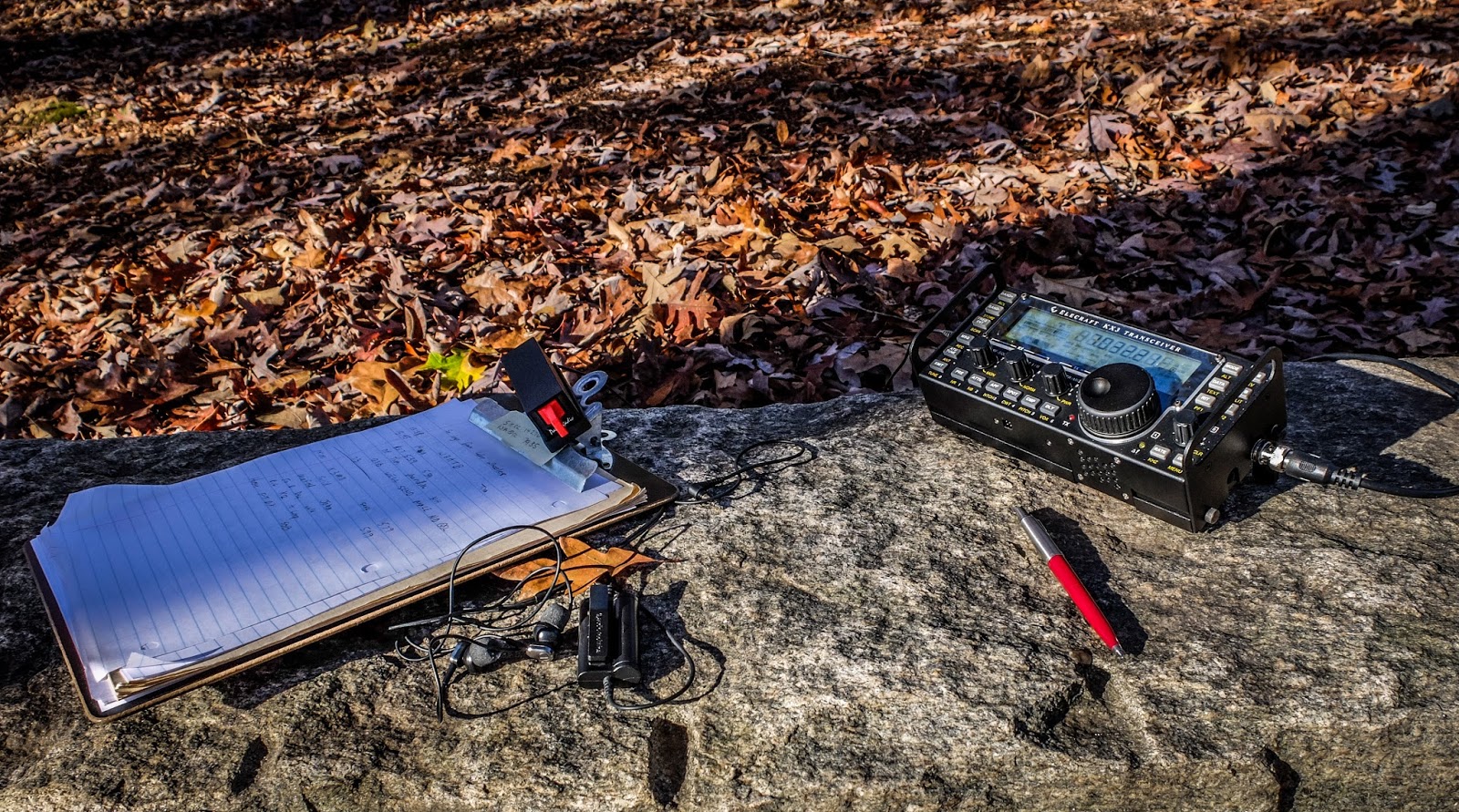 |
| QRP operating position |
I called CQ on the 20m QRP calling frequency (14.060) and had a brief QSO with a lot of QSB (fading). I didn't hear much activity that early in the morning on 20m so I dropped down to 40m and worked the QRP calling frequency (7.030) and had my call answered right away. After that QSO another station jumped in there calling for a specific station so I moved on. 40m was busy. Every time I thought I'd found an open frequency someone would jump back in or if I called QRL? I'd get an R R.
The Palm key has a clip-on, magnetic base which I use to temporarily attach it to my clipboard when I'm not sending. When I'm ready to send I simply pull it off the clipboard and hold it in my left hand. As I noted in an earlier review of the Palm Single Paddle it can be used as a straight key if you turn it on its side. The long ragchew I had on 30m was with a gentlemen who sent me his SKCC number in the first exchange so I quickly turned off the electronic keyer in the KX3's and turned the Palm Single on its side. That station sent me a nice compliment on my straight key FIST; so the little Palm Single key can serve duty as a paddle into a keyer or (in a pinch) as a straight key. I far prefer to use my Kent Hand Key if I'm operating manual key but it's too big to bring along for portable operations and I can't quite picture myself trying to hold onto the giant Kent Hand Key with one hand whilst operating it with the other like I can the Palm Single.
 |
| The Palm Single Paddle works great in portable operating positions |
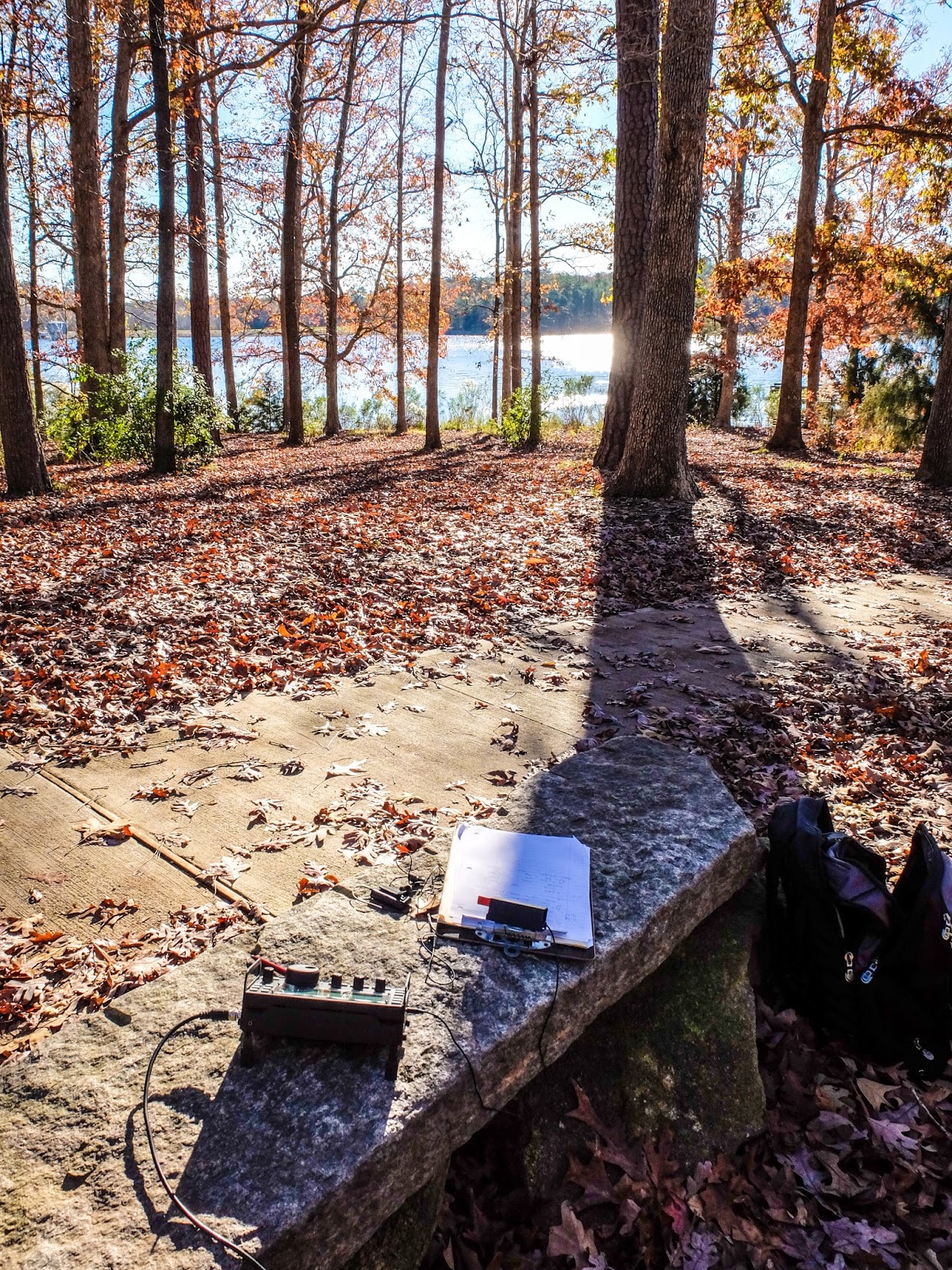 |
| What could be finer than to be in Carolina in the Mooo-oor-ning |
 |
| Enjoying the last nice days of our Fall... birds singing and morse code beeping |
Richard Carpenter, AA4OO, is a regular contributor to AmateurRadio.com and writes from North Carolina, USA. Contact him at [email protected].
What is the big deal with amateur radio? What is it that you hear? (Part 1)

Shortwave radio has been a source for great sci-fi plots, spy intrigue novels, movies, and so on, since radio first became a “thing.” But, what is the big deal, really? What is it that amateur radio operators listen to?
In this video, I share some of the types of signals one might hear on the high frequencies (also known as shortwave or HF bands). This is the first video in an on-going series introducing amateur radio to the interested hobbyist, prepper, and informed citizen.
I often am asked by preppers, makers, and other hobbyists, who’ve not yet been introduced to the world of amateur radio and shortwave radio: “Just what do you amateur radio operators hear, on the amateur radio shortwave bands?”
To begin answering that question, I’ve taken a few moments on video, to share from my perspective, a bit about this shortwave radio thing:
Link to video: https://youtu.be/pIVesUzNP2U — please share with your non-ham friends.
From my shortwave website:
Shortwave Radio Listening — listen to the World on a radio, wherever you might be. Shortwave Radio is similar to the local AM Broadcast Band on Mediumwave (MW) that you can hear on a regular “AM Radio” receiver, except that shortwave signals travel globally, depending on the time of day, time of year, and space weather conditions.
The International Shortwave Broadcasters transmit their signals in various bands of shortwave radio spectrum, found in the 2.3 MHz to 30.0 MHz range. You might think that you need expensive equipment to receive these international broadcasts, but you don’t! Unlike new Satellite services, Shortwave Radio (which has been around since the beginning of the radio era) can work anywhere with very affordable radio equipment. All that you need to hear these signals from around the World is a radio which can receive frequencies in the shortwave bands. Such radios can be very affordable. Of course, you get what you pay for; if you find that this hobby sparks your interest, you might consider more advanced radio equipment. But you would be surprised by how much you can hear with entry-level shortwave receivers. (You’ll see some of these radios on this page).
You do not need a special antenna, though the better the antenna used, the better you can hear weaker stations. You can use the telescopic antenna found on many of the portable shortwave radios now available. However, for reception of more exotic international broadcasts, you should attach a length of wire to your radio’s antenna or antenna jack.
I’m on Twitter, Facebook, and YouTube.
Visit, subscribe: NW7US Radio Communications and Propagation YouTube Channel
Latest antics
I was acutely aware that since the end of September my wife had become a radio widow so promised not to lock myself away in the shack for a while and have been doing some much needed painting and decorating around the house.
I haven't been in much of a radio mood anyway as I have been unwell and am still not fully over my last wobble. Band and weather conditions have been rubbish with a sustained period of high wind and rain including storms Abigail and Barney. As a precaution I dropped the pole and it became apparent I had some maintenance to do on the OCFD.

The shack too had been in need of some sorting out, which I thankfully I did muster enthusiasm to tidy up.
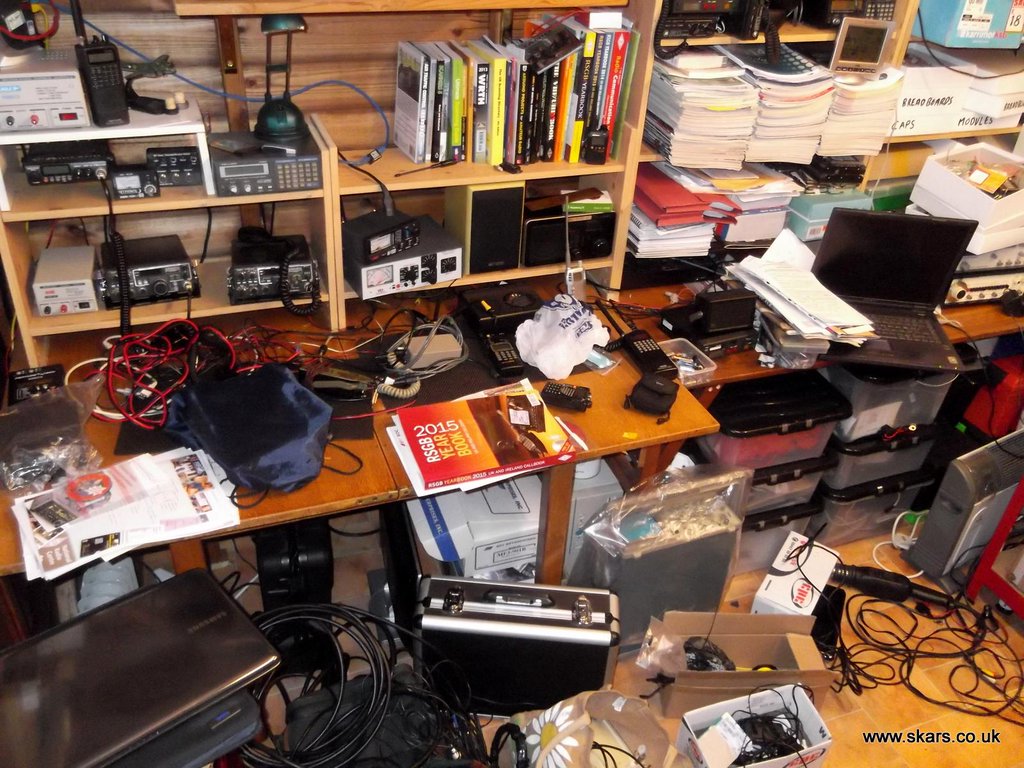
While being largely uninspired I haven't been completely radio silent, I did get on air for the South Kesteven ARS 2m net but found myself suffering some QRM again
It isn't the first time I've seen this sort of signal, but I had thought it had gone away, it seems it is back and stronger! This was an ARISS contact I monitored back in 2013 before I was licensed with a similar noise.
After using the SDR to identify the noise I realised I have been neglecting the FUNCube Dongle for far too long. So ordered some new SMA adapters from HamGoodies and pressed it back into service. I have been using it to decode the telemetry from the FOX-1A (AO-85) satellite with the updated software and have now got myself on the leader board even if the collinear is currently horizontal about four feet off the ground!
South Kesteven ARS had a talk in October by Sean Burton 2E0ENN about amateur DMR where he demonstrated some handsets and the new DV4Mini which allows gateway and internet linking.
I remembered I dabbled a few years ago with decoding PMR DMR using the SDR and a scanner with a discriminator tap using various programs but they were very hit and miss at the time. I reacquainted myself with the various projects and had a go at decoding some amateur transmissions.
I downloaded the latest program called DSDPlus (support at RadioReference.com) and monitoring the nearby GB7RR DMRPlus repeater managing to get some clear decodes with little effort.
Finally this week I gave a presentation at SKARS on the subject of HABs and how to plan a HAB launch. Following on from the Eggsplorer-1 and Hamfest "Pigs In Space" HAB launch I decided to try to explain everything I had learned for anyone else contemplating giving it a go!
It was a long talk (perhaps too long) as I covered everything from building the electronics, software, making the payload box, getting the right balloon, parachute, gas, obtaining permission and then the prediction, launching tracking and recovery.
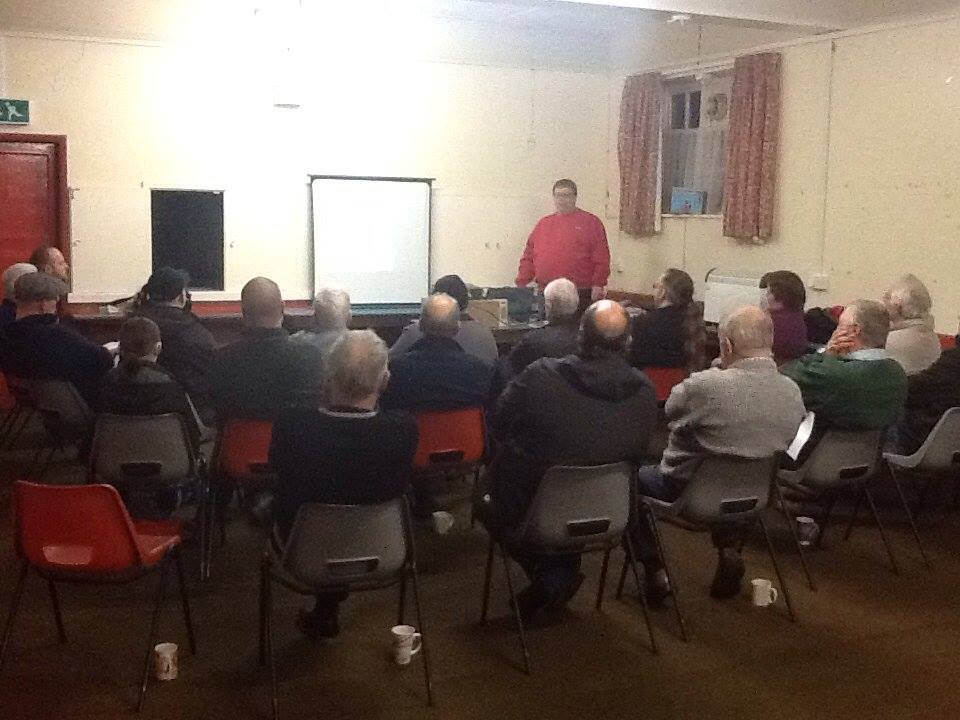
It was a great turnout with a lot of interest.
Andrew Garratt, MØNRD, is a regular contributor to AmateurRadio.com and writes from East Midlands, England. Contact him at [email protected].
 Ham Radio Deluxe |
 W5SWL Electronics |
 Ham Radio Prep |
 KB3IFH QSL Cards  Hip Ham Shirts  HamRadioAuctions HamRadioAuctions Reliance Antennas Reliance Antennas Enigma Shop Enigma Shop |  morseDX  Ni4L Antennas  R&L Electronics R&L Electronics antennas.us antennas.us QRV QRV |
- Matt W1MST, Managing Editor
