 |
 Antenna faulty
 13 January 2016 | by
 It looks like my tri-band Par antenna, which should be a good match on 10m, 20m and 40m is faulty. It is a good match on 10m, but only on 20m and 40m via the ATU. Tomorrow I shall try loading it up as a long wire tuned against ground via the ATU. Somewhere I have a Sandpiper Poliakov vertical that I should erect. As I recall this has a 9:1 unun so it matches well on most HF bands via an ATU.
Even soldering on a coax is hard work these days! Oh to be fit.
At the moment I am on 630m WSPR using the earth-electrode “antenna”.

Roger Lapthorn, G3XBM, is a regular contributor to AmateurRadio.com and writes from Cambridge, England.
Magnetospherically ducted echoes in the San Francisco area
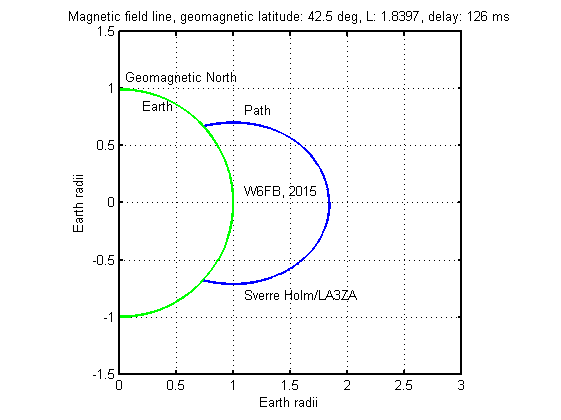
On 7. November 2015, several radio amateurs in northern California heard echoes in the 80 meter band. I was made aware of it by Jack, W6FB in Santa Clara, who recorded signals from K6YT some 25 miles away. According to W6FB, the echo effect was also heard north of Sonoma (several hundred miles north of him, reported by N6ZFO).
KM6I, Gordon, in Palo Alto also heard echoes of his own signals and recorded them. In his blog he analyzed the delay from the output of his transceiver and found 157 ms. He found that to be so close to the round-the-world time for signals of 138 ms, that he assumed that to be the cause.
I don’t agree, so I took the location of W6FB at locator CM97ah (Santa Clara) as a starting point for computing delay. This is latitude 37.31 and longitude -121.96 and gives a geomagnetic latitude of about 42.5 degrees. Then I put it into my program for computing path length along geomagnetic field lines assuming a height of the reflecting ionosphere on the opposite side of 100 km. The result is shown in the figure and predicts a delay time of 126 ms. My estimate of uncertainty is +/-5 ms.
The delay value is slightly less than 138 ms and easy to confuse with a round-the-world path. The challenge with estimating delays like this from the signal is that amateur transceivers may have an unspecified delay between start of transmission and start of sidetone. Measuring on the audio output as done here, measures the sidetone, not the actual RF.
I discussed this source of error in my 2009 QST article “Magnetospheric ducting as an explanation for delayed 3.5 MHz signals.” Therefore the measurement shown above may fit with 138 ms just as well as with 126 ms, it depends on the actual transceiver’s delay.
Other properties of the echo, such as the amplitude of the echo which according to W6FB at times was louder than the direct signal, also point to the duct theory as the explanation.
Others have heard such echoes also:
- 165-168 ms, K4MOG, February 2006, 80 m. Listen to the signal here. This event is also the object of the analysis in my QST article referenced above.
- 210-220 ms, G3PLX, November 2006, 160 m. Listen to the signal here.
- 214-219 ms, W2PA, February 2008, 80 m.
- 237 ms, OZ4UN, January 2009, 80m, Listen to audio file where also OZ7BQ very close by heard the echoes.
- About 200 ms, G3ZRJ, January 2012, 80m. Also heard by GW3OQK, 100 km apart.
Other posts on the theme: Magnetospherically Ducted Echoes or Medium Delayed Echoes
Sverre Holm, LA3ZA, is a regular contributor to AmateurRadio.com and writes from Norway. Contact him at [email protected].
Magnetospherically ducted echoes in the San Francisco area
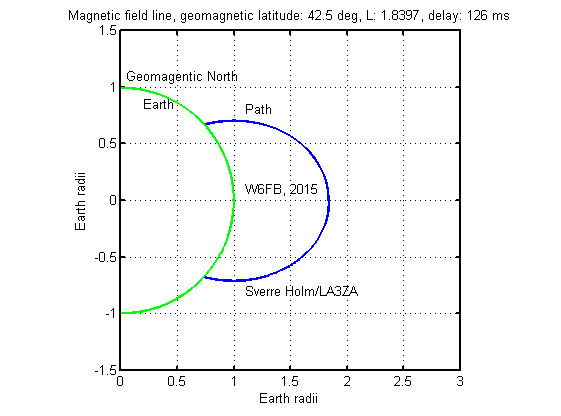
On 7. November 2015, several radio amateurs in northern California heard echoes in the 80 meter band. I was made aware of it by Jack, W6FB in Santa Clara, who recorded signals from K6YT some 25 miles away. According to W6FB, the echo effect was also heard north of Sonoma (several hundred miles north of him, reported by N6ZFO).
KM6I, Gordon, in Palo Alto also heard echoes of his own signals and recorded them. In his blog he analyzed the delay from the output of his transceiver and found 157 ms. He found that to be so close to the round-the-world time for signals of 138 ms, that he assumed that to be the cause.
I don’t agree, so I took the location of W6FB at locator CM97ah (Santa Clara) as a starting point for computing delay. This is latitude 37.31 and longitude -121.96 and gives a geomagnetic latitude of about 42.5 degrees. Then I put it into my program for computing path length along geomagnetic field lines assuming a height of the reflecting ionosphere on the opposite side of 100 km. The result is shown in the figure and predicts a delay time of 126 ms. My estimate of uncertainty is +/-5 ms.
The delay value is slightly less than 138 ms and easy to confuse with a round-the-world path. The challenge with estimating delays like this from the signal is that amateur transceivers may have an unspecified delay between start of transmission and start of sidetone. Measuring on the audio output as done here, measures the sidetone, not the actual RF.
I discussed this source of error in my 2009 QST article “Magnetospheric ducting as an explanation for delayed 3.5 MHz signals.” Therefore the measurement shown above may fit with 138 ms just as well as with 126 ms, it depends on the actual transceiver’s delay.
Other properties of the echo such as the amplitude of the echo which according to W6FB at times was louder than the direct signal. This points to the duct theory as the explanation.
Others have heard such echoes also:
- 210-220 ms, G3PLX, November 2006, 160 m. Listen to the signal here.
- 165-168 ms, K4MOG, February 2006, 80 m. Listen to the signal here.
- 214-219 ms, W2PA, February 2008, 80 m.
- 237 ms, OZ4UN, January 2009, 80m, Listen to audio file where also OZ7BQ very close by heard the echoes.
Other posts on the theme: Magnetospherically Ducted Echoes or Medium Delayed Echoes
Sverre Holm, LA3ZA, is a regular contributor to AmateurRadio.com and writes from Norway. Contact him at [email protected].
Poetic justice?
Trying some JT65 on 40m I was being plagued by S8-S9 of local noise, it is noise I have had regularly (even before the purchase of my PLT devices) so I reconnected up the WiMo QRM Eliminator, which has been collecting dust, to see if I could improve matters.
Using just a short piece of wire as the auxillary 'noise' antenna managed to null out most of it to greatly improve reception. No commentary on the video below but hopefully you can see it working.
Interestingly the noise seems to abate around 11pm when people are off to bed.
Andrew Garratt, MØNRD, is a regular contributor to AmateurRadio.com and writes from East Midlands, England. Contact him at [email protected].
Poetic justice?
Trying some JT65 on 40m I was being plagued by S8-S9 of local noise, it is noise I have had regularly (even before the purchase of my PLT devices) so I reconnected up the WiMo QRM Eliminator, which has been collecting dust, to see if I could improve matters.
Using just a short piece of wire as the auxillary 'noise' antenna managed to null out most of it to greatly improve reception. No commentary on the video below but hopefully you can see it working.
Interestingly the noise seems to abate around 11pm when people are off to bed.
Andrew Garratt, MØNRD, is a regular contributor to AmateurRadio.com and writes from East Midlands, England. Contact him at [email protected].
Ham Radio University 2016
Sunday, January 10, 2016 at Briarcliffe College in Bethpage, NY
- D-Star and System Fusion
Randy Gutentag WA2RMZ and Scott Weis KB2EAR - DMR (Digital Mobile Radio)
Bernie Hunt K2YO - SDR (Software Defined Radios)
Neil Goldstein W2NDG - Keynote Address
ARRL Chief Executive Officer Dave Sumner K1ZZ - Building Your First Ham Station
Phil Lewis N2MUN - Basics of HF Operating
Phil Lewis N2MUN and Mel Granick KS2G
Matt Thomas, W1MST, is the managing editor of AmateurRadio.com. Contact him at [email protected].
The 1st Annual Midwinter 630m Activity Weekend
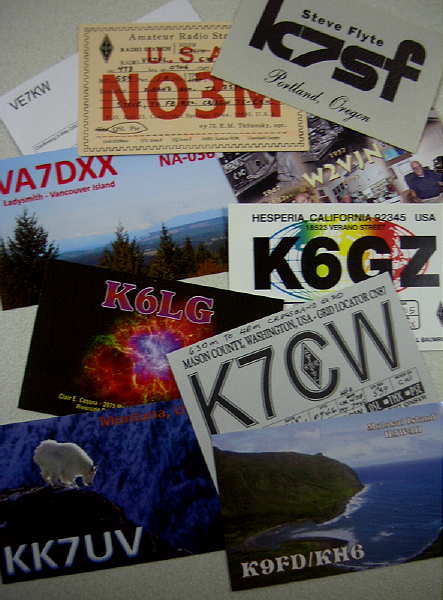
Following late fall's very successful 630m Activity / CW Crossband Weekend in November, several enquiries were soon received asking "when's the next one?" I'm happy to announce that the 'next one' will be held on the first weekend of February and will follow a similar format.
Here is the formal press release describing the event published in the ARRL News:
*****************************************
US and Canadian radio amateurs and experimenters will join forces in February for the first Midwinter 630 Meter Activity Weekend. The event will get under way on February 6 at 0000 UTC (Friday, February 5, in US time zones) and run through 2359 UTC on February 7.
“This event is being undertaken because of the new and quickly growing interest in present 630 meter activities, both in the US and Canada,” said ARRL 600 Meter Experimental Group (WD2XSH) Experiment Coordinator Fritz Raab, W1FR. “Much of the interest is in response to the strong likelihood of US amateurs receiving access to the band in the near future, while Canadian hams are eager to learn more about the present level of Amateur Radio activity on their newest ham band.” The activity weekend comes on the heels of a special event operation over the November 13-14 weekend that included participation by US and Canadian radio amateurs.and the Maritime Radio Historical Society (MRHS).
Raab said the two activity nights will offer interested amateurs in both countries an opportunity to experience the 630 meter band and, through cross-band activity with Canadian amateurs, to take part in activity in the MF spectrum. “Our hope is to see this activity become an annual operating event, to be held very winter on the 630 meter band,” Raab said. “For those who may be building for future 630 meter operation, this event will provide an opportunity to test your ‘receive’ capabilities on MF.”
Operation will be from 472 kHz to 479kHz in various modes. The two-way crossband work will be undertaken by several Canadian stations, all on CW. Canadians will operate on a schedule and listen for callers on specific QSX frequencies in the US ham allocations.
Time: 2130Z - 0130Z both Friday night (Feb 5 - 6Z) / Saturday night (Feb 6 - 7Z) plus QRSS3 / 12 WPM Beacon from 0130 – 1000Z
TX Frequency: 477.7 kHz
RX (QSX) Frequency: 3562 kHz
Station: VE7SL (Steve) CN88 Mayne Island, B.C.
Time: 0200Z - 0700Z both Friday night (Feb 6Z) / Saturday night (Feb 7Z)
TX Frequency: 473.0 kHz
RX (QSX) Frequency: 3566 / 7066 kHz
Station: VE7BDQ (John) CN89 Delta, B.C.
Time: 0330Z - 0700Z both Friday night (Feb 6Z) / Saturday night (Feb 7Z)
TX Frequency: 474.0 kHz
RX (QSX) Frequency: 3555 kHz
Station: VA7MM (Mark) CN89 Coquitlam, B.C.
Time: 0500Z - 0700Z Friday night (Feb 6Z)
0400Z - 0800Z Saturday night (Feb 7Z)
TX Frequency: 475.0 kHz
RX (QSX) Frequency: 1801 kHz / 3574 kHz / 7062 kHz
Time: 0300Z - 0700Z both Friday night (Feb 6Z) / Saturday night (Feb 7Z)
TX Frequency: 476.5 kHz
RX (QSX) Frequency: 1836 kHz / 3558 kHz / 7031 kHz
Time: 0000Z - 0400Z both Friday night (Feb 6Z) / Saturday night (Feb 7Z)
TX Frequency: 477.0 kHz
RX (QSX) Frequency: 3563 kHz / 7058 kHz
“The success of this event largely depends upon the participation of as many amateurs as possible,” Raab said. “We hope that you can find a few hours to participate in this unique midwinter event.” Submit reception reports via e-mail to the respective operators or via the ARRL 600 Meter Experiment website.
*************************************
Hopefully you will be able to participate in the crossband activity by being able to listen on 630m and then able to switch over to HF to transmit. This could involve the use of a separate receiver / transmitter or can often be easily implemented via your transceiver's 'A/B' switch.
No antenna for receiving on 630m? Surprisingly good results can often be had by using a low band wire antenna such as a dipole or inverted-L for listening on 630m ... the antenna does not necessarily need to be resonant. In fact, often times, a non-resonant receiving antenna can provide a better overall S/N ratio than one which is resonant, as these often gather more noise along with signals.
You may want to experiment before hand by listening to many of the numerous U.S. experimental stations operating nightly, mostly in the WSPR mode, between 475.6 and 475.8kHz. Most operators provide a CW identifier following their WSPR transmission but a better way to decode these signals is by installing the latest WSPR software, WSJT-X (freeware), at K1JT's website here. The software works extremely well and is easy to install and get working. If you set the software to 'upload spots', you can share your nightly catches with dozens of other listeners throughout the continent on the WSPRnet website.
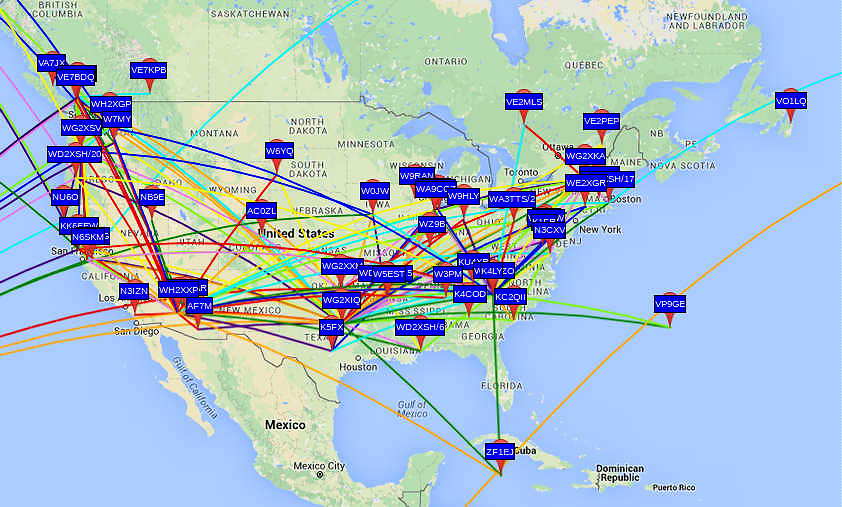 |
| courtesy: KB5NJD's 630m Daily Blog |
Steve McDonald, VE7SL, is a regular contributor to AmateurRadio.com and writes from British Columbia, Canada. Contact him at [email protected].
 Ham Radio Deluxe |
 W5SWL Electronics |
 Ham Radio Prep |
 KB3IFH QSL Cards  Hip Ham Shirts  HamRadioAuctions HamRadioAuctions Reliance Antennas Reliance Antennas Enigma Shop Enigma Shop |  morseDX  Ni4L Antennas  R&L Electronics R&L Electronics antennas.us antennas.us QRV QRV |
- Matt W1MST, Managing Editor
