 |
 Part 2: What to bring for portable operations?
 9 April 2016 | by
- An HF radio……….DUH well of coarse……I’m bringing my Elecraft KX3 it has internal rechargeable batteries and you can plug in an external power source, internal antenna tuner, CW paddles attached to the radio, up to 15 watts of power thanks to the recent firmware upgrade but I will stick with 5 watts and many more portable friendly features.
- The antenna……..I have chosen to use mono band whip antennas. I have the Workman HF whips from 10m to 40m and a great carry case for them. I’m able to Velcro strap them to the rear rack and to the front bar on the bike.
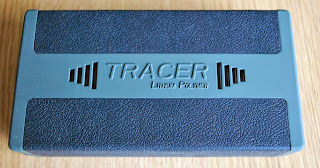
- Spare external battery and I have already the Tracer 4Ah rechargeable battery. I was looking at other batteries but I figured “use what you already have”.
- 3x5 cards with some of the common command functions of the KX3. Such things as setting up CW Keyer memories and playing them,memory setup and recall and dual watch if needed.
- Bring some info on the contests that may be going on that day as I can scoop some contacts that are in a contest. It’s handy to know the exchange they are looking for in the contest.
- Make a list ahead of time that what to bring………there has been to many times to count when I thought I could remember everything only to find out I missed something and I was not able to operate because of it.
Mike Weir, VE9KK, is a regular contributor to AmateurRadio.com and writes from New Brunswick, Canada. Contact him at [email protected].
Amateur Radio Weekly – Issue 106

Final Days of VK0EK (ATNO Days)
One of our objectives is to give an All-Time New One (ATNO) to as many DXers as possible.
VK0EK
April 18th: World Amateur Radio Day
World Amateur Radio Day is the day when IARU Member-Societies can show our capabilities to the public and enjoy global friendship with other Amateurs worldwide.
IARU
Radio amateurs in the quest for geostationary satellites
In the next few years radio amateurs will have access to two geostationary platforms.
EE Publishers
The Doctor is In: New podcast from ARRL
Hosted by QST Editor In Chief Steve Ford, WB8IMY, the ARRL The Doctor is In podcast is a twice-monthly audio podcast that answers your questions.
ARRL
D-STAR satellite to launch from Kourou
OUFTI-1 from the University of Liege, Belgium, will be the first satellite to carry a D-STAR Digital Voice transponder.
AMSAT UK
Fuses: Make sure you can trust them
The Dollar Store fuse turns out to be the worst: running several minutes at 20A, double the rated current.
Noisebridge
Field guide to communications towers
Technically speaking, they are called Base Transmitter Stations (BTS). You might see ‘cell site’ and ‘cell tower’ used interchangeably, but these terms are not synonymous.
Hack A Day
Meteor Scatter season gets underway
Meteor Scatter season has started with the April meteor showers and will continue until the beginning of January next year.
Southgate
Morse News: Get your news the old fashioned way
It’s an application that pulls RSS feeds and translates them to Morse.
Ham Radio QRP
Video
Demolition: Voice of America Radio Towers
The final 48 “quad” towers were felled in a single explosives sequence on Monday, April 4, setting a new World Record in this category.
DCI
Rainy SO-50
From the 2016-03-27 2111Z SO-50 pass over North America.
Space Comms
Amateur Radio Weekly is curated by Cale Mooth K4HCK. Sign up free to receive ham radio's most relevant news, projects, technology and events by e-mail each week at http://www.hamweekly.com.
Portable Ops 14, 15, 16, 17/45: Catching up!
Well, I have been having a bunch of fun on the radio doing portable operations, but I have fallen behind on my blog!
I am going to condense this down with just dates and number of stations worked:
4/4/16 – 4 stations worked (3 of them were SKCC members)
4/5/16 – 3 stations worked (all of them were SKCC members)
4/7/16 – SKCC Europe Sprint:
I was able to get out of the office for a bit and work this sprint. Any station is welcome to participate, but it is setup so the time works better for SKCC European members. The band was in OK shape, and I managed to work 6 stations in 90 minutes.
F6HKA – France, awesome signal here in Kansas, and a great Op!
K1PUG – Connecticut
WH6LE – North Carolina
KG6MC – South Carolina
KD6SX – Oregon
F6EJN – France
So I began the Sprint in France and ended in France! Fun times!
I plan on working SKCC Weekend Sprintathon this weekend. I don’t know how much time I will actually have but will give it a good go when I have time!
Burke Jones, NØHYD, is a regular contributor to AmateurRadio.com and writes from Kansas, USA. Contact him at [email protected].
Portable Ops 14, 15, 16, 17/45: Catching up!
Well, I have been having a bunch of fun on the radio doing portable operations, but I have fallen behind on my blog!
I am going to condense this down with just dates and number of stations worked:
4/4/16 – 4 stations worked (3 of them were SKCC members)
4/5/16 – 3 stations worked (all of them were SKCC members)
4/7/16 – SKCC Europe Sprint:
I was able to get out of the office for a bit and work this sprint. Any station is welcome to participate, but it is setup so the time works better for SKCC European members. The band was in OK shape, and I managed to work 6 stations in 90 minutes.
F6HKA – France, awesome signal here in Kansas, and a great Op!
K1PUG – Connecticut
WH6LE – North Carolina
KG6MC – South Carolina
KD6SX – Oregon
F6EJN – France
So I began the Sprint in France and ended in France! Fun times!
I plan on working SKCC Weekend Sprintathon this weekend. I don’t know how much time I will actually have but will give it a good go when I have time!
Burke Jones, NØHYD, is a regular contributor to AmateurRadio.com and writes from Kansas, USA. Contact him at [email protected].
Backup Your Shack PC
We recently passed World Backup Day on March 31st. These days there seems to be a day for everything, important or not. Backing up your computer data is more important than a lot of people think. I don’t know how many times someone has brought me their computer asking for help when they can’t access something on it. My first question is usually “Do you have a backup?” And the response is more often than not “No! That’s why I need help”. Occasionally I am able to save their data but if their disk drive is too far gone, then it’s lost.
Consider what’s on your computer. I have years and years of digital photos, purchased music files, and a lot of important documents. That doesn’t even begin to cover my ham radio related data. The important things as far as I am concerned that I would rather not lose are my logs, LOTW TQSL certificate files, data files for programming my radios and other data files like antenna plans and such.
Ask yourself this question . . . “Can I get all that stuff back if something terrible happens to my computer and the data is no longer accessible?”
You should be able to answer “Yes, I can!”
I am not going to go into all the possible ways to backup your data. There are USB drives, thumb drives, online services or you can build a home backup server. This article isn’t going to review all those possibilities and I am sure there is some method I left out of this short list.
Consider the 3-2-1 backup rule. The 3-2-1 strategy means having at least 3 copies of your data, 2 of which are on different mediums (i.e.: devices) and at least 1 copy off site. The key to this, is that all 3 copies need to be reasonably up to date. Having the offsite copy too old doesn’t do much good if that’s the one you need to use for a restore.
For my home computers, I use a network drive and an online service. So I have my original copy, my onsite network drive copy, and the offsite online service as my third copy. You don’t have to use an online service. I just like the automatic online, offsite backup.
Another important thing to consider, is the restore itself. Your backup is only as good as your ability to restore it. Occasionally restoring a specific file is a nice test. Backing things up in some super-duper format isn’t any good if it’s too difficult to restore. Also think about how you would restore the operating system and not just your data. You likely don’t need to backup the operating system as most people have restore disks that shipped with their computer or some other install method for the OS.
So, please think about what and how you backup your data. Can you restore it? Do you have an offsite copy? What if I lose my main hard rive and it’s contents?
While those are not nice thoughts, it’s better to be prepared than not . . . . And it seems like a lot of the Ham Radio hobby/service is about being prepared in one form or another.


Wayne Patton, K5UNX, is a regular contributor to AmateurRadio.com and writes from Arkansas, USA. Contact him at [email protected].
Top Hats
 When it comes to discussion of 630m, the topic of antennas seems to top the list. One of the easiest ways to enjoy what 630m has to offer is to try and utilize a low band antenna that may already be in place. An 'inverted-L' for 80 or 160 can be readily bottom-loaded and with a few radials, can provide a good starting point ... but with a little additional work, its efficiency can be easily improved by expanding the top horizontal (top hat) section.
Jim, W5EST, has posted an interesting description of the pros and cons of the 'top hat' in a recent KB5NJD daily 630m report. Those thinking about getting on the band or those considering ways of improving their present antenna might find the information helpful.
Top Hat Advantages:
Higher EIRP comes from a more nearly uniform current distribution all the way up a TX vertical. https://en.wikipedia.org/wiki/T-antenna . But remember that adding top hat doesn’t help you if your license is subject to a legal limit EIRP that’s reached by your station already.
A vertical without a top hat has no current at its tip, meaning the upper part of a hatless vertical is inefficiently used. Average RF current for a hatless short vertical is only half what an RF ammeter shows at the antenna base. Top hat lets a shorter vertical antenna yield same total radiated power TRP by increasing its degree-amperes, as discussed March 31, this blog.
2 amperes of 630m RF base current in a 10° tall hatless short vertical can give 10 degree-amps (2 x ½ x 10°) and yield 15 degree-amps with an ample top hat. A top hat can increase average RF current by about a quarter to half, which could as much as double the TRP.
Top hat increases antenna system capacitance. You get more flexible QSY by decreasing the system Q. SWR increases rapidly as your frequency departs from antenna system resonance, see graph Feb. 10, this blog. With lower system Q the SWR doesn’t increase so rapidly. Then you can QSY temporarily a little way without retuning or by just retuning a little in the shack instead of outdoors at the ATU.
Decreased Q somewhat lowers antenna voltage KV from antenna base to top hat. On 630m Q = (2π 475)L/R by definition and Vantenna = 1.4 Q P / I < Vbreakdown. See Jan. 16, this blog.
Top hat wires can be symmetrically or asymmetrically positioned to give approximately similar capacitance whichever way. I’ve not modeled the effect of a top hat on the azimuth and elevation antenna patterns of an electrically short vertical. I don’t think the effect is very significant. But if you know a link or some better information about this, let us know.
If your radials have extended way beyond the extent of a small top hat high above, then providing longer top hat conductors above the radials can more efficiently utilize the radials. If the radials mostly go in one or two directions, then for highest antenna system capacitance the hat wires should extend in those directions to couple best with the radials. Your experience may suggest this last is not too important, especially if you have a perimeter conductor and/or several ground rods and your soil has favorable conductance.
Another top hat advantage is that top hat conductors are compatible with structural support and stabilization for the very top of an MF/LF vertical antenna. You get added degree-amperes–and steadying at the top to boot.
If the top hat slants upward, its system capacitance contribution is somewhat decreased compared to a top hat of same length horizontally, but the vertical slant contributes radiated power. Depending on the arrangement of antenna and trees on some properties, using a shorter vertical with an upwardly slanting asymmetrical top hat may make the antenna system both easier to guy and less obvious to neighbors.
Putting in a top hat or improving a top hat increases the degree-amperes of a short vertical mainly by distributing the same RF amperes more uniformly. Adding more radials and longer radials decreases the antenna system resistance and increases the degree-amperes of a short vertical mainly by increasing the RF amperes of antenna current itself.
Top Hat Disadvantages:
A top hat obviously requires outdoor work to construct or revise it. You may be able to simply increase your transmitter power TPO more conveniently than to do the outdoor work.
A top hat needs to extend more or less horizontally from the top of the vertical, although the angle is not too critical within +/-45°. Distant supports for the top hat at that top level may be unavailable or expensive and inconvenient to provide. If the top hat were attached to the vertical below the top of the vertical, the otherwise radiation-beneficial top segment of the vertical becomes mostly unused.
If the top hat slants quite steeply downward, its effect on system capacitance may be a wash– more capacitance by closer approach to the ground and less capacitance because same length top hat conductor extends less outward over the ground below. That defeats a reason for putting up a top hat in the first place.
Moreover, if the top hat slants steeply downward, then vertically downward RF current in the top hat cancels part of the radiation from the vertical antenna and at least partially defeats the improvement in vertical antenna current uniformity that the top hat is intended to confer.
A long top hat may not fit on the available real estate. Even if it fits, it may add to visibility as far as difficult neighbors are concerned.
Adding a top hat means you need to retune the ATU after the addition. But so does improving the radials or just about anything else you do.
Top hat conductors add more weight on a vertical than lighter-weight guying does. The weight of the top hat likely adds to the support demanded of the antenna base. If you put downward-slanting top hat conductors under tension at their far ends to keep them from drooping in the middle, then a lot of that tension will be imposed on the vertical too. That can produce a buckling force on the vertical which may call for additional guying halfway up the vertical.
Top hat conductors convey a declining but substantial RF current along their length. That involves I2R losses in the skin effect resistance of the top hat conductors. However, if your earth resistance is high or your radial/grounding system is not very elaborate, some loss in the top hat probably does not decrease the RF amperes of antenna base current very much at a given TPO compared to the improvement in radiation TRP that the top hat gives you.
If skin effect resistance losses in the top hat are significant compared other losses in the system, reducing top hat losses generally means more conductors or heavier conductors in the top hat. That translates to more weight for the whole system to support.
A top hat translates KV of antenna top voltage to its ends. If the top hat extends all the way to leaf cover of trees or shrubs, unexpected sparks might jump to them in quiet weather, or in windy weather, or sometime when such trees or shrubs grow nearer to the top hat end(s).
Generally top hat advantages outweigh their disadvantages so long as you plan intelligently. Please tell us your experiences with top hat advantages and disadvantages!”
 |
| A G3XDV LF top hat |
Jim often adds an interesting op-ed piece to the KB5NJD daily report and sifting back through the past few weeks will provide some great 630m 'food for thought' bed time reading!
Steve McDonald, VE7SL, is a regular contributor to AmateurRadio.com and writes from British Columbia, Canada. Contact him at [email protected].
Get your news the old fashioned way
Morse News
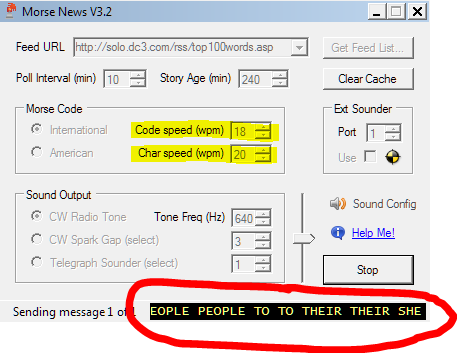 |
| Morse News interface displaying a "Top 100 words" feed scrolling at the bottom |
For instance: you can listen to Morse the way railroad and Civil War telegraphers heard it via the clacking Telegraph sounder, or the early 20th century spark gap transmitters.
As with all software downloads from an untrusted source use your own best judgement whether to install this software and protect yourself from malware. I haven't detected any malware from my install but that doesn't mean it's not there.
Here's the link: http://sourceforge.net/projects/morse-rss-news/files/Morse%20Code%20Tools%203.2/MorseTools32Setup.exe/download
Richard Carpenter, AA4OO, is a regular contributor to AmateurRadio.com and writes from North Carolina, USA. Contact him at [email protected].
 Ham Radio Deluxe |
 W5SWL Electronics |
 Ham Radio Prep |
 KB3IFH QSL Cards  Hip Ham Shirts  HamRadioAuctions HamRadioAuctions Reliance Antennas Reliance Antennas Enigma Shop Enigma Shop |  morseDX  Ni4L Antennas  R&L Electronics R&L Electronics antennas.us antennas.us QRV QRV |
- Matt W1MST, Managing Editor
