 |
 Music To My Ears
 26 April 2016 | by
  In my 'other' life, before retiring, I taught high school for 35 years. I soon became tired of doing my nightly lesson preps and marking of papers on the kitchen table so I built a large oak roll-top style desk, but without the 'roll' part.
It had lots of drawers, both big and small, slots and cubby-holes, and made the nightly homework very much more enjoyable.
The left end of the desk was occupied by my Sony ICF -2010 and above it, on the desk's top shelf, was a small amplified and tuneable ferrite loop antenna. The Sony was tuned to the 500kHz international MF 'distress' frequency, which was mainly used as a CW calling frequency for ships wishing to work the coastal traffic handling stations. Once contact was established, stations would move to the 'QSS' working frequency used by the coastal, so that the distress frequency was not tied-up.
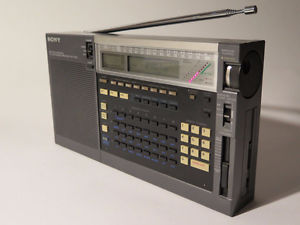
As I sat at the desk doing my nightly prep, the silence would be broken every few minutes with the sound of a CW caller, either a coastal or a ship. It was music to my ears.
On a normal night, the numerous coastals could be heard with their periodic traffic lists interspersed with ships up and down the coast calling with traffic or weather reports. However, on a really good winter night, the frequency was almost constantly abuzz with CW. Ships, as well as the coastals, could be heard from the Gulf of Alaska down to the Gulf of Mexico ... as far west as the Hawaiin Islands and on really rare nights, along the eastern U.S. seaboard. On those nights, 500kHz would sound like 20m CW, even on my little Sony and desktop loop.

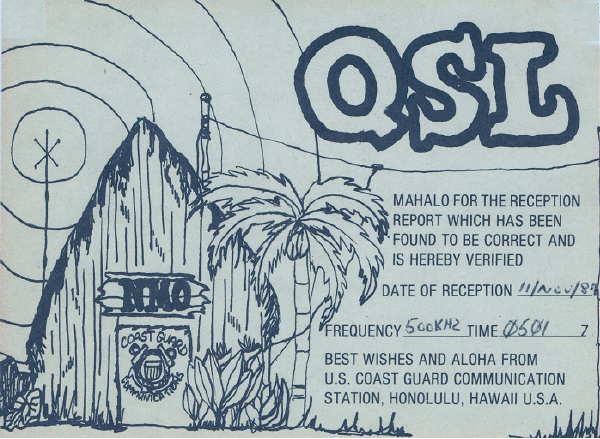

Thanks to the forethought of those that had the good sense to record some of those amazing sounds, you can step back in time and listen to what '500' sounded like back in its prime ... recorded somewhere in western Europe.
The most recent 630m crossband activity brought back these pleasant memories of what the band could sound like at times, with several very strong VE7's and a few weaker U.S. experimental stations to the south, all busily calling CQ at the same time on various frequencies. I consider it a huge privilege to be able to operate on this much revered part of the radio spectrum ... one steeped in such great CW tradition.
I think it won't be too long before 630m will sound much like its old glory days again ... and wouldn't that be a wonderful thing.
Steve McDonald, VE7SL, is a regular contributor to AmateurRadio.com and writes from British Columbia, Canada. Contact him at [email protected].
Where is that blasted noise coming from?
Evil RF noise in Ethernet over power adapters
My internet comes in at a corner of the house. In that room I have my cable modem and a WIFI router. Unfortunately the WIFI is seemingly non-existent at the other end of my house and especially in the upper floor opposite the WIFI router. I tried re-orienting it and different antennas to no avail.As a solution, I purchased an Ethernet over powerline adapter. This routed the Ethernet through the house wiring to receivers plugged into outlets at points where the WIFI was weak, thus providing Internet access to those rooms. The model I purchased also had ethernet ports which I needed for some of my older devices.
Ethernet over powerline seemed like an ideal solution.
 |
| Typical Ethernet over powerline adapter |
The Search
I restored the power and fired up my Yaesu HT which has general coverage receive and tuned it to 7030kHz. I walked around the house and conducted a bit of a fox-hunt for the offending noise. The noise occurred at every outlet in the house !!!I tracked it down to one of the Ethernet powerline receivers. I unplugged it from the wall and discovered blissful silence. I figured it had just gone bad. It was out of warranty so back to the store I went and purchased another set. This time it was a different brand, as the first one was no longer carried.
I installed the new adapters and everything was fine... for a time.
Fool me once shame on you, fool me twice shame on me
This week the noise returned with a vengeance. Being wiser I went straight to the new adapter and unplugged it. Yep it had gone bad again. It was in warranty but I'd learned my lesson. Whatever sort of RF filtering these devices have doesn't last. Something zaps them. I can't plug the receiver into a AC line filter because it stops it from receiving the Ethernet over powerline.So out they came and back to the electronics store I went. This time I purchased a WIFI extender with Ethernet ports built-in. I'm back to blissful RF quiet (to a degree) at my QTH.
The moral of the story
If you have RF noise at your shack and you use these devices, check them out. They could be the S9 noise culprit. If you haven't bought them, take my advice and don't chance it.I didn't think a WIFI extender would work for me because my laptop can't even detect the WIFI in some of my rooms but the WIFI extender (at least the Netgear model) seems to work well. I now have blessed Internet in every room and no more broadband RF noise.
That's all for now
So lower you power and raise your expectations (and rid yourself of pesky RF noise)
72/73
Richard, AA4OO
http://hamradioqrp.com
Richard Carpenter, AA4OO, is a regular contributor to AmateurRadio.com and writes from North Carolina, USA. Contact him at [email protected].
The numbers are down.
 |
| Not really this bad |
Mike Weir, VE9KK, is a regular contributor to AmateurRadio.com and writes from New Brunswick, Canada. Contact him at [email protected].
Weekly Propagation Summary – 2016 Apr 25 16:10 UTC
Here is this week’s space weather and geophysical report, issued 2016 Apr 25 0446 UTC.
Highlights of Solar and Geomagnetic Activity 18 – 24 April 2016
Solar activity was high on 18 Apr due to an M6/1f flare observed at 18/0029 UTC from old Region 2529 (N09, L=342, class/area Eki/850 on 11 Apr). Type II (1869 km/s) and Type IV radio sweeps were observed in conjunction with this event, as well as a 120 sfu Tenflare. Activity dropped to low levels on 19 Apr with a C1/Sf observed at 19/2302 UTC. Very low levels were observed for the remainder of the period after the region departed the disk.
No proton events were observed at geosynchronous orbit.
The greater than 2 MeV electron flux at geosynchronous orbit was at normal to moderate levels throughout the period.
Geomagnetic field activity was mostly quiet on 18-21 Apr. Quiet to unsettled conditions were observed on 22-24 Apr. Isolated active periods were observed on 22 and 24 Apr along with an isolated minor storm period on 23 Apr due to CH HSS effects.
Forecast of Solar and Geomagnetic Activity 25 April – 21 May 2016
Solar activity is expected to be very low to low for the majority of the period with a chance for M-class flares from 03-16 May due to the return of old Region 2529.
No proton events are expected at geosynchronous orbit.
The greater than 2 MeV electron flux at geosynchronous orbit is expected to be at normal to moderate levels with the exception of 01-03 May and 10-13 May following recurrent CH HSS events.
Geomagnetic field activity is expected to be quiet to unsettled on 25-26 Apr as CH HSS effects subside followed by quiet conditions on 27-28 Apr. Quiet to unsettled conditions are expected on 29 Apr to 01 May with active periods likely due to effects from a recurrent, negative polarity CH HSS. An isolated minor storm period is possible on 30 Apr. Mostly quiet conditions are expected on 02-08 May with unsettled to active periods possible on 04 May due to a SSBC. Quiet to active levels are expected on 09-11 May with minor storm periods likely due to negative polarity CH HSS effects. Mostly quiet conditions are expected from 12-18 May. Isolated unsettled to active periods are possible on 14 May due to another SSBC. Quiet to unsettled conditions are expected from 19-21 May with isolated active periods possible due to effects from a recurrent, positive polarity CH HSS.
Don’t forget to visit our live space weather and radio propagation web site, at: http://SunSpotWatch.com/
Live Aurora mapping is at http://aurora.sunspotwatch.com/
If you are on Twitter, please follow these two users: + https://Twitter.com/NW7US + https://Twitter.com/hfradiospacewx
Get the space weather and radio propagation self-study course, today. Visit http://nw7us.us/swc for the latest sale and for more information!
Check out the stunning view of our Sun in action, as seen during the last five years with the Solar Dynamics Observatory (SDO): https://www.youtube.com/watch?v=zXN-MdoGM9g
We’re on Facebook: http://NW7US.us/swhfr
Visit, subscribe: NW7US Radio Communications and Propagation YouTube Channel
LHS Episode #167: Manky Git
 Greetings and salutations. We have another fantastic episode of Linux in the Ham Shack for you this fortnight. In it, the hosts discuss World Amateur Radio Day, UFOs, the Mumblehard botnet, programming, Git, pulseaudio, QSSTV and so...much...MORE. Thanks for tuning in; and please don't forget our Generosity Campaign. Donate if you can. We'd love to see everyone in Dayton this year.
73 de The LHS Crew
P.S. Sorry, we had some audio jitter in the recording this time around. Hopefully the episode is still listenable. We'll get it straightened out for the next one.
Russ Woodman, K5TUX, co-hosts the Linux in the Ham Shack podcast which is available for download in both MP3 and OGG audio format. Contact him at [email protected].
Broke the 100 confirmations mark today!
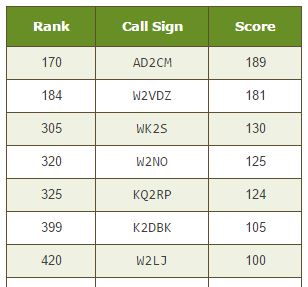
I actually have about 1/2 a dozen more that haven't been confirmed yet. According to LotW, those stations have not uploaded logs since their activations. A few were a while ago, so I guess it's possible that maybe they won't.
While working a few today, it was extremely embarrassing and saddening to see so may out there have no clue on how to handle themselves in a pileup. Guys ..... YOU HAVE TO LISTEN!
Throwing out your call sign ad nauseum without taking a moment to listen is the number one earmark of lid-dome. Seriously, if you send out your call ten times without taking a breath, how are you going to know if the activator is calling you back? By the time you've stopped sending your call, the activator has worked someone else and is calling QRZ again (and everyone else in the pileup has taken note of your call sign - you can count on it!). DON'T BE AN ALLIGATOR! You know, all mouth and no ears! Throw out your call once - maybe twice max, and then open up those ear holes and listen!
Which leads to a second and related problem. If you can't hear the station you are trying to work, you have NO business sending out your call, in the first place. If you can't hear the station well enough to know that he's answering someone else - or worse, is in QSO with someone else; but you keep sending your call anyway ..... bad scene, man, bad scene. You've marked yourself as a QRM generator and no one likes those. Don't rely on the Cluster. Just because DX Summit says Joe Ham is on 7.034 MHz at NPOTA NP256 ..... if you can't hear him, then don't even try. It's a waste of your time and everyone else in the pileup is going to think you're an idiot.
Now everyone makes an honest mistake now and then, and that's OK, But you can tell when someone has no clue as to what they're doing. And frighteningly, it seems to be becoming more and more common.
It's OK to be excited and enthusiastic. It's not OK to be reckless or use poor operating practises. Use common sense, read the DX Code of Conduct and you'll be OK.
72 de Larry W2LJ
QRP - When you call to send the very least!
Larry Makoski, W2LJ, is a regular contributor to AmateurRadio.com and writes from New Jersey, USA. Contact him at [email protected].
Broke the 100 confirmations mark today!
I actually have about 1/2 a dozen more that haven't been confirmed yet. According to LotW, those stations have not uploaded logs since their activations. A few were a while ago, so I guess it's possible that maybe they won't.
While working a few today, it was extremely embarrassing and saddening to see so may out there have no clue on how to handle themselves in a pileup. Guys ..... YOU HAVE TO LISTEN!
Throwing out your call sign ad nauseum without taking a moment to listen is the number one earmark of lid-dome. Seriously, if you send out your call ten times without taking a breath, how are you going to know if the activator is calling you back? By the time you've stopped sending your call, the activator has worked someone else and is calling QRZ again (and everyone else in the pileup has taken note of your call sign - you can count on it!). DON'T BE AN ALLIGATOR! You know, all mouth and no ears! Throw out your call once - maybe twice max, and then open up those ear holes and listen!
Which leads to a second and related problem. If you can't hear the station you are trying to work, you have NO business sending out your call, in the first place. If you can't hear the station well enough to know that he's answering someone else - or worse, is in QSO with someone else; but you keep sending your call anyway ..... bad scene, man, bad scene. You've marked yourself as a QRM generator and no one likes those. Don't rely on the Cluster. Just because DX Summit says Joe Ham is on 7.034 MHz at NPOTA NP256 ..... if you can't hear him, then don't even try. It's a waste of your time and everyone else in the pileup is going to think you're an idiot.
Now everyone makes an honest mistake now and then, and that's OK, But you can tell when someone has no clue as to what they're doing. And frighteningly, it seems to be becoming more and more common.
It's OK to be excited and enthusiastic. It's not OK to be reckless or use poor operating practises. Use common sense, read the DX Code of Conduct and you'll be OK.
72 de Larry W2LJ
QRP - When you call to send the very least!
Larry Makoski, W2LJ, is a regular contributor to AmateurRadio.com and writes from New Jersey, USA. Contact him at [email protected].
 Ham Radio Deluxe |
 W5SWL Electronics |
 Ham Radio Prep |
 KB3IFH QSL Cards  Hip Ham Shirts  HamRadioAuctions HamRadioAuctions Reliance Antennas Reliance Antennas Enigma Shop Enigma Shop |  morseDX  Ni4L Antennas  R&L Electronics R&L Electronics antennas.us antennas.us QRV QRV |
- Matt W1MST, Managing Editor
