 |
 Listen to the music
 15 May 2016 | by
 Comparing CW audio
The Elecraft KX3 and the Ten-Tec Eagle
The radios
Setup
Subjective listening
Richard Carpenter, AA4OO, is a regular contributor to AmateurRadio.com and writes from North Carolina, USA. Contact him at [email protected].
ICQ Podcast Episode 211 – Emergency Comms
In this episode, Martin M1MRB / W9ICQ is joined by ED Durrant DD5LP, Dan Romanchik KB6NU, Chris Howard M0TCH and Martin Rothwell M0SGL to discuss the latest Amateur / Ham Radio news. Colin M6BOY rounds up the news in brief, and this episodes feature is - Emergency Comms
- Young US Ham wins at Science and Engineering Fair
- ARRL Committee Conducting Youth in Amateur RadioSport Survey
- UK Advanced Radio Exam 'on demand'
- Netherlands to Licence Low-Power AM Broadcasters
- RSGB Examination Standards 1st Report
- Hara Arena in Consideration for New Fairgrounds
- UK Air Cadets 5MHz Radio Exercise
- Online Australian Ham Licence Lookup Service
- Robotic Lawn Mower EMC Banned in Sweden
Colin Butler, M6BOY, is the host of the ICQ Podcast, a weekly radio show about Amateur Radio. Contact him at [email protected].
ICQ Podcast Episode 211 – Emergency Comms
In this episode, Martin M1MRB / W9ICQ is joined by ED Durrant DD5LP, Dan Romanchik KB6NU, Chris Howard M0TCH and Martin Rothwell M0SGL to discuss the latest Amateur / Ham Radio news. Colin M6BOY rounds up the news in brief, and this episodes feature is - Emergency Comms
- Young US Ham wins at Science and Engineering Fair
- ARRL Committee Conducting Youth in Amateur RadioSport Survey
- UK Advanced Radio Exam 'on demand'
- Netherlands to Licence Low-Power AM Broadcasters
- RSGB Examination Standards 1st Report
- Hara Arena in Consideration for New Fairgrounds
- UK Air Cadets 5MHz Radio Exercise
- Online Australian Ham Licence Lookup Service
- Robotic Lawn Mower EMC Banned in Sweden
Colin Butler, M6BOY, is the host of the ICQ Podcast, a weekly radio show about Amateur Radio. Contact him at [email protected].
AmateurLogic 90: Everybody’s Talking About Antennas
AmateurLogic.TV Episode 90 is now available for download.
Tommy’s Antenna Hanging. Emile’s Wet Noodle. Peter has a free antenna reference. George builds the Hula Loop.
Plus viewer email and more.
1:02:10
George Thomas, W5JDX, is co-host of AmateurLogic.TV, an original amateur radio video program hosted by George Thomas (W5JDX), Tommy Martin (N5ZNO), Peter Berrett (VK3PB), and Emile Diodene (KE5QKR). Contact him at [email protected].
A New Paddle for a New Extra
 Since my last article was published, I made my fourth attempt to pass the extra exam. I knew I had done better, but was pleasantly surprised when the VEs congratulated me. I’m still trying to believe that since it was only one week ago. Never mind that anyway, it doesn’t really have anything to do with the new CW paddle I made.
Way back when, after I had been on the air for a few months, I decided I’d give CW a shot. I knew I’d need a key or paddle, but didn’t really know where to start. A simple Internet search for CW paddle brought up a very large number of beautiful paddles that nearly made me drool. What prevented the drooling was the price attached to nearly all of those lovely paddles. I wasn’t about to spend that kind of money on something that I didn’t even know I could operate.
My next Internet search included the word “homebrew” to see if it were even possible to make a CW paddle that would work. Much to my amazement, there are hundreds of different designs for homebrew CW paddles. Altoid tins, hacksaw blades, plastic, wood, all wire, metal, you name it, someone had created one. Seeing all of those wonderful homemade paddles, I knew it was possible, but was it possible for me?
Greg Walters, KK4TIX, is a special contributor to AmateurRadio.com and writes from Kentucky, USA.
Amateur Radio Weekly – Issue 111

Hara Arena Update
About the time we all were leaving Hara Arena last year, organizers were putting up posters detailing the upgrades that would soon be made to the aging facility.
KE9V
Icom: 3 booths at Dayton. Dedicated D-STAR and Land Mobile booths
We’ll have three IC-7300s in the main booth including demonstrations of it in operation with our RS-BA1 Remote Control Software.
Icom
Dayton forums to be streamed live
Official live coverage of Hamvention, produced by DARALive.
Hamvention
AMSAT: Top 10 reasons to come to Dayton
Rub shoulders with 25,000 of your best friends at the largest hamfest in the United States.
Southgate
Dual-band mobile supports DMR, D-STAR and C4FM
“NEW RADIO” will operate on the 2m & 70cm bands and support the most common ham digital modes, including DMR, D-STAR and C4FM (System Fusion), plus analog FM.
VA3XPR
Ham sues repeater owners
The issue before us is whether repeater owners have the right to determine who can and cannot use their network.
PRN
Open VHF digital voice radio prototype ready for manufacture
The SM2000 will be a small box that contains a fully functional VHF SDR Digital Voice radio.
Rowetel
DMR is getting big around here
As a member of Auxcomm, I noticed DMR radios were in heavy use at the state EOC. Also, every time I get around a group of hams, the subject of DMR comes up.
KK4DSD
No Nonsense Extra Class Study Guide ready for new question pool
The new Extra Class question pool goes into effect on July 1, 2016. KB6NU’s updated study guide is now available.
KB6NU
Solar Efficiency: It’s Not What You Think
We’ll go through a hypothetical power system step by step and examine solar efficiency, then fit the pieces together to make the picture complete.
Off Grid Ham
Video
Icom IC-7300 MNF ANF IF Filter works on interference
The Icom IC-7300 knocks out annoying interference.
K0PIR
Amateur Radio Weekly is curated by Cale Mooth K4HCK. Sign up free to receive ham radio's most relevant news, projects, technology and events by e-mail each week at http://www.hamweekly.com.
The ZL1SIX Ocean Floater

For those of you that are fans of the low-powered "party balloon" floaters, such as the recent S-9 flight by VE3KCL, now comes a different kind of floater and one that really does float ... on the Pacific Ocean!
The "Ocean Floater" is the work of Bob, ZL1RS, who has been very active in tracking the other floaters from his excellent receiving site down-under. Like the balloons, Bob's beacon also utilizes the QRP Labs U3S hardware to transmit data in both WSPR and JT9 modes. The little beacon runs ~100mw on the 30m WSPR band and tracking this one will likely be a bit more challenging than following the high-flying balloons.
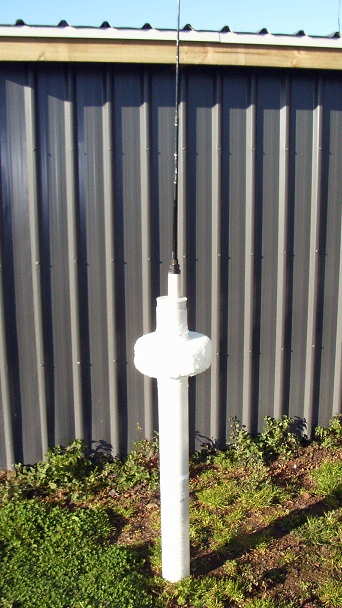 |
| Bob's 'Ocean Floater courtesy: http://www.qsl.net/zl1rs/oceanfloater.html |
Here is Bob's description as he posted to Yahoo Groups QRP Labs:
A small project inspired by Hans' Voyager ideas at
http://www.hanssummers.com/voyager.html ... the Floater is a 100mW
transmitter on the 30m band with a short base-loaded whip antenna
mounted on a buoy that will drift in the Pacific Ocean. It is sending a
standard WSPR transmission once and hour, followed by two JT9
transmissions giving its position, the temperature, and the battery voltage.
The project was deliberately kept very simple. A QRP-Labs U3S
transmitter and firmware made the electronics side easy. The U3S was
rebuilt on a board with a more open layout to allow experimentation and
the addition of a PICAXE controller to switch things on/off as required
to reduce overall battery consumption. Most of the "hard work" was in
the buoy body and antenna. More information about how this went
together can be found at http://www.qsl.net/zl1rs/oceanfloater.html
Today the Floater left on the yacht Windflower to be released into the
south-west Pacific Ocean in a few days time. This will ensure the
Floater is well clear of the coastal currents around ZL that would
otherwise have 'beached' it along the coast if it been launched from the
shore. Unlike balloon flights, things will happen very very slowly, so
updates to the webpage and tracking map will probably only be made on a
daily basis. WSPRnet spots will show the 4 character Maidenhead
locator position, and the JT9 decodes have a 6 character Maidenhead
resolution. Any JT9 decodes you receive will be appreciated via e-mail
to [email protected]
73, Bob ZL1RS
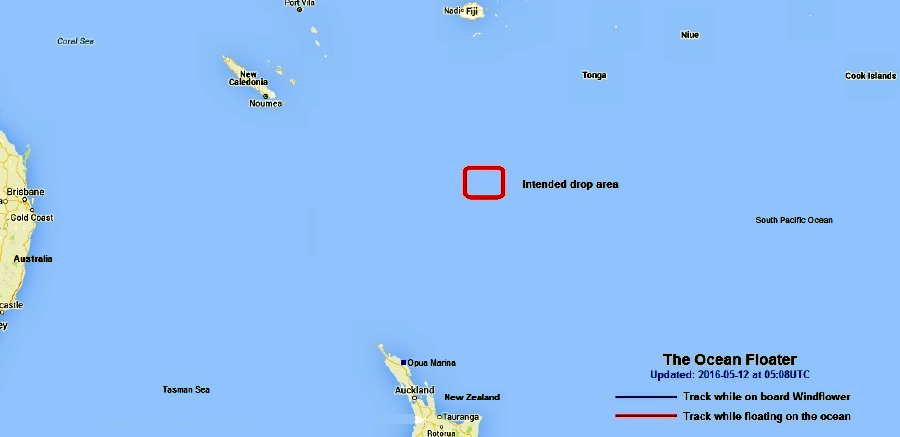
The beacon will use the call "ZL1SIX" and will be launched shortly, near Minerva Reef. Watch Bob's website for tracking and updates and ... good luck Bob!
Steve McDonald, VE7SL, is a regular contributor to AmateurRadio.com and writes from British Columbia, Canada. Contact him at [email protected].
 Ham Radio Deluxe |
 W5SWL Electronics |
 Ham Radio Prep |
 KB3IFH QSL Cards  Hip Ham Shirts  HamRadioAuctions HamRadioAuctions Reliance Antennas Reliance Antennas Enigma Shop Enigma Shop |  morseDX  Ni4L Antennas  R&L Electronics R&L Electronics antennas.us antennas.us QRV QRV |
- Matt W1MST, Managing Editor
