 |
 VE3AB Netty Electronics
 31 May 2016 | by
  While ordering components for my 630m transverter project, an internet search for some needed FT-37-77 cores brought me to the website run by Earl, VE3AB in NE Ontario.
Purchasing just a small number of parts can usually be expensive, considering the high cost of mailing these days but in this case, the toroids and a few other parts turned into a real bargain. Earl is a retired Defence Department Manager and Technical Specialist and has one of the most colorful and informative sites that I've ever run across. The extensive, somewhat 'eclectic' site, might at first appear to be a bit disorganized but it really all works nicely once you delve a little deeper ... and there are many layers on Earl's site. It really is quite different and one thing that comes through is his passion for doing things the right way!
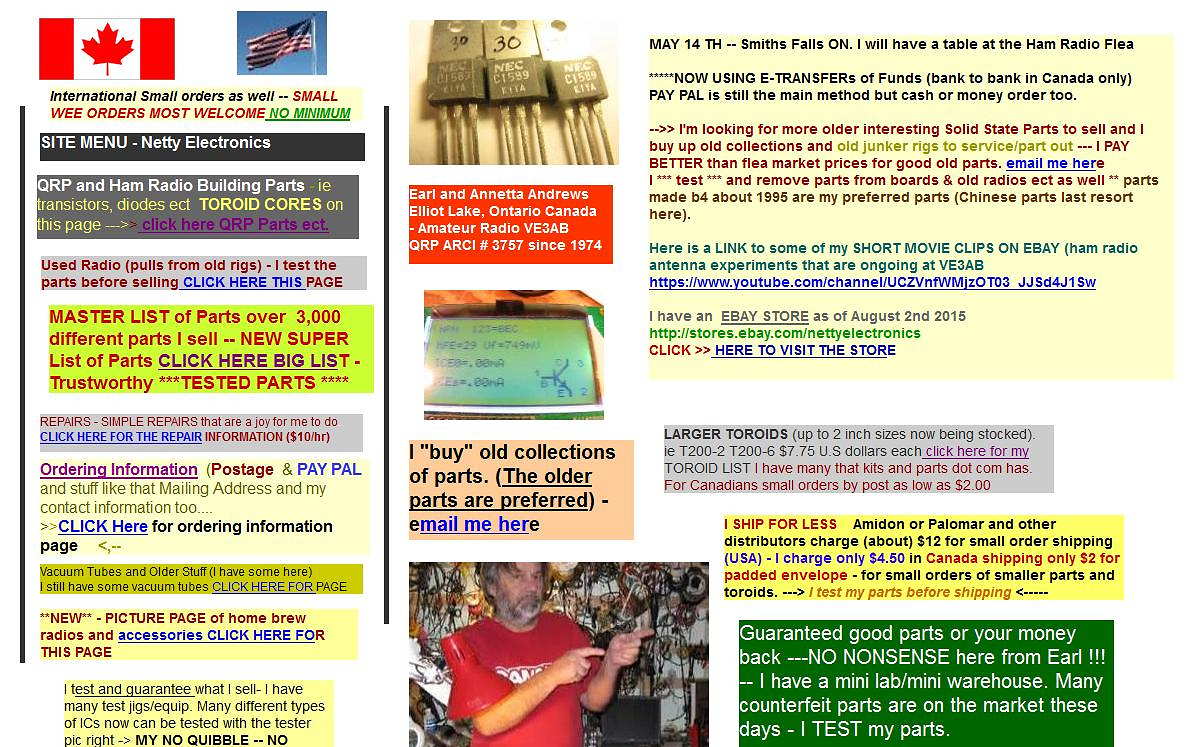
It seems that Earl's two main passions are fishing and supplying quality components at good prices. His dirt-cheap shipping to both Canada and the U.S. is something not often seen any longer, as shipping costs often make small purchases totally uneconomical. Forgive me if this sounds like a blatant plug for Earl's business ... it is not. It's just that I found his site extremely interesting and very different from most ... the fact that he is offering something that many hams might find helpful, is my main motivation.
The introductory 'ham radio' page contains, among other things, a collection of Earl's articles describing repairs on many solid state transceivers while his 'Netty Electronics' page describes his small home-based component selling and acquisition activities. His 'ham electronics magazine' page contains articles on working with circuit boards (re-capping, repairing, de-soldering), antenna articles as well as numerous articles on components, all authored by VE3AB. Earl's website and free services are all financed by personally using monies obtained through sales of parts and part radios as he sees it is a service to the amateur radio hobby, which he obviously loves deeply.
Earl specializes in solid state devices of all description, from vintage to modern. He offers a vast selection of parts for older radios and has information on repairing dozens of older solid state rigs. All parts are tested or guaranteed to be working within specs.

His pages contain extensive information describing his tests of popular Chinese-made transistors, such as this one describing a batch of dual-gate MOSFET BF981 transistors. His 'test' pages are definitely worthy of your attention and, for many, might be a bit of an eye-opener.

If you are looking for a manual for an older rig, Earl has an extensive offering of free manuals on his site. If it's not there, he can probably get it for you.
He is continually buying up collections of older components, as well as new parts ... if you have stuff to unload you might wish to check with him as so many of these valuable parts end up in the trash as shacks go silent. His extensive list of components can be found here. ... you may just find that special part you've been looking for.
One of Earl's goals for the website is to put up a search-engine for his parts but in the meantime, I found my browser's "Find" function worked well in sorting through the large list.
There is enough interesting information on his pages to keep you reading for hours and I find the random nature of much of it rather attractive. Earl says that changes to the site are coming but I hope they're not too drastic ... I kind of like it just the way it is!
Steve McDonald, VE7SL, is a regular contributor to AmateurRadio.com and writes from British Columbia, Canada. Contact him at [email protected].
Buddipole vertical for 80m
I spent the pleasant sunny part of the final day of autumn testing a vertical antenna for 80 metres using Buddipole parts for home.
The back garden space here is barely 4 metres by 4 metres and for the moment the chimney is out of reach. While I have dreams of a magnetic loop for 80m, the vertical is more in reach now.

I installed a counterpoise wire a few feet shy of 66 feet length hidden on a timber fence that runs down the side of the property. The idea is to connect a short fly lead to connect the hidden counterpoise when the antenna is deployed and then disconnect when it’s all packed away. Buddipole components don’t lend themselves to permanent installations. The counterpoise doesn’t follow the recommended dog leg arrangement and is higher off the ground than the 2 feet suggested.
The purpose yesterday was to establish how speedily the antenna could be assembled and adjusted for a frequency of interest such as a net.
Here’s a list of the items used along with the counterpoise:
9′ telescopic whip
2 x 22 inch antenna arms
low band coil + clip
VersaTee
Buddipole short mast
Buddipole tripod
Balun
I was surprised how easily it all went together. The adjustment wasn’t as fiddly as I expected such a short antenna for this band would be, and it appeared to give a usable bandwidth.

Assembly was straightforward. Set up the tripod and mast with only bottom two sections telescoped out. Attach the Versatee horizontally to the top of the mast. Connect the Low Band coil. Leave the red fly lead loose for the moment. Attach two 22 inch antenna arms to a long whip antenna fully extended. Then carefully attach that assembly to the top of the Versatee. I also connected a 1:1 balun between the Versatee and the iP30 SWR Analyser.
The next step is to simply drag the fly lead across the coil turns to identify the best spot to tap the coil. Background noise level rises as you get in the zone. I used the iP30 SWR analyser to narrow it down to a spot 16 turns up from the base of the coil.
This means I was shorting out the bottom 16 turns of the coil. The adjustment is too coarse on a turn by turn basis. You appreciate the value of being able to tap at 1/8 of a turn increments. (The coil is on an octagonal former.)
It took me a few measurements to realise that as I progressed left (from my point of view) I was decreasing the amount shorted out and hence increasing the loading inductance and so lowering the resonant frequency. It’s actually more confusing reading that sentence than understanding it in practice!
My target frequency was 3535kHz and this is a chart of the SWR readings I had when the coil tap was set at what I calculate to be 15 3/4 turns up from the base of the coil.
| frequency | SWR | frequency | SWR |
|---|---|---|---|
| 3505 | 1.8:1 | 3550 | 1.1 |
| 3510 | 1.6 | 3555 | 1.1 |
| 3515 | 1.4 | 3560 | 1.1 |
| 3520 | 1.3 | 3565 | 1.2 |
| 3525 | 1.2 | 3570 | 1.3 |
| 3530 | 1.1 | 3575 | 1.4 |
| 3535 | 1.0 | 3580 | 1.5 |
| 3540 | 1.0 | 3585 | 1.6 |
| 3545 | 1.1 | 3590 | 1.8 |

The 1.0:1 bandwidth was 10 kHz while at 1.5:1 it was in excess of 65 kHz.
From readings at the other possible coil tap points my guess is that at this frequency range each face of the coil moves the resonant frequency by about 4 kHz. One thing to be aware of with the Buddipole hardware is not to accidentally short out adjacent turns of the coil with the coil clip. It’s hard to do but I managed and it will throw your readings.
Next step of course is to make some contacts or at least activate the antenna on WSPR or JT65 to get an idea of whether the signal gets over the fence.
From checking the chart on page 146 of the ‘Buddipole in the Field’ book by B. Scott Andersen, NE1RD, I estimate that my shorting tap at about 16 turns from the base means I’m using about 39-40 uH of loading to achieve resonance at 80m. So that’s a starting point if I wanted to build a more permanent and cheaper vertical installation.
Weekly Propagation Summary – 2016 May 30 16:10 UTC
Here is this week’s space weather and geophysical report, issued 2016 May 30 0216 UTC.
Highlights of Solar and Geomagnetic Activity 23 – 29 May 2016
Solar activity was very low on 23, 25, and 27-29 May with only background flare activity observed. Low levels of solar activity were observed on 24 May due to an isolated C1 flare from Region 2546 (S07, L=223, class/area=Cho/550 on 21 May) and on 26 May due to isolated C1 flares from Regions 2546 and 2548 (N13, L=171, class/area=Dsi/130 on 27 May). No Earth-directed coronal mass ejections were observed during the period.
No proton events were observed at geosynchronous orbit.
The greater than 2 MeV electron flux at geosynchronous orbit was at normal to moderate levels throughout the week.
Geomagnetic field activity was at quiet levels on 23 and 25-26 May and quiet to unsettled levels throughout the remainder of the period with an isolated period of active conditions observed on 28 May due to coronal hole high speed stream influence.
Forecast of Solar and Geomagnetic Activity 30 May – 25 June 2016
Solar activity is expected to be at very low levels with C-class flares possible throughout the outlook period.
No proton events are expected at geosynchronous orbit.
The greater than 2 MeV electron flux at geosynchronous orbit is expected to reach high levels on 05-07 and 12-16 Jun with normal to moderate levels expected throughout the remainder of the outlook period.
Geomagnetic field activity is likely to reach G1 (Minor) geomagnetic storm levels on 30 May and 05 Jun and active conditions are expected on 31 May and 06, 11-13, 17 and 24 Jun, all due to the influence of multiple recurrent coronal hole high speed streams. Quiet and quiet to unsettled conditions are expected throughout the remainder of the outlook period under a nominal solar wind regime.
Don’t forget to visit our live space weather and radio propagation web site, at: http://SunSpotWatch.com/
Live Aurora mapping is at http://aurora.sunspotwatch.com/
If you are on Twitter, please follow these two users: + https://Twitter.com/NW7US + https://Twitter.com/hfradiospacewx
Get the space weather and radio propagation self-study course, today. Visit http://nw7us.us/swc for the latest sale and for more information!
Check out the stunning view of our Sun in action, as seen during the last five years with the Solar Dynamics Observatory (SDO): https://www.youtube.com/watch?v=zXN-MdoGM9g
We’re on Facebook: http://NW7US.us/swhfr
Visit, subscribe: NW7US Radio Communications and Propagation YouTube Channel
ICQ Podcast Episode 212 – User review Icom IC-7300
In this episode, Martin M1MRB / W9ICQ is joined by Leslie Butterfield G0CIB, Edmund Spicer M0MNG and Andy Mace M0MUX to discuss the latest Amateur / Ham Radio news. Colin M6BOY rounds up the news in brief, and this episodes feature is User review of the Icom IC-7300 by Ed Durrant DD5LP
- Elementary School's SSTV CubeSat ISS Deployment
- IARU - Custodian of Operating Standards
- Radio Hams Prepare Florida Hurricane Season
- Using Amateur Radio to Enhance Engineering Education
- Two New Radio’s Seen at Dayton
- New South Hampshire D-STAR Repeater
- Ham Radio at Scout 'Camporee'
- UK Schools Mass launch of 434 MHz Balloons
Colin Butler, M6BOY, is the host of the ICQ Podcast, a weekly radio show about Amateur Radio. Contact him at [email protected].
ICQ Podcast Episode 212 – User review Icom IC-7300
In this episode, Martin M1MRB / W9ICQ is joined by Leslie Butterfield G0CIB, Edmund Spicer M0MNG and Andy Mace M0MUX to discuss the latest Amateur / Ham Radio news. Colin M6BOY rounds up the news in brief, and this episodes feature is User review of the Icom IC-7300 by Ed Durrant DD5LP
- Elementary School's SSTV CubeSat ISS Deployment
- IARU - Custodian of Operating Standards
- Radio Hams Prepare Florida Hurricane Season
- Using Amateur Radio to Enhance Engineering Education
- Two New Radio’s Seen at Dayton
- New South Hampshire D-STAR Repeater
- Ham Radio at Scout 'Camporee'
- UK Schools Mass launch of 434 MHz Balloons
Colin Butler, M6BOY, is the host of the ICQ Podcast, a weekly radio show about Amateur Radio. Contact him at [email protected].
Ham College 17
Part two of our look at the Digital Modes. VOIP. Ohm’s Law questions.
1:01:54
George Thomas, W5JDX, is co-host of AmateurLogic.TV, an original amateur radio video program hosted by George Thomas (W5JDX), Tommy Martin (N5ZNO), Peter Berrett (VK3PB), and Emile Diodene (KE5QKR). Contact him at [email protected].
630m CW Activity
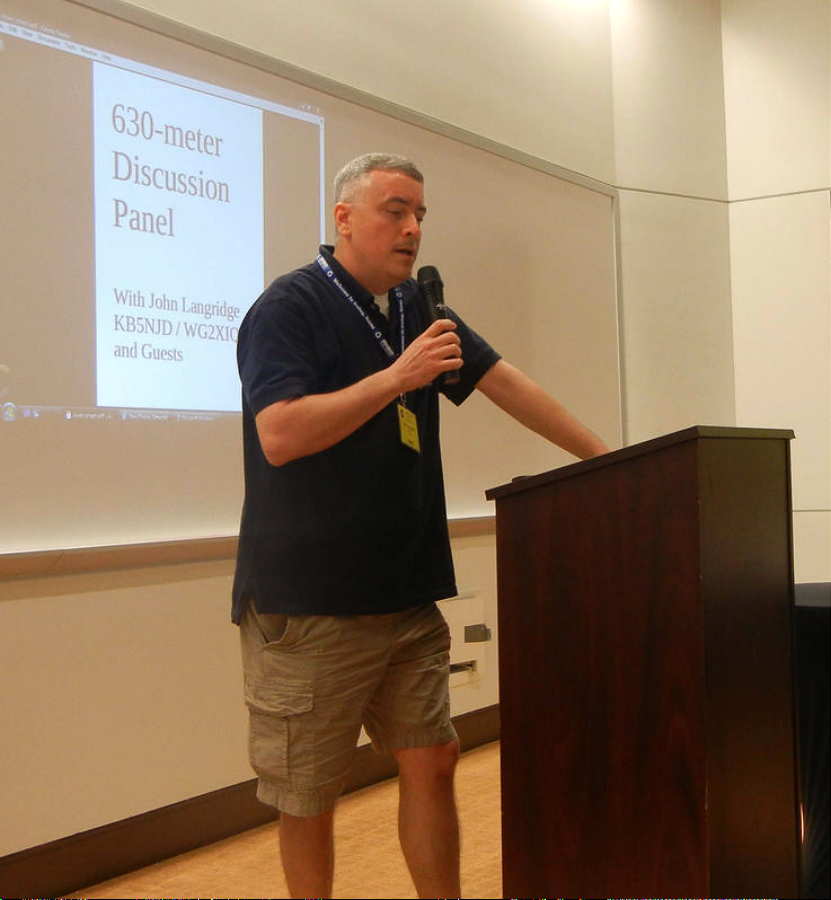 |
| John - KB5NJD talks about his favorite topic, 630m |
New experimental licensee, Jim, WI2XJG in Saint George, Utah, recently posted a question on the Lowfer reflector regarding the status of his favorite mode (CW) on the 630m band. The detailed response, provided by John KB5NJD / WG2XIQ, may well be of interest to others as well:
Hi Jim,
Most regular CW QSO's are occurring from about 472.5 to 475 kHz. Note that in Europe 472.5 kHz is a popular frequency. My freq of choice when open is 474.5 because it puts my signals close enough to the WSPR passband that operators there may be alerted to my activity. It seems its become commonplace to use "CW-USB" receive pass bands unlike other low bands that default to "CW-LSB" (At the end of the day it doesn't matter as long as you know since carrier frequencies are what are typically announced).
As mentioned in previous communications much of the CW activity is by sked arranged either via the reflectors like this or the ON4KST chat or even
direct email. While random CW QSO's are not out of the question they are
rare during the summer as activity is decreased in spite of continued
propagation. YMMV. In the past I have mentioned how it might be
beneficial for you to listen to and decode some WSPR to determine the
current state of the band. Regular CW typically requires about -10 dB S/N
in a 500 Hz BW to make a QSO. If you are not receiving stations at -10 dB
or better, you may not hear any CW from that station.
If you live near an area of high activity, of course, this can be a
different result. As I mentioned before I maintain a daily CW sked at
1030z on 474.5 kHz as wx allows but your ability to hear it, particularly
during the summer may be severely compromised. Even those with very good receive antenna systems like NO3M / WG2XJM in Pennsylvania fight the noise this time of year and it can be hit or miss. I think Eric and I had a
total of two QSO's last summer and they were tough. Winter is a different
story and most nights, poor conditions and QSB aside, could yield a CW
ragchew over that same 1300 mile path. In the Winter I get many reports
from stations across North America that are scanning the band and hear the activity. Its not necessarily too different from operating habits on 160m
in that respect.
Activity nights in the Fall and Winter often yield lots of activity as they
have in previous years and those are announced on the reflectors and often
get a mention in QST a few months before.
As for CW activity in Utah, a good start might be Mike, AI8Z / WD2XSH/12
near Denver, Colorado. Mike has a nice signal and you may be able to catch
him on the 600mrg reflector. Also the guys in the Pacific Northwest are
active but I would strongly advise for you to listen to and decode their
WSPRs first to see what your capabilities really are. Your distance from
the PNW is not much different from your distance to me in Texas.
CW speeds will vary with conditions just as other bands. Good signals and
operators can mean fast CW and those same ops under poor conditions may have to slow it down.
JT9 activity is typically on 474.2 kHz USB dial and "carriers" are
typically between 1000 and 1300 Hz up but this varies. JT9 activity has
been low since we have moved into Spring and much of that is due to
abbreviated operating schedules that result from persistent poor weather
conditions. JT9 will require -24 dB to -27 dB S/N minimums typically for
QSO's and may be a good place for you to start, particularly if you arrange
a sked. I don't see much success from a random CQ on JT9 this time of year
unless guys know you are going to be there. Winter is another story and
guys often watch for signals in the waterfall pretty closely. Announcing
your operating intentions is still a good idea so that guys steer RX
antennas your direction.
Best advice I can give right now is to use WSPR to evaluate your station
(RX now and RX/TX when granted) and band conditions at any given time. It will save you a lot of potential frustration later.
Thanks JD and list for the 630-meter bandwidth!
73!
John KB5NJD / WG2XIQ
John and others continue to maintain vigilance on the 630m band nightly and his 630m web pages remain the best source of up-to-date information on band happenings and progress to final acquisition of the band for U.S. amateurs. If you are thinking of getting on 630m now, or later, a visit to John's site will supply you with a ton of motivation!
For Canadians, that already have the 630m band as well as 2200m, I am trying to keep track of Canadian activity here. As well, there has been much information on 630m published on this blog and looking here will bring up all of the 630m related blog posts.
Steve McDonald, VE7SL, is a regular contributor to AmateurRadio.com and writes from British Columbia, Canada. Contact him at [email protected].
 Ham Radio Deluxe |
 W5SWL Electronics |
 Ham Radio Prep |
 KB3IFH QSL Cards  Hip Ham Shirts  HamRadioAuctions HamRadioAuctions Reliance Antennas Reliance Antennas Enigma Shop Enigma Shop |  morseDX  Ni4L Antennas  R&L Electronics R&L Electronics antennas.us antennas.us QRV QRV |
- Matt W1MST, Managing Editor
