 |
 Weekly Propagation Summary – 2016 May 30 16:10 UTC
 30 May 2016 | by
Here is this week’s space weather and geophysical report, issued 2016 May 30 0216 UTC.
Highlights of Solar and Geomagnetic Activity 23 – 29 May 2016
Solar activity was very low on 23, 25, and 27-29 May with only background flare activity observed. Low levels of solar activity were observed on 24 May due to an isolated C1 flare from Region 2546 (S07, L=223, class/area=Cho/550 on 21 May) and on 26 May due to isolated C1 flares from Regions 2546 and 2548 (N13, L=171, class/area=Dsi/130 on 27 May). No Earth-directed coronal mass ejections were observed during the period.
No proton events were observed at geosynchronous orbit.
The greater than 2 MeV electron flux at geosynchronous orbit was at normal to moderate levels throughout the week.
Geomagnetic field activity was at quiet levels on 23 and 25-26 May and quiet to unsettled levels throughout the remainder of the period with an isolated period of active conditions observed on 28 May due to coronal hole high speed stream influence.
Forecast of Solar and Geomagnetic Activity 30 May – 25 June 2016
Solar activity is expected to be at very low levels with C-class flares possible throughout the outlook period.
No proton events are expected at geosynchronous orbit.
The greater than 2 MeV electron flux at geosynchronous orbit is expected to reach high levels on 05-07 and 12-16 Jun with normal to moderate levels expected throughout the remainder of the outlook period.
Geomagnetic field activity is likely to reach G1 (Minor) geomagnetic storm levels on 30 May and 05 Jun and active conditions are expected on 31 May and 06, 11-13, 17 and 24 Jun, all due to the influence of multiple recurrent coronal hole high speed streams. Quiet and quiet to unsettled conditions are expected throughout the remainder of the outlook period under a nominal solar wind regime.
Don’t forget to visit our live space weather and radio propagation web site, at: http://SunSpotWatch.com/
Live Aurora mapping is at http://aurora.sunspotwatch.com/
If you are on Twitter, please follow these two users: + https://Twitter.com/NW7US + https://Twitter.com/hfradiospacewx
Get the space weather and radio propagation self-study course, today. Visit http://nw7us.us/swc for the latest sale and for more information!
Check out the stunning view of our Sun in action, as seen during the last five years with the Solar Dynamics Observatory (SDO): https://www.youtube.com/watch?v=zXN-MdoGM9g
We’re on Facebook: http://NW7US.us/swhfr
Visit, subscribe: NW7US Radio Communications and Propagation YouTube Channel
ICQ Podcast Episode 212 – User review Icom IC-7300
In this episode, Martin M1MRB / W9ICQ is joined by Leslie Butterfield G0CIB, Edmund Spicer M0MNG and Andy Mace M0MUX to discuss the latest Amateur / Ham Radio news. Colin M6BOY rounds up the news in brief, and this episodes feature is User review of the Icom IC-7300 by Ed Durrant DD5LP
- Elementary School's SSTV CubeSat ISS Deployment
- IARU - Custodian of Operating Standards
- Radio Hams Prepare Florida Hurricane Season
- Using Amateur Radio to Enhance Engineering Education
- Two New Radio’s Seen at Dayton
- New South Hampshire D-STAR Repeater
- Ham Radio at Scout 'Camporee'
- UK Schools Mass launch of 434 MHz Balloons
Colin Butler, M6BOY, is the host of the ICQ Podcast, a weekly radio show about Amateur Radio. Contact him at [email protected].
ICQ Podcast Episode 212 – User review Icom IC-7300
In this episode, Martin M1MRB / W9ICQ is joined by Leslie Butterfield G0CIB, Edmund Spicer M0MNG and Andy Mace M0MUX to discuss the latest Amateur / Ham Radio news. Colin M6BOY rounds up the news in brief, and this episodes feature is User review of the Icom IC-7300 by Ed Durrant DD5LP
- Elementary School's SSTV CubeSat ISS Deployment
- IARU - Custodian of Operating Standards
- Radio Hams Prepare Florida Hurricane Season
- Using Amateur Radio to Enhance Engineering Education
- Two New Radio’s Seen at Dayton
- New South Hampshire D-STAR Repeater
- Ham Radio at Scout 'Camporee'
- UK Schools Mass launch of 434 MHz Balloons
Colin Butler, M6BOY, is the host of the ICQ Podcast, a weekly radio show about Amateur Radio. Contact him at [email protected].
Ham College 17
Part two of our look at the Digital Modes. VOIP. Ohm’s Law questions.
1:01:54
George Thomas, W5JDX, is co-host of AmateurLogic.TV, an original amateur radio video program hosted by George Thomas (W5JDX), Tommy Martin (N5ZNO), Peter Berrett (VK3PB), and Emile Diodene (KE5QKR). Contact him at [email protected].
630m CW Activity
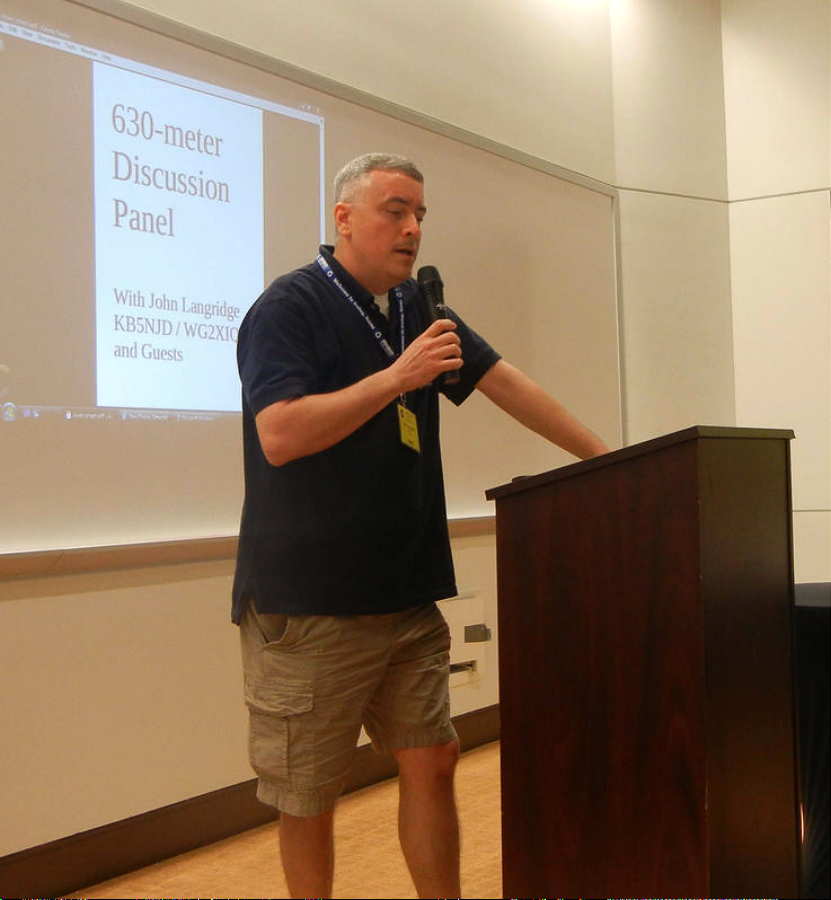 |
| John - KB5NJD talks about his favorite topic, 630m |
New experimental licensee, Jim, WI2XJG in Saint George, Utah, recently posted a question on the Lowfer reflector regarding the status of his favorite mode (CW) on the 630m band. The detailed response, provided by John KB5NJD / WG2XIQ, may well be of interest to others as well:
Hi Jim,
Most regular CW QSO's are occurring from about 472.5 to 475 kHz. Note that in Europe 472.5 kHz is a popular frequency. My freq of choice when open is 474.5 because it puts my signals close enough to the WSPR passband that operators there may be alerted to my activity. It seems its become commonplace to use "CW-USB" receive pass bands unlike other low bands that default to "CW-LSB" (At the end of the day it doesn't matter as long as you know since carrier frequencies are what are typically announced).
As mentioned in previous communications much of the CW activity is by sked arranged either via the reflectors like this or the ON4KST chat or even
direct email. While random CW QSO's are not out of the question they are
rare during the summer as activity is decreased in spite of continued
propagation. YMMV. In the past I have mentioned how it might be
beneficial for you to listen to and decode some WSPR to determine the
current state of the band. Regular CW typically requires about -10 dB S/N
in a 500 Hz BW to make a QSO. If you are not receiving stations at -10 dB
or better, you may not hear any CW from that station.
If you live near an area of high activity, of course, this can be a
different result. As I mentioned before I maintain a daily CW sked at
1030z on 474.5 kHz as wx allows but your ability to hear it, particularly
during the summer may be severely compromised. Even those with very good receive antenna systems like NO3M / WG2XJM in Pennsylvania fight the noise this time of year and it can be hit or miss. I think Eric and I had a
total of two QSO's last summer and they were tough. Winter is a different
story and most nights, poor conditions and QSB aside, could yield a CW
ragchew over that same 1300 mile path. In the Winter I get many reports
from stations across North America that are scanning the band and hear the activity. Its not necessarily too different from operating habits on 160m
in that respect.
Activity nights in the Fall and Winter often yield lots of activity as they
have in previous years and those are announced on the reflectors and often
get a mention in QST a few months before.
As for CW activity in Utah, a good start might be Mike, AI8Z / WD2XSH/12
near Denver, Colorado. Mike has a nice signal and you may be able to catch
him on the 600mrg reflector. Also the guys in the Pacific Northwest are
active but I would strongly advise for you to listen to and decode their
WSPRs first to see what your capabilities really are. Your distance from
the PNW is not much different from your distance to me in Texas.
CW speeds will vary with conditions just as other bands. Good signals and
operators can mean fast CW and those same ops under poor conditions may have to slow it down.
JT9 activity is typically on 474.2 kHz USB dial and "carriers" are
typically between 1000 and 1300 Hz up but this varies. JT9 activity has
been low since we have moved into Spring and much of that is due to
abbreviated operating schedules that result from persistent poor weather
conditions. JT9 will require -24 dB to -27 dB S/N minimums typically for
QSO's and may be a good place for you to start, particularly if you arrange
a sked. I don't see much success from a random CQ on JT9 this time of year
unless guys know you are going to be there. Winter is another story and
guys often watch for signals in the waterfall pretty closely. Announcing
your operating intentions is still a good idea so that guys steer RX
antennas your direction.
Best advice I can give right now is to use WSPR to evaluate your station
(RX now and RX/TX when granted) and band conditions at any given time. It will save you a lot of potential frustration later.
Thanks JD and list for the 630-meter bandwidth!
73!
John KB5NJD / WG2XIQ
John and others continue to maintain vigilance on the 630m band nightly and his 630m web pages remain the best source of up-to-date information on band happenings and progress to final acquisition of the band for U.S. amateurs. If you are thinking of getting on 630m now, or later, a visit to John's site will supply you with a ton of motivation!
For Canadians, that already have the 630m band as well as 2200m, I am trying to keep track of Canadian activity here. As well, there has been much information on 630m published on this blog and looking here will bring up all of the 630m related blog posts.
Steve McDonald, VE7SL, is a regular contributor to AmateurRadio.com and writes from British Columbia, Canada. Contact him at [email protected].
Amateur Radio Weekly – Issue 113

Yaesu FT-891 update
The Yaesu FT-891 is the smallest and lightest 100W HF transceiver ever built at 155x52x218mm and 1.9Kg. Unfortunately, the 2A current draw on standby makes it unsuited for truly portable operations.
QRP Blog
2016 Dayton Hamvention: Exhibits Photos
Extensive photoset of Hamvention exhibitor spaces.
The SWLing Post
The Hamvention Takeaway
You’re looking at about two football fields worth of parking spaces, filled with cars, tents, and collapsible tables and the strangest electronic devices you’ve ever seen.
Hack A Day
Photo tour of the 2016 Dayton Hamvention Flea Market
Weather at the Dayton Hamvention was quite pleasant–cool and partly cloudy.
The SWLing Post
Hamvention wants a future at Hara Arena
The Dayton Amateur Radio Association plans to stay at Hara for “as long as (they) draw breath.”
myDayton Daily News
$25 satellite tracker
I found a $25 pan and tilt solution, meant for mounting cameras from drones.
Paul’s Projects
80 meter inverted L
I needed a cheap and relatively unobtrusive solution and I found one in Len Paget’s (GM0ONX) design for an inverted L.
AmateurRadio.com
FCC denies petition for consideration in vanity call sign dispute
An Arizona radio amateur has been unsuccessful in convincing the FCC to take a 1 × 2 vanity call sign away from its present holder and grant it to him.
ARRL
HF portable ops solar powered
My power source for the Yaesu FT-857D is my 12 volt power can with the batteries being maintained by the two solar panels.
Jerry’s Journal
Is pirate radio still a problem in the digital age?
We are examining why ‘pirate’ radio persists despite the existence of legal alternatives to unlicensed broadcasting.
Middlesex University London
Video
Amateur Radio Weekly is curated by Cale Mooth K4HCK. Sign up free to receive ham radio's most relevant news, projects, technology and events by e-mail each week at http://www.hamweekly.com.
Dayton 2016
Another year, another Dayton in the history books. This was my third Hamvention trek, but this year was a bit different for me as I attended with my girlfriend. She somehow coaxed me into it, despite my concerns she would be bored out of her mind. However, we both had a great time.

Happy Hamventioners
I didn’t take as many pictures this year. At times I felt I could have recycled photos from the last two years and no one would notice. But there were some new sights to see….

Mannequintenna?
Yaesu was handing out truckloads of free “Yaesu 60th Anniversary” hats and other logo-adorned swag as usual. I was tempted to alter a hat to say “Yaesu FT-817 60th Anniversary” as the long-in-the-tooth rig continues to be offered with no modern update in sight. Ride that pony, Yaesu. As Jeff KE9V reported, no, the FT-891 is not an 817 replacement. It’s not an FT-897 replacement, either, so don’t ask. The FT-817 continues to be the Keith Richards of amateur radio rigs.
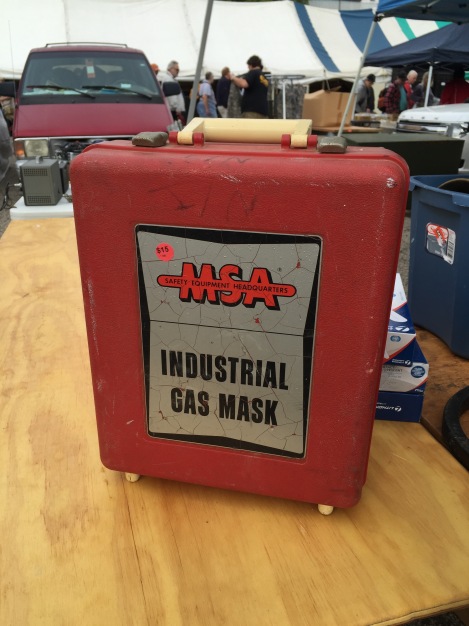
Required Equipment in Hara Arena Bathrooms
The Kenwood booth actually had visitors in contrast with last year when there were more tumbleweeds than attendees. Their newly announced super duper digital VHF/UHF rig undoubtedly attracted inquiries, though shame on their product line management people for not having it ready to sell at Dayton. In Kenwood’s defense, Yaesu’s new FT-891 wasn’t available for purchase, either.
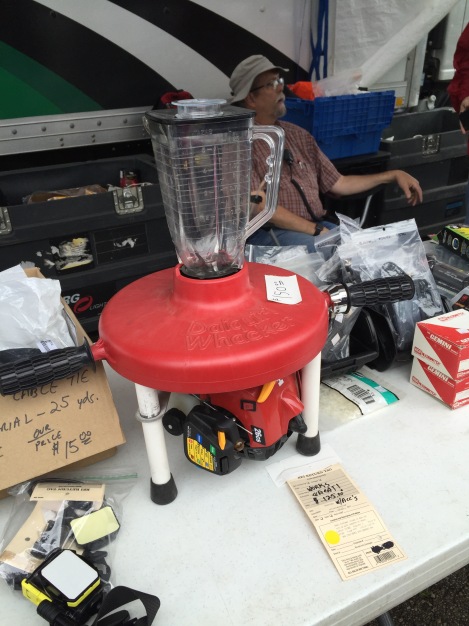
When All Else Fails, Make a Daiquiri
The crazy rig-selling train known as Elecraft continues barreling down the track. As everyone is undoubtedly well aware now, they released the KX2 at the Hamvention. No, this isn’t an X-rated version of the K2, or two K1s merged together, it’s a smaller KX3 without 6 meters or 2 meter add-on capability. This rig could have been a Yaesu FT-817 killer if it had VHF and UHF capability and reasonable pricing. 2 meter capability especially would have made sense to include considering this rig has the size and essentially the form factor of an HT. No doubt Elecraft will sell a ton of these rigs, but then again if they released a new version of the K1 packaged in a 55 gallon drum, they would sell them by the dump truck load.
I question how much longer Elecraft can keep up this sales momentum which I often feel is fueled by unreasonable customer loyalty. (Full disclosure: I own three Elecraft rigs.) Last year’s big announcement was the K3S, an improved K3, which teed off new K3 owners. This year’s release was a repackaged KX3. Elecraft seems to be innovating less and recycling products more.
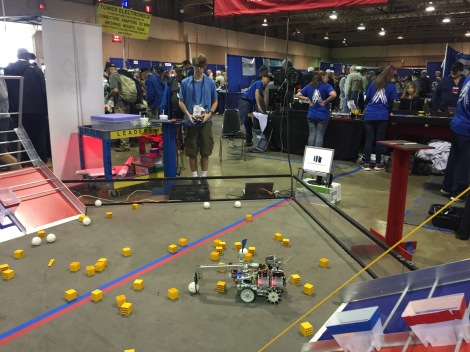
Domo Arigato, Mr. Roboto
I’m pleased to report there was a robot competition area and a local Makerspace representative booth. It’s good to see more Maker-oriented vendors and displays, which is really going to be the key to growing amateur radio after our older amateurs go silent key in the next decade. Hamvention folks, please, keep increasing this type of content.

Mendelson’s Flea Market Tent Family Planning Center
The flea market appeared to be the same size, with many long standing attendees selling the same junk, I mean, classic wares. I think there were less amplifiers for sale this year. That’s just a gut feeling, but I seem to recall many more amps last year. The same goes for rigs.
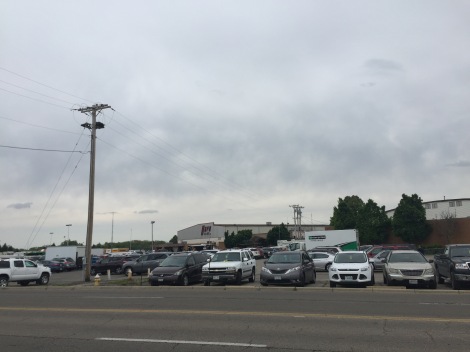
No Hamvention report would be complete without mentioning the condition of Hara Arena. Yes, good old Hara Arena. This is the final year for Hara. Seriously. I’m going on record and predicting it now. Really. This is it. Seriously. Last year’s announced multi-million dollar renovation plan fell through. I can’t imagine the facility can continue operating in its ever-worsening condition as it’s become a human safety nightmare that would cause any sane insurance company underwriter to run away screaming like their hair was on fire. Expect something to happen prior to the next Hamvention, either the occupancy permit being revoked, or the building turning into a pile a rubble on its own or by wrecking ball. Last year. Trust me. That being said, I left late afternoon Saturday sadly waving bye to Hara Arena thinking this may be the last year, like I was losing a dying friend. But the Hamvention is not Hara Arena, and Hara is not the Hamvention.

Anthony, K3NG, is a regular contributor to AmateurRadio.com.
 Ham Radio Deluxe |
 W5SWL Electronics |
 Ham Radio Prep |
 KB3IFH QSL Cards  Hip Ham Shirts  HamRadioAuctions HamRadioAuctions Reliance Antennas Reliance Antennas Enigma Shop Enigma Shop |  morseDX  Ni4L Antennas  R&L Electronics R&L Electronics antennas.us antennas.us QRV QRV |
- Matt W1MST, Managing Editor
