 |
 Deceptive Sun
 6 June 2016 | by
  |
| courtesy: http://sdo.gsfc.nasa.gov/data/ |
A quick glance at Sunday's sun reveals a spotless environment, something we will likely be seeing more often in the years to come as the Solar Minimum arrives around 2020. The last minimum in 2009 saw a total of 260 days of spotless suns and long periods of very little geomagnetic activity.
Incredibly, during the minimum in the 28 year period between 1672 and 1699 there were 50 sunspots total. That's not a week or a month but two 11 year cycles worth. The normal expectation would be 40,000 - 50,000 spots within a 28-year period.
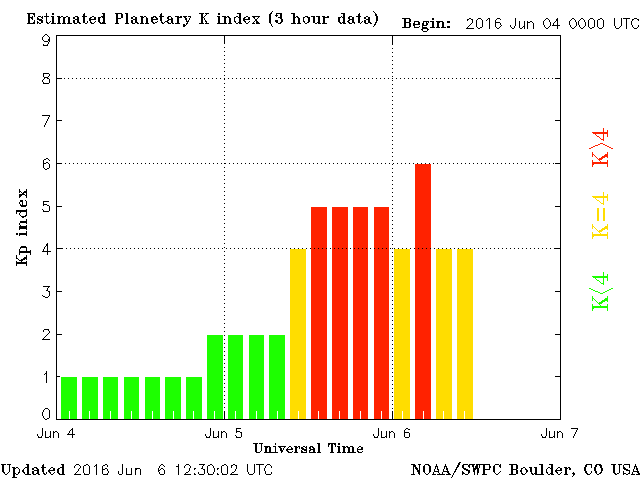
But the present, apparently quiet-looking sun, is not all as it appears as a look at today's satellite data and magnetometer readings indicate we are in the midst of a pretty good disturbance, driving the planetary K-index to level 5.
 |
| courtesy: http://www.swpc.noaa.gov/ |
 |
| courtesy: http://sdo.gsfc.nasa.gov/data/ |
With the vast array of solar instrumentation available to us online, much of the mystery involving propagation has been removed, making the tracking and even the predicting of geomagnetic activity, very much easier nowadays.
 |
| Kiruna Magnetometer: http://www.irf.se/maggraphs/ |
From my location on the west coast of North America, my main 6m interest over the past several summer seasons has been focused on the short-lived and exciting sporadic-e openings over the pole to Europe ... but today's sun is not helping. Most of these fleeting openings seem to require undisturbed fields in the polar regions ... geomagnetic quiet. Once CH738 rotates out of view, hopefully the polar activity will subside and maybe, just maybe, the magical 6m polar path to Europe will tease us once again.
 |
| The July 8th, 2014 magic - West Coast to Europe on 6m |
Steve McDonald, VE7SL, is a regular contributor to AmateurRadio.com and writes from British Columbia, Canada. Contact him at [email protected].
LHS Episode #170: Invasion of the Random Dog
 It's our post-Hamvention episode and it's packed with great information. We start off with a look at hams in the news, special event stations for all Canadian operators, the legalities and procedures for proper third-party operation. Then we move into a comparison of Linux live update procedures and the latest news about Raspberry Pi Zero boards. Then we take a tour of the JT9 and JT65 digital modes using WSJT-X. And there's so much more. Thanks for listening!
73 de The LHS Crew
Russ Woodman, K5TUX, co-hosts the Linux in the Ham Shack podcast which is available for download in both MP3 and OGG audio format. Contact him at [email protected].
How About an Updated FT-817?
The Elecraft KX2 made a big splash with QRP enthusiasts at the Dayton Hamvention this year. HamRadio360 had some good coverage of the product introduction. Basically, the KX2 is a shrunken version of the KX3, covering the HF bands 80m through 10m.
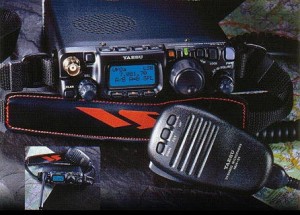
There were rumors circulating that Yaesu would introduce a replacement for the FT-817ND, but that turned out to not be true. It is a good rumor because the original FT-817 was introduced way back in 2001 (according to Wikipedia). Also, Chris Wilson NØCSW was actively soliciting inputs for an 817 replacement at the Central States VHF Conference last summer.
A while back, I did a comparison of the FT-817 and the KX3 (big brother to the KX2). I evaluated the two radios from a VHF/UHF point of view. The FT-817 is the only portable single-radio solution for 50 MHz, 144 MHz and 432 MHz. The KX3 includes 50 MHz standard and 144 MHz is an option. The KX2 leaves out the VHF bands completely to achieve a smaller size.
What’s Next for the FT-817?
Its always fun to speculate on what might be coming in new gear. I expect Yaesu will maintain its position as the QRP transceiver that covers HF/VHF/UHF. It has a long history of delivering cost-effective “do everything” radios. We can look to recent product introductions from Yaesu to get a hint of what might be coming.
The FT-2DR, FT-400DR and FT-991 have all adopted larger touch-screen displays so we can probably expect that for the 817 replacement. However, this will challenge the existing form factor…you can’t just drop a larger display into the existing 817 design. The three newer radios include the System Fusion C4FM digital mode…at this point, I don’t think Yaesu would introduce a VHF/UHF radio without it.
Which raises another question: will the new radio also include a GPS receiver? This capability is a good complement to the C4FM mode in a portable radio. The FT-991 requires you to enter your location manually, which the FT-2DR and FT-400DR use a built-in GPS. But it adds circuitry and complexity so I am going to guess they will leave that out.
I am expecting (hoping?) Yaesu will improve the battery life of the transceiver. (Receive standby current is spec’d at 450 mA.) Even if they don’t improve the current drain, newer battery technology could be used to improve operating time. Also, depending on the form factor changes, it may be wise to dedicate more space for a physically larger battery.
Yaesu will probably improve the overall receiver performance, including advanced DSP features. Many 817 users have complained about the lack of coverage of 162 MHz weather radio in the US. On the transmit side, a little more output power would be nice…maybe match the KX3’s 10 watts on HF. Yaesu could really make the VHF crowd happy (in the US) if they included the 222 MHz band.
Take One Tablet
The radio will surely have a computer I/O port with USB being the most flexible choice. There is an opportunity to innovate a bit here by coupling the radio with Android and iOS tablets. I could see a really nice app that handles logging, CW, PSK31, RTTY, bandscope, and other advanced features. This could take the pressure off having a larger display and loading tons of features into the radio. The most convenient I/O would be wireless, most likely Bluetooth or maybe WiFi. Many of the SOTA and QRP operators already take along a smartphone or tablet for logging and other tasks, so it would be a good fit to that market. The key to this idea is careful human factors design and tight integration with the radio. Do I expect this from Yaesu? Not really. So surprise me and knock my socks off.
Those are my thoughts. Your turn.
73, Bob KØNR
The post How About an Updated FT-817? appeared first on The KØNR Radio Site.
Bob Witte, KØNR, is a regular contributor to AmateurRadio.com and writes from Colorado, USA. Contact him at [email protected].
A slight change of plans…..
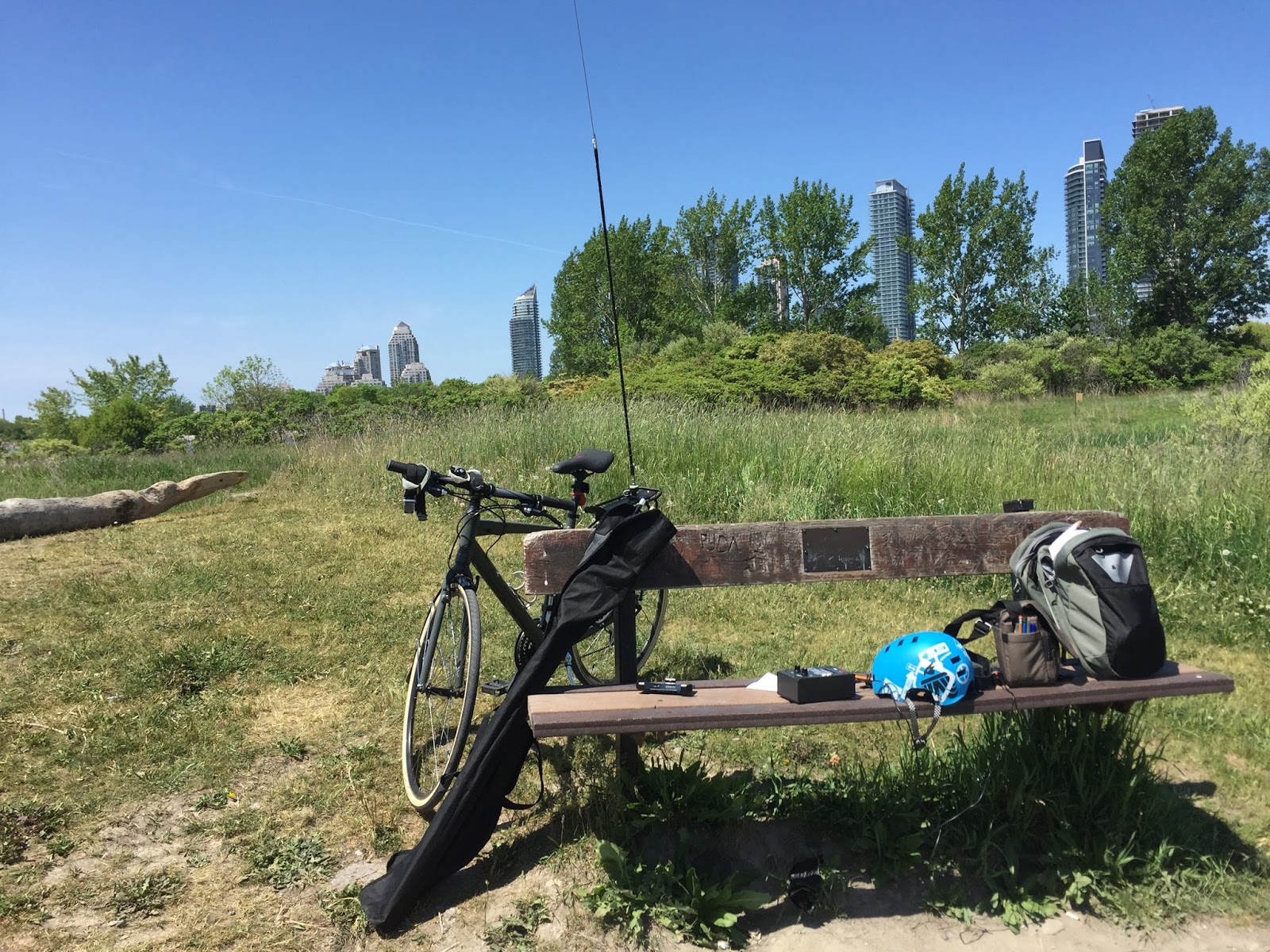 |
| The test setup |
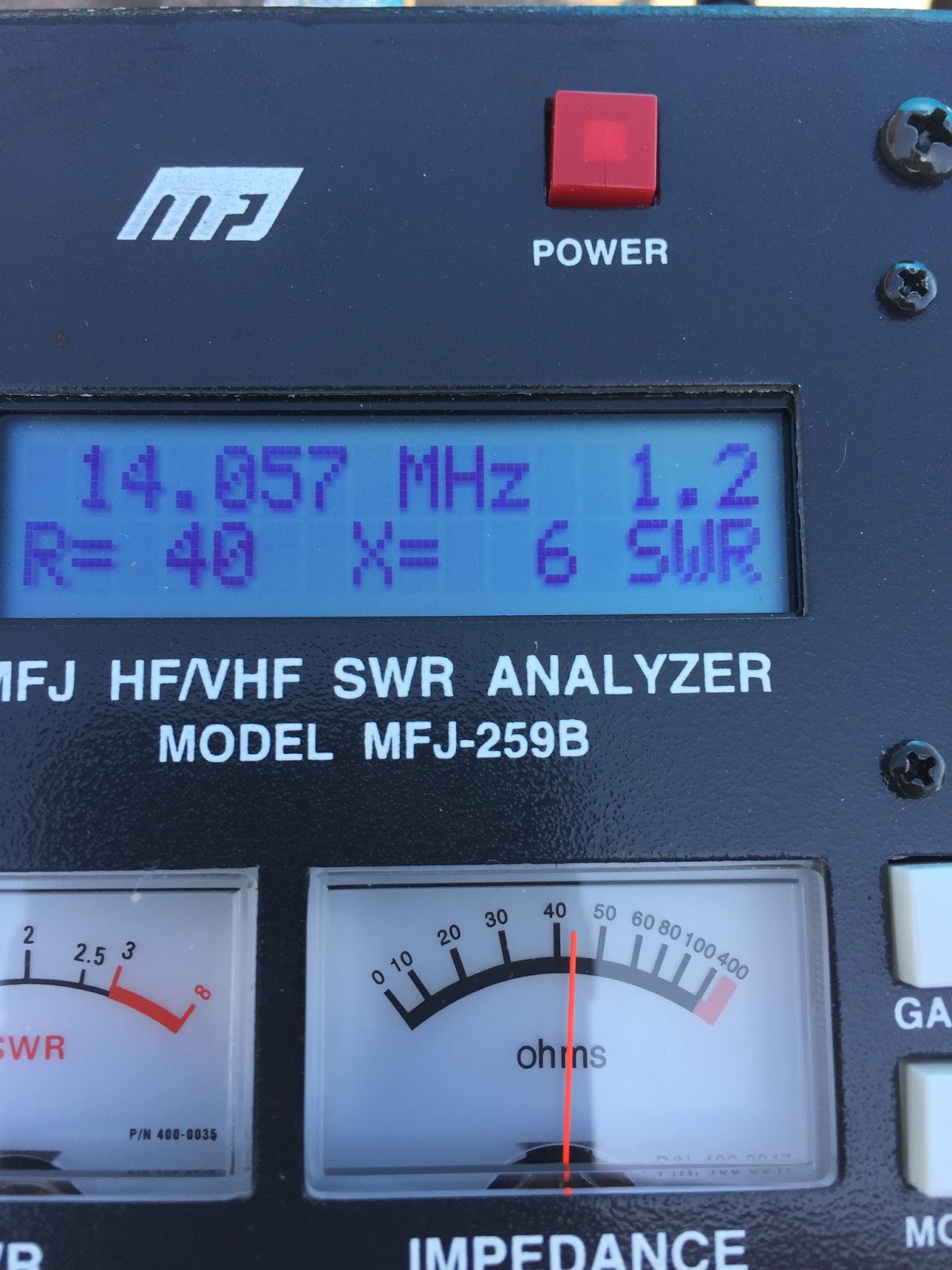 I was out today once again with my portable operations but this time there was no on air time it was time to test and decide. I went out with my MFJ antenna analyzer, mobile whip antennas and various lengths of counter poise. I wanted to see where my 20m mobile whip antenna was resonant and using the MFJ analyzer was the easiest way of doing this. The counter poise for 20m I started with was 17.5 feet long and the SWR was not showing it was resonant in the CW portion of the band but in the SSB section. So I found I have to lengthen the counter poise to 30 feet to get the SWR to 1.2:1 in the CW portion of 20m. This got me to thinking if the mobile whip was the way to go, I did have these antennas hanging around and I wanted to give them a go to see what results I would get. They are still very useful to me when I operate portable mobile from the car and they preform very well in that situation. I wanted to try the whip antenna as I felt it would be a very small footprint of an antenna but with a counter poise of 30 feet the footprint is larger than I would like. From most of my blog reading about portable trail operation, NPOTA operations and just plan old out in the park for the day operation hands down most of the time the antenna of choice was one of LNR's par end fed antenna's. I have looked over the antennas at LNR Precisions site and not sure yet which antenna to get, I am leaning toward the EF-20 as it's not as long (33') as say the other models. I'm really not going to use 40m and I figure (but not sure) I can use the Elecraft KX3's tuner to operate 15 and 10M?? Any feedback about this antenna or others would be appreciated.
Mike Weir, VE9KK, is a regular contributor to AmateurRadio.com and writes from New Brunswick, Canada. Contact him at [email protected].
Amateur Radio Weekly – Issue 114

2016 Hamvention attendance up slightly?
General chairman of the event said attendance this year may have been up slightly from 2015.
ARRL
Can we use a Raspberry Pi model B as FreeDV modem?
I am going to try using them as a headless FreeDV modem similar to the SM1000.
OZ9AEC
6 meter collinear antenna
I like to keep my antennas simple and cheap by using wire as the basis for everything.
High on Solder
Shield Hat: Signal Proof Apparel
It has shielding effectiveness 55dB-65dB from 10 MHz to 4 GHz. Silver is also antibacterial, antimicrobial, antiodor and antistatic.
Shield
Custom 19″ cabinet for a portable repeater
A 19 Inch rack mount is a standardized frame or cabinet for mounting equipment modules.
NT1K
How is Amateur Radio in your country?
European Radio Amateurs’ Organization’s survey wants to determine the current status of amateur radio in your country.
ERAO
Adventures with software defined radio
The SoftRock RXTX Ensemble seemed highly respected and has been available long enough to develop a good user base.
M0SPN
Video
NPOTA Activation: Expect the unexpected
W3ATB shares his NPOTA activation of Saint Gardens (NS60) in New Hampshire on June 1, 2016.
W3ATB
KD2GTM’s Hamvention Recap
All about my experience at my first Hamvention!
KD2GTM
The Transistor: 1953 documentary, anticipating its coming impact
The intent of the film was clearly to give the public of that era their first understanding of what a transistor was and why it mattered so much.
AT&T Tech Channel
Amateur Radio Weekly is curated by Cale Mooth K4HCK. Sign up free to receive ham radio's most relevant news, projects, technology and events by e-mail each week at http://www.hamweekly.com.
AmateurLogic 91: Hamvention 2016 – Part 1
AmateurLogic.TV Episode 91 is now available for download.
Part 1 of Tommy and George’s Hamvention 2016 adventure. Recorded before a live audience at the Icom booth on Friday, May 21st.
Fishing Tales with Darth?
Michael Kalter, W8CI on what’s new at Hamvention.
Don Kunst, W3LNE, Boy Scouts K2BSA VP.
Arthur Kunst, W3WM has some great stories about his 76 years in amateur Radio! You don’t want to miss this.
Valerie Hotzfeld, NV9L and Bob Heil, K9EID join us and talk about Ham Nation and their passions for the hobby.
It’s a bonus episode of AmateurLogic. Look for part two coming soon.
1:08:10
George Thomas, W5JDX, is co-host of AmateurLogic.TV, an original amateur radio video program hosted by George Thomas (W5JDX), Tommy Martin (N5ZNO), Peter Berrett (VK3PB), and Emile Diodene (KE5QKR). Contact him at [email protected].
Magic Band And The DX Window

Late May and early June always sees 6m come to life ... sometimes slowly and sometimes with a 'bang'. Last year's good early start soon flickered-out into what was the poorest sporadic-e season that many could recall. This year's 'start' has almost been a no-show, with just a very few short openings to the south eastern states (Colorado, Utah) and one 'blink and you've missed it' opening to the Great Lakes.
Hopefully the 6m propagation gods are just having some fun with us and things will really spring to life shortly. Once we do get into some periods of good propagation, there are always new arrivals to the band, as most transceivers these days include the 6m band. Every season I hear of newcomers getting their knuckles wrapped for, probably unknowingly and in all innocence, operating inside the 'DX Window'.
If you're new to the band or perhaps not sure how the window should work, here's a short section taken from my Magicband web page, that explains the concept:
Don't Be A 'DX-Window' Lid!
One of the quickest ways to get the 6m community saying nasty things about you behind your back is to mess-up in the DX Window. The DX Window (50.100 - 50.125 kHz) has long been established for one type of contact only, that being a legitimate DX QSO.
The DX Window can only be of value if everyone follows these basic 'rules':
If you are in the U.S.A. or Canada, DO NOT WORK ANY OTHER U.S.A. or CANADIAN STATIONS INSIDE THE WINDOW. The window is NOT for North America - North America contacts.
Do not answer the "CQ" of U.S.A. or VE stations if you are in North America. This creates unnecessary QRM and chances are, they will not respond to your answer anyway. Calling or answering other North Americans in the DX-Window only reinforces bad operating habits, encouraging newcomers to do the same. If you want to work U.S.A. or CANADA, do it outside the DX Window!
Work or call only stations outside of North America inside the DX Window.
The only legitimate exception to these rules, that will not get you in the naughty-corner, is working a KL7, VE8, XE or some other such fairly rare North Americans.
I hate to say it, but some of the worst offenders to the successful function of the DX Window are my fellow VE's, many of whom don't know or don't understand the simple concept of how it works. Now that you know, pass it on!
Now, you may or may not agree with the concept of a DX window, so please don't shoot the messenger. What I do know however, is that if everyone does their best to adhere to the window's concept, it works well. Problems arise when those that should know better, and probably do, decide that for some reason, the concept doesn't apply to them or that it won't hurt, 'just this once'. Others, particularly newcomers, see it and think it's all OK and soon the window is full of domestic QSO's, effectively killing its usefulness.
As conditions slowly improve, hopefully we can work on six this summer. I usually hang out on CW, just below 50.100. As one long-time 6m diehard would often say to me, the newcomer over 40 years ago ... 'We'll see you, all of a sudden!"
Steve McDonald, VE7SL, is a regular contributor to AmateurRadio.com and writes from British Columbia, Canada. Contact him at [email protected].
 Ham Radio Deluxe |
 W5SWL Electronics |
 Ham Radio Prep |
 KB3IFH QSL Cards  Hip Ham Shirts  HamRadioAuctions HamRadioAuctions Reliance Antennas Reliance Antennas Enigma Shop Enigma Shop |  morseDX  Ni4L Antennas  R&L Electronics R&L Electronics antennas.us antennas.us QRV QRV |
- Matt W1MST, Managing Editor
