 |
 DIY Powerpole voltage and current meters
 16 June 2016 | by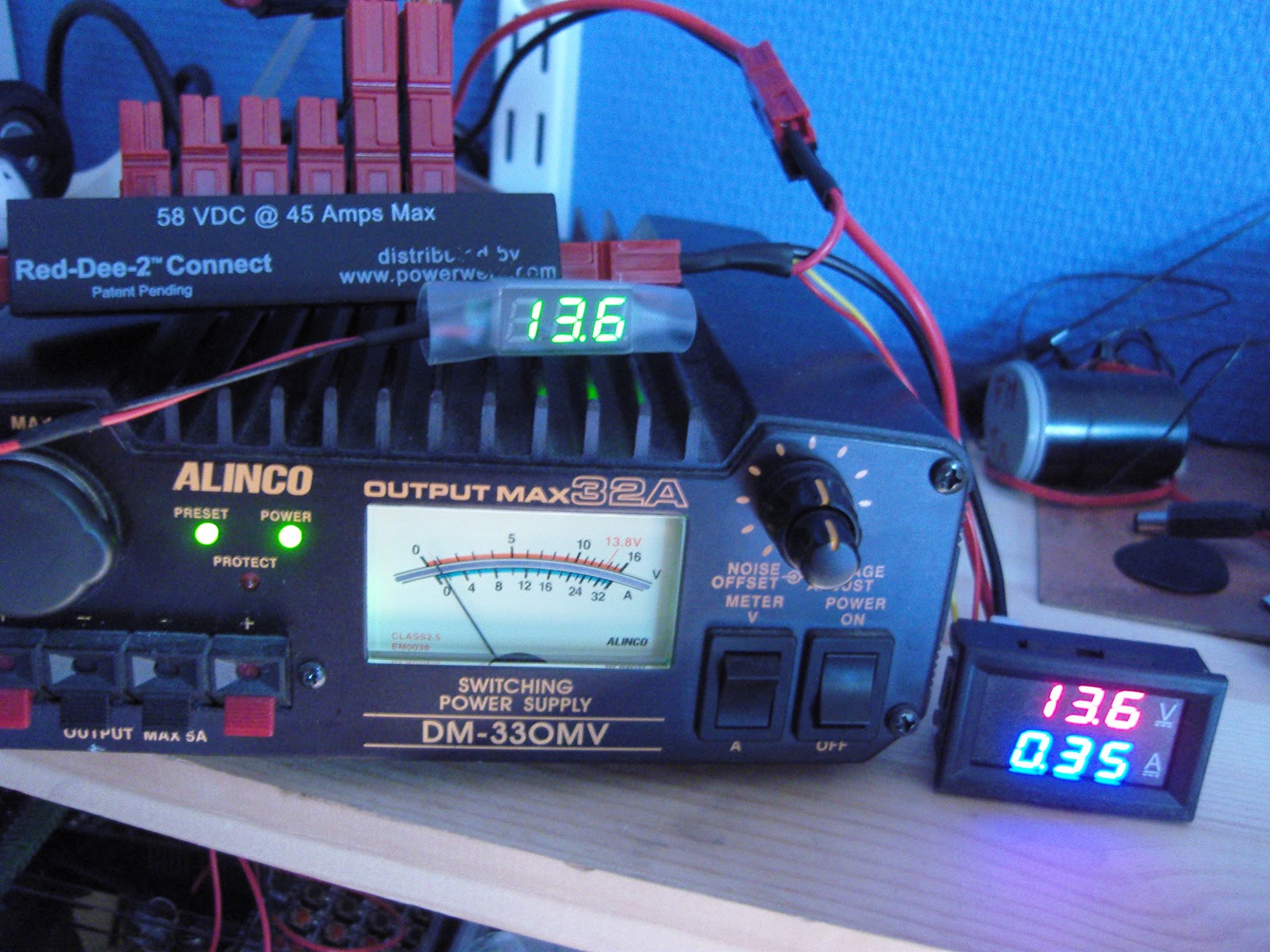
Powerpole voltage and current monitoring is quite nice to have. One can buy commercial meters, but due to the availability of nice and cheap modules, it is very easy to make them oneself.
To the right you’ll see my combined voltage and current meter as well as my volt-meter on top of the power supply.
Both of the modules have been bought on Ebay:
- Miniature 0-30 V DC LED 2 wire Digital voltmeter (371333527599) where the display is 22 by 10 mm. Cost slightly more than $1
- 0-100 V, 0-10 A Dual Voltmeter Ammeter (262455987311) costing less than $3. The module size is 48 x 29 x 26 mm and the letters are 7 mm tall just like the miniature voltage display.

- Related post: “New gadget measures negative resistance“
Sverre Holm, LA3ZA, is a regular contributor to AmateurRadio.com and writes from Norway. Contact him at [email protected].
DIY Powerpole voltage and current meters
Powerpole voltage and current monitoring is quite nice to have. One can buy commercial meters, but due to the availability of nice and cheap modules, it is very easy to make them oneself.
To the right you’ll see my combined voltage and current meter as well as my volt-meter on top of the power supply.
Both of the modules have been bought on Ebay:
- Miniature 0-30 V DC LED 2 wire Digital voltmeter (371333527599) where the display is 22 by 10 mm. Cost slightly more than $1
- 0-100 V, 0-10 A Dual Voltmeter Ammeter (262455987311) costing less than $3. The module size is 48 x 29 x 26 mm and the letters are 7 mm tall just like the miniature voltage display.
Sverre Holm, LA3ZA, is a regular contributor to AmateurRadio.com and writes from Norway. Contact him at [email protected].
SOTANA May Be Right For You
I have “a friend” that could probably use this.

The post SOTANA May Be Right For You appeared first on The KØNR Radio Site.
Bob Witte, KØNR, is a regular contributor to AmateurRadio.com and writes from Colorado, USA. Contact him at [email protected].
If at first you don’t succeed try try again!
Well, here we are once again trying to get the portable ham radio setup going.
My first attempt was to place one of my mono band whips on my bike and set out a counter poise. It was with mixed results, the SWR was sometimes all over, there was a TX error message now and again on my KX3 and basically frustration trying to get it to work. So if at first you don’t succeed try try again.
Last week I was online searching again for another way to get my portable op’s on the air. I was looking for something that was easy to deploy, was portable and worked!
My interest has gone toward the Endfed antennas. I was looking at LNR’s antennas and then I came across the Endfed 40-6m antenna by Steve W1SFR. I shot him some questions regarding the antenna and he got back to me right away with the answers. His Endfed seems to be very well built using Wireman “silky” 18 gauge wire which I have used in the past and been very happy with. There was a nice noticeable quality in both the wire connections and the 9:1 unUn.
The antenna is only 35 feet but you do need about 25 feet of coax to act as a counter poise. Also your rig needs to have an antenna tuner (mine does) to get the benefit of 6m-40m with only a 35′ antenna and no traps. Also it was nice to see on his web site a link to purchase his antenna including shipping to VE3 land.
The shipping was super reasonable the total came to 67.00 U.S. Steve also mentions that his price includes handling as well. Other sites I had gone to being very interested in their antenna to only find out the shipping at times was either 1/2 or more of the price of the antenna.
There was lots of positive reviews on Eham about Steve’s antenna as well. I put some items I am not using in the shack sold them very fast and the funds were in place so I have placed my order and waiting for it to arrive.
I have the 25′ of coax on hand but I do have to head out to the hardware store for some rope 1/8″ nylon rope. Then I’m thinking of placing a water bottle with some sand it it as a weight to get the rope up and over a tree branch…..that is going to take some practice!
Mike Weir, VE9KK, is a regular contributor to AmateurRadio.com and writes from New Brunswick, Canada. Contact him at [email protected].
Just a reminder
Beginning this year, the Hunt has been moved to the third Sunday in August in order to even out spacing a bit between FOBB, the Skeeter Hunt and the NoGA Peanut Power Classic. Also, there are some rule changes for 2016 in order to more fully incorporate NPOTA into the Skeeter Hunt. Make sure to check them out at www.qsl.net/w2lj.

QRP - When you care to send the very least!
Larry Makoski, W2LJ, is a regular contributor to AmateurRadio.com and writes from New Jersey, USA. Contact him at [email protected].
Just a reminder
Beginning this year, the Hunt has been moved to the third Sunday in August in order to even out spacing a bit between FOBB, the Skeeter Hunt and the NoGA Peanut Power Classic. Also, there are some rule changes for 2016 in order to more fully incorporate NPOTA into the Skeeter Hunt. Make sure to check them out at www.qsl.net/w2lj.
QRP - When you care to send the very least!
Larry Makoski, W2LJ, is a regular contributor to AmateurRadio.com and writes from New Jersey, USA. Contact him at [email protected].
Weekly Propagation Summary – 2016 Jun 13 16:10 UTC
Here is this week’s space weather and geophysical report, issued 2016 Jun 13 0444 UTC.
Highlights of Solar and Geomagnetic Activity 06 – 12 June 2016
Solar activity was at very low levels from 06-08 June and again on 10 June. Low levels were reached on 09 June and again from 11-12 June due to C-class flare activity from Region 2552 (N15, L=359, class/area Dao/150 on 11 June). The largest flare of the period was a C6 at 11/2228 UTC. Region 2552 grew rapidly since its emergence on 07 June to a compact beta-delta magnetic class, but appeared to be in decay by 11 Jun as it neared the NW limb. No Earth-directed coronal mass ejections were observed during the period.
No proton events were observed at geosynchronous orbit.
The greater than 2 MeV electron flux at geosynchronous orbit was at moderate levels on 06 June and again from 11-12 June. High levels were reached from 07-10 June with a peak flux of 1,590 pfu observed at 10/1520 UTC.
Geomagnetic field activity ranged from quiet to G2-Moderate geomagnetic storm levels during the period. The period began with solar wind speeds near 650 km/s and total field values near 7 nT while the Bz component fluctuated between +/- 6 nT under the slowly waning influence of a negative polarity coronal hole high speed stream (CH HSS). As a result, mostly active levels and an isolated G2-Moderate storm period were observed during the first half of the UTC day on 06 June. Solar wind speeds continued to decrease to nominal levels by 10 June. Quiet to unsettled conditions were observed on 07 June with quiet conditions on 08-09 June. By midday on 10 June, a solar sector boundary crossing was observed into a positive (away) sector followed by an increase in total field to 14 nT by late on 10 June. A lesser rise in solar wind speed to near 540 km/s was observed as a positive polarity CH HSS moved into a geoeffective position. Solar wind speeds continued to be elevated in the 450 km/s to 550 km/s range for the rest of the period with total field ranging between 7-10 nT. The geomagnetic field responded with quiet to active periods on 10-11 June and quiet to unsettled levels on 12 June.
Forecast of Solar and Geomagnetic Activity 13 June – 09 July 2016
Solar activity is expected to be at very low to low levels for the forecast period.
No proton events are expected at geosynchronous orbit.
The greater than 2 MeV electron flux at geosynchronous orbit is expected to be at high levels on 17-18 June, 26 June-01 July and 04-07 July in response to CH HSS activity.
The geomagnetic field is expected to be at unsettled to active levels on 13, 15-17, 22-24, 26-27 June and from 02-03, 07-09 July with G1-Minor storming likely on 02-03 July due to recurrent CH HSS activity.
Don’t forget to visit our live space weather and radio propagation web site, at: http://SunSpotWatch.com/
Live Aurora mapping is at http://aurora.sunspotwatch.com/
If you are on Twitter, please follow these two users: + https://Twitter.com/NW7US + https://Twitter.com/hfradiospacewx
Get the space weather and radio propagation self-study course, today. Visit http://nw7us.us/swc for the latest sale and for more information!
Check out the stunning view of our Sun in action, as seen during the last five years with the Solar Dynamics Observatory (SDO): https://www.youtube.com/watch?v=zXN-MdoGM9g
We’re on Facebook: http://NW7US.us/swhfr
Visit, subscribe: NW7US Radio Communications and Propagation YouTube Channel
 Ham Radio Deluxe |
 W5SWL Electronics |
 Ham Radio Prep |
 KB3IFH QSL Cards  Hip Ham Shirts  HamRadioAuctions HamRadioAuctions Reliance Antennas Reliance Antennas Enigma Shop Enigma Shop |  morseDX  Ni4L Antennas  R&L Electronics R&L Electronics antennas.us antennas.us QRV QRV |
- Matt W1MST, Managing Editor
