 |
 TX Factor – Episode 12
 27 July 2016 | by
 The next show in the series has just hit the airwaves. In this extended summer episode, there is not one, but two rig reviews. The Sun Expert Electronics Transceiver MB1 and the elusive Icom IC-7300 are comprehensively analyzed by ML&S’ Gary Spiers M0TIG and Chris Ridley G8GKC from Icom UK.
Also in this show, Bob teaches Mike a thing or two about amateur satellite operating, and our free-to-enter-draw is back with a chance to win a copy of the recently revised and updated Getting Started with Amateur Satellites book featured in the item.
We hope you enjoy watching the show.
Nick Bennett 2EØFGQ co-hosts TX Factor with Bob McCreadie GØFGX and Mike Marsh G1IAR. Contact the team at [email protected]
VHF/UHF Digital Voice – a peek into the future
Digital Voice on VHF/UHF is clearly here to stay. Even though the mainstream manufacturers are supporting it (their own version of it), it’s still fairly niche now. It will grow. But what’s it going to look like in the near future?
As things have developed, we have several walled gardens: D-STAR, DMR, P-25, C4FM (Yaesu System Fusion), and a little NXDN. As NW Digital’s John Hays K7VE has said in talks at several ham gatherings, they are “95% the same, and 100% incompatible.” They all rely on the same AMBE vocoder to encode and decode the digital voice, but they all package it differently.
I’ve been living in a bit of an alternate reality, thanks to shooting video at the ARRL/TAPR Digital Communications Conferences and at some of the more esoteric forums at Dayton and other hamfests. In that universe – actually more of a future than a present – we don’t have to choose which closed system we want to buy into. We don’t have to carry three or four handhelds around to cover all the modes, and hope our belt is strong enough to keep our pants up (and guaranteeing a feature spot on HamSexy). We can operate a single radio that can run all the DV modes, along with analog FM.
That radio doesn’t exist today, but it will.
Bruce Perens K6BP and Chris Testa KD2BMH have been working on a radio they eventually calledKatena, an SDR designed for any mode you could stuff into it (FM, SSB, various digital voice modes), but especially a version of FreeDV for VHF/UHF – a little different than the FreeDV used on HF. The radio would use the open source CODEC2 vocoder for FreeDV, and it could also use the AMBE chip (or derived software… Bruce has been looking into getting around AMBE patents) to do the other modes.
You can follow the progress of the Katena (originally called Whitebox – as opposed to black box, because it’s all open source) in various HamRadioNow videos, starting with Chris Testa’s initial presentation at the 2012 DCC in Atlanta. That’s Episode 44, A Practical Handheld SDR, on YouTube at https://youtu.be/YrbmlP1M1AI. I’ll list the string of videos that cover this topic at the end of this post.
Chris and Bruce have laid it all out there, so it’s a little painful to watch their talk at the 2016 Dayton Hamvention® where they admit defeat… temporarily. That’s in the newest episode, #262, at https://youtu.be/ZK_qLSKlqIY. Goodbye Katena, hello Phoenix.
Chris got as far as a 3rd generation prototype. But Chris isn’t an experienced RF engineer, and he discovered what a more seasoned RF guy might have known already, and probably from the same hard lessons. Wideband RF is very hard. As Bruce explains, making an SDR board that can transmit from DC to Daylight is possible (HackRF and others). But that doesn’t make it a transmitter. The RF it generates is dirty – it has harmonics, noise and spurs all over the place. It takes a lot of work, and filters, to clean that up. So making a radio that can transmit from, say 50 to 3000 MHz with reasonable power and good purity is a challenge. Chris’s design wasn’t up to the challenge, and he explains it in the forum.
They aren’t giving up, but they are going back to the drawing board to take advantage of newer technology (and that train isn’t going to slow down anytime soon). Bruce hopes for a prototype by the Orlando HamCation next February, but I wouldn’t hold him to that.
Meanwhile, Wireless Holdings has announced the DV4mobile, and listed some general specs on their web site. It’s pitched as a 20 Watt, 3-band mobile (144, 222 and 440) with FM plus “C4FM, D-Star, DMRplus, dPMR, P25 and NXDN (later via software update).” It will also include and LTE radio for connection to the cell network, and the software to let you keep using the digital modes through their networks the way you use the various dongles now. Wireless Holdings makes their own series of dongles for D-STAR, DMR, P-25 and Fusion, with varying capabilities. Their announcement doesn’t include FreeDV. Their development has been behind closed doors – they haven’t appeared at the DCC or given talks at hamfests.
Another company, Connect Systems, announced a multi-digital mode radio a couple years ago, and keeps pushing back the release date. They’ve been delivering popular FM/DMR radios (monoband, chose VHF or UHF).
So far, none of the big guys – ICOM, Yaesu, Kenwood or Alinco – have shown interest in making a radio that would do “the competition’s” modes. Kenwood, of course, has thrown in with ICOM on D-STAR, at least for one handheld coming out later this year. Alinco, the company that actually produced the firstdigital voice amateur radio (that went nowhere, but they did it), has yet to commit. Chinese companies are jumping on the DMR bandwagon, but none has produced either a D-STAR or Fusion radio.
The FreeDV radio is sort of a wild card. David Rowe VK5DGR, the ham who developed the free, open-source CODEC2, is working on a radio for FreeDV (and FM). He’s calling it the SM-2000. Bruce talks about it a little in the Dayton forum, and David has published some details on his blog, but it hasn’t crossed over to any kind of polished marketing. I found a recent video of David detailing it on YouTube: https://youtu.be/sg08zgiSFG8. It’s a fairly terrible video with bad audio (mic on camera in the back of the room, so full of reverb), but the information is worth the pain.
He begins with a review of the current FreeDV system for HF Digital Voice. The new VHF stuff starts about 5 minutes in. At about 12 minutes you’ll hear the most amazing comparison of FM and DV I’ve ever heard. The FM is too noisy to understand. The DV is solid. It turns the typical FM/DV comparison on its head. The rest is semi-deep technical stuff that hits my limit, but I get the broad strokes (and all the coughs and sneezes of the audience – I think I might catch a cold just from watching).
Bruce Perens has noted that any of the big or little manufacturers could implement FreeDV for free – it’s open source. FlexRadio has incorporated the HF version in their 6000 series. Nobody had expressed interest in the VHF version, yet. It’s pretty new. So David is developing a radio mostly as a demonstration project, but it will be something you can buy. It won’t be your main radio.
If FreeDV VHF catches on, it’ll be somewhat game changing. A bit narrower than D-STAR, it is also TDMA like DMR – it can switch between TX and RX rapidly. DMR uses that to put two ‘voice channels’ on one RF channel. David Rowe talks about building an on channel repeater that needs no duplexer. Paging Frequency Coordinators!
I would love to have a radio that can do all the digital voice modes. I would like to see what FreeDV could do to VHF/UHF operation, though I’m conflicted about the TDMA repeater concept. That could make repeaters so cheap and easy that everyone could do it… and they would! And the bands would be a mess. Part of the reason the frequency coordinators can more or less cap the number of repeaters in bands that are “full” is that repeaters are fairly difficult and expensive to build and maintain. But if David’s radios work well, that’s what’s gonna happen.
Index:
HRN 44 – Practical Handheld SDR, from the DCC https://youtu.be/YrbmlP1M1AI
HRN 149: What’s a Whitebox? https://youtu.be/WF9SK5f0NUM
HRN 193: Digital Voice is Exploding (maybe) (David Rowe interview) https://youtu.be/SmyVEwjhG_k
HRN 194: HT of the Future https://youtu.be/wq29i8gMm8c
HRN 226: K6BP – Open Hardware Challenges https://youtu.be/kE6mrwTCxus
HRN 238: ‘Front Panel’ (for the HT of the Future), from the DCC https://youtu.be/xHaYrDVYPO8
HRN 262: Digital Modes Now and for the Future https://youtu.be/ZK_qLSKlqIY
FreeDV SM2000 Presentation at Gippstech 2016 https://youtu.be/sg08zgiSFG8
Gary Pearce, KN4AQ, is the host of HamRadioNow.tv. If you enjoy this and other HamRadioNow programs, help keep them 'on the air' with a contribution. Contact him at [email protected].
Wonderful Sweden
Back from a month in Europe and we had a good time there. Two weeks in Sweden, touring in a motor home and the rest in my native the Netherlands, visiting family and filling our bellies with Dutch goodies like drop and kroketten.
If you have never been to Sweden then I heartily recommend you to visit it. Beautiful scenery with free camping wherever you like and wonderful people who have a very relaxed lifestyle. And they all speak English, too. We rented this motor home….

…and after two days of acclimatizing we parked it in the driveway of Rune and Heide, SM5COP and SM5NZG respectively. Rune was the first Swedish contact in my Taiwanese logbook and I had mailed him some questions before our trip, which he answered more than elaborately. We hadn’t planned to visit his part of Sweden, but the invitation to celebrate the midsommar festivities with them was more than worth the detour. Rune and Heide are such friendly and hospitable people and their guest book shows this abundantly. Rune took us fishing, swimming and rowing on the nearby lake and Heide showed us how her bees keep the honey flowing in (over 300 kg already, this year). Rune also gave us a tour of Strängnäs on the first hot day of the year in Sweden: 27 degrees Celsius. Coming from Taiwan we had less problems with it than Rune did, the poor guy.
We did little ham radio stuff as we were too busy with other fun things (and jet lagged), but I did admire the 40+ meter tower with mono-band antennas in his garden a lot. What a dedication went in to the building of this marvelous outfit, not at least because Rune and Heide moved to their present location especially to be able to do this. Can’t think of a more dedicated ham couple. Their shack features various TenTec rigs and a K3 line with scope and 500W amp. I tuned around a lot, heard some familiar calls from Asia, some from Field Day stations in the US and a lot of Italians. Ah, as if I never left Europe. The one and only QSO I made was with ON5DN and what a nice chat with Diane in Dutch it was.


Apart from the Taiwanese treats I also wanted to bring something special and personal, so I delved into my small key collection and parted with my Chinese DX20-1 straight key. A lot of SKCC contacts were made with this key, but in the hands of two experienced hams like Rune and Heide it would be of much better use.

After getting a lot of honey from Heide and some good advice from Rune we parted to experience more of amazing Sweden.
Hans "Fong" van den Boogert, BX2ABT, is a regular contributor to AmateurRadio.com and writes from Taiwan. Contact him at [email protected].
Weekly Propagation Summary – 2016 Jul 25 16:10 UTC
Here is this week’s space weather and geophysical report, issued 2016 Jul 25 0218 UTC.
Highlights of Solar and Geomagnetic Activity 18 – 24 July 2016
Solar activity was low on 18-20 and 22 July with multiple C-class flares from Regions 2565 (N04,L=175, class/area Dho/320 on 16 July) and 2567 (N05, L=166, class/area Dki/380 on 21 July). The largest flare during that period was a C4.6 from Region 2567 at 20/2215 UTC. Moderate solar levels were observed on 21 and 24 July with four M-class flares observed from Region 2567. The largest flare during that period was an M2.0 observed at 24/0620 UTC. Activity reached high levels on 23 July with three M-class flares from Region 2567. The first was an M5.0, which peaked at 23/0211 UTC. The second was an M7.6/2b flare with an associated 310 sfu Tenflare. The final was an M5.5/3b, which peaked 15 minutes later at 23/0531 UTC had accompanying Type II (729 km/s shock velocity) and Type IV radio emissions, as well as a 900 sfu Tenflare. Two CMEs were observed in coronagraph imagery lifting off the west limb at 23/0524 UTC and 23/0548 UTC. Both CMEs were determined to not have an Earth-directed component.
No proton events were observed at geosynchronous orbit. However, a slight enhancement to near 1 pfu was observed at 23/0725 UTC due to the flare activity from early on 23 July.
The greater than 2 MeV electron flux at geosynchronous orbit was at high levels on 18-19 July, normal levels from 20-23 July, and moderate levels on 24 July.
Geomagnetic field activity reached minor storm levels on 19-20 and 24 July due to the shock arrival of two CMEs. The first shock arrival was likely associated with flare activity on 16 July and was observed at the ACE spacecraft at 19/2310 UTC with a speed of approximately 450 km/s. The Bt component increased from near 5 nT to 17 nT and Bz reached a maximum southward deviation of -12 nT. Minor storm levels were observed from 19/2355 until 20/0600 UTC. The second shock enhancement was observed near 24/1450 UTC and likely associated with flare activity on 20 July. Wind speeds increased from near 400 km/s to 470 km/s accompanied by a Bt enhancement from 5 nT to 13 nT and southward deflection of Bz to -9 nT for nearly three hours. Minor storm conditions were observed with this event during the 24/1800-2100 UTC synoptic period. Geomagnetic field activity was quiet on 18, 21-23 July with a nominal solar wind.
Forecast of Solar and Geomagnetic Activity 25 July – 20 August 2016
Solar activity is expected to be very low to low for the first half of the period with a chance for M-class flares from 05-19 August due to the return of old Region 2567.
No proton events are expected at geosynchronous orbit.
The greater than 2 MeV electron flux at geosynchronous orbit is expected to be at normal to moderate levels for the majority of the period with high levels from 05-15 August due to recurrent CH HSS events.
Geomagnetic field activity is expected to reach active levels on 25-27 July due to lingering CME effects and the arrival of a positive polarity CH HSS. Active to minor storm levels are expected on 29 July, 03-05, 08, and 10 August due to recurrent CH HSS activity. Mostly quiet to unsettled conditions are expected for the remainder of the period.
Don’t forget to visit our live space weather and radio propagation web site, at: http://SunSpotWatch.com/
Live Aurora mapping is at http://aurora.sunspotwatch.com/
If you are on Twitter, please follow these two users: + https://Twitter.com/NW7US + https://Twitter.com/hfradiospacewx
Get the space weather and radio propagation self-study course, today. Visit http://nw7us.us/swc for the latest sale and for more information!
Check out the stunning view of our Sun in action, as seen during the last five years with the Solar Dynamics Observatory (SDO): https://www.youtube.com/watch?v=zXN-MdoGM9g
We’re on Facebook: http://NW7US.us/swhfr
Visit, subscribe: NW7US Radio Communications and Propagation YouTube Channel
Weak Signal Volume Levels
 A recent posting on Yahoo's Perseus SDR Group inquired about the use of external or PC-based DSP manipulation of signals partially masked by noise to improve readability. The most interesting part of this short discussion was the result of one response indicating:
"BTW one of the best and most simple noise reductions is to lower the volume."
to which the original inquirer responded:
"BTW, lower the volume to reduce noise ... ?? That was a joke, right ??"
Other comments soon followed, including my own, initially:
"Actually, for whatever reason, this works...at least when copying very very weak CW signals. I think it is more of an ear-brain thing where the noise
gets more focus than the signal when listening at moderate levels but
cranking everything down to a very low level has always improved copy for
me....not sure why this works as well as it does."
From Roelof Bakker, PAØRDT:
"The ear brain system works much better at low volume as it is easily
overloaded by strong signals. Similar like too much direct light in
your eyes will degrade contrast. I guess this is getting worse with
age, but I am not sure about that.
I have been watching many videos on YouTube which demonstrate ham
radio gear and most if not all use far to high volume settings,
which degrades readability. I believe it is a normal habit to raise
the volume for weak signals, but this is often contra productive.
When listening for weak signals at low volume settings, a quiet room
is mandatory. I have taken considerable effort in building a quiet
PC, that is aurally quiet.
What does wonders for copying weak signals with the PERSEUS is to
switch off the AGC."
"No it's not a joke and it's not the RF Gain. It's one of the capabilities of the human ear.
Of course qrm can be limited and reduced but noise is difficult. What you often see is that with all those noise reduction things is that the volume drops. Make an audio recording of a part with and without a (white) noise limiter switched on. Open it into an audio editor and you will see that the amplitude of the part where the noise reduction is on is lower. Now amplify that part to the same level as where the limiter is not active and play it back. You will be astonished how little the difference is.
It's probably also a thing that can differ from person to person but I've never seen tools that can make an unreadable signal readable. Most of the time they sound just different, not better."
Likely there is a ton of data showing how our ear / brain link deals with noise or tones buried in noise. With audio levels set to anything above bare minimum, I think it's very easy for your brain to react mainly to the noise and not to the tone. Reducing this level possibly puts the two back on even levels ... even though there really has been no change in signal-to-noise ratio.
When trying to copy very weak, difficult signals, I've always found that turning audio levels down to bare minimums helps me personally. As Roelof mentioned, the entire environment must be dead quiet as well so that there are no outside distractions. Even the sounds of the headphone cord, brushing against clothing or the table top, can make the difference between copy and no copy. Decades of copying very weak ndb CW idents buried in the noise as well as spending several years on 2m CW moonbounce, has taught me that my ear-brain connection works best when audio inputs are very, very low.
 |
| courtesy: http://justagwailo.com/ |
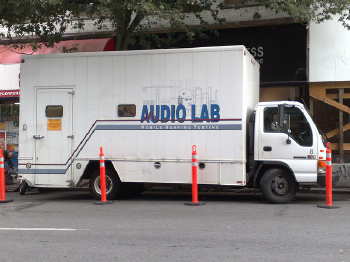
As an interesting aside, my years of copying weak CW tones, has shown itself in other ways as well. Before retirement as a high school tech ed teacher, staff were required to have their hearing checked annually, as part of the medical plan's requirement. Each year the mobile audio lab would roll-up for the tests. I would always make sure to sit perfectly still, with no headphone cord wires brushing against my clothing. The tones varied in frequency and intensity and were often extremely weak, not unlike the weak echoes I was used to copying from the lunar surface. The reaction from the examiner was always the same, every year ... complete astonishment when checking the results and usually a comment that I had the hearing of a teenager! Thankfully my hearing, which I've always been careful to protect, remains exceptionally good, for which I am truly grateful ... so often this is a genetic thing and there is little one can do about controlling hearing-loss as one ages.
I shudder anytime I see a young person with headphones or earbuds firmly in place and with the music volume cranked up to unbelievably high levels. Sadly, many of them will likely pay the price for this later in life as such hammering-away at the delicate auditory mechanism has a cumulative rather than a short-term effect.
So ... the next time you find yourself trying to copy that ultra-weak signal just riding along in the noise, try turning the audio way, way down. Take a deep breath and listen to the tone, not the noise. If you ask me, the best signal filter is still the one between our ears.
Steve McDonald, VE7SL, is a regular contributor to AmateurRadio.com and writes from British Columbia, Canada. Contact him at [email protected].
Saved by something or other
Today I almost bought a new rig. I say almost because it has been the closest time I have ever got to buying a new rig. I had a week with a KX3 and found it wasn’t to my taste, not because it didn’t perform well but for some reason or another it just didn’t do it for me. So I looked at the new Icom IC7300 and was really taken aback by it. It looks like a great rig and I’m sure it’ll do a lot for those that buy it, one day I might get one. Today I almost did. My finger was hovering over the buy now….I put one in the basket and got the credit card out. My XYL pointed out I could afford it (This made me very suspicious). Then I realised I was sure I didn’t actually want it. Am I losing the fun of radio?
I don’t think so.
I bought a LNR Precision Mountain Topper last April and have used it a handful of times and enjoyed the portability of it all. The simplicity and the lack of domestic real estate needed to make it work for me. I put together a neat little pack for taking away with me and I think I’ll refine that a little. Some things might look familiar, others look like they’re missing, notably a ‘flight deck’ or ‘thing to put your radio on whilst you’re operating out and about’. I’m going to laser cut a bespoke one that will fit into the case (which by the way is an old Dremel carry case). More on that later

So I decided to save my money and think about a shack in the box that I really miss, a Yaesu FT817ND. I sold my 817 a couple of years ago and regretted it from the minute I sold it. I think I will get myself a decent second hand one of those with a few of the bells and whistles I didn’t have the first time around. At least that’s what I think I’ll do today.
Tomorrow I’m sure I’ll change my mind again.
Alex Hill, G7KSE, is a regular contributor to AmateurRadio.com and writes from Cumbria, UK. Contact him at [email protected].
ICQ Podcast Episode 216 – DA0HQ Contest
In this episode, Martin M1MRB / W9ICQ is joined by Edmund Spicer M0MNG, Chris Howard M0TCH and Ed Durrant DD5LP to discuss the latest Amateur / Ham Radio news. Colin M6BOY rounds up the news in brief, and this episodes feature is an interview with the organisers of the DA0HQ Contest site.
- Malaysian Amateur Radio Licences Changes
- BBC Starts Roll-Out of International Radio App
- US Ham’s Save Kids from Surrounded Campfire
- Earthing and the Radio Amateur
- Ofcom Proposes Ham Band for Wi-Fi
- UK Amateurs Visit 10 Downing Street
- AES Ham Radio Store Closing Down
- New European Table of Frequency Allocations
- Australian Radio Operator Fined and Off Air
Colin Butler, M6BOY, is the host of the ICQ Podcast, a weekly radio show about Amateur Radio. Contact him at [email protected].
 Ham Radio Deluxe |
 W5SWL Electronics |
 Ham Radio Prep |
 KB3IFH QSL Cards  Hip Ham Shirts  HamRadioAuctions HamRadioAuctions Reliance Antennas Reliance Antennas Enigma Shop Enigma Shop |  morseDX  Ni4L Antennas  R&L Electronics R&L Electronics antennas.us antennas.us QRV QRV |
- Matt W1MST, Managing Editor
