 |
 Field Day – ’29 Style!
 27 June 2016 | by
  |
| courtesy: WA3TTS & NO3M |
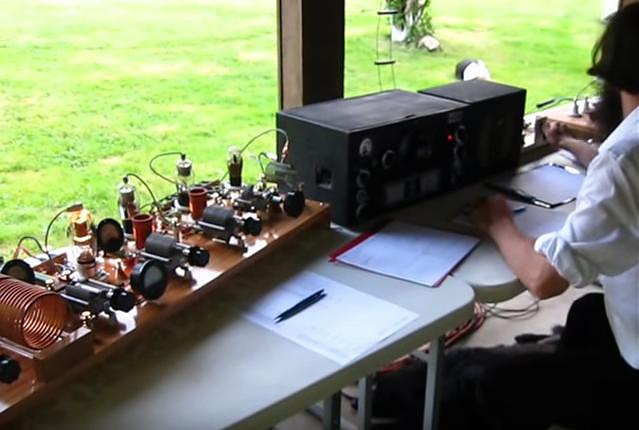
In Eric's own words:
I had a 1920/1930s style Field Day setup this weekend and a bunch of guys over. 80M doublet with homebrew open wire line (approx 550 ohm), the transmitter was a 27-24-24-865 job more or less straight out of July 1931 QST, but with a Hartley instead of crystal oscillator. 27 tuned to 80M, first 24 to 40M, second 24 also 40M, and the 865 on 40M. About 10W. Never did get a chance to try her out on 20M by using the second 24 as a doubler.
I also built the complementary amplifier using a 203A from the August 1931 QST article. I had not even tested the amplifier, only having been finished at 1AM Saturday morning!! It is somewhat different in that the grid circuit is composed of the driving rig's antenna coupling coil/cap, re-wired to be in parallel, not series, of course. It was coined as being a good amp for any existing power oscillator or MOPA, We did a quick job of neutralizing while the gang was here and fired it up..... no modern measurement devices in sight, so we were only going on RF current. 0.9 amps into 50 ohm (pre-tuned the homebrew link coupled, balanced tuner with an analyzer beforehand)... so about 40 watts. I was hoping for 100W.... anyways, after most guys left, a couple of us starting messing around with it more, mainly tightening the output coupling of the MOPA and amp tanks. NICE! 1.45 amps, ie. 105W on 40M.
Anyways, I'll have a full writeup and photos on my website in a few days. We used an HRO5 for a receiver; everyone commented on how good it sounded and well it handled. Of course, this is from a bunch of guys that grew up with this stuff and/or has owned one at one time or another. Everyone had a great time and lots of good discussion and visiting, including 153 QSOs with that pile of junk!
73 Eric NO3M
Most will agree that Eric's station is far from a "pile of junk" as his superb homebrewing skills are clearly evident! Setting up this old style gear can be challenging at any time, but doing it for an outside weekend operation must have been a ton of work. Well done Eric!
For more information about building and operating '29-style transmitters, see the links on my blog sidebar.
Steve McDonald, VE7SL, is a regular contributor to AmateurRadio.com and writes from British Columbia, Canada. Contact him at [email protected].
Weekly Propagation Summary – 2016 Jun 27 16:10 UTC
Here is this week’s space weather and geophysical report, issued 2016 Jun 27 0346 UTC.
Highlights of Solar and Geomagnetic Activity 20 – 26 June 2016
Solar activity was very low during the entire summary period with only B-class flare activity observed. No Earth-directed CMEs occurred.
No proton events were observed at geosynchronous orbit.
The greater than 2 MeV electron flux at geosynchronous orbit reached high levels on 21-22 Jun and 25-26 Jun following coronal hole high speed stream events. Normal to moderate levels were observed on the remaining days.
Geomagnetic field activity was quiet on 20-21 Jun. Mostly quiet conditions were observed early on 22 Jun but activity increased after 22/1800 UTC due to enhanced solar wind parameters and unsettled to minor storm levels were observed. Quiet to unsettled conditions with isolated active periods were observed on 23-24 Jun due to negative polarity CH HSS effects. Quiet to unsettled conditions were observed on 25-26 Jun with an isolated period of active conditions observed from 26/2100-2400 UTC due to CH HSS effects.
Forecast of Solar and Geomagnetic Activity 27 June – 23 July 2016
Solar activity is expected to be very low throughout the forecast period with a slight chance for C-class activity.
No proton events are expected at geosynchronous orbit.
The greater than 2 MeV electron flux at geosynchronous orbit is expected to be at high levels from 27 Jun to 01 Jul following CH HSS effects. Normal to moderate levels are expected on 02-03 Jul as a CIR redistributes electrons. High levels are expected to return from 04-07 Jul following a recurrent CH HSS. Moderate levels are expected from 08-21 Jul followed by moderate to high levels on 22-23 Jul following another recurrent CH HSS.
Geomagnetic field activity is expected to begin at unsettled to active levels but decrease to mostly quiet levels by midday on 27 Jun and remain quiet through 29 Jun. Quiet to unsettled conditions are expected from 30 Jun to 05 Jul with isolated active conditions possible on 03 Jul due to a recurrent negative polarity CH HSS. Quiet conditions are expected on 06 Jul. Quiet to unsettled conditions are expected from 07-12 Jul with minor storms possible on 11 Jul and active periods likely on 12 Jul due to effects from a recurrent positive polarity CH HSS. Mostly quiet conditions are expected to return from 13-18 Jul with unsettled periods possible on 14-15 Jul. Quiet to unsettled conditions are expected on 19-21 Jul due to negative polarity CH HSS effects with an isolated active period likely on 19 Jul. Quiet conditions are expected for the remainder of the period.
Don’t forget to visit our live space weather and radio propagation web site, at: http://SunSpotWatch.com/
Live Aurora mapping is at http://aurora.sunspotwatch.com/
If you are on Twitter, please follow these two users: + https://Twitter.com/NW7US + https://Twitter.com/hfradiospacewx
Get the space weather and radio propagation self-study course, today. Visit http://nw7us.us/swc for the latest sale and for more information!
Check out the stunning view of our Sun in action, as seen during the last five years with the Solar Dynamics Observatory (SDO): https://www.youtube.com/watch?v=zXN-MdoGM9g
We’re on Facebook: http://NW7US.us/swhfr
Visit, subscribe: NW7US Radio Communications and Propagation YouTube Channel
ICQ Podcast Episode 214 – Calibration
In this episode, Martin M1MRB / W9ICQ is joined by Leslie Butterfield G0CIB and Matthew Nassau M0NJX to discuss the latest Amateur / Ham Radio news. Colin M6BOY rounds up the news in brief, and this episodes feature is Calibration.
EURO 2016 Amateur / Ham Radio Award
Ofcom Remove Amateur / Ham Radio Statistics
White House honors Limor Fried AC2SN
Russia Trial Electromagnetic Warfare System
FCC Technological Advisory Council Noise Floor Inquiry
New National Belize Amateur / Ham Radio Society
RadioShack Photography Competition
ZS1TWO Cape Town 2m Beacon
Colin Butler, M6BOY, is the host of the ICQ Podcast, a weekly radio show about Amateur Radio. Contact him at [email protected].
ICQ Podcast Episode 214 – Calibration
In this episode, Martin M1MRB / W9ICQ is joined by Leslie Butterfield G0CIB and Matthew Nassau M0NJX to discuss the latest Amateur / Ham Radio news. Colin M6BOY rounds up the news in brief, and this episodes feature is Calibration.
EURO 2016 Amateur / Ham Radio Award
Ofcom Remove Amateur / Ham Radio Statistics
White House honors Limor Fried AC2SN
Russia Trial Electromagnetic Warfare System
FCC Technological Advisory Council Noise Floor Inquiry
New National Belize Amateur / Ham Radio Society
RadioShack Photography Competition
ZS1TWO Cape Town 2m Beacon
Colin Butler, M6BOY, is the host of the ICQ Podcast, a weekly radio show about Amateur Radio. Contact him at [email protected].
Amateur Radio Weekly – Issue 117

Field Day 2016 is upon us!
Sean, KX9X, Media and Public Relations Manager for the ARRL comes by to share the League’s perspective of the event as well as some tips and tricks to make this Field Day one to remember.
HamRadio360
Field Day 2016 site locator
To find a location near you, type in your town and state in the Location or Call Sign box on the left.
ARRL
It’s Field Day weekend 2016: find a local event, have fun
If you live in North America and have an interest in becoming a ham radio operator, this is the weekend to check out what amateur radio is all about.
The SWLing Post
Are you ready for Field Day?
I’ve been working on my set up for portable HF operations for the last couple of months. It is nothing elaborate or even remotely fancy. It does work and that is good enough for me.
N0RVS
VLF, LF, MF experimenters will transmit ARRL Field Day greetings
A number of Experimental (Part 5) licensees — nearly all of them radio amateurs — have been plying the depths of the radio spectrum as the ham radio community awaits FCC action on the new 2200 and 630 meter bands.
ARRL
Field Day 2016: Activate Off Grid Systems!
Be flexible and understand that Field Day means different things to different people. For some, it’s a serious disaster preparedness drill. For others, it’s a contest, a public outreach effort, or a picnic in the park with radios.
Off Grid Ham
Checklist for a GOTA station
So, I don’t forget to bring anything, I thought I’d come up with a checklist for the station.
KB6NU
Special event station K1D to operate satellites on Field Day
In an effort to encourage more kids and their families to get involved in the hobby, the kids at Ham Radio (dot) World are working to put an all-kids Special Event ARRL Field Day station on the air.
Southgate
“Amateur Radio Week” proclamations abound in advance of Field Day
Several states, counties, and communities across the US have officially recognized the public contributions of Amateur Radio.
ARRL
New Mexico wildfire emergency threatens some Field Day sites
Amateur Radio Emergency Service (ARES®) volunteers in New Mexico late last week responded to the Dog Head fire, which is affecting Torrance and Bernalillo counties, and that activation continues.
ARRL
Field Day 2016 rules [PDF]
Field Day is open to all amateurs in the areas covered by the ARRL/RAC Field Organizations and countries within IARU Region 2. DX stations residing in other regions may be contacted for credit, and may submit entries as check-logs.
ARRL
Amateur Radio Weekly is curated by Cale Mooth K4HCK. Sign up free to receive ham radio's most relevant news, projects, technology and events by e-mail each week at http://www.hamweekly.com.
Got Noise?
 |
| courtesy: ARRL's Utility Noise (RFI) Signatures |
Excuse me if I seem somewhat cynical, but where have they been for the past twenty years as RF pollution, of now unbelievable proportions, has become the norm for most amateurs living in populated regions? In view of the present ubiquitous level of noise pollution, asking this question now is really akin to closing the barn door long after the horses have escaped ... and sadly, they are going to be very difficult, if not impossible, to round-up.
As radio amateurs, we are probably high on the list of those most negatively impacted by unwanted RF crud and were probably the first to bring this issue to the forefront. Many amateurs have watched, and continue to watch helplessly, as their noise floors climb higher and higher. For some, it happened overnight. In major cities and suburbs, it has become increasingly difficult to listen to normal AM radio because of RF noise pollution, so it's not just hams who are affected.
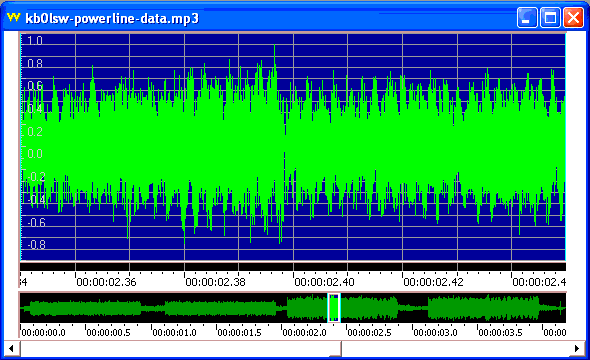
In many cases, the noise is powerline related and although this is part of the inquiry, in most cases this is probably not the main problem. Powerline noise is well acknowledged and here in Canada, RF pollution stemming from powerline radiation is illegal. Hydro authorities are required to clean-up noisy lines by government mandate (Industry Canada) and seem to react positively to complaints by amateurs. I believe a similar mandate is in play south of the border but because of the vast numbers of hydro operators operating in so many jurisdictions, getting action often seems fraught with difficulty.
The inquiry seems focused on the more nefarious types of radiation sources ... those that are not powerline-related, such as RFI caused by switching power supplies, light dimmers, electric motors, high efficiency lighting, computers, portable electronic devices, wireless routers ... generally any type of device radiating unwanted RF emissions.
Presently, complaints about this type of RF noise to governing bodies or to national associations, mostly seem to go without effective response ... solutions to the problem seem to be left to the amateur to "fix" the offending device or to just "accept it", rather than to put responsibilities on the manufacturers creating the problems. I know personally of amateurs who have just given up the hobby or have moved to the countryside because of impossibly-high illegal noise levels. It seemed as if calls for tighter government controls on electronic device emission-levels, especially on inexpensive and poorly-designed imports, largely from the far east, fell upon deaf ears. Some European jurisdictions found a ridiculous solution to the growing complaints by slackening even further, the allowable 'accepted' levels of spurious emissions. Previously illegal noise-making devices became legal overnight!
In the meantime, noisy electronic devices continue to flood the market at exponential levels ... only now, does the FCC pose this mind-boggling question! Equally stunning is their assertion that "... in search for concrete evidence of increased noise floors, we have found limited quantitative data to support this presumption." Perhaps if they had been maintaining vigilance instead of ignoring complaints when the problems were first reported, they would already have a huge body of the 'quantitative data' they are now seeking.
The Technical Advisory Council Noise Floor Inquiry (ET Docket No. 16-191) is well worth reading for any radio amateurs interested in finding solutions to growing noise problems. The three-page document includes a short list of questions to which responses are sought ... your input is vital, especially if hard data can accompany your comments.
Is it too late to turn the tide? There is no doubt that at this late date, it will be a huge uphill climb. The public notification document can be found here and the deadline for submissions, which can be made here, is August 11, 2016.
Steve McDonald, VE7SL, is a regular contributor to AmateurRadio.com and writes from British Columbia, Canada. Contact him at [email protected].
Packing small
We’re off for our first real holiday in five years. Two weeks in Sweden in a rented motor home. Can’t wait to enjoy the fresh air and laid-back lifestyle. The results of the end-fed half wave (EFHW) experiments were good enough that I packed it in my suitcase. For transmitter I decided not to take my KX3 but get a simple crystal controlled CW kit from eBay. Only cost a few bucks and it is fun just to see if I can make some QSOs with it at all. If not, then nothing lost. I modified the LPF so I can also stick some 20 meter crystals in it. The straight key is a J37 (SKCC QSOs wanted) and a 5/12 Volt battery pack completes the setup.

See you on the bands!
Hans "Fong" van den Boogert, BX2ABT, is a regular contributor to AmateurRadio.com and writes from Taiwan. Contact him at [email protected].
 Ham Radio Deluxe |
 W5SWL Electronics |
 Ham Radio Prep |
 KB3IFH QSL Cards  Hip Ham Shirts  HamRadioAuctions HamRadioAuctions Reliance Antennas Reliance Antennas Enigma Shop Enigma Shop |  morseDX  Ni4L Antennas  R&L Electronics R&L Electronics antennas.us antennas.us QRV QRV |
- Matt W1MST, Managing Editor
