 |
 AmateurLogic 94: Plain Brown Wrapper
 15 August 2016 | by
AmateurLogic.TV Episode 94 is now available for download.
In this extra long episode Peter adds a display to his Arduino Uno. Emile visits the W5SLA hamfest. George explains how a triode tube amplifier works.
Our friend from the ‘Great White North’, Mike Morneau, VE3MIC demonstrates the Universal Digital Repeater Controller operating D-Star on a competing format repeater.
We unwrap a ‘Mystery Package’ that arrived from a foreign country. George and Tommy sample fine Canadian cuisine and Marmite for the first time. Which wins the title of most awful taste ever, Marmite or Vegemite?
Plus plenty of the usual fun and some great viewer photos.
1:55:40
George Thomas, W5JDX, is co-host of AmateurLogic.TV, an original amateur radio video program hosted by George Thomas (W5JDX), Tommy Martin (N5ZNO), Peter Berrett (VK3PB), and Emile Diodene (KE5QKR). Contact him at [email protected].
Lithuania from the Beach
Judy and I went to the beach today. It was 93F. We walked along the shore, rode our bikes, and I worked a little DX.

After walking a mile or so along the beach, Judy took a swim and lay down for some sun, and I set up the KX3 on a bench overlooking Rye Harbor. Above the rocky shore wild roses decorated the entire area. I set up a 33 foot collapsible DK9SQ mast, which I happened to have in the camper. I used a cord to hold it to the back of the bench.

The wire is running alongside the pole. The yellow string you see coming out the side is just a line attached to the wire. I usually use it to toss over a tree branch. I didn’t bother to disconnect it.
I tuned up on 20 meters and made my first contact with John W5LNI in Arkansas. He gave me a 559 and he was 599 with 300 watts and a log periodic antenna. “UR 8 watts doing FB here,” he sent. I was really happy to make a contact with the poor band conditions.

Next I heard another station in Arkansas calling CQ. Darron KG5ABL answered and we exchanged quick 599s. He said he was having trouble with QSB and we signed.
Up the band a little, Remi LY8O in Lithuania was very strong. I answered his CQ and he gave me a 559. What a thrill to work Europe from the beach. Thanks for the nice QSO, Remi.
After packing up, we rode our bikes along the coast for a couple of miles. What a glorious day!
Jim Cluett, W1PID, is a regular contributor to AmateurRadio.com and writes from New Hampshire, USA. Contact him at [email protected].
Goodbye FM, welcome DMR
Since I left the Netherlands in 2010 the situation on VHF/UHF there has changed considerably. The Dutch telecom regulator (Agentschap Telecom, or AT for short) revised their repeater policy which resulted in some well known repeaters not getting their licence renewed. On the other hand it opened up opportunities for new experiments like the Coversity network in the north of the country, inter regional repeaters PI3UTR and even the world’s first intercontinental repeater PI2NOS with an access point on the Caribbean island of Curaçao (PJ2NOS). If you want to listen in you can visit the 70 cm webSDR at http://websdr.pi1utr.ampr.org:8901/.
What the AT also noted was that the 70 cm band was quite underused and that there were many requests for digital voice repeaters. The frequency allocation for digital repeaters was expanded and that resulted in a wave of new repeaters, mostly DMR. If you look at the current repeater coverage map it is clear that there are only few places in Holland without DMR coverage.  Unfortunately for System Fusion users this means that their repeaters aren’t getting permits to go on air. Part of the problem is that areas are already covered by DMR and D-Star repeaters and part is that System Fusion repeaters run in dual mode: analog FM and digital C4FM. Running an analog repeater in the digital segment of the band or vice versa doesn’t make sense, of course, hence the rejections.
Curious about the fast rise of DMR I decided to check it out a couple of weeks ago while I was in Holland on a family visit. I pre-ordered a Tytera MD-390 which was waiting for me the day I arrived. Unfortunately, without programming (installing a codeplug) the thing won’t work. Being a DMR newbie I decided to call in the help of the local chapter of the VERON, who meet every Friday night in their own club shack in Arnhem. I wasn’t the only one who brought a DMR rig, which confirmed again that DMR is quite popular in Holland. The local DMR repeater owner Cor (PD0GHF) knew immediately what I wanted and called Dave (PD5DOF) in to help me out. Here he is working hard to get the codeplug in order.
 After a while he got it right and my rig sprang to life. The MD-390 came with two antennas and the longer one was necessary to be able to hit the repeaters when we were indoors.
 Cor then explained the use of Talk Groups and reflectors and although I understood most, DMR is still rather complex if you come from the analog world. But back home on the camping where we stayed I tried it out and it worked. My first DMR QSO was with Cor (PD0GHF), so that was fun.
After two weeks of using the MD-390 I was totally hooked. The rig can do both DMR and analog NFM and I did make a few QSOs via PI2NOS in good old NFM mode. But NFM pales in comparison with DMR. I have never been able to stand the white noise that is so typical in FM mode; it tires my ears too much. When there is a signal I really have to strain my ears to follow the conversation, especially with weaker signals that have a lot of artifacts. Because of this I have never liked having an FM rig in my car, either.
DMR, on the other hand, is crystal clear. The signal is either there or not there, but when it is there it seems the person is standing right next to you. There is a little “robotic” sound effect, often associated with digital voice, but overall I didn’t find it disturbing. There were no problems hitting local and more distant repeaters and quality was very constant. Amazing that they can put all this in 6.25 kHz of bandwidth. It makes good old NFM look “old” to me.
And then there is the linking of repeaters. Via my local DRM repeater I could talk to any one in the Netherlands on the repeater in their neighbourhood, not just the hams within reach of my repeater. The internet helps out here and linking is global. Saturday at 16 UTC the DMR-MARC World Wide Net is held and you can hear hams from all over the world checking in on Talk Group 2. Amazing!
Now I know many of you old timers will object to digital and the use of the internet in ham radio: “First it was Echolink, now it’s all this digital voice stuff hooked into the net. If it’s not radio, it’s got nothing to do with us hams. And digital signals don’t make for good DXing anyway. FM, AM and SSB degrade more gracefully and provide better signals under challenging conditions.”
I understand the objections. Even I rather listen to good old AM radio on shortwave and SSB on the ham bands. Unfortunately, these modes are fading out and are being replaced by others, if you like it or not. I still don’t understand the attraction of using any of the JT-modes, but they are more popular than ever. To me they are not what ham radio is about, but I accept that many others don’t agree with me. Luckily ham radio is such a diverse a hobby that everyone can find his or her “thing” and be happy with it.
And besides, we hams are quite innovative and always keep radio in the back of our head. We want to be independent, after all. Up and coming in the Netherlands is Hamnet. In short: HAMNET is a high speed amateur radio multimedia network based on commercial wireless devices using mainly the 6 cm band. An internet for hams via radio waves. Guess what you can use to connect all those DMR repeaters with each other instead of the internet? Analog is dead. Long live digital!
Hans "Fong" van den Boogert, BX2ABT, is a regular contributor to AmateurRadio.com and writes from Taiwan. Contact him at [email protected].
Remembering The ‘Woodpecker’
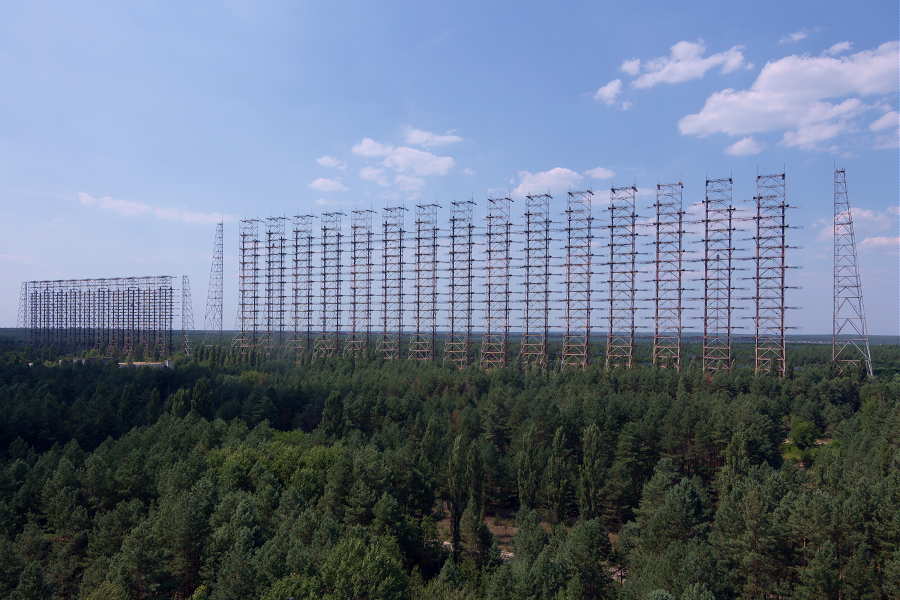
Those of you that have been hams for a long time will no doubt recall the Russian 'Woodpecker'. The 'Woodpecker' was a strong, fast repeating signal / racket that often wiped out amateur communications on 20m here in North America ... maybe other parts of the world as well.
Amateurs with yagis eventually determined that the signals (yes there was more than one it seemed) were coming from the USSR. The QRM was persistent and in spite of formal complaints being lodged via diplomatic channels, continued for many years ... from 1978- 1989. Some of the new transceivers built during the time actually had a 'WOODPECKER' position on the noise blanker switch, hopefully offering some relief to the problem.
For you younger folks, here's what Duga usually sounded like:
Several web searches brought up numerous descriptions of the Duga (Russian for 'arc' or 'bow') project, some with conflicting information. From what I can sort out, there were three Duga sites ... one near Chernobyl, another near Chernihiv and a third, much later, in Siberia. The first two (Duga and Duga-1) were in the Soviet Ukrainian SSR (now Ukraine) while the third was located near Komsolmosk-on-Amur in the Russian far east. One source indicates that the second Chernobyl site is often misidentified as the Duga-3 array and should be referred to as Duga-1, with Duga-2 being the Siberian location.
Initial speculation suggested this intrusive signal was some form of 'jammer' ... very common during the Cold War. It wasn't long before the true nature of Duga was thought more likely to be an 'over-the-horizon' (OTH) long-range radar system for detecting the launch of North American missiles aimed at the USSR. The three radar sites gave the Soviets good over-the-pole coverage as well as to the east, where it could also be utilized for tracking domestic rocket launches.
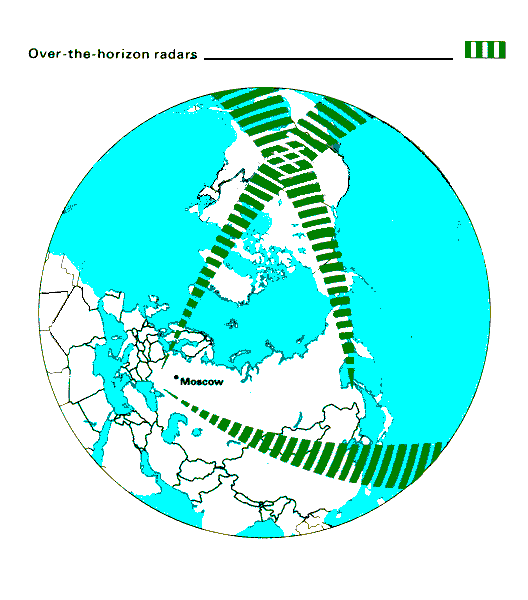 |
| courtesy: http://www.globalsecurity.org/wmd/world/russia/steel-yard.htm |
The antennas themselves appear to be phased dipole curtain arrays, commonly used in various configurations by shortwave HF broadcasters.
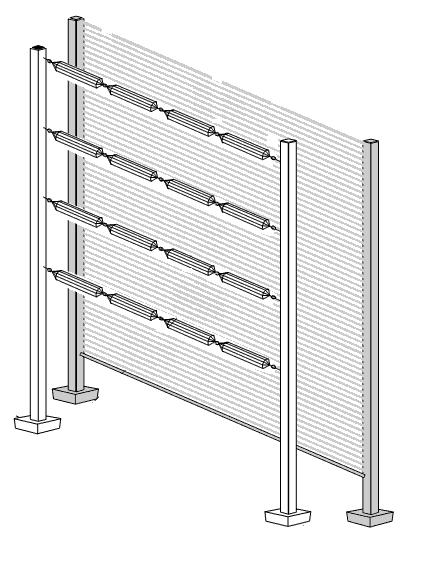 |
| courtesy: http://www.antenna.be/hr.html |
Each site was paired with a receiving array ... remember, this was a radar system, with two of the three systems having the receiving array located tens of kilometers from the transmitter. The Chernobyl Duga is said to have had the receiving antenna located on site. Sources discussing physical size indicate the dimensions for the receiving array to be larger than those of the transmitting antenna. It seems possible then, that the pictures and videos commonly found are those of the receiving array and not of the transmitting antenna. It might make sense to have more gain on 'receive' than on 'transmit' as echoes from small targets many thousands of miles away would not be easy to detect. No matter what the actual case, I can only imagine the fun of hooking up an HF transceiver to one of these arrays during a DX contest on 20m CW!
The Chernobyl site shows two arrays, side-by-side ... possibly the larger being that used for receiving and the smaller one for transmitting. This antenna has been noted as a 30/10/2 array ... 2 bays, 30 dipoles wide and 10 high, 600 elements in all!
Further research tends to indicate that each dipole is what is called a 'Nadanenko' dipole. The main feature of this style was its cage-styled construction, giving the element a large diameter resulting in a broad bandwidth.
 |
| courtesy: https://shema.info/en/antenna/ |
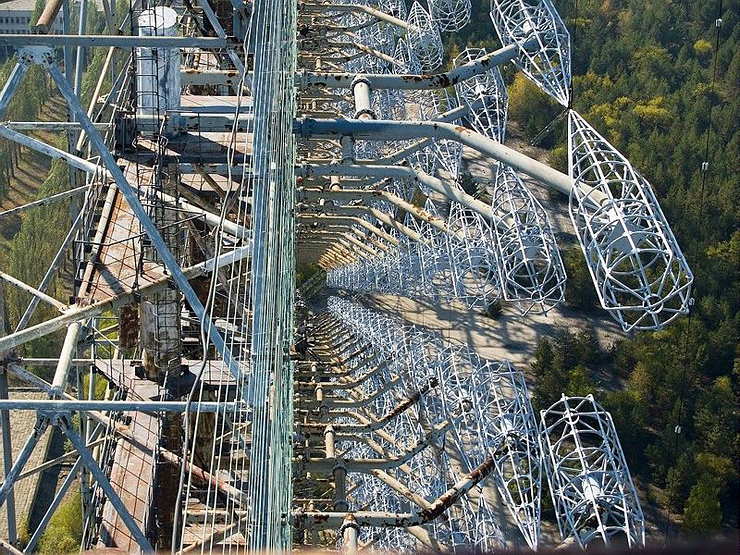 |
| courtesy: englishrussia.com |
First, you see that there are two sets of arrays 15 driven elements wide by 10 driven elements high for a total of 600 elements! They are intermeshed and offset from each other by 1/2 wavelength both vertically and horizontally. There is a horizontal wire screen reflector behind the driven elements.
Some of the other things I noticed are ...
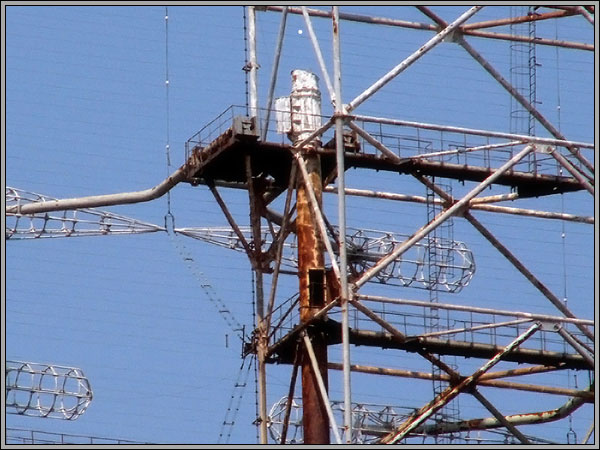
... you can see the open-wire feeds and reflector screen. Each set of collinear elements is fed individually with open wire line. There is a support line between each two bays of driven elements.
... that the reflector screen is supported on the sides by the stand-alone free-standing towers at each side of the array. (I had been wondering why they would have those towers next to the array like that. Now I know.)
... that the element supports are steel pipe instead of fiberglass (or something similar). Apparently, the shape of the radiators allows for the pipe supports to enter the element cages at the element low-impedance point which made the supports invisible to the antenna and also allowed for the supports to not radiate themselves.
 |
| courtesy: http://anzee.livejournal.com/65530.html |
The Duga system was operative between 7 and 19MHz, with 40kHz wide pulses, usually lasting for about seven minutes. The most common pulse rate was at ~10Hz but this sometimes varied. Power levels used often mention 10 megawatts but it's not clear if this was RF output, peak pulse power or ERP.
It's somewhat gratifying after all these years, to actually see close-up, where the Woodpecker signal started its journey around the world and to appreciate the superb engineering that went into these impressive structures ... but sad to see the last one in such a rusted state of decay and abandonment. It would be nice to hear it just one more time ... but please, only for a couple of minutes.
Steve McDonald, VE7SL, is a regular contributor to AmateurRadio.com and writes from British Columbia, Canada. Contact him at [email protected].
Monarch Ridge South SOTA Activation (W0C/SP-058)
For the 2016 Colorado 14er Event, I had to choose really easy SOTA summits to activate because I had fractured my ankle earlier in the summer. At this point, I was able to hobble around with a protective boot but walking more than a few hundred feet was difficult. On Saturday, we drove up Pikes Peak and took a short stroll away from the vehicle to operate. On Sunday, we decided to activate Monarch Ridge South (W0C/SP-058), using the sight-seeing tram that goes to the top.
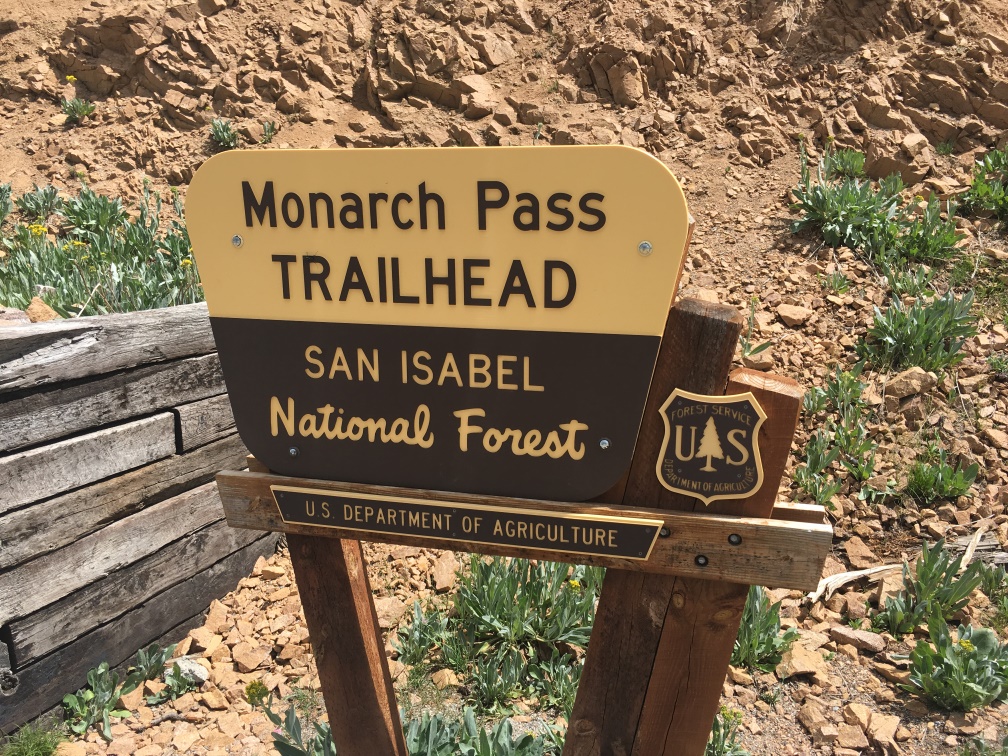 Access is right off Monarch Pass (Hwy 50), where there is a large parking lot. There is a trail that goes to the top and we’ll be back to hike that some other time. (Actually, Joyce K0JJW and I already tried to snowshoe to the top in blizzard conditions but that is another story for another day.) The trail is a popular mountain bike route, so we saw lots of bikers in the parking lot unloading gear. Monarch Pass is oriented north/south and the trail heads off to the east (behind the tram building).
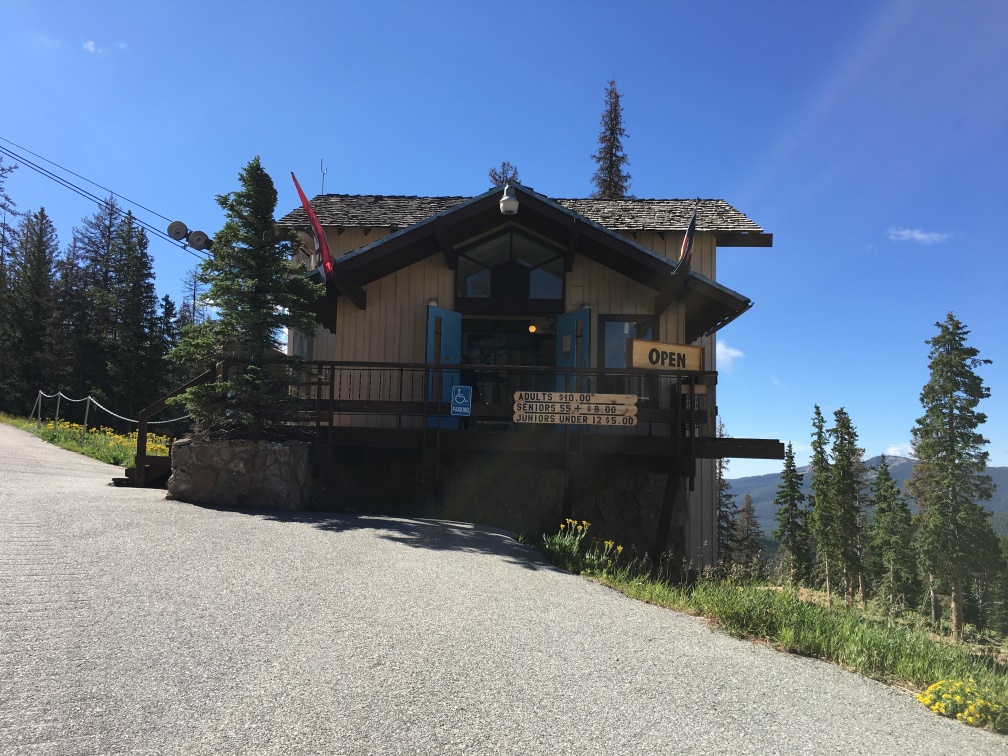 The tram boarding location is inside this building at the bottom of the tram. We purchased tickets in the nearby gift shop, which is worth a look if you need a map, book, ice cream cone or trinkets. See their website for latest schedule and pricing.
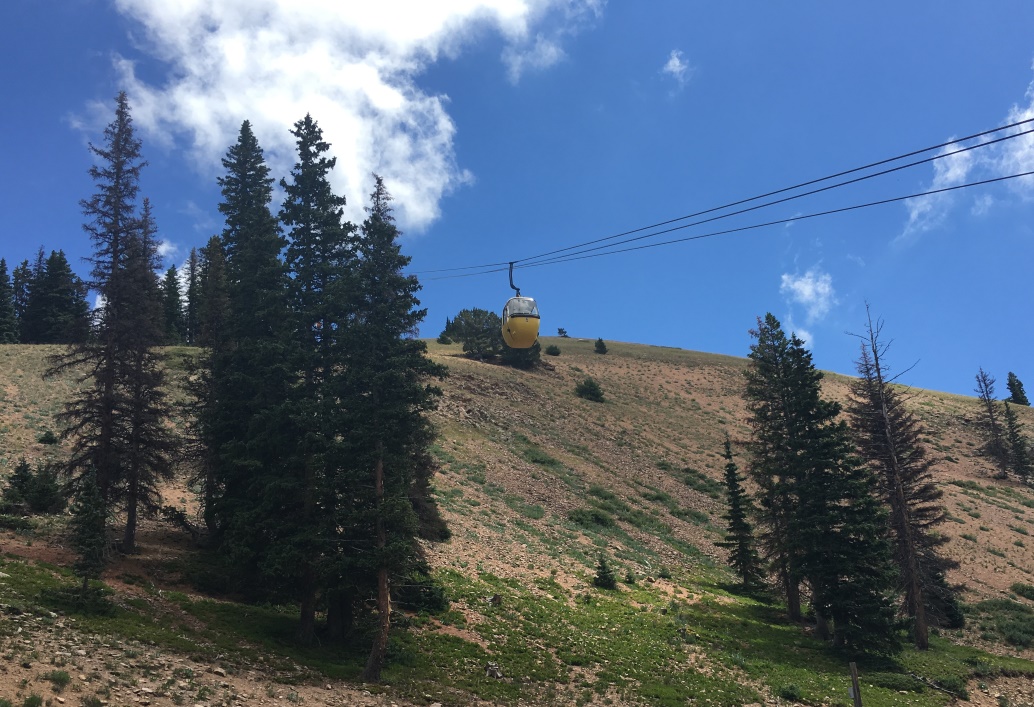 Here’s a photo of the tram going up the side of the mountain. Of course, the views are great and the ride takes about 10 minutes. The tram car holds four people and a reasonable amount of SOTA gear.
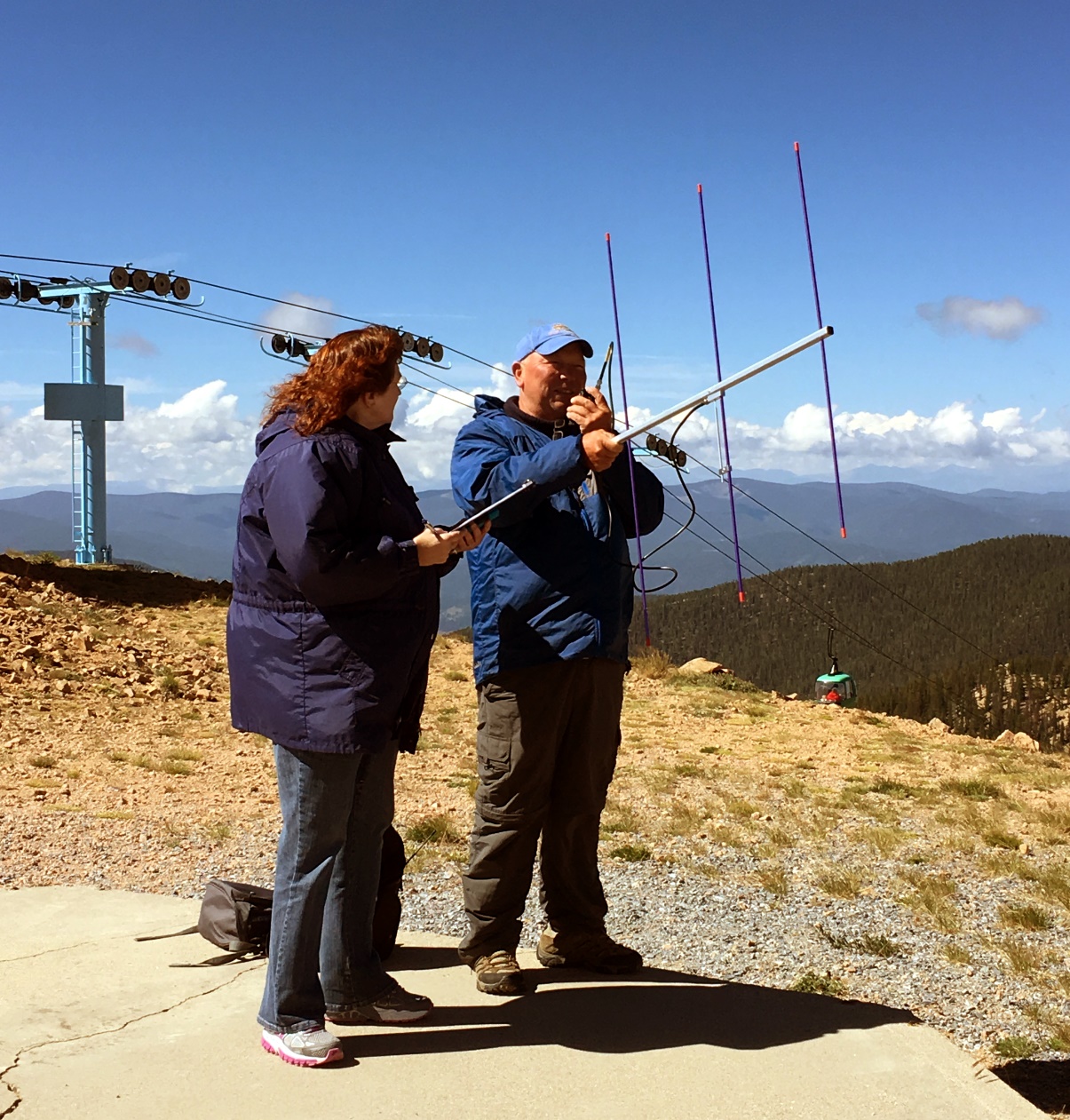 At the top, Denny KB9DPF made contacts on 2m FM, aided by expert logger Kathy KB9GVC. The actual summit is a ways to the south of the tram, maybe a tenth of a mile, but we operated from a concrete pad on the north side. The ridge is flat and we judged the activation area to be very large.
We made a total of 13 contacts on 2m and 70cm, including 5 other SOTA summits (S2S).
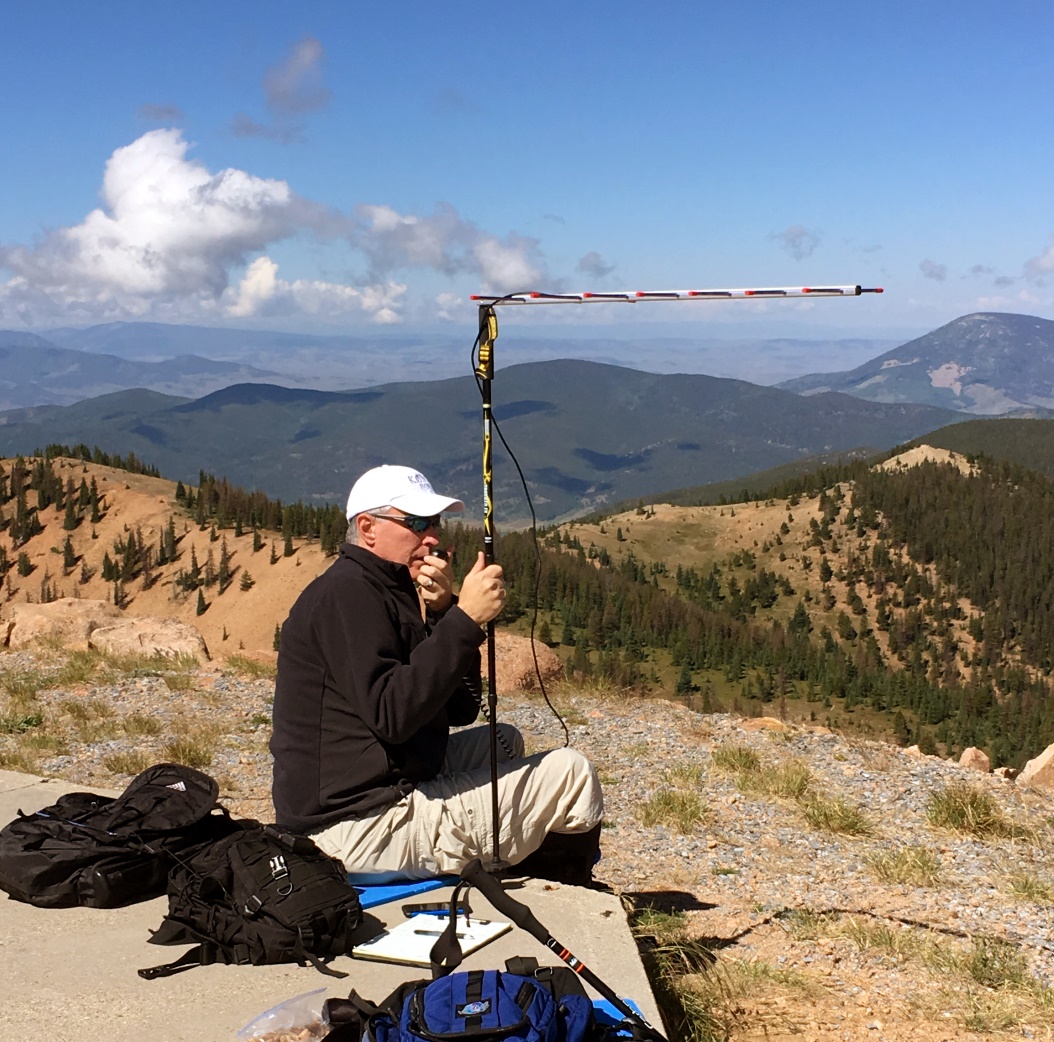 I used my Yaesu FT-817 on 432.100 MHz SSB, hoping to find someone in the UHF contest that is happening concurrently with the 14er event. I didn’t work anyone on 70cm SSB but I did work K3ILC in Colorado Springs on FM at a distance of ~90 miles. Not too bad. The Arrow antenna is attached to my hiking stick via the camera mount thread.
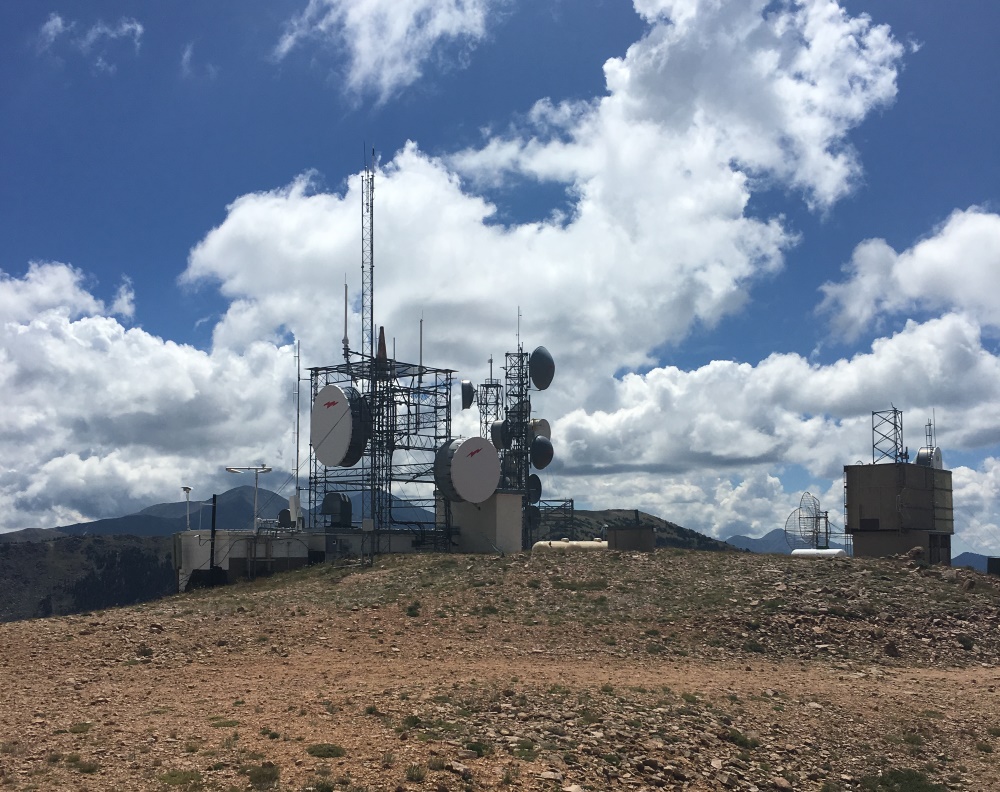 There is a substantial radio site on Monarch Ridge that did provide some RF interference to us on 2 meters. The 70 cm band seemed to be unaffected but I can’t be sure. The “bad boy” transmitter is the KMYP automated weather station (AWOS) transmitting continuously on 124.175 MHz. Well, at least we could receive current weather information. We did relocate to put some distance between us and the transmitters but my lack of mobility kept us from going too far.
If you are looking for an easy access SOTA summit near Monarch Pass with excellent views, this is it. The hike up should not be very difficult but the tram makes it even easier. If you plan to operate 2 meters, expect some interference. Next time, I’ll try locating even further away from the transmitter site. I might even bring along some bandpass filters. Other SOTA enthusiasts have reported no problems on the HF bands.
At the time of this post, there are plans to put a 2m amateur repeater at this site on 145.325 MHz.
73, Bob K0NR
The post Monarch Ridge South SOTA Activation (W0C/SP-058) appeared first on The KØNR Radio Site.
Bob Witte, KØNR, is a regular contributor to AmateurRadio.com and writes from Colorado, USA. Contact him at [email protected].
WØC/FR-030 (Chief Mountain) 3569m / 11709ft
On Sunday, 7 August 2016 I completed my 9th SOTA activation. Which I realize doesn’t sound like very many considering I completed my very first SOTA activation in November of 2011. Between November 2011 and November 2012 I added seven more to the list. Then I got sick, got busy, had some personal issues and before I knew it the summer of 2016 was quickly slipping away.
For those who have followed my other blog and my podcast (Practical Amateur Radio Podcast), you are aware I started exercising and eating better to get in better shape and lose weight. While I’ve taken over 10 million steps, walked just short of 5,000 miles and climbed 22,000 floors since I started wearing my Fitbit in the summer of 2013, today was the first SOTA activation I had attempted since losing over 50 pounds. While I’m presently in a weight holding pattern, I still make every effort to complete 10,000 steps per day. This walking has kept me in pretty good shape considering where I was just a few years ago. Best I can remember, it took me over 2 hours to hike to the summit of Chief Mountain in 2013.
The trailhead of Chief Mountain is about 40 minute drive from my QTH. As Chief Mountain is extremely popular with hikers/peak baggers I wanted to get an early start. I arrived at the trailhead just after 6:30 AM. With my boots tightly laced and my pack strapped to my back, I hit the trail at 6:45 AM.

The above trail sign is approx. 1 mile from the trailhead parking area and 2 miles below the summit.
One hour and five minutes later I’m standing on the summit of Chief Mountain. The total trail length is approx. 3 miles with a total elevation gain of just under 1,000. This is a great hike and I highly recommend it.
My SOTA HF setup hasn’t changed since 2012. If it works, why mess with it? I use a Buddipole vertical setup with a single wire counterpoise. For this activation I setup for the 20 meter band. I pack enough hardware to create a full-size 1/4 wave length vertical (no coil) along with a 1/4 wave length elevated counterpoise. With band conditions being less than desirable, I believe the extra weight of the two aluminum arms (versus the coil) was worth the effort.

My Buddipole vertical setup with my SOTA flag flying proudly.
Of course, my Elecraft Kx3 (serial number 057) running 10 watts is still very much my pride and joy of my QRP setup and I power it all with my 4+ year old Buddipole A123 Nanophosphate Battery Pack (13.2v, 9.2Ah). However, I must admit I was a little worried if my A123 battery pack would still work after all this time. But I would not be disappointed. They performed just as expected.
HF Contacts (20m SSB)
In just a little over 45 minutes I worked 24 stations from across the US and Canada. Many stations were familiar from previous activations along with many new ones. New Hampshire was the furthest QSO made during this activation.
Thanks to W0MOS, AD1C, N1CC, N1KB, NE4TN, KG3W, K7ZO, VE2JCW, WG0AT, W9MRH, KI4SVM, K2JB, N9FZV, W0MNA, NS7P, VA6FUN, K3SAE, W9RCJ, KK6GMN, KB5IMK, WA9BNZ, N1RCQ, KX3DX, KD0HRM.

A quick “selfie” from my operating position.
VHF Contacts (2m FM)
I don’t always pack along the Elk 2m/440 5 element log-periodic antenna. But as this was the 25th Annual Colorado 14er and SOTA weekend, I wanted a chance to make as many summit to summit (S2S) QSO’s as possible. Again, the added weight paid off. I made an additional six VHF QSO’s with four of those being S2S QSO’s.
Thanks to KD0WHB, WB9KPT, N0BCB, KK6JQV, KC1EPN
Summit to Summit (S2S)
As an activator, we often have the opportunity to work other mountaintop stations in what are known as Summit to Summit (S2S) QSO’s. As this was the 25th annual Colorado 14er and SOTA weekend, I knew my chances of working several Colorado mountain top stations would be good. During the 90 minutes I spent on Chief Mountain I managed to work eight stations on seven different mountain tops. Including two stations out of state (California and Oregon).
All-in-all this was very much a successful SOTA activation. While the HF band conditions were not perfect, the time spent on the air from almost 12,000 ASL was certainly worth it. Anytime I take amateur radio outdoors it always ends up being about the experience and not about anything else. Just the way it should be….
Until next time…
73 de KDØBIK (Jerry)
Jerry Taylor, KD0BIK, is a regular contributor to AmateurRadio.com and writes from Colorado, USA. He is the host of the Practical Amateur Radio Podcast. Contact him at [email protected].
WØC/FR-030 (Chief Mountain) 3569m / 11709ft
On Sunday, 7 August 2016 I completed my 9th SOTA activation. Which I realize doesn’t sound like very many considering I completed my very first SOTA activation in November of 2011. Between November 2011 and November 2012 I added seven more to the list. Then I got sick, got busy, had some personal issues and before I knew it the summer of 2016 was quickly slipping away.
For those who have followed my other blog and my podcast (Practical Amateur Radio Podcast), you are aware I started exercising and eating better to get in better shape and lose weight. While I’ve taken over 10 million steps, walked just short of 5,000 miles and climbed 22,000 floors since I started wearing my Fitbit in the summer of 2013, today was the first SOTA activation I had attempted since losing over 50 pounds. While I’m presently in a weight holding pattern, I still make every effort to complete 10,000 steps per day. This walking has kept me in pretty good shape considering where I was just a few years ago. Best I can remember, it took me over 2 hours to hike to the summit of Chief Mountain in 2013.
The trailhead of Chief Mountain is about 40 minute drive from my QTH. As Chief Mountain is extremely popular with hikers/peak baggers I wanted to get an early start. I arrived at the trailhead just after 6:30 AM. With my boots tightly laced and my pack strapped to my back, I hit the trail at 6:45 AM.

The above trail sign is approx. 1 mile from the trailhead parking area and 2 miles below the summit.
One hour and five minutes later I’m standing on the summit of Chief Mountain. The total trail length is approx. 3 miles with a total elevation gain of just under 1,000. This is a great hike and I highly recommend it.
My SOTA HF setup hasn’t changed since 2012. If it works, why mess with it? I use a Buddipole vertical setup with a single wire counterpoise. For this activation I setup for the 20 meter band. I pack enough hardware to create a full-size 1/4 wave length vertical (no coil) along with a 1/4 wave length elevated counterpoise. With band conditions being less than desirable, I believe the extra weight of the two aluminum arms (versus the coil) was worth the effort.

My Buddipole vertical setup with my SOTA flag flying proudly.
Of course, my Elecraft Kx3 (serial number 057) running 10 watts is still very much my pride and joy of my QRP setup and I power it all with my 4+ year old Buddipole A123 Nanophosphate Battery Pack (13.2v, 9.2Ah). However, I must admit I was a little worried if my A123 battery pack would still work after all this time. But I would not be disappointed. They performed just as expected.
HF Contacts (20m SSB)
In just a little over 45 minutes I worked 24 stations from across the US and Canada. Many stations were familiar from previous activations along with many new ones. New Hampshire was the furthest QSO made during this activation.
Thanks to W0MOS, AD1C, N1CC, N1KB, NE4TN, KG3W, K7ZO, VE2JCW, WG0AT, W9MRH, KI4SVM, K2JB, N9FZV, W0MNA, NS7P, VA6FUN, K3SAE, W9RCJ, KK6GMN, KB5IMK, WA9BNZ, N1RCQ, KX3DX, KD0HRM.

A quick “selfie” from my operating position.
VHF Contacts (2m FM)
I don’t always pack along the Elk 2m/440 5 element log-periodic antenna. But as this was the 25th Annual Colorado 14er and SOTA weekend, I wanted a chance to make as many summit to summit (S2S) QSO’s as possible. Again, the added weight paid off. I made an additional six VHF QSO’s with four of those being S2S QSO’s.
Thanks to KD0WHB, WB9KPT, N0BCB, KK6JQV, KC1EPN
Summit to Summit (S2S)
As an activator, we often have the opportunity to work other mountaintop stations in what are known as Summit to Summit (S2S) QSO’s. As this was the 25th annual Colorado 14er and SOTA weekend, I knew my chances of working several Colorado mountain top stations would be good. During the 90 minutes I spent on Chief Mountain I managed to work eight stations on seven different mountain tops. Including two stations out of state (California and Oregon).
All-in-all this was very much a successful SOTA activation. While the HF band conditions were not perfect, the time spent on the air from almost 12,000 ASL was certainly worth it. Anytime I take amateur radio outdoors it always ends up being about the experience and not about anything else. Just the way it should be….
Until next time…
73 de KDØBIK (Jerry)
Jerry Taylor, KD0BIK, is a regular contributor to AmateurRadio.com and writes from Colorado, USA. He is the host of the Practical Amateur Radio Podcast. Contact him at [email protected].
 Ham Radio Deluxe |
 W5SWL Electronics |
 Ham Radio Prep |
 KB3IFH QSL Cards  Hip Ham Shirts  HamRadioAuctions HamRadioAuctions Reliance Antennas Reliance Antennas Enigma Shop Enigma Shop |  morseDX  Ni4L Antennas  R&L Electronics R&L Electronics antennas.us antennas.us QRV QRV |
- Matt W1MST, Managing Editor
