 |
 Transverter-Amp-Antenna Relay Control Box
 15 September 2016 | by
As mentioned in my last blog, using a transverter to drive a separate amplifier requires some method of switching system in order to automatically handle the antenna, transverter and amplifier input / output ports. To run a relay switching system in the WSPR or JT-9 modes requires that the switching be controlled by the transceiver's PTT line which in turn is controlled by the WSPR software. Using VOX keying is out of the question as it causes the relays to be 'hot-switched' and with higher power will eventually lead to their demise.
For many years I managed PTT line control via my laptop's comm port but these are now things of the past, requiring switching to be done via the USB port. There are many commercial products available that will do this nicely as well as handle the audio feed from radio to computer and vice-versa, but I found that my homebrew version worked just fine. Making it work via the USB port however required a serial-to-usb converter. This was described here, in an earlier blog and for the few dollars invested has proven to be a very reliable interface.
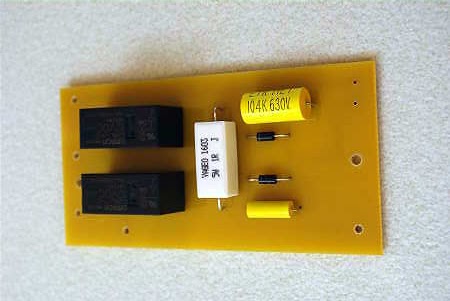
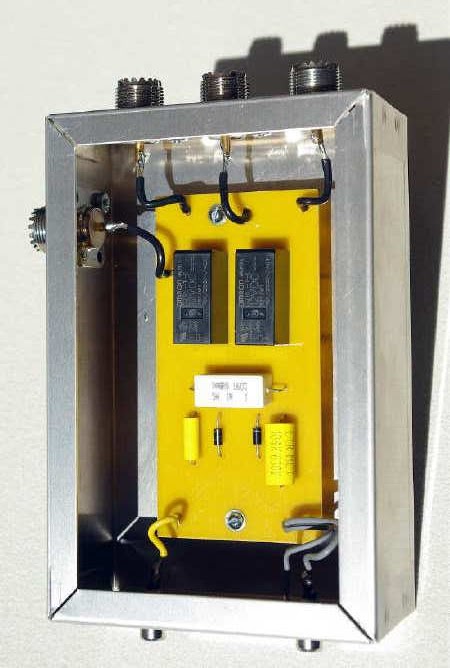
The schematic of the switching control unit is shown below. It uses two inexpensive OMRON G2RL-1-E DC12 relays purchased from Digikey. Although not coaxial, the $3.09 (U.S.) relay will easily handle a kilowatt as decribed by W6PQL. These relays have large contacts, rated at 16A. I added a few extra components that absorb any relay switching transients as well as remove any RF on the control lines.
 |
| Relay Control Unit |
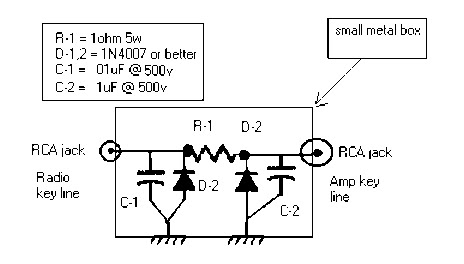 |
| Keying Line Damper: courtesy: KK5DR |
I must say a few words about Digikey's service. I really am amazed at what a superb job they do in supplying hobbyists with small orders. So many companies nowadays cannot be bothered with such things or demand a large minimum order for the privilege of handling your purchase! From what I can tell, Digikey bends over backwards to help out the little guy, with no minimums as well as dirt-cheap, fast shipping. Living in Canada, I'm used to U.S. dealers making me jump hoops to place an order, only to find out that the cost of shipping is often prohibitively high or they ship only via UPS which I will not accept.
I placed a small two-page order with Digikey via their excellent web site on a Tuesday afternoon. On Friday morning, there was a knock at my door at 0800 hours ... it was a courier service delivering my parts! To put this in context, I live on a small island in the middle of Georgia Strait, accessible only by air or by ferry. To me this service is incredible and the cost of postage was only $6.00 (U.S.). I really have no idea how they do this but they obviously have put into operation a very efficient system ... hats off to them and their skilled management that has figured this all out. A few years ago I sent in orders to both Digikey and to Mouser, each within an hour of each other. Like my recent order, the Digikey parts arrived in just a few days while the Mouser parts took over three weeks ... perhaps things have changed since then but this is the reason I use and recommend Digikey whenever I can.
Once I had the needed parts, I quickly built a PCB for the switcher and put it together in a day so that I might begin 630m skeds with VK4YB as soon as possible.

If you would like a full-size layout suitable for the iron-on toner PCB construction method, I'll be happy to send you one via email.
The first test run with VK4YB at 0300 local time proved problematic. When I fired up at full ERP, I immediately saw some output instability on the scopematch screen. Before I could shutdown however, I had blown a FET in the amplifier, shutting me down and sending me back to bed to worry about the situation.
Having had time to think about the problem made me suspect something in the new relay changeover unit since that was the only new variable in the system. I suspected that perhaps the relays were not fully seated before being hit with full RF output and the possible hot-switching had caused enough short-lived SWR to take out the very reactance-sensitive FET final. In many years of operation with the amplifier, this was the first blown FET I have had. When I built it, I made sure that the FETS would be easily accessible (see below) should such an occasion arise ... unlike my initial transmitter, where replacing a FET was a nightmare.
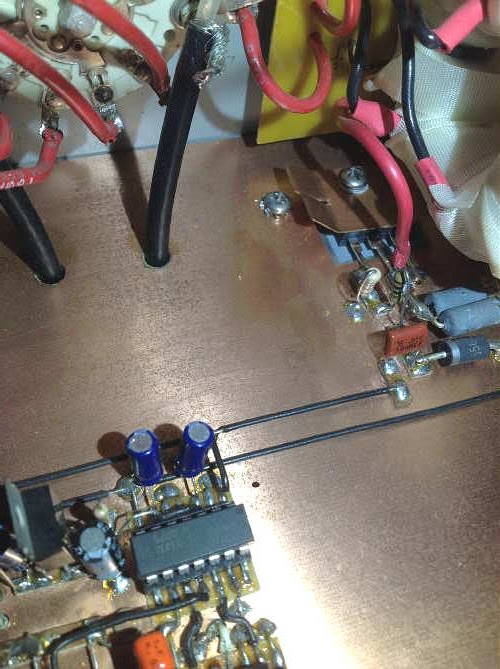
Fortunately, when FETs go south on a push-pull amplifier, only one FET will blow ... whichever one was conducting at the time, thus preserving the remaining FET. I flipped a coin and unsoldered the source lead of the left hand FET and measured it. Sure enough it had a drain-to-source short. My day was off to a better start. Once replaced, I set out to determine what had caused it to blow in the middle of the night.
Since I didn't want to blow another FET, I could only 'key-up' in very short bursts and see if the instability was still present. I put the amplifier on a dummy load and everything seemed normal but when put onto the antenna, it reappeared. Suspecting an arc in the loading coil, I checked it carefully. I indeed did find a charred blackened section near the top high-voltage end of the coil but that could have been a short-lived event from the past as I'm sure small crawly things often meet their demise between the windings without causing any problems other than a quick puff of smoke or a short-lived arc to the PVC coil form.
After cleaning the coil and removing any carbon paths as well as giving it a few coats of varnish, I was hopeful that the problem would be gone ... but no, the scopematch indicated it was still misbehaving. As well, I could hear a weak but audible high-pitched oscillation coming from somewhere in the amplifier's circuitry. I suspected that it came from one of the output transformers but with the fan noise it was impossible to accurately locate the source of the rogue 'squeal' when briefly keying-up.
Fast forward several hours of pulling out what was left of my hair and I was no further ahead. The amp continued to work fine at high power, via the new relay system, into my dummy load but into the perfectly matched antenna, the problem remained. It was at this point that I decided to look at the input signal from the doubler, a nice squarewave at 950kHz for the amp's divide-by-two input chip. The scope instantly indicated a dual squarewave with more than one frequency present!
 |
| Recently built W1VD 'Frequency Doubler' |
It looked like the doubler was not getting enough 475kHz input to actually double properly and its output was a mixture of 950 and (mostly) 475kHz. The amp's divide-by-two input would then try and turn this into a mixture of 475 and (mostly) 237 kHz which the highly-tuned antenna system would balk at, producing the unwanted FET-killing reactance. Being passive and none-reactive, the dummy load was quite happy to take the signal all day long if I let it.
With the mystery solved, full ERP beaconing and scheduling with VK4YB has begun once again, but the TransPacific path has been stingy for the past few mornings ... hopefully this will change now that I'm ready again, barring any further complications.
Steve McDonald, VE7SL, is a regular contributor to AmateurRadio.com and writes from British Columbia, Canada. Contact him at [email protected].
SOTA plus NPOTA on Signal Mountain (W7Y/TT-161)
Signal Mountain (W7Y/TT-161) is now my favorite spot in the Grand Teton National Park. The summit is well-marked on the Grand Teton NP map, on the east side of Jackson Lake. It has a paved road to the top and it provides excellent views of Jackson Hole and the surrounding mountains. Oh, and it’s a great location for ham radio.
On this summit, I did a combination Summits On The Air (SOTA) and National Parks On the Air (NPOTA) activation. Well, sort of. It turns out that when I packed for the trip, I included my usual SOTA gear, which is all VHF. For NPOTA, I loaded up my HF DXpedition gear that needs a pretty hefty power source. These means that the HF stuff uses my car battery, so it is not SOTA-compliant. Oh well.
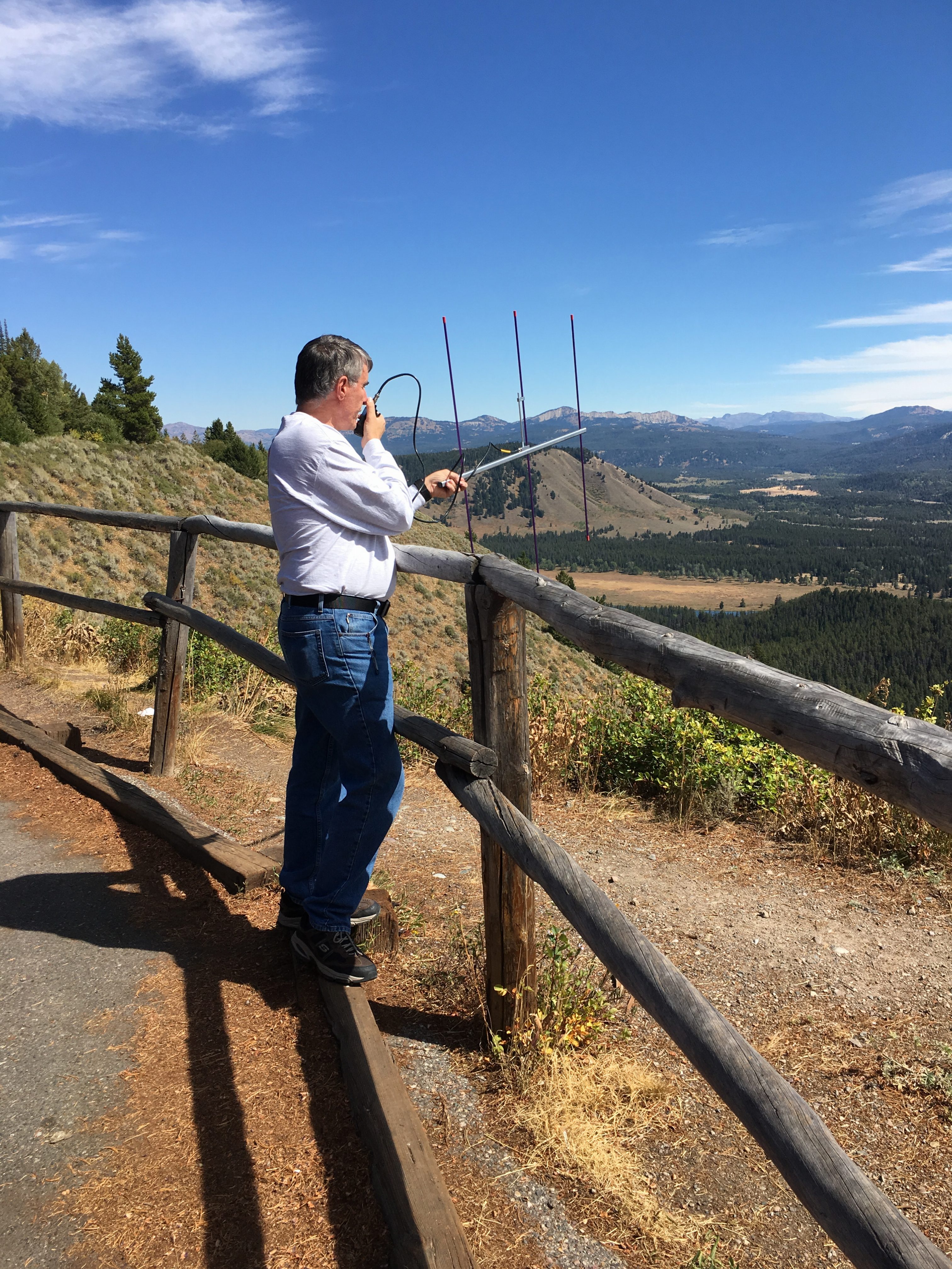
For the SOTA activation, I used the Yaesu FT-1DR and my 3-element Arrow yagi antenna to work a handful of stations on 146.52 MHz. I was a little concerned about finding enough stations listening on 52, but once again a little bit of patience payed off and I made my four QSOs.
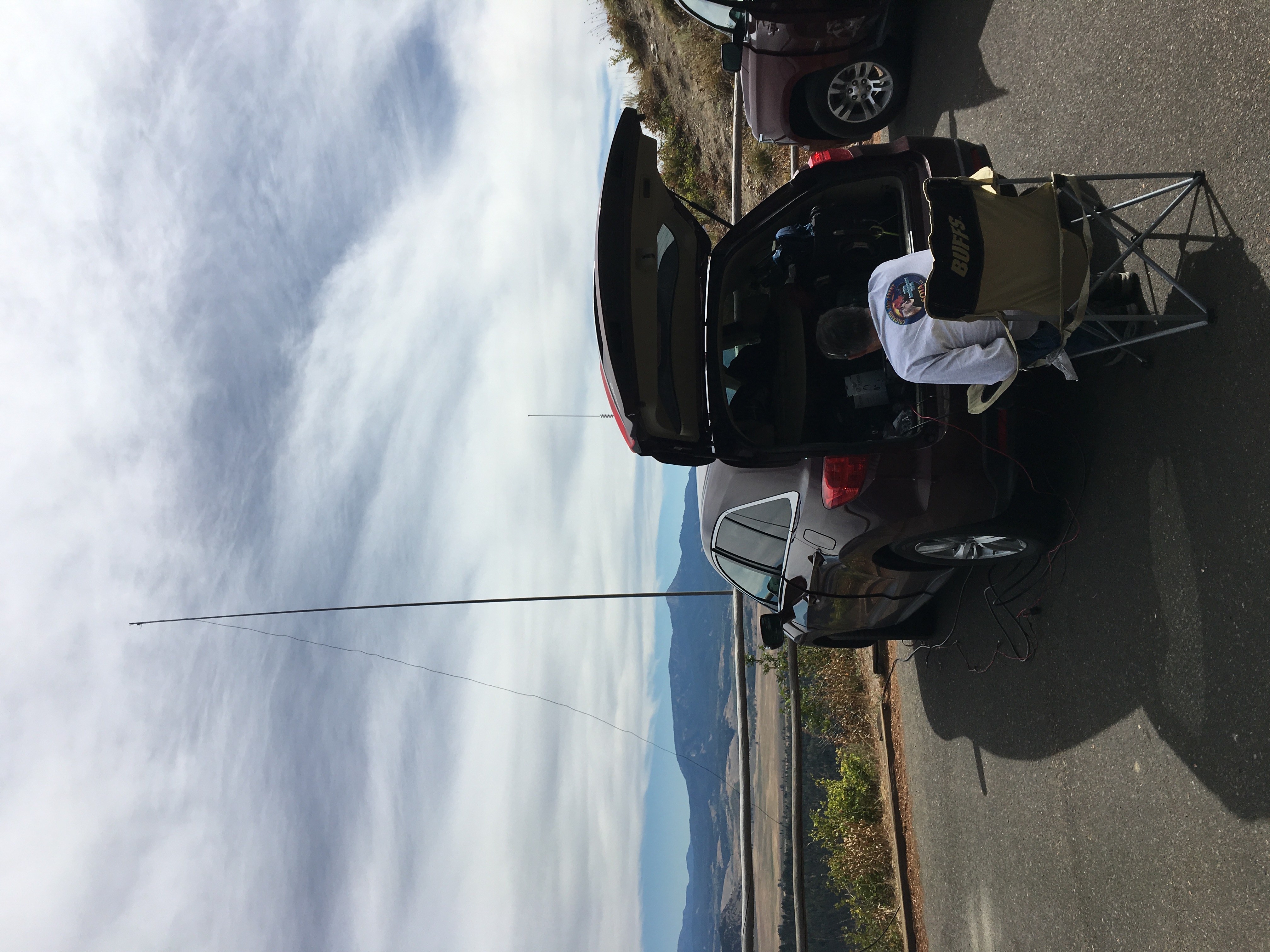
Then I set up the NPOTA station to activate Grand Teton National Park (NP23). My equipment was a Yaesu FT-991 driving an end-fed half-wave for 20m from LNR Precision. I’ve tried a number of different portable antennas over the years but have found that a half-wave radiator up in the air is a pretty effective antenna. This could be a center-fed dipole antenna but that can be a challenge to support, depending on the physical location.
The end-fed half-waves (EFHW) from LNR Precision are easily supported using a non-conductive pole such as the 10m SOTABEAMS pole. The top two sections of the pole are too thin to support much of antenna, so I have removed them. This makes my pole about 9 meters in length which is still long enough to support a 20m halfwave. (The antenna angles out a bit as shown in the photo but its pretty much vertical.) I attached the pole to a fence post using some hook/loop straps. I don’t fiddle with the length of the antenna, I just let the antenna tuner in the FT-991 trim up the match. This is the same configuration I used in Antigua (V29RW), where it worked great.
The FT-991 is a great little radio for this kind of operation. The SUV we were driving is not set up for HF operation so I just located the radio in the back of the vehicle and plopped down on a folding camp chair. For power, I clipped directly onto the vehicle battery with fused 10 gauge wires.
I started by making a few calls on 20m ssb. As soon as I was “spotted” on the usual web sites, I had a good pileup going. I worked 40 stations in about 40 minutes, so averaged one QSO per minute overall. Thanks to everyone that worked me; all contacts have been uploaded to Logbook of The World.
Oh, and it was a lot of fun.
73, Bob K0NR
The post SOTA plus NPOTA on Signal Mountain (W7Y/TT-161) appeared first on The KØNR Radio Site.
Bob Witte, KØNR, is a regular contributor to AmateurRadio.com and writes from Colorado, USA. Contact him at [email protected].
630m Early Morning Skeds
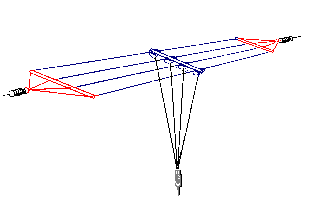
This past week I was eventually able to mate my W1VD frequency doubler with my 630m FET amplifier and run some higher powered tests on 630m WSPR and JT9 modes.
Up until this time, I have been limited to about 1/2 W EIRP but using the amplifier allows me to get to the 5W EIRP limit. I have been using the VK4YB transverter's 475kHz reduced output of 1W and driving the doubler previously built as part of a transverter project. The doubler produces a nice 950kHz squarewave to drive my amplifier's divide-by-two flip-flop input circuit which in turn produces the dual antiphase outputs needed to drive the push-pull switching FETs in the final amplifier. Being a linear transverter, when used alone at 70W, it will run any mode that the IC756 ProIII will produce such as SSB, WSPR etc, but my switching FET amplifier is class-D, non-linear, which limits it to non-linear modes such as CW, WSPR and JT-9, the most popular modes on 630m.
A few days ago, VK4YB and I ran our first 630m sked on JT9 as conditions looked favorable. Unfortunately, this was before I had my transverter / antenna switching system completed so I was limited to the barefoot transverter at ~ 1/2W EIRP. Using a transverter to drive an external amplifier means the antenna must be switched between the amplifier output and the transverter input in addition to switching the transverter's output between the antenna and the amplifiers input. I'll post details of my switching system, and inexpensive but power-capable relays, in an upcoming blog as there are probably many 630m operators planning on doing something similar.
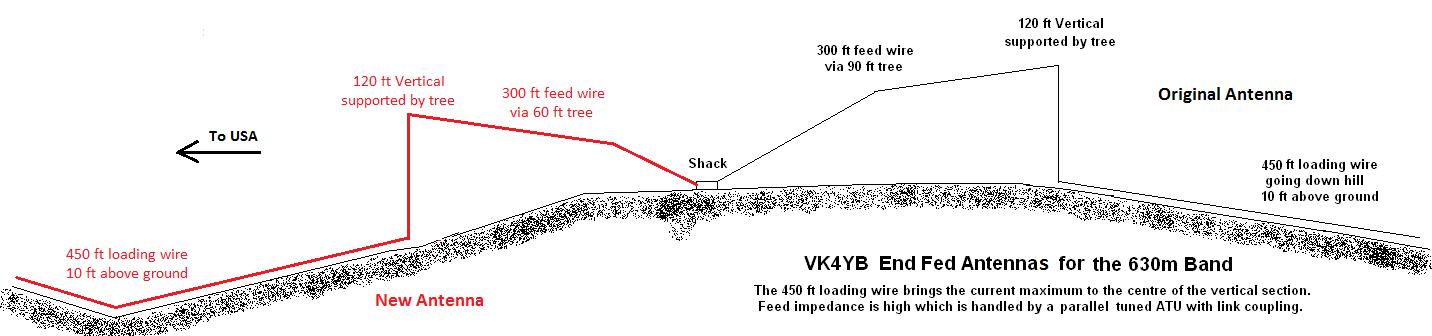
Thanks to Roger's huge antenna, his 90W signal was making it through well enough on this end but he was not able to decode anything from me.
1109 -26 0.3 1098 @ VE7SL VK4YB QG62
1111 -28 0.3 1098 @ VE7SL VK4YB QG62
1147 -24 0.1 1100 @ VE7SL VK4YB QG62
1149 -27 0.1 1100 @ VE7SL VK4YB QG62
1153 -27 0.1 1100 @ VE7SL VK4YB QG62
1159 -26 0.1 1100 @ VE7SL VK4YB QG62
1209 -26 0.0 1100 @ VE7SL VK4YB QG62
1225 -25 0.1 1100 @ VE7SL VK4YB QG62
1227 -26 -0.0 1100 @ VE7SL VK4YB QG62
1229 -24 0.1 1100 @ VE7SL VK4YB QG62
1239 -23 0.1 1100 @ VE7SL VK4YB QG62
1247 -26 0.0 1100 @ VE7SL VK4YB QG62
1249 -26 0.1 1100 @ VE7SL VK4YB QG62
1253 -23 0.1 1100 @ VE7SL VK4YB QG62
1255 -28 0.1 1100 @ VE7SL VK4YB QG62
1257 -26 0.1 1100 @ VE7SL VK4YB QG62
1303 -27 0.2 1100 @ VE7SL VK4YB QG62
1305 -23 -0.1 1100 @ VE7SL VK4YB QG62
1307 -25 -0.1 1100 @ VE7SL VK4YB QG62
1309 -23 -0.1 1100 @ VE7SL VK4YB QG62
1313 -25 0.0 1100 @ VE7SL VK4YB QG62
1319 -27 0.0 1100 @ VE7SL VK4YB QG62
1323 -22 0.1 1100 @ VE7SL VK4YB QG62
1325 -25 -0.1 1100 @ VE7SL VK4YB QG62
1327 -24 0.0 1100 @ VE7SL VK4YB QG62
1329 -25 0.0 1100 @ VE7SL VK4YB QG62
My location on the 'wrong' side of Mayne Island requires me to fire directly into a very nearby 600' hilltop, directly in Roger's path.
 |
| I'm at the base of the hill on the far right. The large mountains are on Vancouver Island and then open Pacfic. |
| VE7SL | 0.475633 | -25 | CN88iu | 5 | VK4YB | QG62ku | 11820 | |||
| VE7SL | 0.475633 | -26 | CN88iu | 5 | VK4YB | QG62ku | 11820 | |||
| VE7SL | 0.475632 | -23 | CN88iu | 5 | VK4YB | QG62ku | 11820 | |||
| VE7SL | 0.475632 | -26 | CN88iu | 5 | VK4YB | QG62ku | 11820 | |||
| VE7SL | 0.475632 | -30 | CN88iu | 5 | VK4YB | QG62ku | 11820 | |||
| VE7SL | 0.475634 | -28 | CN88iu | 5 | VK4YB | QG62ku | 11820 | |||
| VE7SL | 0.475634 | -30 | CN88iu | 5 | VK4YB | QG62ku | 11820 | |||
| VE7SL | 0.475634 | -30 | CN88iu | 5 | VK4YB | QG62ku | 11820 | |||
| VE7SL | 0.475633 | -28 | CN88iu | 5 | VK4YB | QG62ku | 11820 | |||
| VE7SL | 0.475633 | -29 | CN88iu | 5 | VK4YB | QG62ku | 11820 | |||
| VE7SL | 0.475633 | -27 | CN88iu | 5 | VK4YB | QG62ku | 11820 | |||
| VE7SL | 0.475632 | -28 | CN88iu | 5 | VK4YB | QG62ku | 11820 | |||
| VE7SL | 0.475630 | -28 | CN88iu | 5 | VK4YB | QG62ku | 11820 | |||
| VE7SL | 0.475629 | -29 | CN88iu | 5 | VK4YB | QG62ku | 11820 | |||
| VE7SL | 0.475629 | -31 | CN88iu | 5 | VK4YB | QG62ku | 11820 | |||
| VE7SL | 0.475629 | -30 | CN88iu | 5 | VK4YB | QG62ku | 11820 |
With the antenna / transverter / amplifier switching unit complete, Roger and I will continue to watch band conditions favorable to the Trans-Pacific path and hopefully exchange signals sometime this fall before the path disappears until next spring. For Roger, near Brisbane, the path peaks for him in the late evening while for me, it means crawling out of bed at 0330 local time to check the prop, hoping to find good signals from down under ... working VK on 630m would be well worth losing a few hours of nightly sleep!
Steve McDonald, VE7SL, is a regular contributor to AmateurRadio.com and writes from British Columbia, Canada. Contact him at [email protected].
Weekly Propagation Summary – 2016 Sep 12 16:10 UTC

Here is this week’s space weather and geophysical report, issued 2016 Sep 12 0323 UTC.
Highlights of Solar and Geomagnetic Activity 05 – 11 September 2016
Solar activity was at very low levels on 05-11 Sep. Region 2591 (N05, L=144, Cro/025 on 11 Sep) produced a B9.6 flare at 10/1920 UTC, the strongest of the period. No Earth-directed CMEs were observed were observed during the period.
No proton events were observed at geosynchronous orbit.
The greater than 2 MeV electron flux at geosynchronous orbit was at very high levels on 05 Sep and high levels from 06-11 Sep due to CH HSS influence. The largest flux value of the period was 56,842 pfu observed at 05/1815 UTC.
Geomagnetic field activity was at quiet to minor storm levels on 05 Sep due to a period of prolonged southward Bz during the waning phase of a CH HSS. Solar wind speed continued to decline over the period from a high near 600 km/s to 340 km/s by the end of the period. Activity decreased to quiet to active conditions on 06 Sep and to quiet to unsettled conditions on 07 Sep. A final increase to quiet to active conditions was observed on 08 Sep before quiet conditions dominated for the remainder of the period.
Forecast of Solar and Geomagnetic Activity 12 September – 08 October 2016
Solar activity is expected to be at very low to low levels throughout the forecast period.
No proton events are expected at geosynchronous orbit.
The greater than 2 MeV electron flux at geosynchronous orbit is expected to be at normal to moderate levels on 12-20 Sep and 26-28 Sep. High levels expected on 21-25 Sep, 29 Sep – 01 Oct, and 06-08 Oct. Very high levels are likely between 02-05 Oct. High and very high levels are anticipated to result from recurrent CH HSS events.
Geomagnetic field activity is expected to be at quiet to active levels on 12 Sep as a solar sector boundary crossing is anticipated to transition into a weak, negative polarity, CH HSS. As the CH HSS influence wanes, quiet to unsettled levels are likely over 13-14 Sep. Quiet conditions are expected on 15-16 Sep under an ambient solar wind environment. 17-21 Sep will likely to be at quiet to active conditions as a negative polarity CH HSS influences the near-Earth environment. Quiet conditions are again expected from 22-25 Sep. 26-27 Sep are likely to be at unsettled to active conditions from a small, positive polarity, CH HSS. 28-30 Sep are likely to see field active range from unsettled to major storm levels from a strong, positive polarity, CH HSS. As the CH HSS influence wanes, unsettled to minor storm levels are likely on 01 Oct and quiet to active levels are expected from 02-05 Oct. Quiet conditions are expected to return over 06-08 Oct under a nominal solar wind regime.
Don’t forget to visit our live space weather and radio propagation web site, at: http://SunSpotWatch.com/
Live Aurora mapping is at http://aurora.sunspotwatch.com/
If you are on Twitter, please follow these two users: + https://Twitter.com/NW7US + https://Twitter.com/hfradiospacewx
Get the space weather and radio propagation self-study course, today. Visit http://nw7us.us/swc for the latest sale and for more information!
Check out the stunning view of our Sun in action, as seen during the last five years with the Solar Dynamics Observatory (SDO): https://www.youtube.com/watch?v=zXN-MdoGM9g
We’re on Facebook: http://NW7US.us/swhfr
Visit, subscribe: NW7US Radio Communications and Propagation YouTube Channel
LHS Episode #175: True Lies on VHS
 Hurricanes, YOLO, Spanish letters, BSD, rocket science, call books, loggers, Maylasia, cult movies and more--all in this episode of Linux in the Ham Shack!
73 de The LHS Crew
Russ Woodman, K5TUX, co-hosts the Linux in the Ham Shack podcast which is available for download in both MP3 and OGG audio format. Contact him at [email protected].
AmateurLogic 95: What Goes Up
AmateurLogic.TV Episode 95 is now available for download.
It’s out of this world. In this episode D-Star hotspots just got easier to use. Tommy shows us the DVMega Blue Stack. George Interviews Bill Brown, WB8ELK in Huntsville and learns about his Pico Balloon experiments. Emile brings to light a possible Commspiracy.
Details of our 11th Anniversary Icom IC-7300 giveaway and more.
1:23:49
George Thomas, W5JDX, is co-host of AmateurLogic.TV, an original amateur radio video program hosted by George Thomas (W5JDX), Tommy Martin (N5ZNO), Peter Berrett (VK3PB), and Emile Diodene (KE5QKR). Contact him at [email protected].
Slacker SOTA Activation in the Tetons (W7Y/TT-061)
The Grand Teton National Park has plenty of mountains for Summits On The Air (SOTA) activations, so I wanted to activate a few of them as we enjoyed the park. I am still recovering from a fractured ankle, so I was definitely looking for an easy-peasy summit to activate on our trip. It turns out there is a summit right at the top of the Jackson Hole Arial Tram that operates during the summer months (W7Y/TT-061). (This tram serves the ski area during the winter.)
The SOTA database shows this summit as unnamed and refers to it by elevation, 10450. The locals may refer to this as Rendezvous Mountain, not to be confused with Rendezvous Peak (W7Y/TT-035). For SOTA purposes its just “10450”.
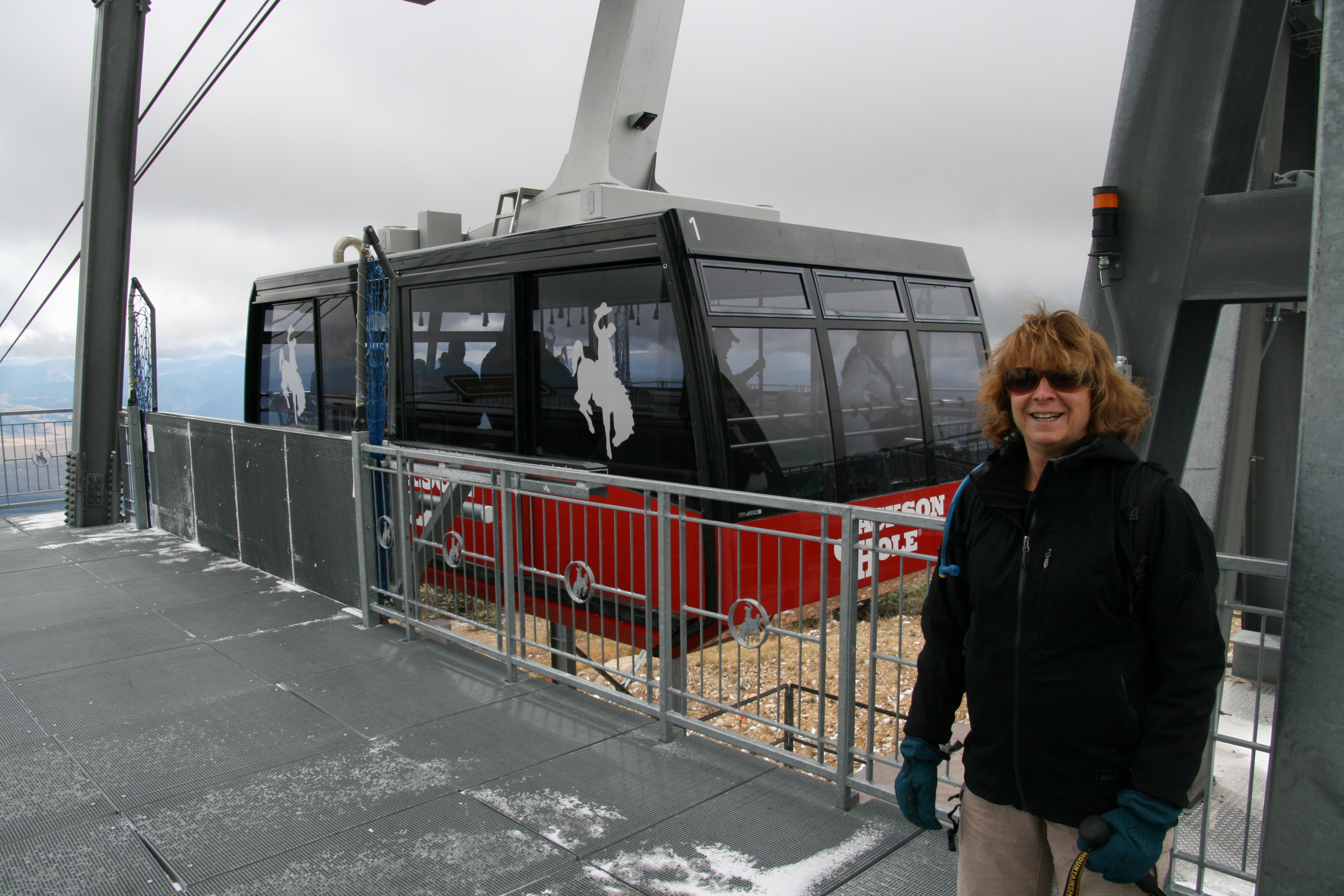
Well, this sounds pretty awesome…ride the tram to the top and play ham radio. Now the bad news: the ticket for the tram is $42. It’s an all day pass that gives you access to other lifts and plenty of hiking trails but still it is expensive. OK, slightly better news: if you purchase online you can get the pass for $32. There are senior and other pricing options, so check out the web site for the latest info.
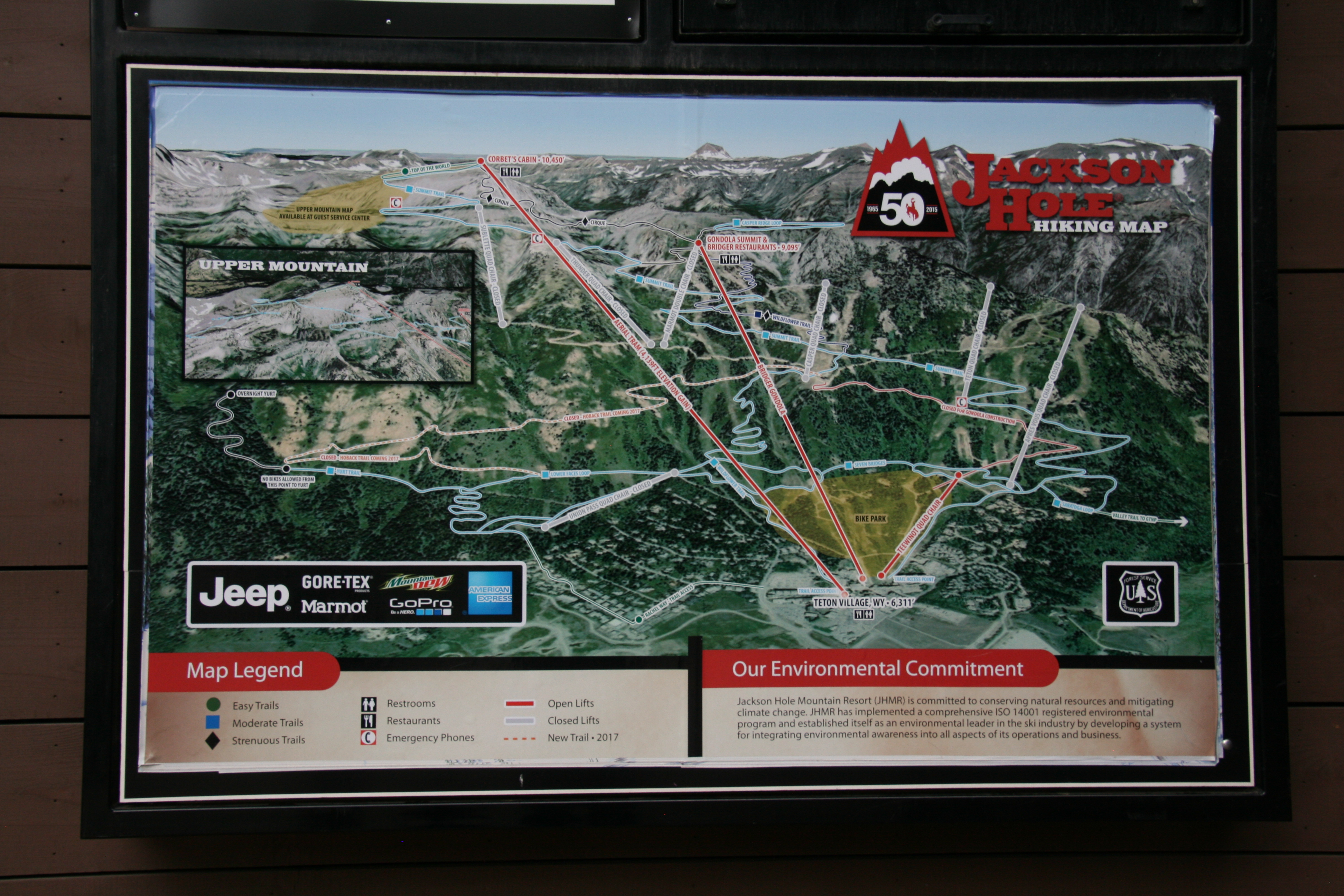
The September weather was overcast and cold at the summit. I opted for a simple VHF activation using my Yaesu FT-1DR and a half-wave vertical antenna. I had my 3-element 2m yagi with me but I didn’t deploy it. I figured that my ability to contact folks on 2m fm would be limited more by who happens to be monitoring…signal strength would not be a major factor.
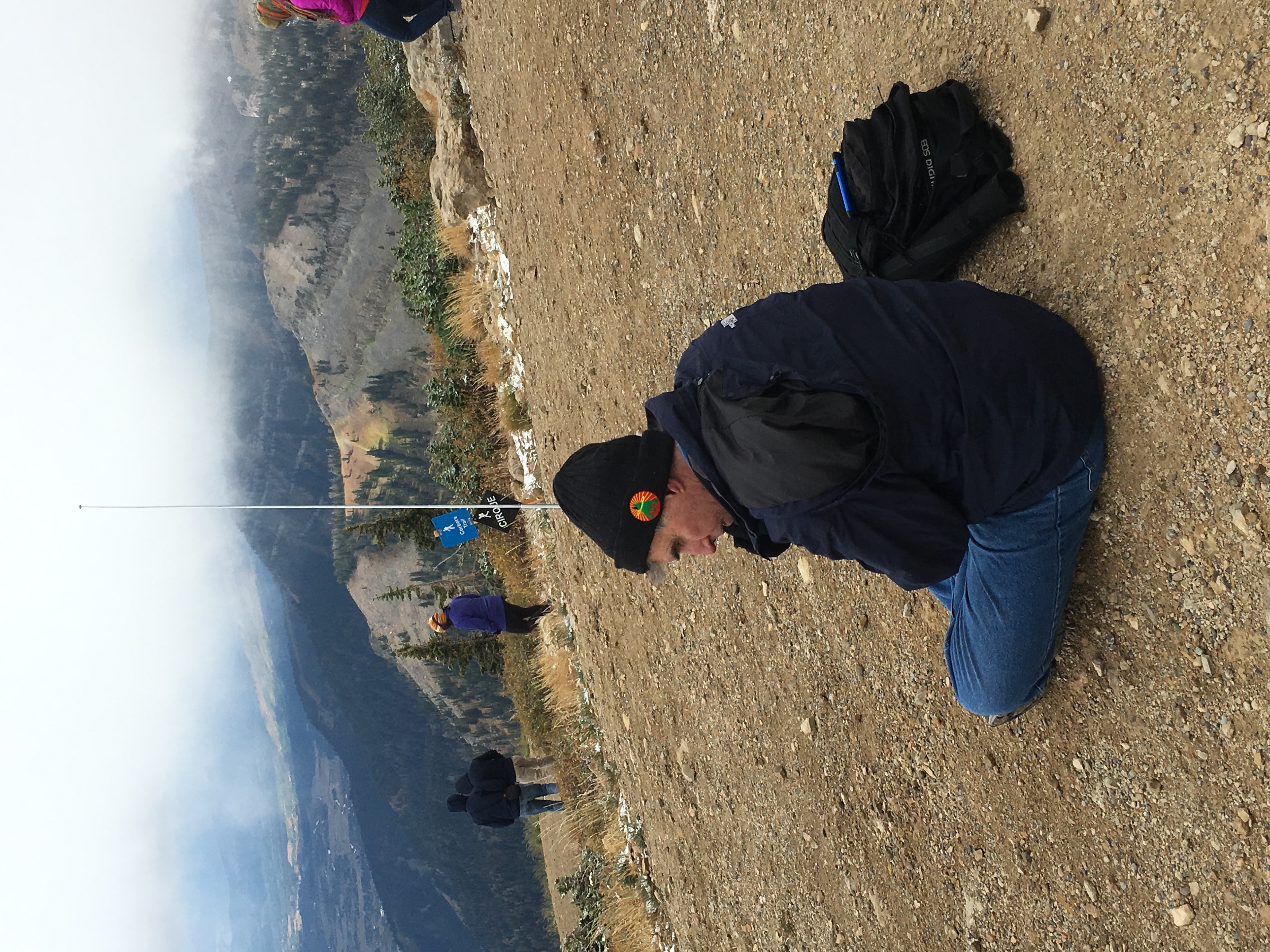
It was cold at the top and I was glad that I packed my gloves, hat and a decent jacket. I made five contacts by calling on 146.52 MHz.
The tram ride was quite enjoyable with good views of the Jackson Hole area. However, this may go down in history as my most expensive SOTA activation.
73, Bob K0NR
The post Slacker SOTA Activation in the Tetons (W7Y/TT-061) appeared first on The KØNR Radio Site.
Bob Witte, KØNR, is a regular contributor to AmateurRadio.com and writes from Colorado, USA. Contact him at [email protected].
 Ham Radio Deluxe |
 W5SWL Electronics |
 Ham Radio Prep |
 KB3IFH QSL Cards  Hip Ham Shirts  HamRadioAuctions HamRadioAuctions Reliance Antennas Reliance Antennas Enigma Shop Enigma Shop |  morseDX  Ni4L Antennas  R&L Electronics R&L Electronics antennas.us antennas.us QRV QRV |
- Matt W1MST, Managing Editor
